
Hello,
we are planning to build soon. Since we are constructing a KfW 70 house with 30 cm (12 inches) Ytong exterior blocks and therefore will not add any insulation to the facade, my question is whether I can lay the brick veneer directly onto the Ytong or if I need to leave a 1-2 cm (0.4-0.8 inches) gap?
My concern is that if I use brick slips, they are glued directly to the Ytong, but standard 11.5 cm (4.5 inches) brick units are usually laid with a certain gap. Unfortunately, I only find this advice when insulation is involved, which I do not want, as I have read a lot of negative things about that, like mold, moisture, etc.
So should the brick be glued directly to the Ytong or installed with a gap?
I hope someone can help me!
we are planning to build soon. Since we are constructing a KfW 70 house with 30 cm (12 inches) Ytong exterior blocks and therefore will not add any insulation to the facade, my question is whether I can lay the brick veneer directly onto the Ytong or if I need to leave a 1-2 cm (0.4-0.8 inches) gap?
My concern is that if I use brick slips, they are glued directly to the Ytong, but standard 11.5 cm (4.5 inches) brick units are usually laid with a certain gap. Unfortunately, I only find this advice when insulation is involved, which I do not want, as I have read a lot of negative things about that, like mold, moisture, etc.
So should the brick be glued directly to the Ytong or installed with a gap?
I hope someone can help me!
I just spoke with Town & Country, and the agent sent me a sample certificate for a standard bungalow instead of a KfW70 energy certificate as I requested. At the next meeting, I’ll ask about the additional cost for 365mm (14 inches) Ytong with a thermal conductivity (lambda) value of 0.07. According to Ytong, this could theoretically meet KfW55 standards.
I ran the figures through a U-value calculator, and 300mm (12 inches) thickness should be sufficient with a lambda value of 0.07, but I figure more insulation is better.
However, I still don’t know: do I need to leave a 1–2cm (0.4–0.8 inch) gap between the Ytong and the facing brickwork, or can I attach it directly like brick slips?
Many thanks in advance to Bauexperte for the clarification.
I ran the figures through a U-value calculator, and 300mm (12 inches) thickness should be sufficient with a lambda value of 0.07, but I figure more insulation is better.
However, I still don’t know: do I need to leave a 1–2cm (0.4–0.8 inch) gap between the Ytong and the facing brickwork, or can I attach it directly like brick slips?
Many thanks in advance to Bauexperte for the clarification.
B
Bauexperte24 Apr 2014 08:08Hello,
Regards, Bauexperte
baschti schrieb:Try searching for the term "Riemchen" in the search function. Among other results, you will find this thread: https://www.hausbau-forum.de/threads/Klinker-oder-Riemchen.9237
I still don't really know ^^ Do I need to leave a 1-2cm (0.4-0.8 inch) gap between the Ytong blocks and the facing brickwork, or can I attach it directly like the brick slips?!
Regards, Bauexperte
Read through completely... Apart from a lot of off-topic discussion, no new information. I already knew that you can apply thin brick slips directly to aerated concrete. But what about real facing bricks? Honestly, I'm a bit concerned that if the bare wall (unplastered aerated concrete) is followed by a 1-2cm (0.4-0.8 inch) air gap and then the facing bricks, condensation might form between the bricks and the aerated concrete. Does anyone have experience with this?
B
Bauexperte24 Apr 2014 15:51Hello,
You don’t necessarily need an air cavity; it can also be a cavity insulation. Drainage openings in the lowest course of bricks, and everything works well—provided the facade installers do their work carefully.
The choice between an air gap and cavity insulation is a kind of ongoing debate, similar to the discussion about centralized versus decentralized ventilation systems.
Regards, Bauexperte
baschti schrieb:In Germany, there is a DIN standard for everything, in this case 1053-1.
...but what about real facing bricks? Honestly, I’m a bit worried that if there is a bare wall (unplastered aerated concrete) with a 1–2cm (0.4–0.8 inch) air gap and then the facing brick, condensation might form between the brick and the aerated concrete... does anyone have experience with this?
You don’t necessarily need an air cavity; it can also be a cavity insulation. Drainage openings in the lowest course of bricks, and everything works well—provided the facade installers do their work carefully.
The choice between an air gap and cavity insulation is a kind of ongoing debate, similar to the discussion about centralized versus decentralized ventilation systems.
Regards, Bauexperte
This is what I mean... with this material, it is said that "theoretically" there is no problem with attaching facing bricks directly to the aerated concrete. But does this cause any disadvantages? Does the air cavity provide benefits? Besides the fact that the inner masonry is protected against driving rain:
Masonry with Cavity Joint
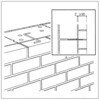
Two-shell aerated concrete masonry with cavity joint
consists of an outer facing brick shell directly connected to the inner load-bearing masonry shell. The cavity joint must be ≥ 2 cm (0.8 inches) wide and thus acts as a barrier against driving rain. It is recommended to render the outer side of the load-bearing shell before building the facing shell, or to construct both shells simultaneously, filling the cavity joint layer by layer with fluid mortar. Both shells must also be tied together with metal wall ties. Be careful: using different materials with varying thermal conductivities can cause stresses leading to structural damage. From a building physics perspective (thermal and sound insulation), aerated concrete masonry can be built monolithically—that is, as a single layer with plaster applied on both sides—without problems. The use of two-shell masonry is often influenced by regional or climatic conditions, where the facade is not plastered but covered with facing bricks for weather protection.
Masonry with Air Cavity
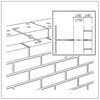
Two-shell aerated concrete masonry with air cavity
offers excellent building physics properties when properly constructed. Driving rain is effectively kept away from the inner shell by the outer shell. Differences in material stresses do not cause issues. The air cavity must have a connection to the outside air through ventilation openings (ventilation bricks at the bottom, open head joints at the top) to ensure continuous airflow that removes moisture vapor. The cavity must be between ≥ 60 mm and < 150 mm (2.4 inches to < 6 inches) thick. The outer shell must be carefully built to prevent mortar from falling into the cavity. Both shells must be tied together with metal wall ties, which should be installed according to regulations with drip plates.
Masonry with Air Cavity and Insulation
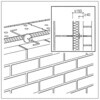
Two-shell aerated concrete masonry with air cavity and insulation
is constructed like masonry with an air cavity. However, here the air cavity only needs to be ≥ 4 cm (1.6 inches) thick. Because the total distance between the two masonry shells generally must not exceed 15 cm (6 inches), the insulation thickness is limited to 11 cm (4.3 inches). The wall ties must be installed in the same way as before and, in addition to the drip plates, especially when using fiber insulation materials, they should include insulation support washers. The air cavity must have a connection with the outside air to ensure continuous ventilation that removes moisture vapor.
Masonry with Cavity Insulation
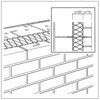
Two-shell aerated concrete masonry with cavity insulation
consists of an inner load-bearing shell and an outer non-load-bearing shell, between which up to 15 cm (6 inches) of insulation material is installed without an air cavity. Suitable insulation materials include panel-type products as well as approved loose-fill types. Unlike masonry with an air cavity, the insulation layer here is exposed to higher moisture loads. Both shells must be tied together with metal wall ties. Drainage openings must be included at the bottom to allow any moisture accumulation to be drained away.
Masonry with Cavity Joint
Two-shell aerated concrete masonry with cavity joint
consists of an outer facing brick shell directly connected to the inner load-bearing masonry shell. The cavity joint must be ≥ 2 cm (0.8 inches) wide and thus acts as a barrier against driving rain. It is recommended to render the outer side of the load-bearing shell before building the facing shell, or to construct both shells simultaneously, filling the cavity joint layer by layer with fluid mortar. Both shells must also be tied together with metal wall ties. Be careful: using different materials with varying thermal conductivities can cause stresses leading to structural damage. From a building physics perspective (thermal and sound insulation), aerated concrete masonry can be built monolithically—that is, as a single layer with plaster applied on both sides—without problems. The use of two-shell masonry is often influenced by regional or climatic conditions, where the facade is not plastered but covered with facing bricks for weather protection.
Masonry with Air Cavity
Two-shell aerated concrete masonry with air cavity
offers excellent building physics properties when properly constructed. Driving rain is effectively kept away from the inner shell by the outer shell. Differences in material stresses do not cause issues. The air cavity must have a connection to the outside air through ventilation openings (ventilation bricks at the bottom, open head joints at the top) to ensure continuous airflow that removes moisture vapor. The cavity must be between ≥ 60 mm and < 150 mm (2.4 inches to < 6 inches) thick. The outer shell must be carefully built to prevent mortar from falling into the cavity. Both shells must be tied together with metal wall ties, which should be installed according to regulations with drip plates.
Masonry with Air Cavity and Insulation
Two-shell aerated concrete masonry with air cavity and insulation
is constructed like masonry with an air cavity. However, here the air cavity only needs to be ≥ 4 cm (1.6 inches) thick. Because the total distance between the two masonry shells generally must not exceed 15 cm (6 inches), the insulation thickness is limited to 11 cm (4.3 inches). The wall ties must be installed in the same way as before and, in addition to the drip plates, especially when using fiber insulation materials, they should include insulation support washers. The air cavity must have a connection with the outside air to ensure continuous ventilation that removes moisture vapor.
Masonry with Cavity Insulation
Two-shell aerated concrete masonry with cavity insulation
consists of an inner load-bearing shell and an outer non-load-bearing shell, between which up to 15 cm (6 inches) of insulation material is installed without an air cavity. Suitable insulation materials include panel-type products as well as approved loose-fill types. Unlike masonry with an air cavity, the insulation layer here is exposed to higher moisture loads. Both shells must be tied together with metal wall ties. Drainage openings must be included at the bottom to allow any moisture accumulation to be drained away.
Similar topics