
Hello everyone,
I need your help with the architectural planning for our planned townhouse. I will skip the fully completed checklist since the planning is already quite advanced, but I will keep the relevant questions.
Development Plan / Restrictions
Plot size: >1,000 m² (1,200 sq. yards)
Number of parking spaces: 2
Number of floors: 2, single-story extension on the ground floor
Roof type: hipped roof, single-story extension on the ground floor
Style: townhouse
Orientation: north/south
Basement, floors: none
Number of occupants, ages: 3 (2x 30; 1x 2 years) – designed for 4
Space requirements on ground floor and upper floor: approx. 110 m² (1,184 sq. ft), approx. 75 m² (807 sq. ft)
Office: family use
Guests per year: very rarely
Open or closed architecture: closed
Conservative or modern construction: conservative, but without ornamentation
Open kitchen, kitchen island: no, kitchen island
Number of dining seats: 4
Fireplace: yes
Balcony, roof terrace: balcony, mostly to cover the entrance area
Garage, carport: garage
Planning done by: do-it-yourself then architect
What do you especially like?: appearance, the extension, the large ground floor
What don’t you like?: living room depth of 4.14 m (13.6 ft), due to the staircase; room width <3.5 m (11.5 ft) upstairs
Preferred heating technology: ground-source heat pump, KfW 55 standard
Attached is our floor plan. Currently, I see two main issues: first, we are bothered by the 4.14 m (13.6 ft) depth of the living room; second, we had planned the upstairs living spaces to be 3.50 m (11.5 ft) wide each in the contract drawing. Now that the architect has finalized the design, they have become narrower because of the real concrete staircase.
Is my concern about the insufficient living room depth and the room width justified?
Do you have any ideas on how to solve both problems?
For the living room depth, I see only the following options:
- Staircase: add one more step at the landing. However, this means a wall would come in about 1.20 m (3.9 ft) at the landing. If I increase the room width upstairs, the corridor at the landing might become too narrow. Perhaps some optimization is possible by reducing the gap between the balustrade and the railing.
- Extend the living room outer wall by 0.3 m (1 ft) – but this costs around 5,500 EUR and gains only 30 cm (1 ft). I don’t see a good cost/benefit balance, especially as the total area is already quite large at 185 m² (1,991 sq. ft).
- Reduce the ground floor ceiling height from 2.70 m (8 ft 10 in) back down to 2.55 m (8 ft 4 in) – this saves about three-quarters of a step; the only question is whether it still looks good with a 40 m² (430 sq. ft) living room.
Any other comments? Looking forward to your feedback.
Good luck, Redsonic
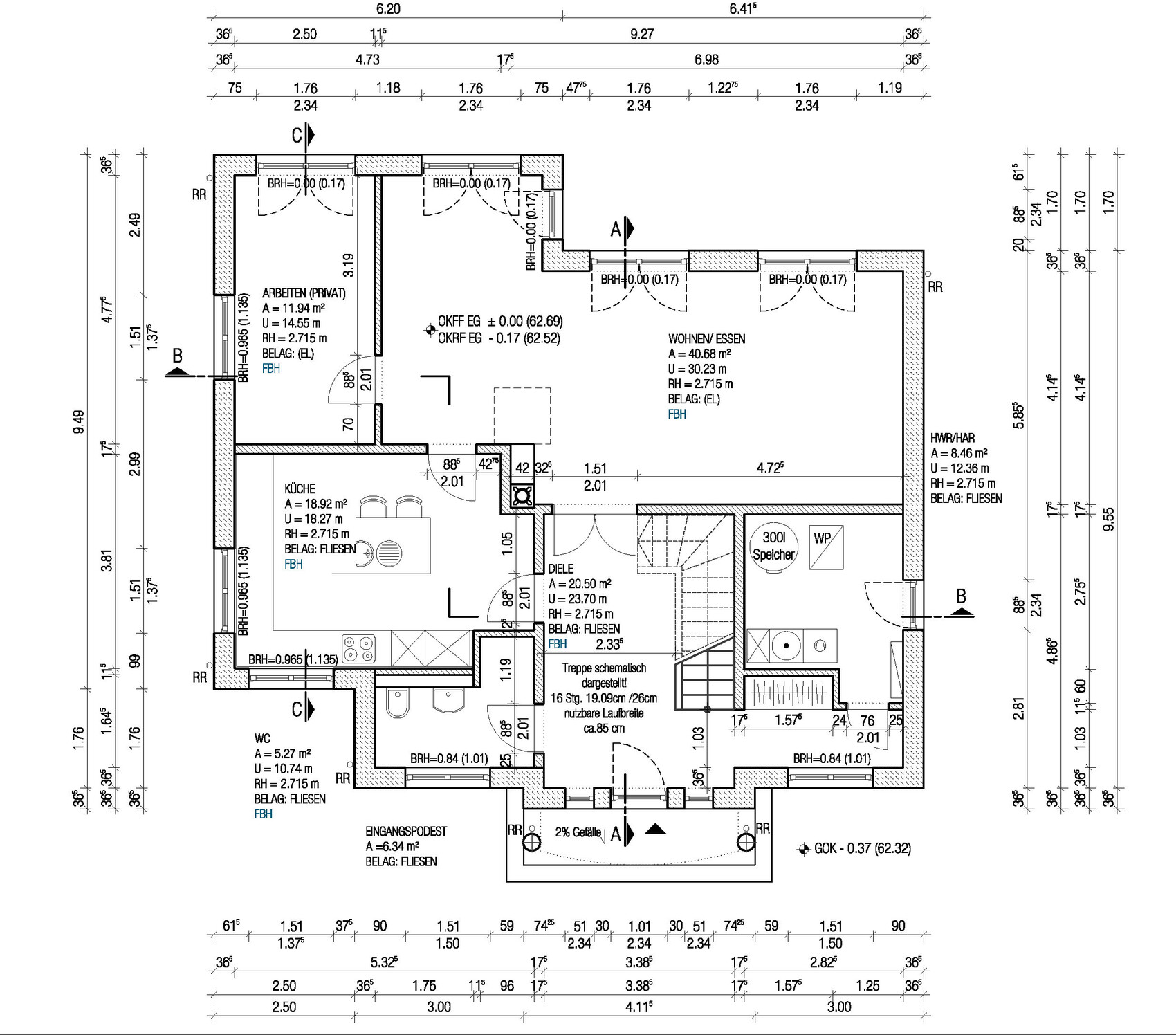
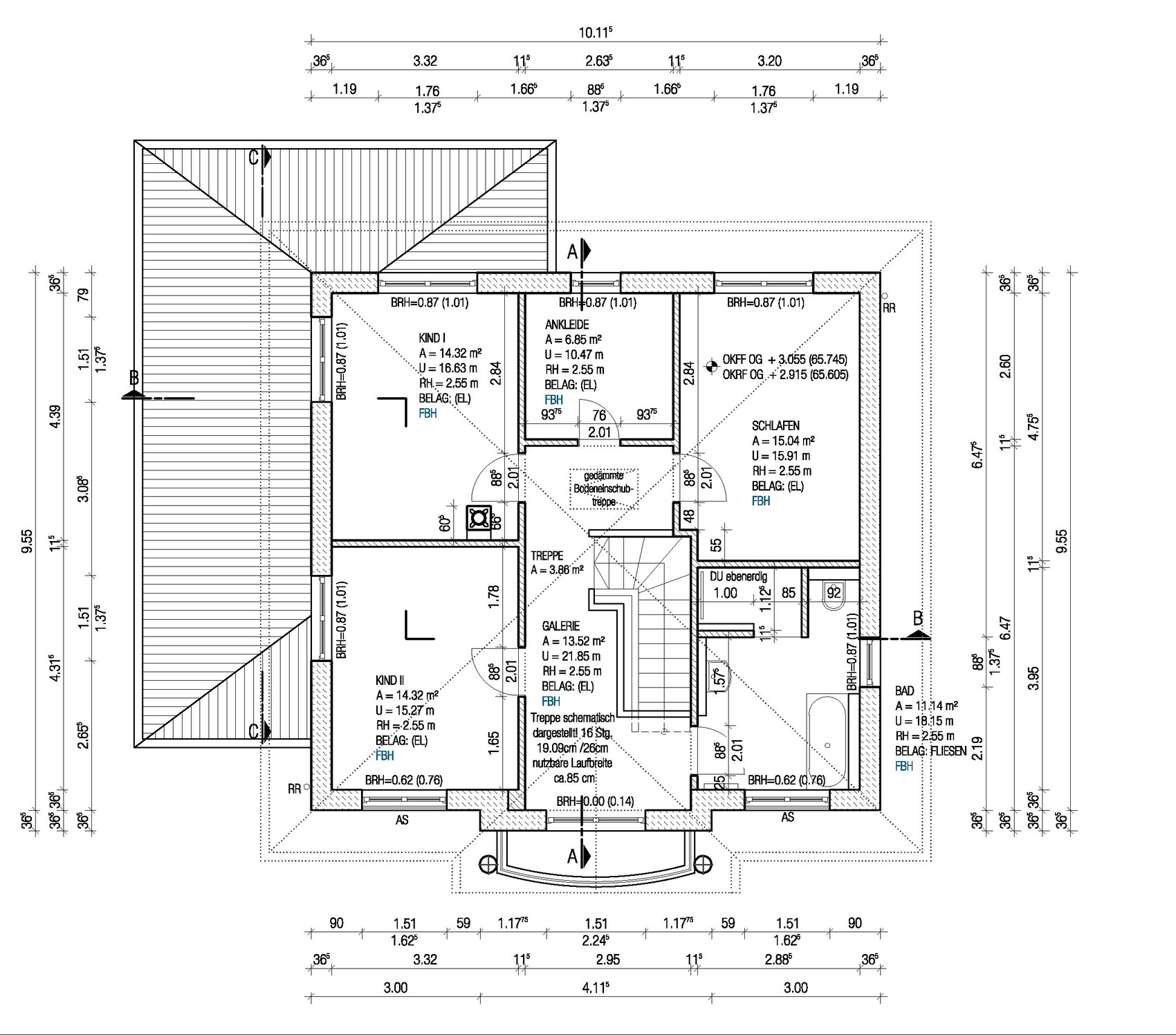
I need your help with the architectural planning for our planned townhouse. I will skip the fully completed checklist since the planning is already quite advanced, but I will keep the relevant questions.
Development Plan / Restrictions
Plot size: >1,000 m² (1,200 sq. yards)
Number of parking spaces: 2
Number of floors: 2, single-story extension on the ground floor
Roof type: hipped roof, single-story extension on the ground floor
Style: townhouse
Orientation: north/south
Basement, floors: none
Number of occupants, ages: 3 (2x 30; 1x 2 years) – designed for 4
Space requirements on ground floor and upper floor: approx. 110 m² (1,184 sq. ft), approx. 75 m² (807 sq. ft)
Office: family use
Guests per year: very rarely
Open or closed architecture: closed
Conservative or modern construction: conservative, but without ornamentation
Open kitchen, kitchen island: no, kitchen island
Number of dining seats: 4
Fireplace: yes
Balcony, roof terrace: balcony, mostly to cover the entrance area
Garage, carport: garage
Planning done by: do-it-yourself then architect
What do you especially like?: appearance, the extension, the large ground floor
What don’t you like?: living room depth of 4.14 m (13.6 ft), due to the staircase; room width <3.5 m (11.5 ft) upstairs
Preferred heating technology: ground-source heat pump, KfW 55 standard
Attached is our floor plan. Currently, I see two main issues: first, we are bothered by the 4.14 m (13.6 ft) depth of the living room; second, we had planned the upstairs living spaces to be 3.50 m (11.5 ft) wide each in the contract drawing. Now that the architect has finalized the design, they have become narrower because of the real concrete staircase.
Is my concern about the insufficient living room depth and the room width justified?
Do you have any ideas on how to solve both problems?
For the living room depth, I see only the following options:
- Staircase: add one more step at the landing. However, this means a wall would come in about 1.20 m (3.9 ft) at the landing. If I increase the room width upstairs, the corridor at the landing might become too narrow. Perhaps some optimization is possible by reducing the gap between the balustrade and the railing.
- Extend the living room outer wall by 0.3 m (1 ft) – but this costs around 5,500 EUR and gains only 30 cm (1 ft). I don’t see a good cost/benefit balance, especially as the total area is already quite large at 185 m² (1,991 sq. ft).
- Reduce the ground floor ceiling height from 2.70 m (8 ft 10 in) back down to 2.55 m (8 ft 4 in) – this saves about three-quarters of a step; the only question is whether it still looks good with a 40 m² (430 sq. ft) living room.
Any other comments? Looking forward to your feedback.
Good luck, Redsonic
I don’t understand what your concerns are... The walk-in closet/dressing room is planned to be 263 cm (104 inches) wide. I usually calculate using Ikea Pax wardrobes with sliding doors = 2x66 cm (2x26 inches) = 132 cm (52 inches)... so that leaves roughly 130 cm (51 inches) between the wardrobes, which is much more than in most floor plans I’ve seen recently in this forum.
I also find 414 cm (163 inches) in the living area appropriate, although it should be furnished at some point. It looks like sofas are planned again in front of floor-to-ceiling windows.
The dining area might be a bit tight, as it’s only about 280 cm (110 inches) wide. Perhaps the 620 cm (244 inches) length could be extended to 650–700 cm (256–276 inches), shifting the corner of the house slightly to the right according to the plan.
The cloakroom already has more space allocated than many other floor plans. There is still the space under the stairs, which could be used well for built-in wardrobes if a closed staircase is planned.
Bathroom... okay, it’s only 11.1 sqm (120 sq ft), but it has a nice large shower, bathtub, a discreet toilet, and space for a washbasin around 140 cm (55 inches) wide. Again, this is more spacious and better positioned than many I’ve seen here before.
I would just insist on precise planning for the staircase and related areas. The floor plan mentions it’s schematic, and the dimensions seem a bit tight to me. You also have to consider the overlap with the upper floor space to avoid headroom issues when going up or down. The bathroom door needs to be taken into account here as well.
Personally, I would be the one to combine dining and cooking near the terrace and separate the living area.
I also find 414 cm (163 inches) in the living area appropriate, although it should be furnished at some point. It looks like sofas are planned again in front of floor-to-ceiling windows.
The dining area might be a bit tight, as it’s only about 280 cm (110 inches) wide. Perhaps the 620 cm (244 inches) length could be extended to 650–700 cm (256–276 inches), shifting the corner of the house slightly to the right according to the plan.
The cloakroom already has more space allocated than many other floor plans. There is still the space under the stairs, which could be used well for built-in wardrobes if a closed staircase is planned.
Bathroom... okay, it’s only 11.1 sqm (120 sq ft), but it has a nice large shower, bathtub, a discreet toilet, and space for a washbasin around 140 cm (55 inches) wide. Again, this is more spacious and better positioned than many I’ve seen here before.
I would just insist on precise planning for the staircase and related areas. The floor plan mentions it’s schematic, and the dimensions seem a bit tight to me. You also have to consider the overlap with the upper floor space to avoid headroom issues when going up or down. The bathroom door needs to be taken into account here as well.
Personally, I would be the one to combine dining and cooking near the terrace and separate the living area.

Redsonic schrieb:
conservative or modern construction: conservative, but without frills That is not reflected in the floor plan for me. In my opinion, there are too many corners and projections.
I would prefer to eliminate some of the projections and instead create more usable living space on the ground floor (widening the living room) and the upper floor (widening the children's rooms/bedrooms).
But I am more of a straightforward person => it’s all a matter of personal taste.
Hello
I am not a fan of spiral stairs at all. They feel simply too narrow to me. How about a staircase with a landing? That would shorten the length of the stairs and allow the living room to become wider. Okay, the hallway would get narrower because of the wider staircase. But this can be visually balanced with an open staircase design.
Steven
I am not a fan of spiral stairs at all. They feel simply too narrow to me. How about a staircase with a landing? That would shorten the length of the stairs and allow the living room to become wider. Okay, the hallway would get narrower because of the wider staircase. But this can be visually balanced with an open staircase design.
Steven

How often do such floor plans suffer from being forced into a predefined framework called "town villa" or something similar. Floor plans should be developed based on the usage context, habits, and routines of the future occupants. The house shape itself then emerges in interaction with the floor plan development. External constraints only apply if they cannot be changed for legal building reasons or site-specific conditions, for example when designing a terraced house or urban development where the building footprint is defined by property or building boundaries. However, this does not seem to be the case here. A professional designer should be consulted again. Even DIY designs that are stubbornly clung to will not fundamentally improve through revisions if the initial design approach is flawed.

Similar topics