
ᐅ Floor Plan of Urban Villa / Structural Engineering Feedback, Layout Arrangement
Created on: 11 Jan 2014 16:07
N
NZiege
Hello,
we are currently planning our house construction in a rural area, classified as a redevelopment site.
The design is intended to be an urban villa style, with two full floors and a hip or pyramid roof. The exterior will be plastered, possibly combined with natural stone slabs.
The county regulations limit us to a maximum of 160 sqm (1722 sq ft) of living space, plus additional rooms such as a utility room and a storage room.
It is important for us to have an open living/dining area with an open kitchen and a fireplace functioning as a room divider. Additionally, a home office on the ground floor is needed since my partner works independently from home as a media designer. On the upper floor, we wanted a connected "master suite" consisting of a bedroom, dressing room, and bathroom. Since we wake up at different times, the dressing room and bathroom should be located together but separated well. A bathroom for the children was also important to us.
Another requirement was to avoid too many straight, high walls so that the house does not appear too blocky from the outside. We tried to achieve this by incorporating two projections in the living area and a recessed entrance.
Do you have any ideas or feedback regarding the layout, room sizes, or do you see any issues that definitely won’t work (e.g., structural concerns)?
I appreciate all input!
Best regards and many thanks in advance!
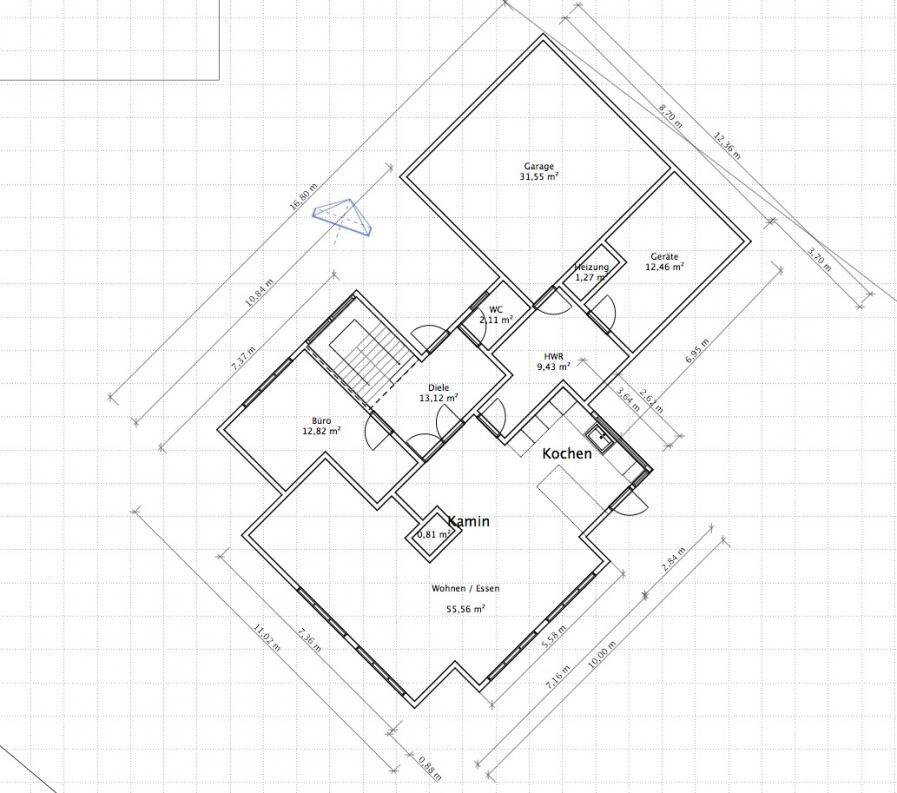
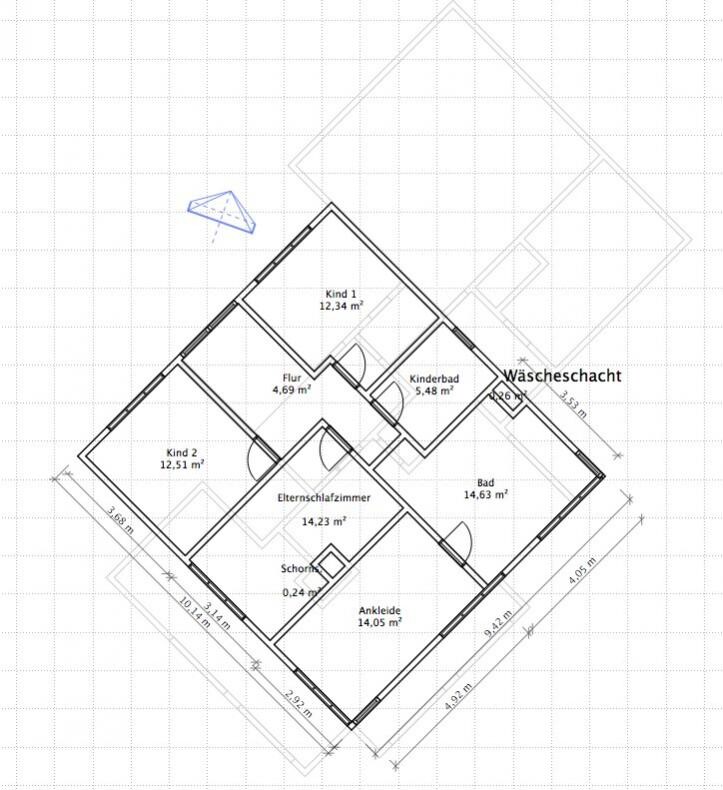
we are currently planning our house construction in a rural area, classified as a redevelopment site.
The design is intended to be an urban villa style, with two full floors and a hip or pyramid roof. The exterior will be plastered, possibly combined with natural stone slabs.
The county regulations limit us to a maximum of 160 sqm (1722 sq ft) of living space, plus additional rooms such as a utility room and a storage room.
It is important for us to have an open living/dining area with an open kitchen and a fireplace functioning as a room divider. Additionally, a home office on the ground floor is needed since my partner works independently from home as a media designer. On the upper floor, we wanted a connected "master suite" consisting of a bedroom, dressing room, and bathroom. Since we wake up at different times, the dressing room and bathroom should be located together but separated well. A bathroom for the children was also important to us.
Another requirement was to avoid too many straight, high walls so that the house does not appear too blocky from the outside. We tried to achieve this by incorporating two projections in the living area and a recessed entrance.
Do you have any ideas or feedback regarding the layout, room sizes, or do you see any issues that definitely won’t work (e.g., structural concerns)?
I appreciate all input!
Best regards and many thanks in advance!
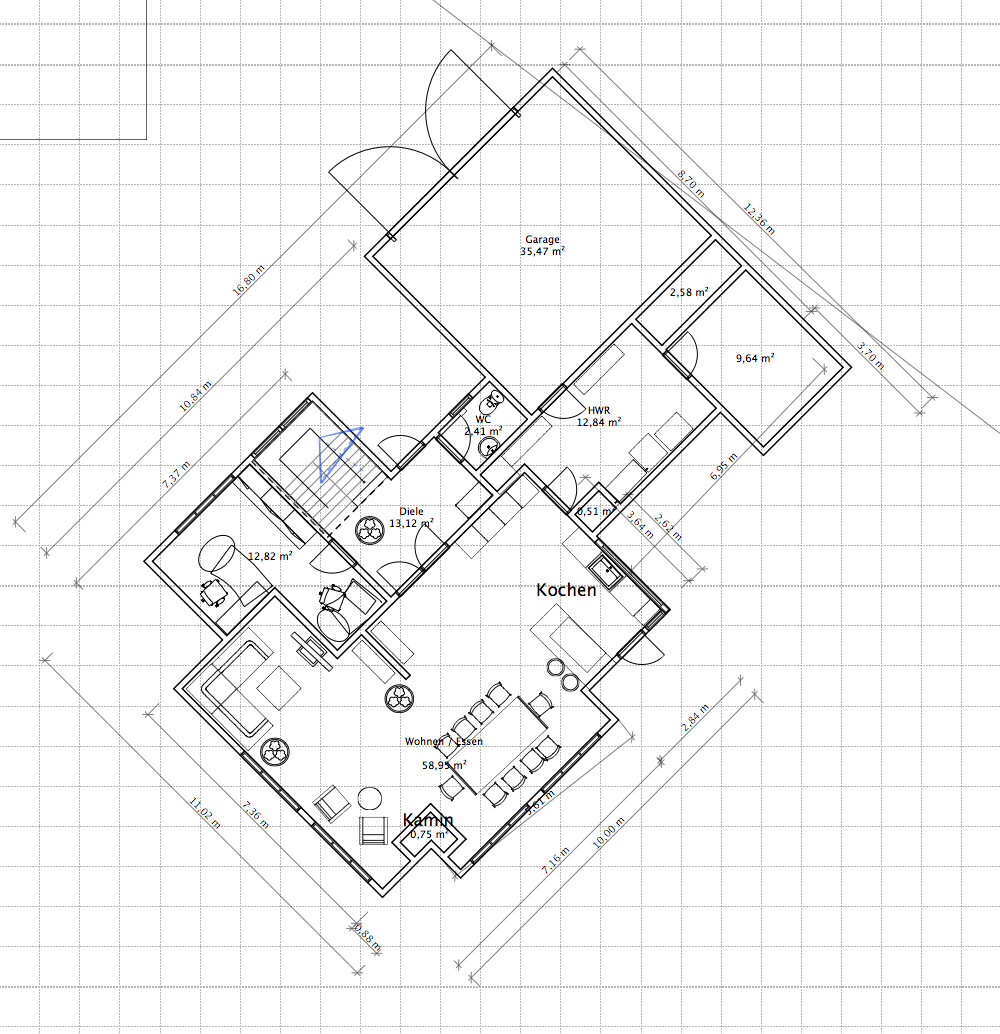
So, we have been busy again.
Ground floor:
First floor:
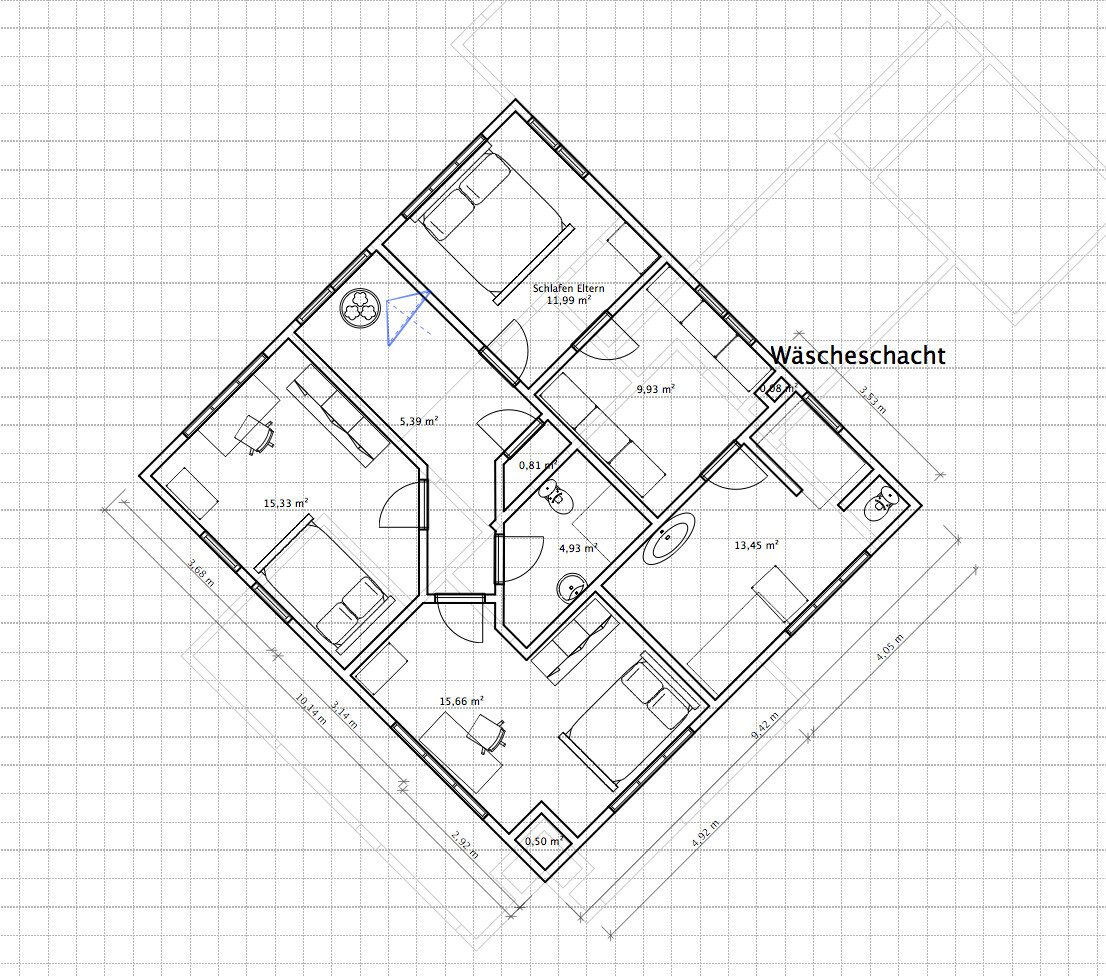
Second floor:
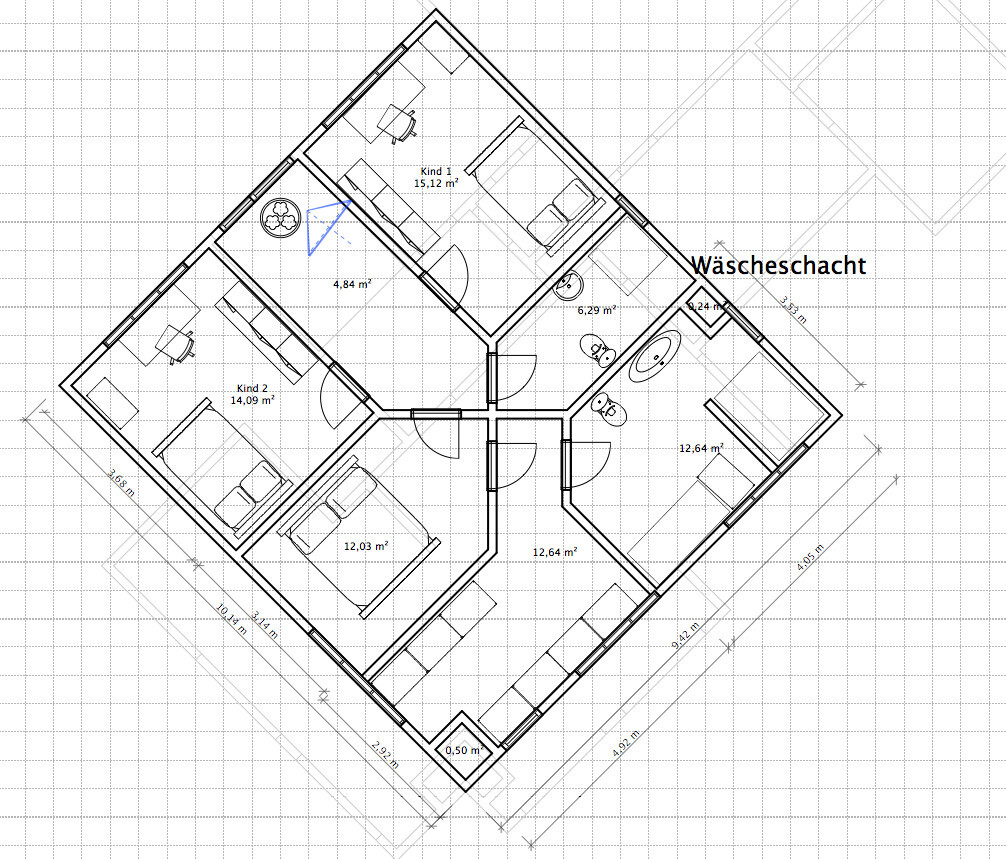
We designed two versions for the first floor. We prefer the first one. The small room in the hallway is meant to be a storage closet for the vacuum cleaner and watering can.
On the ground floor, we moved the fireplace from the center of the room to the corner. It is still visible from every side of the room, but the chimney no longer interferes on the upper floor.
In addition, we shifted the utility room out of the main living area. This way, it is no longer a narrow corridor but useable space.
We find the hallway by the staircase quite comfortable in size. There is room for a coat rack and some space to accommodate more than two guests and hang their jackets.
We are still looking for ways to make better use of the office.
I don’t fully understand the situation with the fireplace flues. It seems like the fireplace would need to be next to the heating system, but hardly anyone does that, right? In our region, they are usually separate. Also, about 80% of the houses here have two chimneys.
Ground floor:
First floor:
Second floor:
We designed two versions for the first floor. We prefer the first one. The small room in the hallway is meant to be a storage closet for the vacuum cleaner and watering can.
On the ground floor, we moved the fireplace from the center of the room to the corner. It is still visible from every side of the room, but the chimney no longer interferes on the upper floor.
In addition, we shifted the utility room out of the main living area. This way, it is no longer a narrow corridor but useable space.
We find the hallway by the staircase quite comfortable in size. There is room for a coat rack and some space to accommodate more than two guests and hang their jackets.
We are still looking for ways to make better use of the office.
I don’t fully understand the situation with the fireplace flues. It seems like the fireplace would need to be next to the heating system, but hardly anyone does that, right? In our region, they are usually separate. Also, about 80% of the houses here have two chimneys.
NZiege schrieb:
The part about "through the bedroom" is definitely true. But I think the two meters (6.5 feet) should be doable without waking anyone up. With the lights on or off?
W
Wanderdüne14 Jan 2014 09:09I actually don’t think it’s a bad idea for future homeowners to create visual sketches of their future home. This can help clarify their own wishes.
BUT: it requires a very critical approach, and it has to be clear that these sketches cannot serve as the basis for a professional design.
It also has to be clear how to proceed. If you go to an architect, you should not show them your own design, as it can limit their creativity. In that case, only a list of requirements matters. If you go to a construction manager, general contractor, or similar and show them your own design, you may be praised for even the worst ideas, and the house will get built—quick money for them.
So first a question: How do you want to proceed from here? At the moment, the design is still far from the quality of a generic, impersonal catalog floor plan that does not consider the homeowners’ wishes or the site conditions.
Regards,
WD
BUT: it requires a very critical approach, and it has to be clear that these sketches cannot serve as the basis for a professional design.
It also has to be clear how to proceed. If you go to an architect, you should not show them your own design, as it can limit their creativity. In that case, only a list of requirements matters. If you go to a construction manager, general contractor, or similar and show them your own design, you may be praised for even the worst ideas, and the house will get built—quick money for them.
So first a question: How do you want to proceed from here? At the moment, the design is still far from the quality of a generic, impersonal catalog floor plan that does not consider the homeowners’ wishes or the site conditions.
Regards,
WD
Thank you again.
We are having our house designed by an architect. He has already created a first draft. For this, we only had to specify which rooms we wanted and their approximate sizes. The draft turned out to be the embodiment of "square, practical, and good," and the room sizes did not match our wishes (see attachment). Tomorrow morning is our second meeting with the architect, where we will discuss what needs to be changed according to our ideas.
The drawing we created here simply reflects a combination of all our clearly defined goals. Some corners are designed perfectly according to our wishes, while others were just "adjusted" or "fitted," like the office/living room corner, which is not optimal. We are hoping for the architect’s help precisely with these issues.
We thought about bringing our floor plan to this meeting to explain our wishes using specific sections—for example, the recesses in the dining and living areas or the kitchen layout. As for the upper floor, we are relatively flexible. Ideally, it should be practical, without wasting space, with straight walls, and well-designed rooms. But we are unable to achieve this on our own and hope the architect can help again.
We haven’t yet considered the direction in which doors open—so far, just that there is space for a door in the wall. This will definitely require some detailed planning.
We have budgeted 300,000 EUR. The plot is already owned. We live in a rural area. We have not included any personal labor or help from friends.
We do not have children yet.
We provided the architect with the following room specifications:
Living room, dining room, kitchen: approx. 55 sqm (of which kitchen approx. 11 sqm), open layout, with a fireplace facing both directions. Kitchen with an island or breakfast bar opening into the room. Utility room adjacent to kitchen and garage.
Office: 12-15 sqm
Guest toilet: 2 sqm
Hallway: no preference, as small as possible while allowing enough space to welcome guests
Child rooms 1 and 2: approx. 15 sqm each
Master bedroom: 12-14 sqm
Bathroom: 14 sqm
Dressing room: approx. 10-12 sqm
Children’s bathroom: approx. 5 sqm
Including hallways, we want to stay under the 160 sqm limit. The utility room of 15 sqm is additional. The architect’s first draft does not come close to this, which was the trigger for us to draw a plan ourselves.
Furthermore, we noted the following points (among many others for the interior design):
Construction type: Single-family house
Building style: two full floors, “townhouse” type, with recesses/bay windows to break up the facade, straight dining and living areas
Entrance as a bay window spanning both floors
Roof type: hip roof or tent roof
Roof overhang 1m (3.3 feet) or more
Ceiling height: 2.50 m (8.2 feet)
Basement: no
Attic: yes, for storage, no planned conversion
Facade: plaster (white, off-white, beige/brown tones) combined with possibly colored dark plaster, brick, or large panels resembling natural stone on the recesses
Garage: double garage connected to the house via the utility room
Terraces: yes, south-facing at living/dining area and kitchen
Balcony: no
Windows: floor-to-ceiling, large, facing the garden
Sliding doors to the garden
Horizontal windows possible as well
Possibly light strips spanning two floors toward garden and entrance
Blinds/shutters: yes, if possible
Stairs: in entrance/hallway, solid construction
Technical features: LED lighting
Empty conduit pipes throughout the house in sufficient quantity
Data cables for future smart home installation
Power outlets recessed into window reveals
Interior style: open, bright, few doors
Dominated by light colors and dark floors (wood look)
Straight lines
Lots of glass
Interior walls plastered
Ground Floor:
Living, dining, kitchen, guest toilet, hallway/stairs, office, utility room
Upper Floor:
Bedroom, dressing room, bathroom, children’s rooms 1 and 2, children’s bathroom, storage room
Do you think it would be better to have the meeting without our floor plan, even though we already have detailed wishes for certain parts of the house? The floor plan is definitely not perfect or the ultimate solution. For each problem area, we are open to suggestions. We just wanted to use it to define the style, building type, and rough layout.
We are having our house designed by an architect. He has already created a first draft. For this, we only had to specify which rooms we wanted and their approximate sizes. The draft turned out to be the embodiment of "square, practical, and good," and the room sizes did not match our wishes (see attachment). Tomorrow morning is our second meeting with the architect, where we will discuss what needs to be changed according to our ideas.
The drawing we created here simply reflects a combination of all our clearly defined goals. Some corners are designed perfectly according to our wishes, while others were just "adjusted" or "fitted," like the office/living room corner, which is not optimal. We are hoping for the architect’s help precisely with these issues.
We thought about bringing our floor plan to this meeting to explain our wishes using specific sections—for example, the recesses in the dining and living areas or the kitchen layout. As for the upper floor, we are relatively flexible. Ideally, it should be practical, without wasting space, with straight walls, and well-designed rooms. But we are unable to achieve this on our own and hope the architect can help again.
We haven’t yet considered the direction in which doors open—so far, just that there is space for a door in the wall. This will definitely require some detailed planning.
We have budgeted 300,000 EUR. The plot is already owned. We live in a rural area. We have not included any personal labor or help from friends.
We do not have children yet.
We provided the architect with the following room specifications:
Living room, dining room, kitchen: approx. 55 sqm (of which kitchen approx. 11 sqm), open layout, with a fireplace facing both directions. Kitchen with an island or breakfast bar opening into the room. Utility room adjacent to kitchen and garage.
Office: 12-15 sqm
Guest toilet: 2 sqm
Hallway: no preference, as small as possible while allowing enough space to welcome guests
Child rooms 1 and 2: approx. 15 sqm each
Master bedroom: 12-14 sqm
Bathroom: 14 sqm
Dressing room: approx. 10-12 sqm
Children’s bathroom: approx. 5 sqm
Including hallways, we want to stay under the 160 sqm limit. The utility room of 15 sqm is additional. The architect’s first draft does not come close to this, which was the trigger for us to draw a plan ourselves.
Furthermore, we noted the following points (among many others for the interior design):
Construction type: Single-family house
Building style: two full floors, “townhouse” type, with recesses/bay windows to break up the facade, straight dining and living areas
Entrance as a bay window spanning both floors
Roof type: hip roof or tent roof
Roof overhang 1m (3.3 feet) or more
Ceiling height: 2.50 m (8.2 feet)
Basement: no
Attic: yes, for storage, no planned conversion
Facade: plaster (white, off-white, beige/brown tones) combined with possibly colored dark plaster, brick, or large panels resembling natural stone on the recesses
Garage: double garage connected to the house via the utility room
Terraces: yes, south-facing at living/dining area and kitchen
Balcony: no
Windows: floor-to-ceiling, large, facing the garden
Sliding doors to the garden
Horizontal windows possible as well
Possibly light strips spanning two floors toward garden and entrance
Blinds/shutters: yes, if possible
Stairs: in entrance/hallway, solid construction
Technical features: LED lighting
Empty conduit pipes throughout the house in sufficient quantity
Data cables for future smart home installation
Power outlets recessed into window reveals
Interior style: open, bright, few doors
Dominated by light colors and dark floors (wood look)
Straight lines
Lots of glass
Interior walls plastered
Ground Floor:
Living, dining, kitchen, guest toilet, hallway/stairs, office, utility room
- Open living-dining-kitchen area, possibly a sliding door between the living and dining/kitchen area
- Kitchen bar pulled into the room as a room divider and visual barrier to the dining table (or kitchen island)
- Freestanding fireplace/stove on a small partition wall within the living room
Upper Floor:
Bedroom, dressing room, bathroom, children’s rooms 1 and 2, children’s bathroom, storage room
- Dressing room connected to bathroom and bedroom as a unit
- Small storage room for vacuum cleaner, etc.
- Children’s rooms and bathroom will only be built out as needed
Do you think it would be better to have the meeting without our floor plan, even though we already have detailed wishes for certain parts of the house? The floor plan is definitely not perfect or the ultimate solution. For each problem area, we are open to suggestions. We just wanted to use it to define the style, building type, and rough layout.
Similar topics