
ᐅ Floor plan for a 180 m² urban villa with a basement, designed for a family with three children – what are your thoughts?
Created on: 27 Dec 2020 15:20
K
Kraj
Hello dear forum members,
after reading along for a long time, the time has finally come for us as well.
Since we are always open to criticism, different perspectives, and suggestions, we look forward to your opinions on our floor plan design.
Before entering the crucial phase, the two of us created a self-designed floor plan, and this is the one we want to move forward with.
Now, onto the details:
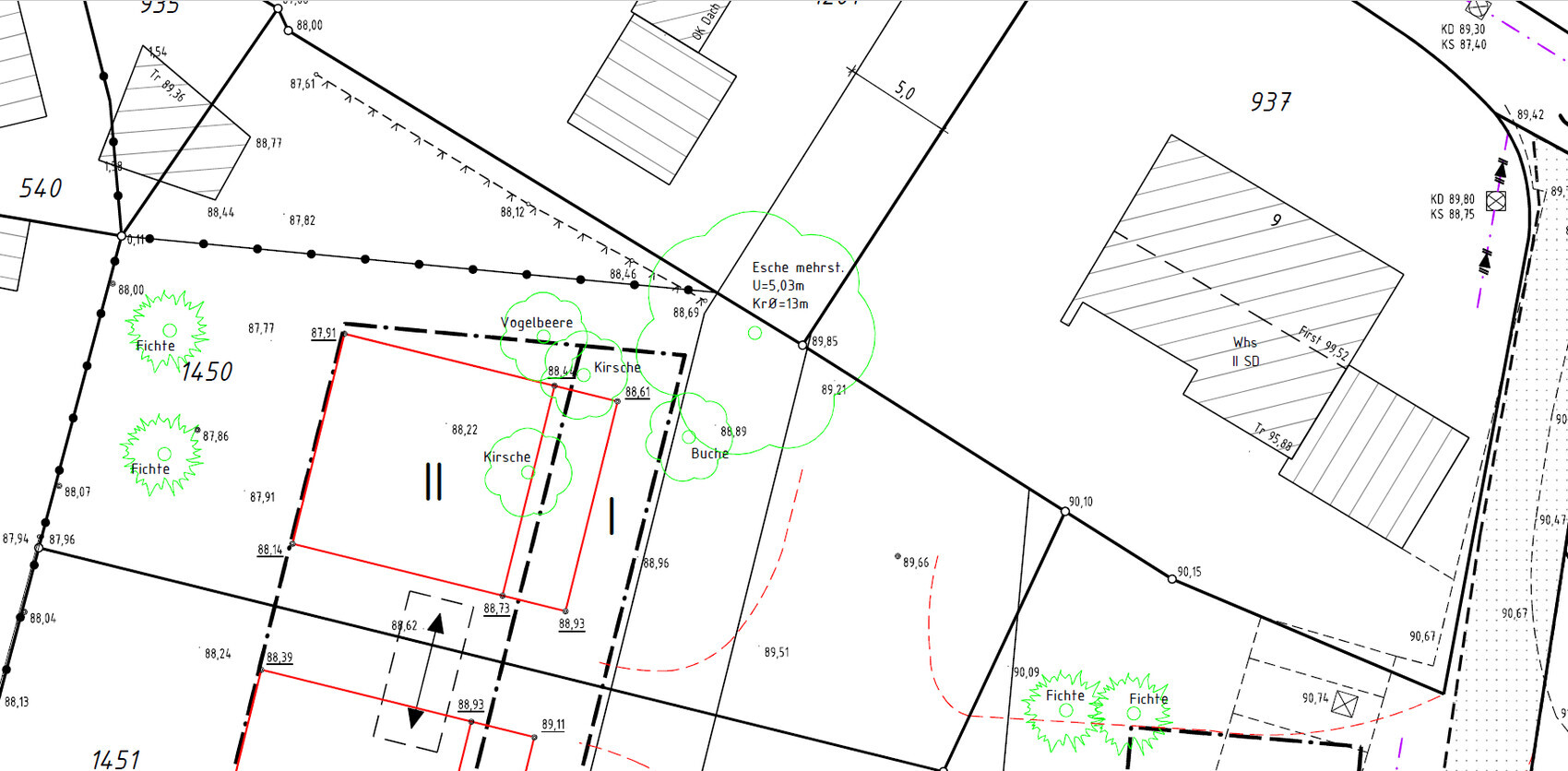
Development Plan/Restrictions
Plot size: 880m² (0.22 acres)
Slope: Approximately 2m (6.5 feet) between the east and west property boundaries but varying significantly—see surveying documents
Floor area ratio: 0.4
Gross floor area ratio: 0.8
Building envelope, building line and boundary: 13x10m (43x33 feet) for one full story and 10x10m (33x33 feet) for two full stories
Edge development: None
Number of parking spaces: No requirements
Number of stories: 2
Roof type: According to the development plan, pitched roofs are mandatory
Architectural style: Urban villa
Orientation: Main entrance on the east side, terrace and recreational garden on the west side, utility garden on east side
Maximum heights/limits: According to the development plan no specification other than two full stories
Other requirements: Rainwater must infiltrate the plot. According to the soil report, the ground is not optimally permeable. Additionally, some hydrostatic pressure from groundwater is expected. Therefore, we plan to install a cistern to use rainwater.
Client Requirements
Style, roof type, building type: Solid construction (Ytong), 35cm (14 inches) hip roof with 80cm (31 inches) knee wall
Basement, floors: Basement 10x10m (33x33 feet) precast waterproof concrete basement (white tank construction)
Number of occupants, age: Parents 36 and 33, children 3.5 and 1.5 years old, plus one due July 2021
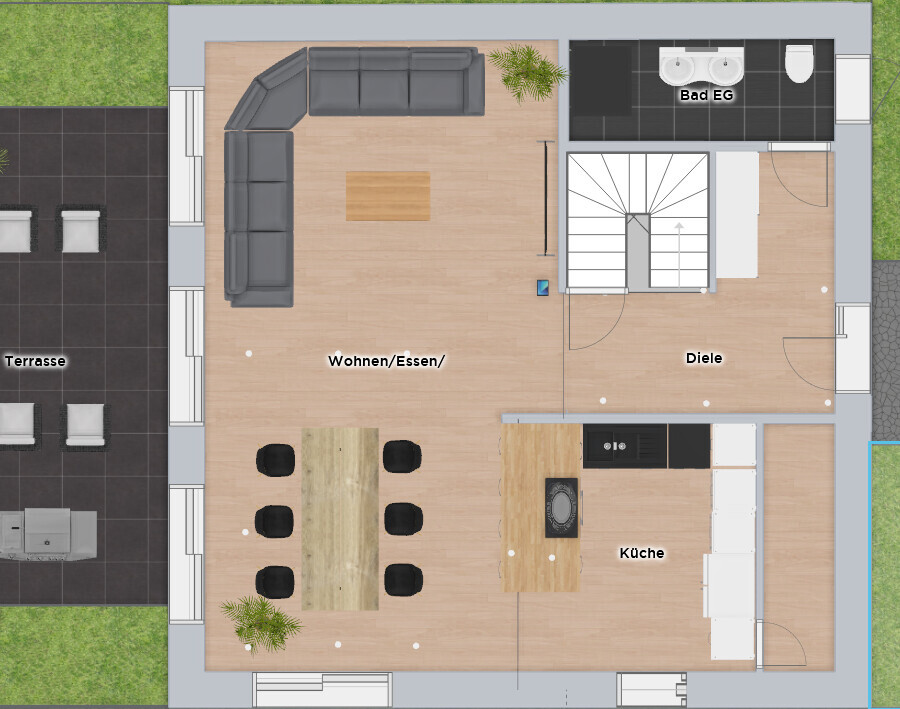
Space requirements on ground floor and upper floor: Ground floor 80m² (860 sq ft), upper floor 80m² (860 sq ft), attic 15-20m² (160-215 sq ft), basement mainly utility but with a larger fitness room planned
Office: Family use or home office?: Home office only. Before COVID-19, working at home 2-3 days a week; in 2020 a total of 10 months working from home; after COVID-19 probably 3-4 days a week home office
Overnight guests per year: 5
Open or closed architecture: Open on the ground floor
Traditional or modern construction: Modern
Open kitchen, kitchen island: Open with large kitchen island, cooking happens daily, about once a month guests up to 8 people, pantry directly adjacent to kitchen
Number of dining seats: 6-8, expandable with an additional table
Fireplace: No
Music/stereo wall: No
Balcony, roof terrace: No
Garage, carport: Large garage plus possibly 1-2 guest parking spaces
Utility garden, greenhouse: Yes, large greenhouse (possibly earth-sheltered) planned on east side with south orientation
Other wishes/special features/daily routine, also reasoning why certain things should or should not be included: Very bright ground floor with many windows, where only the middle lift-and-slide door and the door near the kitchen can be opened, all other windows on the ground floor are fixed glazing. Photovoltaics and KNX home automation system are planned.
House Design
Who created the plan: DIY
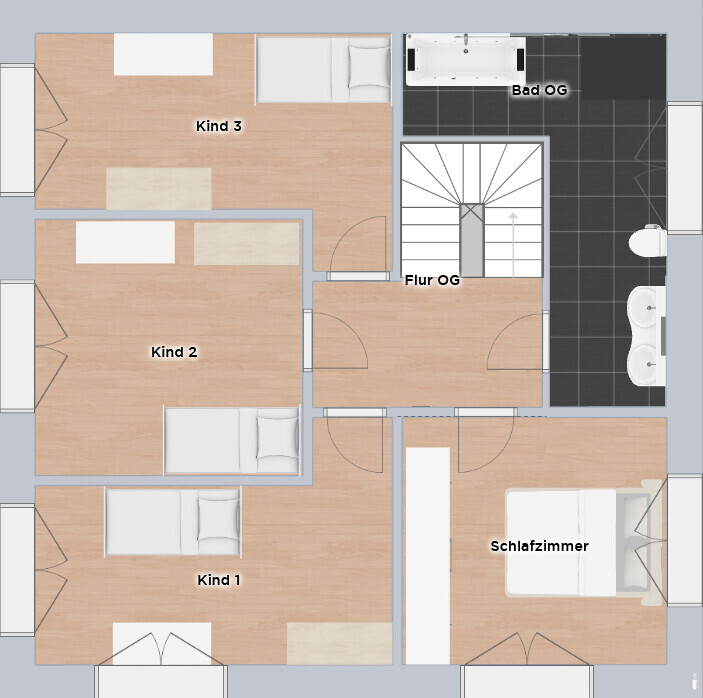
What do you especially like? Why?: Large living/dining area, open kitchen, pantry, three children’s rooms roughly equal in size facing the garden
What do you dislike? Why?: No walk-in closet in the master bedroom
Price estimate according to architect/planner: 400,000 without additional construction costs
Personal price limit for the house including equipment: 415,000
Preferred heating technology: Geothermal (either probe or trench collector) with underfloor heating
If you had to give up, which details/extensions
-could you do without: Walk-in closet in the bedroom
-could you not do without: Large living/dining area, open kitchen, pantry, three children’s rooms roughly equal in size facing the garden
Why is the design the way it is now?
This is the 12th or 13th version after long discussions and considerations. Whether it is more or less final also depends on your feedback.
What is the most important/basic question about the floor plan summarized in 130 characters?
Optimally use space and layout, avoid pitfalls.
after reading along for a long time, the time has finally come for us as well.
Since we are always open to criticism, different perspectives, and suggestions, we look forward to your opinions on our floor plan design.
Before entering the crucial phase, the two of us created a self-designed floor plan, and this is the one we want to move forward with.
Now, onto the details:
Development Plan/Restrictions
Plot size: 880m² (0.22 acres)
Slope: Approximately 2m (6.5 feet) between the east and west property boundaries but varying significantly—see surveying documents
Floor area ratio: 0.4
Gross floor area ratio: 0.8
Building envelope, building line and boundary: 13x10m (43x33 feet) for one full story and 10x10m (33x33 feet) for two full stories
Edge development: None
Number of parking spaces: No requirements
Number of stories: 2
Roof type: According to the development plan, pitched roofs are mandatory
Architectural style: Urban villa
Orientation: Main entrance on the east side, terrace and recreational garden on the west side, utility garden on east side
Maximum heights/limits: According to the development plan no specification other than two full stories
Other requirements: Rainwater must infiltrate the plot. According to the soil report, the ground is not optimally permeable. Additionally, some hydrostatic pressure from groundwater is expected. Therefore, we plan to install a cistern to use rainwater.
Client Requirements
Style, roof type, building type: Solid construction (Ytong), 35cm (14 inches) hip roof with 80cm (31 inches) knee wall
Basement, floors: Basement 10x10m (33x33 feet) precast waterproof concrete basement (white tank construction)
Number of occupants, age: Parents 36 and 33, children 3.5 and 1.5 years old, plus one due July 2021
Space requirements on ground floor and upper floor: Ground floor 80m² (860 sq ft), upper floor 80m² (860 sq ft), attic 15-20m² (160-215 sq ft), basement mainly utility but with a larger fitness room planned
Office: Family use or home office?: Home office only. Before COVID-19, working at home 2-3 days a week; in 2020 a total of 10 months working from home; after COVID-19 probably 3-4 days a week home office
Overnight guests per year: 5
Open or closed architecture: Open on the ground floor
Traditional or modern construction: Modern
Open kitchen, kitchen island: Open with large kitchen island, cooking happens daily, about once a month guests up to 8 people, pantry directly adjacent to kitchen
Number of dining seats: 6-8, expandable with an additional table
Fireplace: No
Music/stereo wall: No
Balcony, roof terrace: No
Garage, carport: Large garage plus possibly 1-2 guest parking spaces
Utility garden, greenhouse: Yes, large greenhouse (possibly earth-sheltered) planned on east side with south orientation
Other wishes/special features/daily routine, also reasoning why certain things should or should not be included: Very bright ground floor with many windows, where only the middle lift-and-slide door and the door near the kitchen can be opened, all other windows on the ground floor are fixed glazing. Photovoltaics and KNX home automation system are planned.
House Design
Who created the plan: DIY
What do you especially like? Why?: Large living/dining area, open kitchen, pantry, three children’s rooms roughly equal in size facing the garden
What do you dislike? Why?: No walk-in closet in the master bedroom
Price estimate according to architect/planner: 400,000 without additional construction costs
Personal price limit for the house including equipment: 415,000
Preferred heating technology: Geothermal (either probe or trench collector) with underfloor heating
If you had to give up, which details/extensions
-could you do without: Walk-in closet in the bedroom
-could you not do without: Large living/dining area, open kitchen, pantry, three children’s rooms roughly equal in size facing the garden
Why is the design the way it is now?
This is the 12th or 13th version after long discussions and considerations. Whether it is more or less final also depends on your feedback.
What is the most important/basic question about the floor plan summarized in 130 characters?
Optimally use space and layout, avoid pitfalls.
Kraj schrieb:
only our designs that we would actually enter the race with,Let those stay at home.Kraj schrieb:
how to do it better. Maybe an architect here has a different approach.Look, an architect costs money. When you hire a general contractor (GC), the architect’s services are included. And yes, there are ambitious people, like me, but honestly, I don’t feel like spending 2-3 hours on this when I already know it won’t work on 10m x 10m (33ft x 33ft). And since you currently don’t see that the pantry is just eating up money without any benefit, it would be a wasted effort. Maybe @Würfel* will come up with something?If everything here were arranged neatly and functionally, including a 2m x 2m (6.5ft x 6.5ft) pantry where you can conveniently place a crate of beer and a second fridge close by, plus a perfect cloakroom, it still wouldn’t be seen as better, because you have already hit the 3D button too many times and convinced yourselves your design looks good. This design, painstakingly created with software by you, is your baby, and someone coming along with a different design wants to take your baby away or replace it… that usually doesn’t work.
Kraj schrieb:
What are we supposed to do with the sqm in each child’s room? We still don’t understand that.The door to two children’s rooms is placed in an ugly bump-out that serves no purpose other than to make the living area square meters look better on paper. But here it’s wasted space. It turns 13 sqm (140 sq ft) of usable space into 12 sqm (130 sq ft).Kraj schrieb:
We are also not happy with the bathroom—how could it be arranged differently?By doing many things differently and actually leaving a proper room for the bathroom.Kraj schrieb:
My wife really wants the pantry to be next to the kitchen, even if it’s only 1 meter wide. Next to the kitchen for you means: I have to walk all around the house just to get to the "other end" to reach my pantry... Is your wife going to carry the wine, juice, and beer crate that far?
Kraj schrieb:
Since we are always open to criticism, different perspectives, and suggestions, we look forward to your opinions on our floor plan design.At least the original poster is open to other opinions. 🙄K1300S schrieb:
At least the OP is open to other opinions. 🙄That’s true. And I almost forgot: I think it’s a good decision to place the home office in the basement. Thanks to the slope, you can install a regular window there, so the room won’t feel like a basement.
K
knalltüte29 Dec 2020 21:23Kraj schrieb:
.... Thanks for the tip about the round duct. Do you have an estimate of how much floor height you lost compared to a rectangular duct?
Labeling the cables could really be helpful, and I’m willing to accept the extra effort... We have a 25cm (10 inches) floor construction on the ground floor, so there is enough space (we install the mechanical ventilation system within the floor, while most people put it in a suspended ceiling). Other mechanical ventilation ducts run past the knee wall, so space is not an issue there either. With rectangular ducts/channels, the airflow is less efficient than with round ducts, so you need a larger cross-sectional area. I think a maximum of 2cm (0.8 inches) additional installation height is required.
For labeling, I have several Brady label printers (which I also need occasionally for work). I use vinyl labels up to 10cm (4 inches) wide and up to 15m (49 feet) long 🙂. But for our initial temporary labeling on site (while installing), we just used roll labels and wrote on them with a thin permanent marker. If you write neatly, that can actually be permanent. It lasts a long time (I bought some rolls cheaply on eBay, "Brady Label THT B427 CLR 2.75" X 1.0862" WHT Y378995 800 labels a Roll" and I probably won’t use them all).

Kraj schrieb:
Maybe the attached site plan with specific measurements helps. Not really helpful. Mainly, it is still too limited in scale. At least the additional info ...Kraj schrieb:
This site plan comes from an initial building inquiry, which is why it includes the zones I (1 full storey) and II (2 full storeys).... is useful, as it allows the site plan to be interpreted better: I now see the building envelope as approximately 14.5 to 15 m (47.5 to 49 feet) deep, about 10 m (33 feet) wide at the back, but around 13 m (43 feet) wide at the front; and that zones I and II probably are not requirements, but simply taken from a specific preliminary inquiry.https://www.instagram.com/11antgmxde/
https://www.linkedin.com/company/bauen-jetzt/
ypg schrieb:
Better leave those at home.
You know, an architect costs money. With a general contractor (GC), you also get the architect’s services included. Yes, there are ambitious people, like me for example, but honestly, I’m not interested in spending 2–3 hours on this when I already know it won’t work on a 10 x 10 meter (33 x 33 feet) footprint. And since you currently don’t see that the pantry is just eating money without any benefit, it would be a wasted effort.
Maybe @Würfel* will come up with something?
If you arranged everything properly and functionally here, including a 2 x 2 meter (6.5 x 6.5 feet) pantry where you can easily place a crate of beer and even a second fridge within short reach, plus a perfect cloakroom, it still wouldn’t be seen as better because you have already pressed the 3D button too often and fallen in love with your design.
This design, laboriously created by you with the software, is your baby, and someone coming along with a different design wants to take your baby away or swap it out… that usually doesn’t happen.
The door to two children’s bedrooms opens into an ugly recess that serves no real purpose other than to artificially inflate the living area square meters. Here it is wasted. It reduces a usable 13 square meters (140 square feet) to 12 square meters (130 square feet).
By doing many things differently, you can also save space for a bathroom.
For you, at the kitchen means walking all around the house in a circle just to get to the “other end” of your pantry… Does your wife carry the wine, juice, and beer crates? Well, I wouldn’t go so far as to see it as our baby. We don’t have an emotional attachment and consider it purely a floor plan proposal, admittedly drawn by us using a tool, but nothing more. I have already mentioned several times that we are just entering the race with it, with no claim that no further changes are possible.
If in the end something completely different comes out and we still have three children’s rooms, one bathroom, and one bedroom on the upper floor, we will be fine with that.
And maybe we will even take your advice and go to the architect without our design and just be surprised by what he comes up with for our requirements.
K1300S schrieb:
At least the original poster (OP) is open to other opinions. 🙄 We definitely are, otherwise we would still insist on our floor plan and not consider any of your suggestions, which is not the case.
ypg schrieb:
Right. And I forgot: I think it’s good that you decided to move the office to the basement. Because of the slope, you can install a normal window there, so the room won’t feel like a basement. Thanks again for the tip; your reasoning was convincing, and only because of that did we switch the office from the attic to the basement and now have to make sure the slight slope of the land is optimally used. So much for the idea that we wouldn’t be open to other opinions 😉
superzapp schrieb:
We have a 25 cm (10 inch) floor buildup on the ground floor, so we have enough space (we install controlled mechanical ventilation in the floor, whereas most put it in a dropped ceiling). Other controlled ventilation ducts run past the knee walls, so there is no space problem either. With rectangular ducts/channels, the airflow is less favorable than with round ducts, so you need a larger cross-section. I think a maximum of 2 cm (about 1 inch) more height is required…
For labeling, I have several Brady label printers since I occasionally need them for work. I have vinyl labels up to 10 cm (4 inches) wide and up to 15 m (50 feet) long 🙂. But for our first temporary labeling on site (directly during installation), we just used labels on a roll and wrote on them with a fine permanent marker. If you write neatly, it can stay like that. It lasts forever (I bought a few rolls cheaply on eBay, "Brady Label THT B427 CLR 2.75" X 1.0862" WHT Y378995 800 labels a Roll" and will certainly not use them all). Are your ducts installed in the precast concrete slab? If I use round ducts, I would put them into the precast slab and provide openings at the same time to avoid later core drilling, chiseling, or similar work.
Thanks for the tip about Brady labels. Are those self-laminating?
11ant schrieb:
Not really bulky. Mainly it is still too compartmentalized. At least the additional info…
…is useful, so the site plan can be interpreted better: now I see the building envelope more like about 14.5 to 15 meters (48 to 49 feet) deep, 10 meters (33 feet) at the back, but about 13 meters (43 feet) wide at the front; and that I and II here are probably not requirements but simply adopted from a specific preliminary request project. According to the architect, however, those are the requirements: building envelope 10 x 10 meters (33 x 33 feet) for two full floors or 10 x 13 meters (33 x 43 feet) for stepped floors. In the 10 x 13 meter area, only one full floor is allowed, but on the upper floor a full 10 x 10 meter (33 x 33 feet) floor can be added.
We were advised either to extend the basement to 10 x 13 meters (33 x 43 feet) to build 10 x 13 with a stepped floor, or to keep the basement and building within the 10 x 10 meter (33 x 33 feet) building envelope.
Similar topics