
Hello everyone,
I’m not sure if my question fits in this category, and I couldn’t find any posts addressing my specific issue here or in other forums.
My post is less about advice on how to fix the described defect and more about whether our general contractor (GC) can legally proceed as they are:
We are building with a local GC who has been in business for 25 years, and we remain very satisfied with our choice. For several years now, especially since the company switched to monolithic construction, they have frequently encountered the problem of cracks appearing in the exterior plaster around the transition area between masonry, precast concrete ceiling panels, and the parapet (attic wall) on flat roof constructions. Since then, they have continuously tried, but without success, to solve this issue. Here are the relevant construction details for the parapet area:
Masonry: 36.5 cm (14 inches) Poroton T9
Precast concrete ceiling panel: 22 cm (9 inches) thick, with 120 mm (5 inches) exterior insulation (Poroton ceiling edge shells)
Parapet: one 36.5 cm (14 inches) Poroton T9 block, topped with a Poroton U-shaped shell filled with concrete and anchored about 1 meter (3 feet) from each corner into the precast concrete panels with reinforcing steel
Exterior plaster in the parapet area is applied in two layers, reinforced with mesh
This was the plan so far. The GC assumes the cause is that the ceilings settle (slightly sag) during the first year, causing the corners of the slabs at the parapet to slightly lift upward, which then leads to cracks in the exterior plaster. When cracks were repaired after one year, this phenomenon reportedly did not reoccur.
Various measures have already been taken: more reinforcement, wider blocks for the parapet filled with more concrete to apply more load on the slabs, preventing the slab from “rising” at the exterior edge. So far, none of this has been successful.
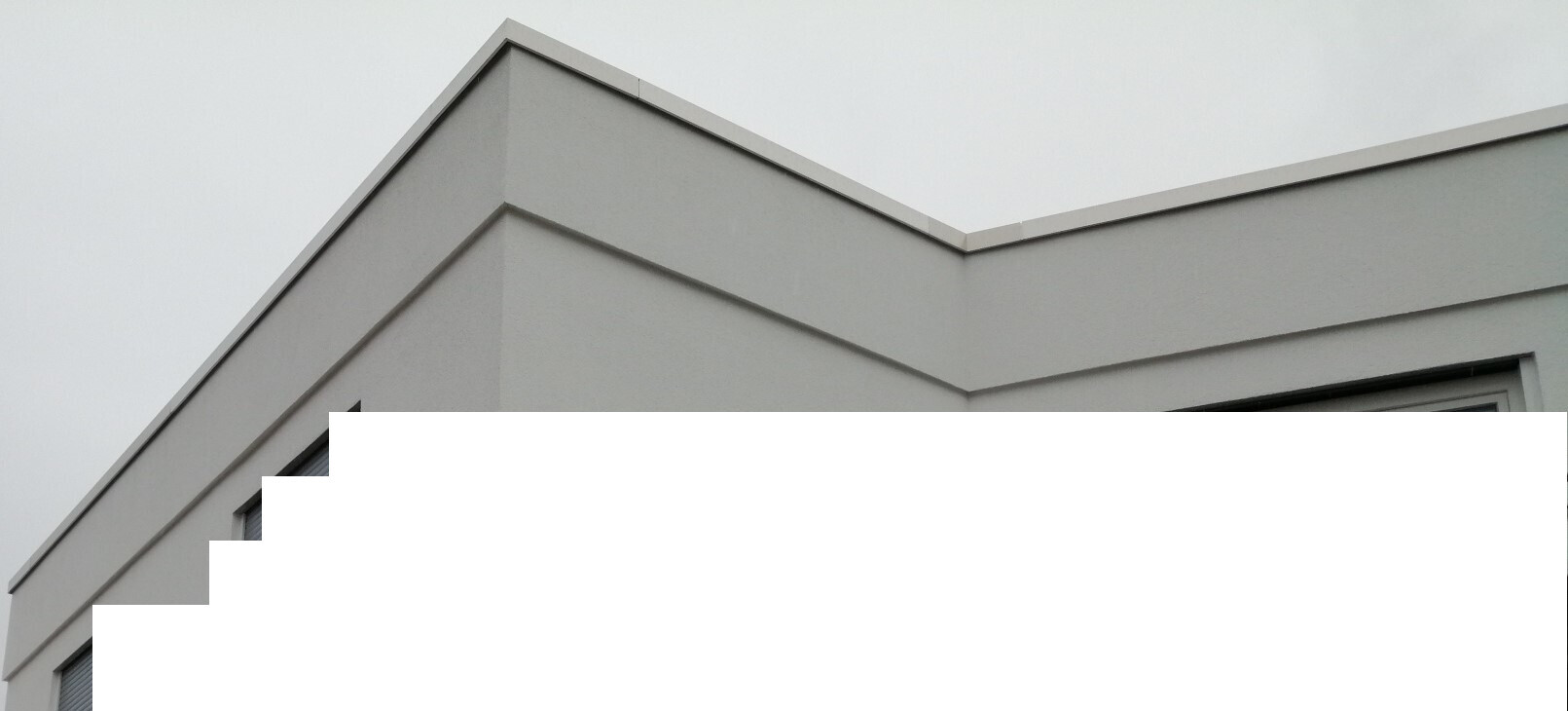
Now the plan is to install exterior insulation and finish system (EIFS/WDVS) with 40 mm (1.5 inches) thickness on the parapet area, extending downward about 20 cm (8 inches) over the transition from masonry to the precast ceiling panel (see photo). Besides the fact that this looks terrible, we wonder if this will actually solve the problem and have rejected this approach. Instead, we proposed delaying plastering the house for one year, since the problem reportedly ceases to appear after that period.
Our current options are:
1. Proceed with the original plan but sign a waiver excluding cracks from warranty coverage because the problem is known and we do not want to accept the GC’s solution
2. Accept the unattractive EIFS/WDVS variant
3. Remove the plastering work from the contract and manage the exterior plaster ourselves next year
We are not really happy with any of these options. Ideally, we would choose option 1 but without the exclusion clause, meaning everything stays as contractually agreed. Can the GC legally force such a clause on us? Is it lawful if the house undergoes such a major change in appearance (we definitely would not have chosen a flat roof if we had known about this look from the start)?
Thank you very much for your help, and apologies if this post is in the wrong subforum.
I’m not sure if my question fits in this category, and I couldn’t find any posts addressing my specific issue here or in other forums.
My post is less about advice on how to fix the described defect and more about whether our general contractor (GC) can legally proceed as they are:
We are building with a local GC who has been in business for 25 years, and we remain very satisfied with our choice. For several years now, especially since the company switched to monolithic construction, they have frequently encountered the problem of cracks appearing in the exterior plaster around the transition area between masonry, precast concrete ceiling panels, and the parapet (attic wall) on flat roof constructions. Since then, they have continuously tried, but without success, to solve this issue. Here are the relevant construction details for the parapet area:
Masonry: 36.5 cm (14 inches) Poroton T9
Precast concrete ceiling panel: 22 cm (9 inches) thick, with 120 mm (5 inches) exterior insulation (Poroton ceiling edge shells)
Parapet: one 36.5 cm (14 inches) Poroton T9 block, topped with a Poroton U-shaped shell filled with concrete and anchored about 1 meter (3 feet) from each corner into the precast concrete panels with reinforcing steel
Exterior plaster in the parapet area is applied in two layers, reinforced with mesh
This was the plan so far. The GC assumes the cause is that the ceilings settle (slightly sag) during the first year, causing the corners of the slabs at the parapet to slightly lift upward, which then leads to cracks in the exterior plaster. When cracks were repaired after one year, this phenomenon reportedly did not reoccur.
Various measures have already been taken: more reinforcement, wider blocks for the parapet filled with more concrete to apply more load on the slabs, preventing the slab from “rising” at the exterior edge. So far, none of this has been successful.
Now the plan is to install exterior insulation and finish system (EIFS/WDVS) with 40 mm (1.5 inches) thickness on the parapet area, extending downward about 20 cm (8 inches) over the transition from masonry to the precast ceiling panel (see photo). Besides the fact that this looks terrible, we wonder if this will actually solve the problem and have rejected this approach. Instead, we proposed delaying plastering the house for one year, since the problem reportedly ceases to appear after that period.
Our current options are:
1. Proceed with the original plan but sign a waiver excluding cracks from warranty coverage because the problem is known and we do not want to accept the GC’s solution
2. Accept the unattractive EIFS/WDVS variant
3. Remove the plastering work from the contract and manage the exterior plaster ourselves next year
We are not really happy with any of these options. Ideally, we would choose option 1 but without the exclusion clause, meaning everything stays as contractually agreed. Can the GC legally force such a clause on us? Is it lawful if the house undergoes such a major change in appearance (we definitely would not have chosen a flat roof if we had known about this look from the start)?
Thank you very much for your help, and apologies if this post is in the wrong subforum.
 Neubauling1 Apr 2021 14:09
11ant schrieb:
I’m completely at a loss as to what problem is shown (or was supposed to be shown) here.I think the picture is the solution with the external thermal insulation composite system (ETICS). The original poster wanted to show how it would look.kinderpingui schrieb:
Our tendency strongly leans towards option 4I also think option 4 is the best.
Neubauling schrieb:
I think the picture shows the solution with the external thermal insulation composite system (ETICS). The original poster wanted to illustrate how it would look. Do you mean an external image just to show us what a parapet is?
What would really help here is much more the following: photos of the problem area (please in context, not extreme close-ups of just the focal point), and (hand) sketches of the current situation, the proposed solution, and alternative proposals.
https://www.instagram.com/11antgmxde/
https://www.linkedin.com/company/bauen-jetzt/

The discussion was about the proposed solution to apply an additional layer of ETICS (External Thermal Insulation Composite System) to cover potential cracks. For example, I thought the ETICS would be installed flush with the surface, so I found the image helpful for explanation, even though it does not represent the problem, which still has to occur.
Honestly, I would not agree to any of the options involving extra costs if these were already contractually agreed upon beforehand. Problems need to stay where they belong, and in this case, that is with the general contractor. The fact that he wants to conveniently shift this to the scope of owner-provided work is, frankly, quite audacious.
Honestly, I would not agree to any of the options involving extra costs if these were already contractually agreed upon beforehand. Problems need to stay where they belong, and in this case, that is with the general contractor. The fact that he wants to conveniently shift this to the scope of owner-provided work is, frankly, quite audacious.
K
kinderpingui2 Apr 2021 10:3111ant schrieb:
I would like to help, but I don’t understand the whole problem: the photo crop hides (due to which mysteries exactly?) more than it shows, is difficult to interpret in terms of scale and perspective, and does not reveal any problem area, nor is it explained. The little that can be seen looks flawless. The text mentions that plastering will still follow – however, the picture gives the impression of the final finish coat. I’m completely confused about what problem is supposed to be shown.Neubauling schrieb:
I think the picture shows the solution with the external insulation system. The OP wanted to demonstrate how it would look.@Neubauling thanks for the explanation.
We are building with a general contractor and the exterior plastering will start soon. The contractor builds about 5 to 10 houses per year and has had the problem for around 5 years (since they switched to monolithic construction and stopped using external insulation systems) that cracks form around the parapet on flat roofs. The contractor refuses the originally planned execution because it would obviously lead to problems, and wants to take preventive measures, which I understand. All previously implemented measures, supported by expert opinions, have so far failed, which is why we are now considering this variant with 4 cm (1.5 inches) external insulation. This has already been implemented on one project (the example photo). However, we do not like this and are looking for other solutions together. Our preferred option is currently to apply base plaster first and then the finish coat after 1 to 3 years.
@11ant, is it clearer now?
K1300S schrieb:
The discussion was about the proposed solution to apply an additional layer of external insulation to cover potential cracks. For example, I thought the insulation would be installed flush, so I found the photo helpful to explain that, even though it doesn’t show the problem, which hasn’t yet appeared.
Honestly, I wouldn’t agree to either option with additional costs if this was already contractually agreed beforehand. Problems should remain where they belong, and in this case that’s with the general contractor. The fact that they want to shift the issue cleverly into the area of self-performed work strikes me as quite cheeky.Thank you for your response and the additional comments for @11ant. I think it is in everyone’s interest to try to prevent the defect from occurring at all and to look for solutions. The contractor’s offer of the external insulation without extra cost for us is this option we don’t want. That was exactly my original question: can the general contractor impose this on us, or rather: can they impose a clause where we would be liable for a possible defect because they offer a solution that supposedly avoids the defect, but we do not want it? I think it will be difficult to answer without knowing the contract in detail. As a layperson, I have not found any general clause like this in the contract so far. However, it should also be said that the contract does not specify how exactly the parapet should be executed. It only says: wall thickness, height, and material at the contractor’s discretion. The same goes for the plaster…
Thanks to everyone for your support 🙂
What I mainly don’t understand here is why you don’t simply explain what this is about with pictures. Normally, I am a very quick reader, but then the original poster also has to do their part, which you have not done here (pictures of your problem, both photos and drawings or sketches, are completely missing). Counterproductively, you show (without explaining that it is) a picture of something entirely different from your construction site: I have long known what to imagine under an parapet, and I can picture a step in a plaster surface as well. But apart from the fact that this is certainly not 4 cm (1.6 inches), there is unfortunately no illustration here of how we should imagine your parapet.
Above the upper floor exterior wall, a ceiling is to be installed here, which even with a monolithic wall construction—that is, the wall itself without insulation board on it—requires an insulation strip, and cracks in the plaster are now feared at this transition. The contractor has been aware of this issue for five years from experience with flat roof connections on walls without external thermal insulation composite systems (ETICS, also known as EIFS or external wall insulation). At this point, I sympathize with you for choosing a contractor who, on one hand, has not found a solution to a known problem for five years, yet on the other hand does not refuse a contract for a flat-roofed building without ETICS.
But whether a solution exists or not, the contractor must have an understanding of the connections of the components (firstly in general and secondly regarding his proposed solutions A, B, C, etc.) and, unlike a lay client, must also be able to draw them (and have already drawn them—because this should not seriously be a decision made on-site during the supervisor’s inspection)!
What I begin to understand despite your borderline rude reluctance to provide illustrations is that at least you are searching for unsuitable solutions. One of these would now be to apply an additional insulation strip overlapping the ceiling-wall joint on the ceiling’s insulation strip (note: the ceiling alone does not constitute a parapet any more than one swallow makes a summer—there is still a glaring lack of a representation of how this entire parapet is supposed to be "built" here!). However, how this is supposed to be mounted so that it is floating and elastically separated has so far been left unaddressed. I cannot help like this!
A very basic question: what happens to the plaster on this contractor’s houses in the area of the insulation strips of the ground floor ceiling?
https://www.instagram.com/11antgmxde/
https://www.linkedin.com/company/bauen-jetzt/
Above the upper floor exterior wall, a ceiling is to be installed here, which even with a monolithic wall construction—that is, the wall itself without insulation board on it—requires an insulation strip, and cracks in the plaster are now feared at this transition. The contractor has been aware of this issue for five years from experience with flat roof connections on walls without external thermal insulation composite systems (ETICS, also known as EIFS or external wall insulation). At this point, I sympathize with you for choosing a contractor who, on one hand, has not found a solution to a known problem for five years, yet on the other hand does not refuse a contract for a flat-roofed building without ETICS.
But whether a solution exists or not, the contractor must have an understanding of the connections of the components (firstly in general and secondly regarding his proposed solutions A, B, C, etc.) and, unlike a lay client, must also be able to draw them (and have already drawn them—because this should not seriously be a decision made on-site during the supervisor’s inspection)!
What I begin to understand despite your borderline rude reluctance to provide illustrations is that at least you are searching for unsuitable solutions. One of these would now be to apply an additional insulation strip overlapping the ceiling-wall joint on the ceiling’s insulation strip (note: the ceiling alone does not constitute a parapet any more than one swallow makes a summer—there is still a glaring lack of a representation of how this entire parapet is supposed to be "built" here!). However, how this is supposed to be mounted so that it is floating and elastically separated has so far been left unaddressed. I cannot help like this!
K1300S schrieb:With a rigid cladding of the problematic area, you logically cannot solve an elasticity issue. Even a contractor who was formerly a butcher should understand that, and only someone who was formerly a real estate agent might not.
The topic was the description of the proposed solution to apply an additional layer of ETICS to cover potential cracks.
K1300S schrieb:In this case, that would have meant slimming the ceiling support by the thickness of the ETICS. At this point, I am increasing my assessment from "real estate agent" to "mayor of @goalkeeper" ;-)
I had, for example, thought the ETICS would be installed flush.
A very basic question: what happens to the plaster on this contractor’s houses in the area of the insulation strips of the ground floor ceiling?
https://www.instagram.com/11antgmxde/
https://www.linkedin.com/company/bauen-jetzt/
Similar topics