
@fach1werk
@Steffi33
@all creatives
I’ve been painting a black lacquered wooden desk, a brown pine lacquered shelf, and a wooden chair with chalk paint for the first time over the past two days—all surfaces are more or less lightly sanded. I also painted a lacquered shelf (IKEA) on the side. It’s not working at all. Even the second coat doesn’t cover where I start with the brush. Corners that I go over again after 10 minutes clump up and get thick. Surfaces become crumbly if I go over them again after 5 minutes. Either it doesn’t cover or the paint drips. If I didn’t hope that this is probably normal and that I need to sand everything to get a nice finish, I would have given up by now.
What am I doing wrong?
Using a short-pile roller was also a disaster: the typical texture like textured wallpaper but without coverage.
I wanted a tactile, great white desk, but what I got are clumped spots and a waste of time... for the price of the paint, I could have already bought a new desk.
@Steffi33
@all creatives
I’ve been painting a black lacquered wooden desk, a brown pine lacquered shelf, and a wooden chair with chalk paint for the first time over the past two days—all surfaces are more or less lightly sanded. I also painted a lacquered shelf (IKEA) on the side. It’s not working at all. Even the second coat doesn’t cover where I start with the brush. Corners that I go over again after 10 minutes clump up and get thick. Surfaces become crumbly if I go over them again after 5 minutes. Either it doesn’t cover or the paint drips. If I didn’t hope that this is probably normal and that I need to sand everything to get a nice finish, I would have given up by now.
What am I doing wrong?
Using a short-pile roller was also a disaster: the typical texture like textured wallpaper but without coverage.
I wanted a tactile, great white desk, but what I got are clumped spots and a waste of time... for the price of the paint, I could have already bought a new desk.
Hello Yvonne, I don’t have any advice on this. I haven’t used chalk paint before. So far, I have always used latex paint for that. Alternatively, we had some leftover white paint (Remmers Rofalin Acrylic) from our roof battens... I also used it to paint wood indoors. However, after the first coat, it needs to be sanded. The second coat then has a very nice satin finish.
Example of a self-built door frame (made from raw timber boards from a hardware store), painted with the Remmers paint:
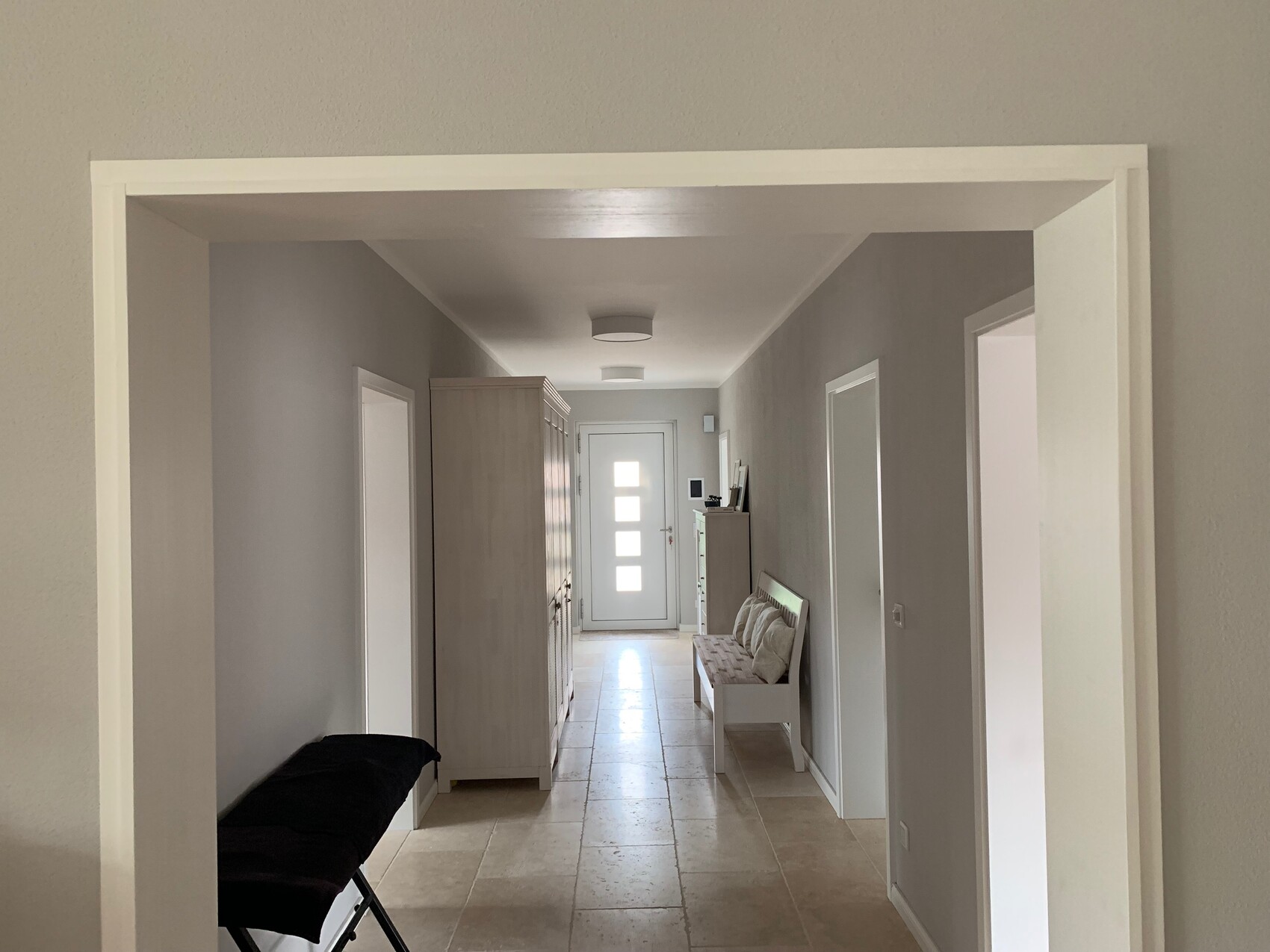
Best regards, Steffi
Example of a self-built door frame (made from raw timber boards from a hardware store), painted with the Remmers paint:
Best regards, Steffi
F
fach1werk1 Aug 2019 07:57Dear Yvonne,
I only just discovered you, I was on vacation.
Chalk paint is sold for shabby chic finishes, but it is not a durable coating. You would soon have greasy corners on your desk that truly reflect shabby wear, unless you apply a topcoat sealer at the end. However, this will only make it more resistant to wiping, not really impact-resistant.
If you absolutely want to use this paint, apply a thin layer of a sealing or blocking material underneath, which may also be thinned. This ensures the topcoat absorbs evenly. The degree of absorption can be controlled by the dilution of the sealing layer. If I were to be tough, I’d use a durable water-based stair varnish as a base; it’s affordable and widely available. Then apply the desired coating on top. For those less skilled in DIY than you: Absorption here means the liquid part of the paint is drawn capillary into the substrate, while the solid part remains on the surface, forming the visible texture or structure you may not want.
In general, I would create a shabby look rather with a colored primer as a base and use (highly) pigmented, probably white waxes on top. You can add some pigment to the wax if you want more coverage, but use it sparingly or buy the right product from the start. Waxes are easy to apply, easy to touch up later, and allow some maintenance if areas get worn off through use. They definitely do not attract dirt like chalk paint does with its open-pored structure. However, hard waxes do wear down gradually under frequent mechanical stress.
Latex paint can work initially, but I would advise against it. It won’t stay attractive for long. Latex paint is basically a dispersion with a higher binder content. The binder is pure acrylic resin in aqueous solution. Dispersion paints often contain mineral fillers (barite), which make them thick and heavy. These fillers attract dirt. The wipe resistance of latex paint comes from the binder, which is expensive, so only the minimum amount is used. The binder itself doesn’t dry hard; it forms a flexible plastic film when fully dried.
Hope you end up with a beautiful piece!
Best regards,
Gabriele
I only just discovered you, I was on vacation.
Chalk paint is sold for shabby chic finishes, but it is not a durable coating. You would soon have greasy corners on your desk that truly reflect shabby wear, unless you apply a topcoat sealer at the end. However, this will only make it more resistant to wiping, not really impact-resistant.
If you absolutely want to use this paint, apply a thin layer of a sealing or blocking material underneath, which may also be thinned. This ensures the topcoat absorbs evenly. The degree of absorption can be controlled by the dilution of the sealing layer. If I were to be tough, I’d use a durable water-based stair varnish as a base; it’s affordable and widely available. Then apply the desired coating on top. For those less skilled in DIY than you: Absorption here means the liquid part of the paint is drawn capillary into the substrate, while the solid part remains on the surface, forming the visible texture or structure you may not want.
In general, I would create a shabby look rather with a colored primer as a base and use (highly) pigmented, probably white waxes on top. You can add some pigment to the wax if you want more coverage, but use it sparingly or buy the right product from the start. Waxes are easy to apply, easy to touch up later, and allow some maintenance if areas get worn off through use. They definitely do not attract dirt like chalk paint does with its open-pored structure. However, hard waxes do wear down gradually under frequent mechanical stress.
Latex paint can work initially, but I would advise against it. It won’t stay attractive for long. Latex paint is basically a dispersion with a higher binder content. The binder is pure acrylic resin in aqueous solution. Dispersion paints often contain mineral fillers (barite), which make them thick and heavy. These fillers attract dirt. The wipe resistance of latex paint comes from the binder, which is expensive, so only the minimum amount is used. The binder itself doesn’t dry hard; it forms a flexible plastic film when fully dried.
Hope you end up with a beautiful piece!
Best regards,
Gabriele
Dear Gabriele,
Thank you for your detailed reply.
I have already made my decision. Conclusion: artificial surfaces cover better than stained wood. Self-painted surfaces don’t have to be perfect, so I am practicing tolerance.
The desk, with its 50cm (20 inches) depth, was too narrow for my computer and had to be replaced. Despite the wax layer.
A new one has taken its place in the office. Since I completely renovated the room, including the walls, the space is now close to a perfect makeover. The furniture was just an accessory here.
I will now use up the leftover chalk paint for small items like picture frames and similar.
Thank you for your detailed reply.
I have already made my decision. Conclusion: artificial surfaces cover better than stained wood. Self-painted surfaces don’t have to be perfect, so I am practicing tolerance.
The desk, with its 50cm (20 inches) depth, was too narrow for my computer and had to be replaced. Despite the wax layer.
A new one has taken its place in the office. Since I completely renovated the room, including the walls, the space is now close to a perfect makeover. The furniture was just an accessory here.
I will now use up the leftover chalk paint for small items like picture frames and similar.
Similar topics