
Hello Home Builders,
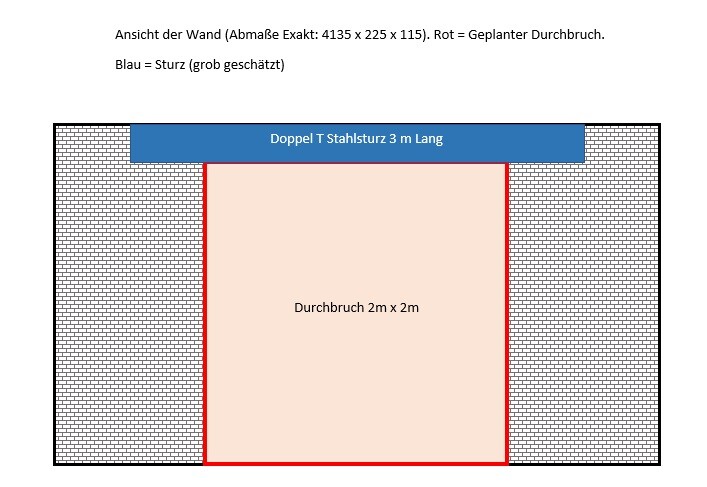
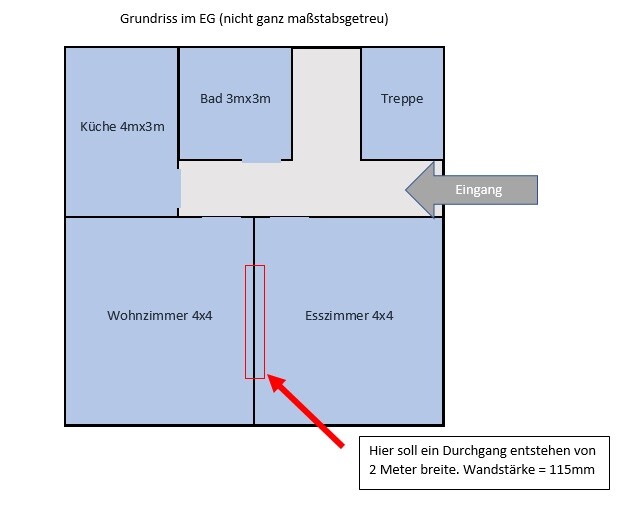
I am planning to create an opening in a load-bearing wall in my future house:
The problem: Load-bearing wall.
The solution: Steel lintel (to be calculated by a structural engineer beforehand).
The question: How can the installation be done?
Is my approach for installing the lintel correct?
The lintel should rest on the masonry (115 mm (4.5 inches)).
Fix the lintel in place and pack with mortar -> wait until everything is firmly set.
Start the wall opening (using an angle grinder + demolition hammer).
Finish by plastering everything neatly. -> Done?
Thank you very much for your suggestions. I hope I am not being too naïve about this!
Regards,
Klaus.
I am planning to create an opening in a load-bearing wall in my future house:
The problem: Load-bearing wall.
The solution: Steel lintel (to be calculated by a structural engineer beforehand).
The question: How can the installation be done?
Is my approach for installing the lintel correct?
- Support the ceiling with props (borrowed from the drywall installer).
- Create the upper opening in the wall to fit the double T steel lintel.
The lintel should rest on the masonry (115 mm (4.5 inches)).
Fix the lintel in place and pack with mortar -> wait until everything is firmly set.
Start the wall opening (using an angle grinder + demolition hammer).
Finish by plastering everything neatly. -> Done?
Thank you very much for your suggestions. I hope I am not being too naïve about this!
Regards,
Klaus.

saar2and schrieb:
However, I don’t believe that a 115mm (4.5 inches) wall is load-bearing. Joedreck schrieb:
There are also walls that are not load-bearing but serve as bracing, if I’m correctly informed. It cannot be ruled out that this wall is load-bearing or at least provides bracing. Supporting a steel beam on a wall of one brick thickness may require more than just a deep embedment of the beam. In such cases, it might be necessary to use higher strength masonry units under the beam. Planning this without a structural engineer is not responsible. Overall, I would recommend a thorough investigation of the entire structure. This is also to avoid unexpected obstacles such as riser or downpipes right in the middle of your nice opening.
https://www.instagram.com/11antgmxde/
https://www.linkedin.com/company/bauen-jetzt/
 KlausMajore24 Jun 2017 21:20
The wall is made of standard bricks. Unfortunately, I assume the wall is load-bearing. Here is a simplified building plan (I hope the resolution is sufficient). The basement walls are 240mm (9.5 inches) thick. Above that (except for the shafts), the walls are 115mm (4.5 inches) thick. Above the wall where the lintel is to be installed, there is a wall from the upper floor.
I don’t want to cut costs in the wrong place, but I also don’t want to spend unnecessary money.
There are no risers or downpipes inside the wall at that location.
Best regards,
KlausMajore

I don’t want to cut costs in the wrong place, but I also don’t want to spend unnecessary money.
There are no risers or downpipes inside the wall at that location.
Best regards,
KlausMajore
The cross-section shows that there is a timber beam ceiling between the ground floor and the upper floor, which means that all walls continuing up to the upper floor are load-bearing.
According to the illustration, the basement ceiling is made of concrete. This should allow the remaining wall to support a steel beam as planned. However, I expect it will be necessary to initially make the opening wider and then rebuild below the beam supports using calcium silicate bricks.
An alternative—depending on the importance of this wall (on the upper floor) for the roof structure—could be to remove the wall on the upper floor and reconstruct it as a lightweight partition. Practically speaking, it may be helpful to consult a carpenter to determine how to support the roof structure down to the basement ceiling. This could affect the location of the desired opening.
https://www.instagram.com/11antgmxde/
https://www.linkedin.com/company/bauen-jetzt/
According to the illustration, the basement ceiling is made of concrete. This should allow the remaining wall to support a steel beam as planned. However, I expect it will be necessary to initially make the opening wider and then rebuild below the beam supports using calcium silicate bricks.
An alternative—depending on the importance of this wall (on the upper floor) for the roof structure—could be to remove the wall on the upper floor and reconstruct it as a lightweight partition. Practically speaking, it may be helpful to consult a carpenter to determine how to support the roof structure down to the basement ceiling. This could affect the location of the desired opening.
https://www.instagram.com/11antgmxde/
https://www.linkedin.com/company/bauen-jetzt/
KlausMajore25 Jun 2017 20:07You guys here are simply outstanding!
I would be reluctant to break through the wall on the upper floor, but the lightweight partition wall still makes sense.
On Thursday, I’m going to the notary, then two weeks to the Canary Islands...
Work will start at the end of July, and I will definitely provide feedback on how it was done.
I will also consult a structural engineer for advice.
Regards,
KlausMajore
I would be reluctant to break through the wall on the upper floor, but the lightweight partition wall still makes sense.
On Thursday, I’m going to the notary, then two weeks to the Canary Islands...
Work will start at the end of July, and I will definitely provide feedback on how it was done.
I will also consult a structural engineer for advice.
Regards,
KlausMajore
KlausMajore schrieb:
By calcium silicate brick, do you mean limestone? Yes, although bricks with higher strength are also available. Under the support of the beam, the pressure is partially higher than on a "uniform" wall.
KlausMajore schrieb:
But using a lightweight partition wall still makes sense. As I said: first investigate the relationships with the roof structure. The cross-section indicates interconnections. A carpenter should take a look at this.
The brick size used suggests a construction date from 1955 onwards, but the construction style is probably partly more traditional than the then current state of the art, likely for cost-saving reasons.
https://www.instagram.com/11antgmxde/
https://www.linkedin.com/company/bauen-jetzt/
Similar topics