
ᐅ Is it advisable to mix exterior walls made of Poroton clay blocks with interior walls made of calcium silicate blocks?
Created on: 1 Feb 2024 08:13
A
Alrico1Hello everyone,
For a three-story monolithic construction, we are planning our house with a 42.5cm (17 inches) Poroton exterior wall. Either the S7 or S8 version, which is a filled brick with increased web thickness and therefore improved sound insulation, which is important to us.
According to our architect, they generally try to stay with the same material for interior walls because of shrinkage and expansion behavior. However, sand-lime bricks contribute to better sound insulation inside. Therefore, he recommends sand-lime bricks for the load-bearing (24cm (9.5 inches)) and non-load-bearing (11.5cm (4.5 inches) and 17.5cm (7 inches)) interior walls.
I would be interested in your opinions and experiences regarding the following:
1. What are your experiences with the combination of Poroton on the outside and sand-lime bricks on the inside?
2. Are there any special construction measures to be considered when implementing this mixed construction method "Poroton / sand-lime brick" to prevent potential cracking?
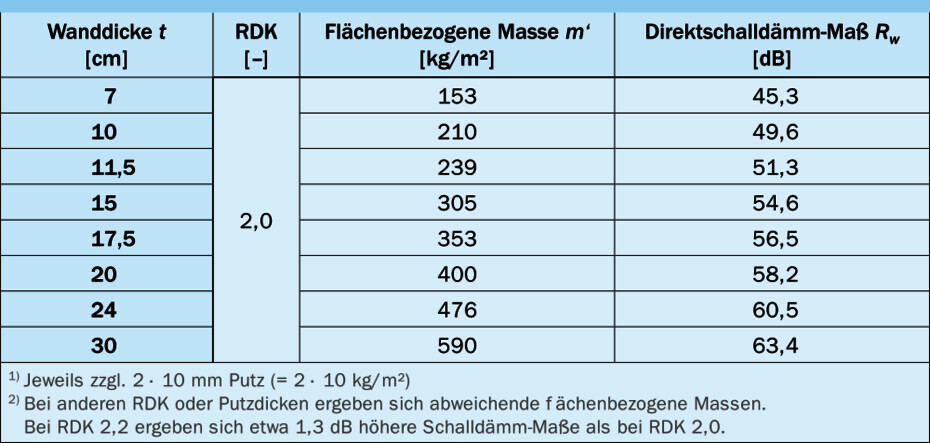
3. The direct sound reduction index Rw for a 24cm (9.5 inches) sand-lime brick is 60.5 dB (see attachment), while for a 24cm (9.5 inches) Poroton hollow brick plan it is 56.1 dB. Is a difference of 4.4 dB significant?
Thanks and best regards!
For a three-story monolithic construction, we are planning our house with a 42.5cm (17 inches) Poroton exterior wall. Either the S7 or S8 version, which is a filled brick with increased web thickness and therefore improved sound insulation, which is important to us.
According to our architect, they generally try to stay with the same material for interior walls because of shrinkage and expansion behavior. However, sand-lime bricks contribute to better sound insulation inside. Therefore, he recommends sand-lime bricks for the load-bearing (24cm (9.5 inches)) and non-load-bearing (11.5cm (4.5 inches) and 17.5cm (7 inches)) interior walls.
I would be interested in your opinions and experiences regarding the following:
1. What are your experiences with the combination of Poroton on the outside and sand-lime bricks on the inside?
2. Are there any special construction measures to be considered when implementing this mixed construction method "Poroton / sand-lime brick" to prevent potential cracking?
3. The direct sound reduction index Rw for a 24cm (9.5 inches) sand-lime brick is 60.5 dB (see attachment), while for a 24cm (9.5 inches) Poroton hollow brick plan it is 56.1 dB. Is a difference of 4.4 dB significant?
Thanks and best regards!
S
sascha-t4-le1 Feb 2024 12:49That exactly happened to us once. Afterwards, I saw the damage that resulted.
The thing is, sand-lime aerated concrete shrinks, whereas fired bricks do not, or only very slightly. At every joint between interior and exterior walls, cracks appeared in the plaster. You could tell from the cracks that the sand-lime aerated concrete wall had moved due to shrinkage.
If you don’t plan to use wallpaper, I would avoid mixing these building materials.
The thing is, sand-lime aerated concrete shrinks, whereas fired bricks do not, or only very slightly. At every joint between interior and exterior walls, cracks appeared in the plaster. You could tell from the cracks that the sand-lime aerated concrete wall had moved due to shrinkage.
If you don’t plan to use wallpaper, I would avoid mixing these building materials.

Alrico1 schrieb:
Hello everyone,
we are planning our house as a 3-story monolithic construction. ... unfortunately only with a single question, although this forum community can offer much more comprehensive help.
Alrico1 schrieb:
1. What are your experiences with the combination of Poroton on the outside and calcium silicate blocks on the inside?
2. Are there any special structural measures to consider when implementing this mixed construction method "Poroton / calcium silicate blocks" to prevent possible cracking? I have no personal experience with this mixed construction method (I am a tenant in a homogeneous pumice block building), but I know it has been widely used by general contractors as well as structural engineers for a long time (which suggests there are no major issues). Structural measures include, for example, mesh tape in the plaster, but also expansion joints, which I personally do not see as a serious problem, especially since they don’t necessarily have to be visually noticeable.
Alrico1 schrieb:
3. The sound reduction index Rw for a 24cm (9.5 inch) calcium silicate block is 60.5 dB (see attachment), while for a 24cm (9.5 inch) Poroton hollow clay block it is 56.1 dB. Is a difference of 4.4 dB significant? The scale is not linear, which can lead to misinterpretation. The practical experience and product data sheets have so little in common that I usually advise my clients to avoid relying on data sheets and instead trust the practitioners – also in the sense of not suggesting them new, unproven methods.
https://www.instagram.com/11antgmxde/
https://www.linkedin.com/company/bauen-jetzt/
A
allstar831 Feb 2024 15:53We have 42.5 cm (17 inches) aerated concrete exterior walls. Inside, we have aerated concrete walls of various thicknesses and calcium silicate brick walls. The calcium silicate brick walls are for the secondary apartment. I find calcium silicate bricks excellent in terms of sound insulation. Next time, I would use them throughout the entire house.
Additionally, we have a soundproof door. It only cost an extra 200€ and works really well. Note that it has a different frame and a bottom seal. Consider this carefully beforehand because everything would need to be replaced.
If you are interested in soundproofing, you should also consider the overall concept, including decoupling of roller shutters and similar elements. You can still hear them throughout the house.
Additionally, we have a soundproof door. It only cost an extra 200€ and works really well. Note that it has a different frame and a bottom seal. Consider this carefully beforehand because everything would need to be replaced.
If you are interested in soundproofing, you should also consider the overall concept, including decoupling of roller shutters and similar elements. You can still hear them throughout the house.
Similar topics