
Hello everyone,
We are currently at the stage in our planning where we have submitted the building notification. The city now states that the terrace roof, being a separate structural element, cannot be included in the calculation of the number of floors. Inclusion is only possible if the roof is clearly part of the house structure, for example, a shed roof or extended ceiling slabs.
Since the building regulations do not allow for two full stories, we wanted to reach that value using this terrace.
Now, my question: Are there any additional options beyond the two mentioned above that would allow this to count toward the living area?
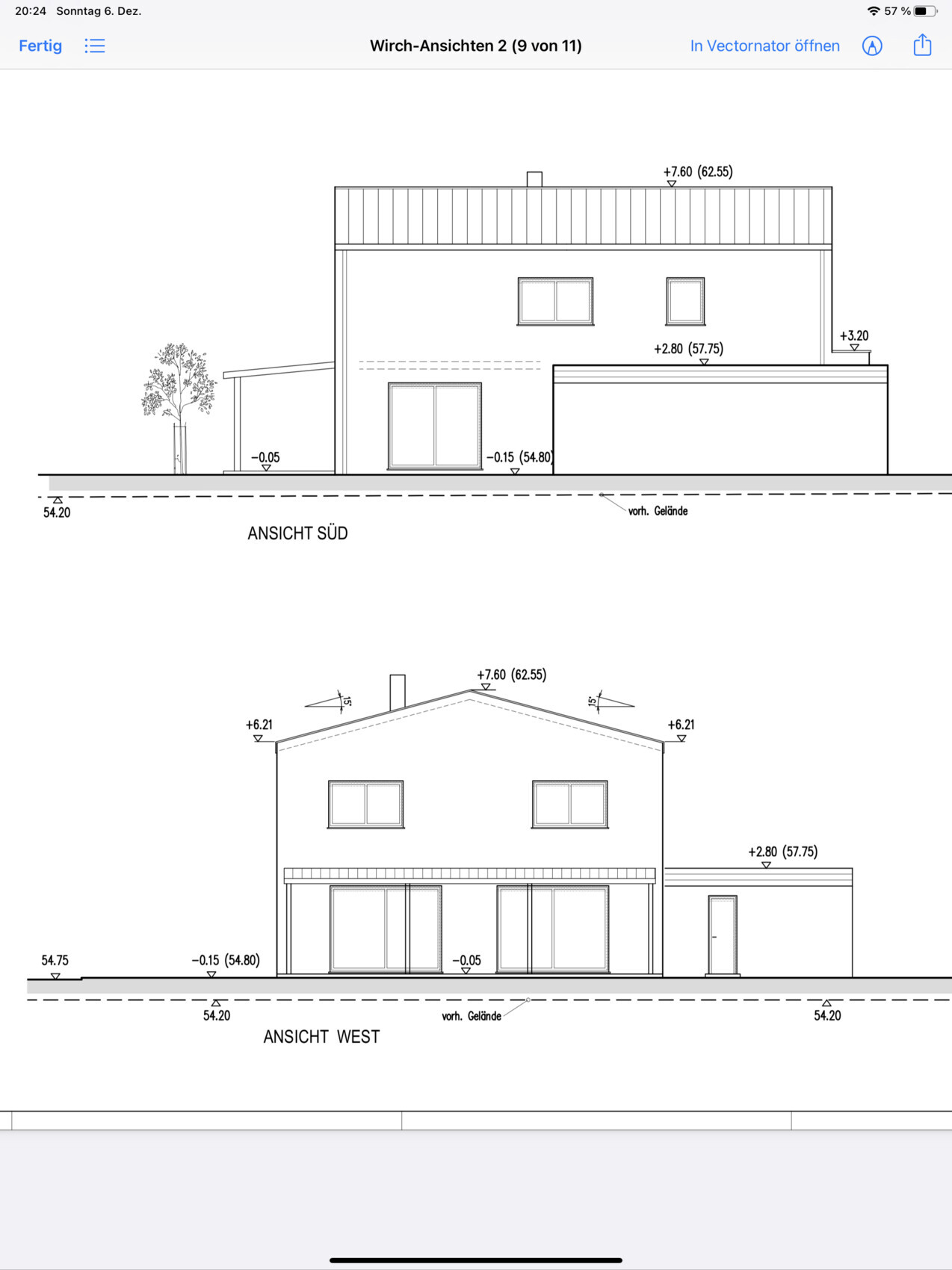
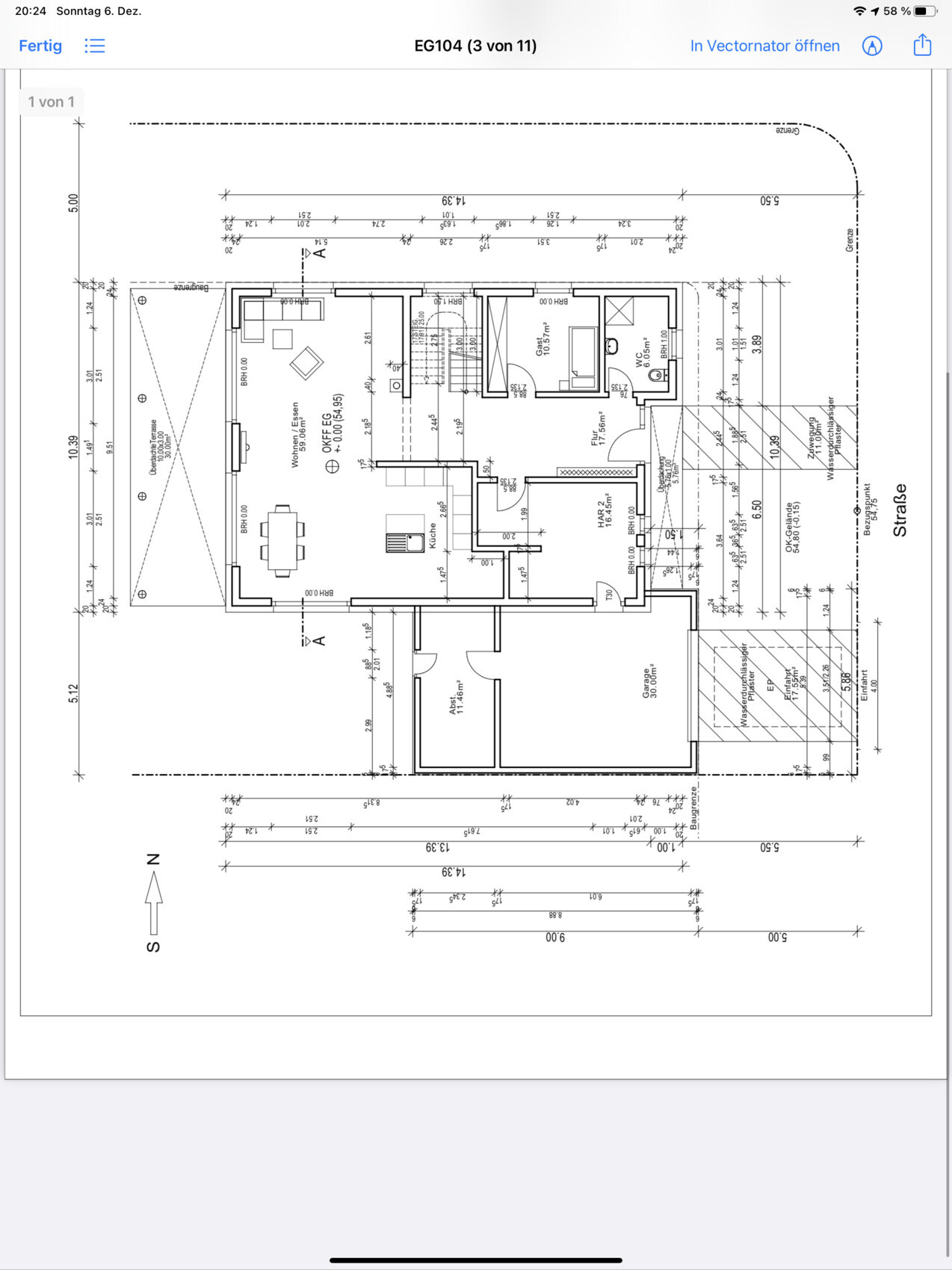
Attached are the floor plan of the ground floor and rear and side elevations.
Regards,
KonstantinW
We are currently at the stage in our planning where we have submitted the building notification. The city now states that the terrace roof, being a separate structural element, cannot be included in the calculation of the number of floors. Inclusion is only possible if the roof is clearly part of the house structure, for example, a shed roof or extended ceiling slabs.
Since the building regulations do not allow for two full stories, we wanted to reach that value using this terrace.
Now, my question: Are there any additional options beyond the two mentioned above that would allow this to count toward the living area?
Attached are the floor plan of the ground floor and rear and side elevations.
Regards,
KonstantinW

sascha-t4-le schrieb:
But no one addresses this. To me, it shows that most people here just state their own opinions without referring to legal texts and their interpretations. I did not find this meaningful here:
sascha-t4-le schrieb:
• Areas of building parts that extend beyond the building’s outer walls, such as balconies, are excluded when calculating the gross floor area; this does not apply if balconies are covered, and it also does not apply to covered terraces. I do not read this as relating to questions about full stories (storeys), but rather about floor area ratio (FAR); as in some countries, it matters if a terrace that extends beyond the building envelope is attached to the house or is “out at sea.”
https://www.instagram.com/11antgmxde/
https://www.linkedin.com/company/bauen-jetzt/
sascha-t4-le schrieb:
I find it surprising that the building permit/planning document does not mention stepped floors. Usually it says d Usually... if the zoning plan already excludes it through other regulations, then there is no need to list it explicitly.
sascha-t4-le schrieb:
Balconies are generally excluded from the calculation of gross floor area; this does not apply if balconies are covered, nor does it apply to covered terraces. This applies to calculations for floor area ratio / plot ratio. Rules for full-height floors must be considered separately.
Although: You are of course right. Without all the information, one can only guess or offer a suggestion. The responsibility lies with the builder or architect.
S
sascha-t4-le9 Dec 2020 12:4011ant schrieb:
I don’t interpret this as referring to the question of full storeys, but rather to plot ratio issues; similar to how in some countries it matters whether a terrace extending beyond the building envelope is attached to the house or “on open water.”I see it differently. This paragraph is copied from a chapter dealing with the definition of full storeys. If you are interested, I can provide the complete interpretation of §2.4.4 below:
2.4.4 The characteristic of being a full storey can also be lost in non-top storeys with pitched roofs. However, the special regulation for setback storeys only applies to the top storey of a building.
If a previously top storey loses this characteristic due to an extension upwards, the special regulation for setback storeys no longer applies. As a result, the maximum number of full storeys legally allowed under planning regulations may be exceeded.
For the definition of storeys, see section 2.3.3.
The “gross floor area of the storey below” is measured according to DIN 277 Part 1 along the outer edges or external surfaces of the building’s enclosing walls or—if the storey has no enclosing walls—along the outer edges or surfaces of the structural elements delimiting the storey. This means:
• Areas of building elements extending beyond the enclosing walls, such as balconies, are not included in the calculation of gross floor area; this does not apply if balconies are covered, nor for covered terraces,
• Areas set back from the external wall alignment, such as loggias, are included in the gross floor area calculation.
Areas of garages integrated into the building are included. Areas of attached garages are excluded from the floor area calculation. Since the concept of a full storey has only planning law significance, whether a garage is integrated depends on the building’s external appearance and not on the technical separation between garage use and other uses.
For attic storeys, a hypothetical plane at a height of 2.30 m (7.5 ft) is established, which is to be related to the gross floor area of the storey below for assessing full storey status. Covered loggias and dormer windows are included in this hypothetical area. Open loggias and roof recesses that are not covered are excluded from the calculation of the hypothetical area.
If there is no “storey below” in the case of an attic storey (e.g., a roof-only house), the calculation is based on the gross floor area of the attic storey itself.
K
KonstantinW27 Jan 2021 15:36So...
after the winter break, there has been some progress.
For those who still want to know.
After consulting with the city, we were informed that the responsible office in our building area decided not to include the terrace roof in the calculation of the number of storeys.
What worked for my sister-in-law was actually a mistake on their part, as they had not paid close enough attention.
We have now decided to replace the terrace roof in the plans with a conservatory, which according to the city will be recognized as habitable space and will count towards the number of storeys.
This way, we meet the required two-thirds ratio, so our house counts as having one full storey.
We also considered setting walls in or out or having only a partial roof, but we eventually discarded those ideas to avoid spoiling the appearance of the house.
after the winter break, there has been some progress.
For those who still want to know.
After consulting with the city, we were informed that the responsible office in our building area decided not to include the terrace roof in the calculation of the number of storeys.
What worked for my sister-in-law was actually a mistake on their part, as they had not paid close enough attention.
We have now decided to replace the terrace roof in the plans with a conservatory, which according to the city will be recognized as habitable space and will count towards the number of storeys.
This way, we meet the required two-thirds ratio, so our house counts as having one full storey.
We also considered setting walls in or out or having only a partial roof, but we eventually discarded those ideas to avoid spoiling the appearance of the house.
H
Hänsel&Gretel2 Aug 2023 00:39sascha-t4-le schrieb:
I see it differently. This excerpt is taken from a chapter dealing with the definition of a full storey. If you are interested, I will include the complete interpretation of §2.4.4 below:
2.4.4 The status of a full storey may also be lost in non-top floors with a pitched roof. In contrast, the privilege for setback storeys applies only to the topmost storey of a building.
If an extension causes the previously top floor to lose this status, the privilege of the setback storey rule no longer applies. This may result in exceeding the number of full storeys permitted under planning regulations.
For the definition of storey see section 2.3.3.
The “gross floor area of the storey below” is determined in accordance with DIN 277 Part 1 by the outer edges or outer surfaces of the enclosing walls of the building, or—if the storey has no enclosing walls—by the outer edges or outer surfaces of the elements that delimit the storey. This means:
• Areas of building parts that extend beyond the enclosing walls of the building, e.g., balconies, are excluded from the calculation of the gross floor area; this does not apply if balconies are covered, nor to covered terraces,
• Areas set back from the outer wall line, e.g., loggias, are included in the calculation of the gross floor area.
Areas of garages integrated within the building are added. Areas of attached garages are disregarded in the area calculation. Since the concept of full storey is relevant only in planning terms, the assessment of whether a garage is integrated depends on the external appearance of the building, not on the structural separation between garage use and other uses.
In the case of roof storeys, the imaginary level determined at a height of 2.30 m (7.5 feet) that is used to relate the full storey status to the gross floor area of the storey below shall include covered loggias and dormers. Loggias and roof recesses that are not covered are excluded when determining the imaginary floor area.
If a roof storey does not have a “storey below” (e.g., a single-roof house), the calculation must be based on the gross floor area of the storey itself. Where (from which source) does this excerpt come from? Thank you!
H
Hänsel&Gretel2 Aug 2023 13:24Hänsel&Gretel schrieb:
Where does this excerpt come from (which manufacturer)? Thank you!Is this, as mentioned at the beginning, really an excerpt from the 2006 HE-HBO (or perhaps a commentary)?Similar topics