
Hello dear members,
Just registered and already have my first question. A brief introduction about us: we are 34 and 30 years old, no children and none planned. We don’t know what the future holds in a few years.
We plan to start building our house, hopefully if the winter weather cooperates, as soon as we finalize the floor plan. Unfortunately, I, Michaela, tend to be a perfectionist (symmetry, etc.). I can’t let it go and want everything to be well thought out and planned, which is starting to annoy me as well.
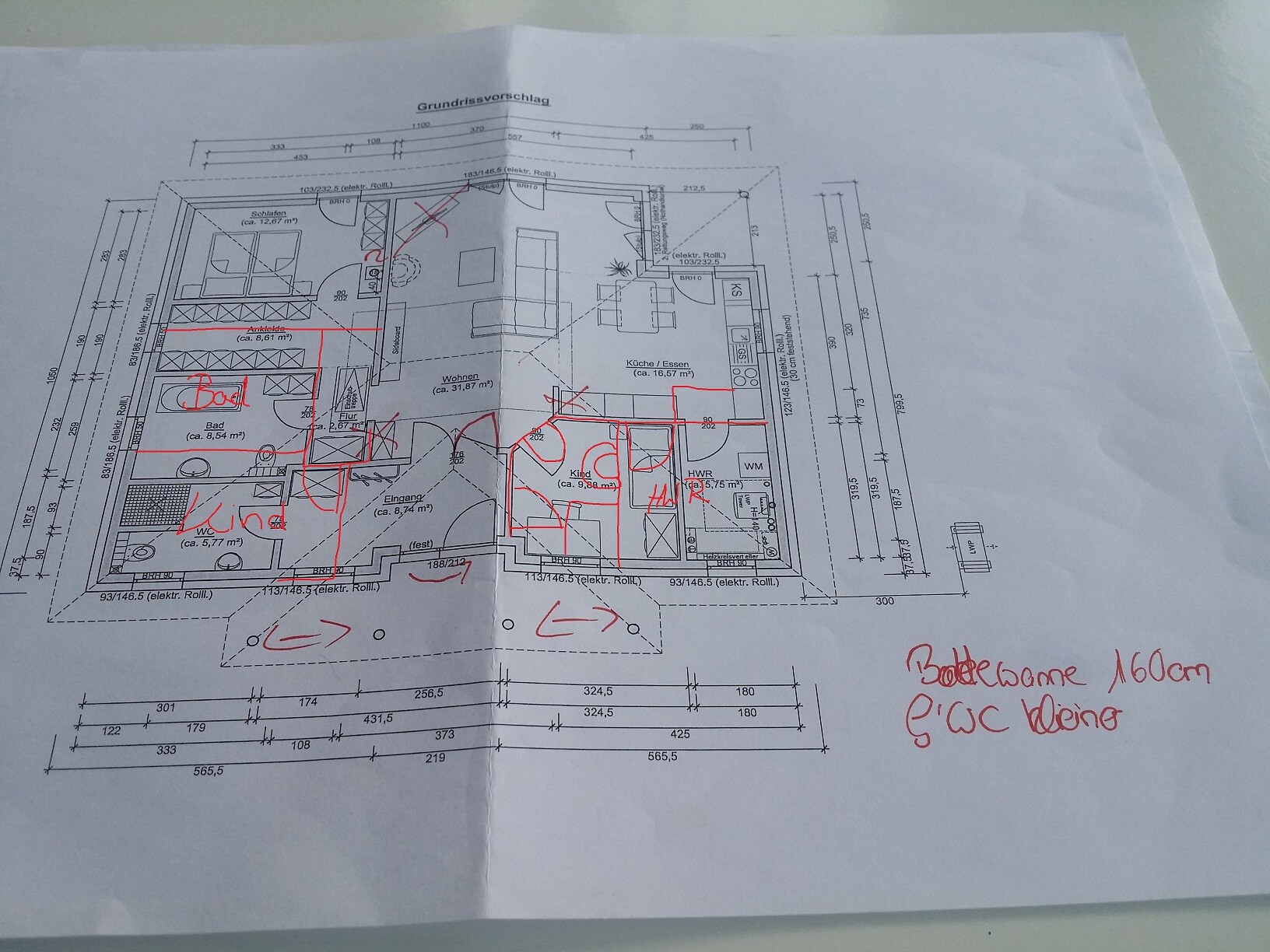
Since we are building rather small, aiming for about 114 m2 (1227 sq ft) of living space and trying not to compromise on anything at this size, the floor plan design is quite challenging. Among other things, we do not want all rooms to be accessible from the hallway, and we also want to keep a covered terrace. The bungalow will consist of only three rooms. Therefore, we want to keep the option open to convert the attic later if needed. In this context, we are planning space for a future space-saving staircase and the necessary preliminary work; at least that is the goal. The bungalow will have a hip roof, with the roof pitch increased from 30 degrees to 34 degrees, and the hallway correspondingly larger. Ideally, we would like a gable dormer. Since those are too expensive, a skylight window would be a compromise. Of course, a larger bungalow would be the best option but it is too costly. The construction company charges about 700.00 euros per m2. In hindsight, working with an architect might have been more cost-effective, but that is how it is and that is not what this is about.
Maybe you have ideas, suggestions, can give tips, or share what we should pay attention to or consider.
I am of course attaching the floor plan. I hope that something can still be recognized despite the manual changes.
I look forward to reading your replies and wish you a nice weekend.
Best regards,
Michaela
Just registered and already have my first question. A brief introduction about us: we are 34 and 30 years old, no children and none planned. We don’t know what the future holds in a few years.
We plan to start building our house, hopefully if the winter weather cooperates, as soon as we finalize the floor plan. Unfortunately, I, Michaela, tend to be a perfectionist (symmetry, etc.). I can’t let it go and want everything to be well thought out and planned, which is starting to annoy me as well.
Since we are building rather small, aiming for about 114 m2 (1227 sq ft) of living space and trying not to compromise on anything at this size, the floor plan design is quite challenging. Among other things, we do not want all rooms to be accessible from the hallway, and we also want to keep a covered terrace. The bungalow will consist of only three rooms. Therefore, we want to keep the option open to convert the attic later if needed. In this context, we are planning space for a future space-saving staircase and the necessary preliminary work; at least that is the goal. The bungalow will have a hip roof, with the roof pitch increased from 30 degrees to 34 degrees, and the hallway correspondingly larger. Ideally, we would like a gable dormer. Since those are too expensive, a skylight window would be a compromise. Of course, a larger bungalow would be the best option but it is too costly. The construction company charges about 700.00 euros per m2. In hindsight, working with an architect might have been more cost-effective, but that is how it is and that is not what this is about.
Maybe you have ideas, suggestions, can give tips, or share what we should pay attention to or consider.
I am of course attaching the floor plan. I hope that something can still be recognized despite the manual changes.
I look forward to reading your replies and wish you a nice weekend.
Best regards,
Michaela
W
winnetou7830 Jul 2017 18:04Oh, that was my question: so the roof and everything is insulated there.
No, no. The roof remains a cold roof. You go upstairs to the attic through an insulated stairwell, stand in a small landing at the top, then there is a door in front of you. When you open it, you enter the cold or, in summer, very warm attic space. This stairwell acts as the insulated separation between the heated living area and the unheated storage space.
So, compared to a hatch, the additional work includes a staircase, an insulated stairwell, and a door at the top instead of a hatch, about 2 meters (6.5 feet) high. The cost in our case was $8,000 compared to the hatch solution. This also included increasing the roof pitch by 10 degrees, from 25 to 35 degrees, a studio instead of a truss, and the floor was finished with tongue-and-groove boards, making it fully walkable. Karsten
So, compared to a hatch, the additional work includes a staircase, an insulated stairwell, and a door at the top instead of a hatch, about 2 meters (6.5 feet) high. The cost in our case was $8,000 compared to the hatch solution. This also included increasing the roof pitch by 10 degrees, from 25 to 35 degrees, a studio instead of a truss, and the floor was finished with tongue-and-groove boards, making it fully walkable. Karsten
W
winnetou7830 Jul 2017 19:14Yes, that's what I meant, but the roof in the entrance area is simply insulated.
So. Since we have now been living in our bungalow (linked here) for three weeks, I can share some experiences with you.
Rooms accessible from the hallway: This is ideal. A bungalow’s advantage is that you can quickly reach every corner from the "center." Whether you prefer the living room to be this center is a matter of taste. Since we have a small son, I’m very glad that he walks through the hallway with his muddy boots instead of through the living room. Plus, I don’t have to carry my dirty laundry through the living room to the washing machine. Especially when guests are there and I need to start a load quickly, this is very convenient. Muddy boots also tend to end up disappearing in the utility room.
Utility room: Yours is far too small. In a bungalow (especially if built without a basement), you need to carefully plan storage for the ironing board and other items. Your utility room will be full with technical equipment and the washing machine. Allow at least 3 additional square meters (about 32 square feet) so you can move around comfortably.
Guest toilet: Having a shower is nice (but you should still invest in a second one for the main bathroom!), but its location is inconvenient for you. The guest room and guest toilet should be next to each other. Here, however, your door opens into the living room. So guests (or later children) always have to walk through the living room with their belongings to use the shower. My suggestion: move the children’s room to the left side.
Walk-in closet: This is really a matter of preference. Personally, I think walk-in closets are wasted space. Others swear by them. I would rather have a larger bedroom and a spacious wardrobe. I would convert that door into a double window. You won’t be using that as a garden exit. Nobody wants to bring dirt into the bedroom.
Pull-down attic ladder: It’s positioned very tightly. If the dimensions allow, place it in the hallway. Otherwise, you awkwardly have to edge along the walls. My parents have the same problem. Poorly planned.
Attic conversion: Either you build a bungalow or a one and a half / two-story house. You should choose one and do it properly. Intermediate solutions are problematic. An attic planned for conversion needs to be insulated from the start (otherwise, with a hip roof it’s no fun at all). That costs money, even if you may never use it. The great thing about a bungalow is that if, in ten years, you urgently need more space, you can always remove walls, rearrange, and finally add access to the attic. Then it will be a coherent and well-designed concept.
My suggested changes: Remove the walk-in closet and add half its area to the bedroom. Then move the bathroom forward. Swap the guest toilet with the children’s room. The whole layout should be adjusted so the children’s room is at least 12 square meters (about 129 square feet). From our experience, this is enough for one child. It may be necessary to make the house slightly larger. One meter (about 3 feet) deeper makes a big difference.
The guest toilet would then have its entrance from the hallway (which will be slightly reduced). This makes it possible to enlarge the utility room, and if you move the door to this room to the left, you can arrange the kitchen in an L-shape. I sketched it out once.
Rooms accessible from the hallway: This is ideal. A bungalow’s advantage is that you can quickly reach every corner from the "center." Whether you prefer the living room to be this center is a matter of taste. Since we have a small son, I’m very glad that he walks through the hallway with his muddy boots instead of through the living room. Plus, I don’t have to carry my dirty laundry through the living room to the washing machine. Especially when guests are there and I need to start a load quickly, this is very convenient. Muddy boots also tend to end up disappearing in the utility room.
Utility room: Yours is far too small. In a bungalow (especially if built without a basement), you need to carefully plan storage for the ironing board and other items. Your utility room will be full with technical equipment and the washing machine. Allow at least 3 additional square meters (about 32 square feet) so you can move around comfortably.
Guest toilet: Having a shower is nice (but you should still invest in a second one for the main bathroom!), but its location is inconvenient for you. The guest room and guest toilet should be next to each other. Here, however, your door opens into the living room. So guests (or later children) always have to walk through the living room with their belongings to use the shower. My suggestion: move the children’s room to the left side.
Walk-in closet: This is really a matter of preference. Personally, I think walk-in closets are wasted space. Others swear by them. I would rather have a larger bedroom and a spacious wardrobe. I would convert that door into a double window. You won’t be using that as a garden exit. Nobody wants to bring dirt into the bedroom.
Pull-down attic ladder: It’s positioned very tightly. If the dimensions allow, place it in the hallway. Otherwise, you awkwardly have to edge along the walls. My parents have the same problem. Poorly planned.
Attic conversion: Either you build a bungalow or a one and a half / two-story house. You should choose one and do it properly. Intermediate solutions are problematic. An attic planned for conversion needs to be insulated from the start (otherwise, with a hip roof it’s no fun at all). That costs money, even if you may never use it. The great thing about a bungalow is that if, in ten years, you urgently need more space, you can always remove walls, rearrange, and finally add access to the attic. Then it will be a coherent and well-designed concept.
My suggested changes: Remove the walk-in closet and add half its area to the bedroom. Then move the bathroom forward. Swap the guest toilet with the children’s room. The whole layout should be adjusted so the children’s room is at least 12 square meters (about 129 square feet). From our experience, this is enough for one child. It may be necessary to make the house slightly larger. One meter (about 3 feet) deeper makes a big difference.
The guest toilet would then have its entrance from the hallway (which will be slightly reduced). This makes it possible to enlarge the utility room, and if you move the door to this room to the left, you can arrange the kitchen in an L-shape. I sketched it out once.
 Michaela198631 Jul 2017 11:18
Hello everyone,
First of all, thank you very much for the responses.
I will take my time to read everything carefully later.
Wishing you a great start to the new workweek.
Best regards
First of all, thank you very much for the responses.
I will take my time to read everything carefully later.
Wishing you a great start to the new workweek.
Best regards
Similar topics