
Hello everyone,
finally, we have reached an important step… the plot is signed for.
We want to build with an architect and already have some ideas about what we like and what we don’t.
We definitely want to give the architect the opportunity to apply their expertise regarding the floor plan… maybe they can convince us.
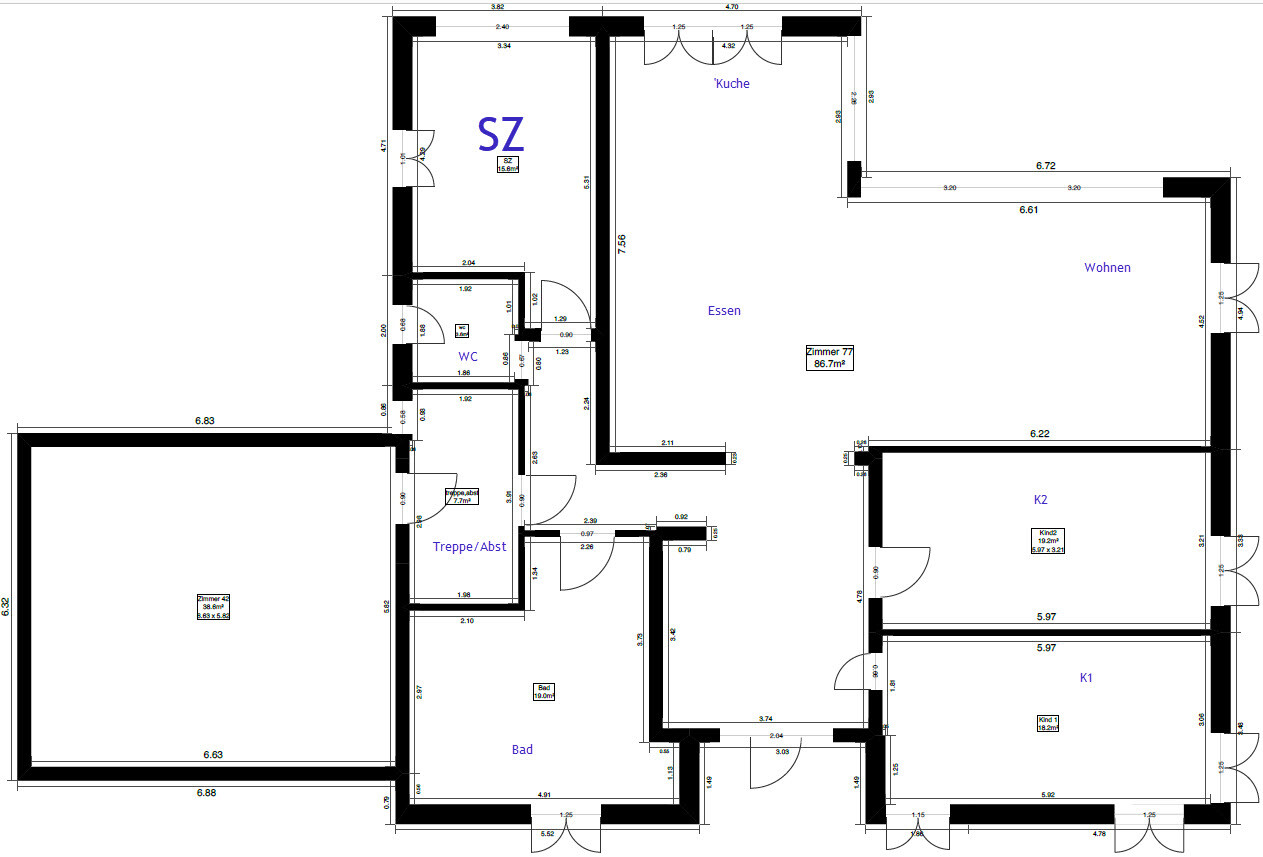
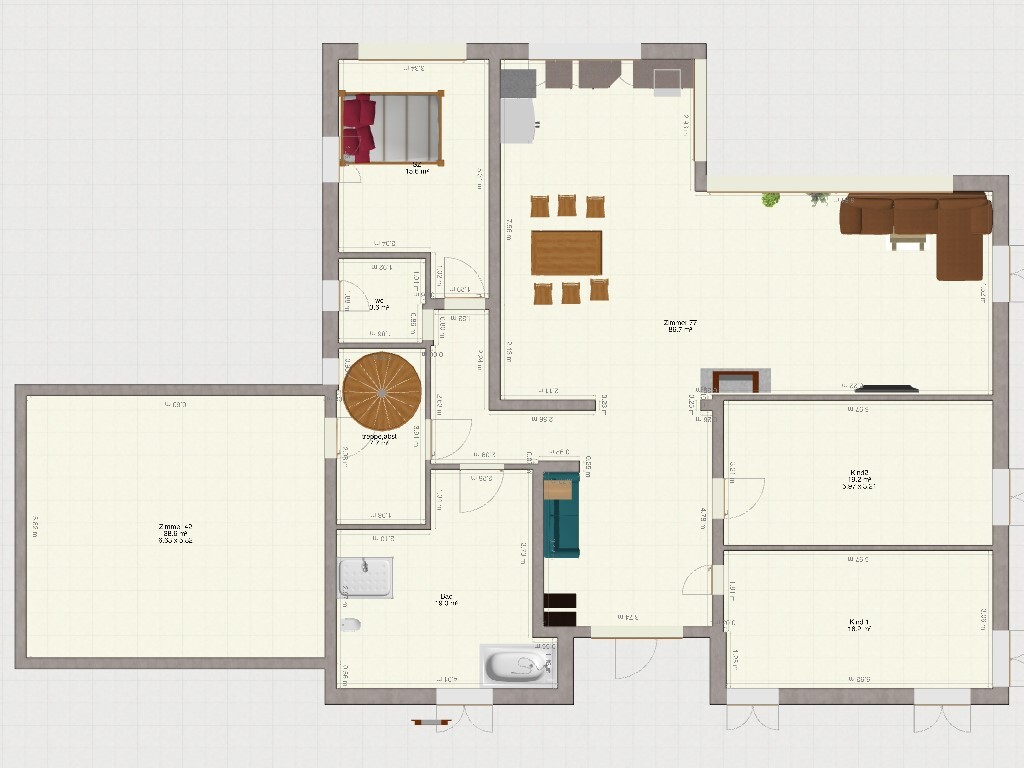
But if not, we are currently (almost) quite happy with this self-drawn floor plan.
A few key facts…
Plot size: 660 sqm (about 7100 sq ft), floor area ratio 0.4, no slope, approximately 26m x 25m (85 ft x 82 ft)
Longest building side allowed: max. 15m (about 49 ft)
L-shaped bungalow with covered terrace (southwest side)
We want to build with a basement. This should have windows with natural daylight behind the garage on the east side. There will be 2–3 living rooms down there (playroom, hobby room, later for the kids or grandparents if necessary).
The roof will not be converted into a living space — 20-22° (degrees) pitch, hip roof, for aesthetic reasons.
We know that a basement is more expensive than a second floor, etc. The budget is roughly 650,000–700,000 (currency).
Utility room, laundry room, sauna, etc. will all be located in the basement since there is enough space. 🙂
Now to the floor plan:
We like an open design with a large entrance area.
What we like about this floor plan:
Children’s area separated from parents
Connection from the garage with access to the storage room and basement
Access from kitchen and living room to the terrace possible
Master bedroom with direct view of the garden on the southeast side (in summer the shutters are closed anyway)
Children’s rooms with windows facing west, slightly southwest.
Open questions…
Are the children’s rooms too narrow at almost 3m (about 10 ft)?
Is the living room too narrow at almost 4.5m (about 15 ft)?
The L-shape at the terrace is about 3m (10 ft) deep — here we could possibly adjust a bit to enlarge the children’s rooms.
My wife doesn’t like that the kitchen is visible directly from the entrance area.
(I prefer the kitchen visibility over the living room couch). What do you think is better or worse?
The kitchen window is on the south side, possibly too much sun… maybe we should add an awning if needed.
I can’t fit a second toilet elsewhere without making the children’s rooms even smaller… so it will remain a guest toilet for the parents.
Is a door between the entrance area and the living area for a windbreak useful, or unnecessary? (We have underfloor heating.)
(Maybe a hidden interior door, but I’m unsure what happens if it gets damaged.)
The floor area ratio will be tight… 15m x 15m = 225 sqm (about 11,200 sq ft) + garage + driveway… we might need to reduce the width a bit.
660 sqm x 0.4 = 264 sqm (about 2,840 sq ft).
I have seen many floor plans here… wishes and practicality have to match somewhere.
I’m really curious about the experts’ opinions…
Is it rubbish or usable?
Thanks
finally, we have reached an important step… the plot is signed for.
We want to build with an architect and already have some ideas about what we like and what we don’t.
We definitely want to give the architect the opportunity to apply their expertise regarding the floor plan… maybe they can convince us.
But if not, we are currently (almost) quite happy with this self-drawn floor plan.
A few key facts…
Plot size: 660 sqm (about 7100 sq ft), floor area ratio 0.4, no slope, approximately 26m x 25m (85 ft x 82 ft)
Longest building side allowed: max. 15m (about 49 ft)
L-shaped bungalow with covered terrace (southwest side)
We want to build with a basement. This should have windows with natural daylight behind the garage on the east side. There will be 2–3 living rooms down there (playroom, hobby room, later for the kids or grandparents if necessary).
The roof will not be converted into a living space — 20-22° (degrees) pitch, hip roof, for aesthetic reasons.
We know that a basement is more expensive than a second floor, etc. The budget is roughly 650,000–700,000 (currency).
Utility room, laundry room, sauna, etc. will all be located in the basement since there is enough space. 🙂
Now to the floor plan:
We like an open design with a large entrance area.
What we like about this floor plan:
Children’s area separated from parents
Connection from the garage with access to the storage room and basement
Access from kitchen and living room to the terrace possible
Master bedroom with direct view of the garden on the southeast side (in summer the shutters are closed anyway)
Children’s rooms with windows facing west, slightly southwest.
Open questions…
Are the children’s rooms too narrow at almost 3m (about 10 ft)?
Is the living room too narrow at almost 4.5m (about 15 ft)?
The L-shape at the terrace is about 3m (10 ft) deep — here we could possibly adjust a bit to enlarge the children’s rooms.
My wife doesn’t like that the kitchen is visible directly from the entrance area.
(I prefer the kitchen visibility over the living room couch). What do you think is better or worse?
The kitchen window is on the south side, possibly too much sun… maybe we should add an awning if needed.
I can’t fit a second toilet elsewhere without making the children’s rooms even smaller… so it will remain a guest toilet for the parents.
Is a door between the entrance area and the living area for a windbreak useful, or unnecessary? (We have underfloor heating.)
(Maybe a hidden interior door, but I’m unsure what happens if it gets damaged.)
The floor area ratio will be tight… 15m x 15m = 225 sqm (about 11,200 sq ft) + garage + driveway… we might need to reduce the width a bit.
660 sqm x 0.4 = 264 sqm (about 2,840 sq ft).
I have seen many floor plans here… wishes and practicality have to match somewhere.
I’m really curious about the experts’ opinions…
Is it rubbish or usable?
Thanks
I
Iotafreak6 Apr 2021 23:00Sounds interesting. Flat roofs are not allowed here, and as I mentioned, we prefer a different look. Having the master bedroom on a different floor than the children's rooms is probably only feasible when the kids are teenagers... right now that wouldn’t work. Also, I don’t want to have to go up the stairs to the bedroom every time. Thanks anyway.
Hangman schrieb:
It’s not about cost, and nobody wants to take away your bungalow—both are well deserved.
However, you inevitably cover a lot of ground area, reducing your plot space (and 660 square meters (7,100 square feet) is not that big), and you end up with the typical bungalow issues of having a lot of traffic space and little natural light inside. The basement doesn’t improve this... on the contrary: if it doesn’t work well on the ground floor, how should a light well or light courtyard illuminate the basement? It will be like a cave!
How about a Bungalow 2.0: a long building with a steeper pitched roof, and a sauna, relaxation room (library), etc. in the attic? Maybe with an open space connecting to the living area. If you want an L-shape, you could add a glazed flat-roofed cube extending into the garden. This could serve as an upper terrace with a view and access from the sauna. So, only about 120-140 square meters (1,300-1,500 square feet) downstairs, and another 40-50 square meters (430-540 square feet) of luxury upstairs with the master bedroom and wellness area? That way you would also keep much more of the beautiful plot with the nice view?
I
Iotafreak6 Apr 2021 23:04Thank you...
I understand all the points.
Great information.
I understand all the points.
Great information.
haydee schrieb:
Especially during the self-planning phase, always draw all rooms to scale including the existing or desired furniture. This way, you can best see where the personal tight spots are for you.
Does the bookshelf fit, the shoe cabinet, the dream sofa?
In many floor plans, dollhouse furniture is shown, and the dining area fits in every camper van.
Regarding your floor plan
Bedroom: Try drawing in a wardrobe in the size you want. And don’t just say, well, then the suits will go to the basement.
Guest WC in the private area
Family bathroom is extremely large
Children’s rooms are not in the private area at all. You always have to go through the large hallway. The bedroom orientation would be better for this. K2 is a bit dark.
The open plan living area is large but won’t feel spacious and bright.
Hallway wardrobe directly at the door will almost always look untidy.
Hallway to the basement and bathroom is rather narrow and dark.
Staircase to the basement will not be easy to use.
I
Iotafreak6 Apr 2021 23:09Yes, I am a bit concerned that the architect might design everything according to their own ideas and vision. However, our wishes should come first, as long as they are feasible. I want to give the architect something to at least get an idea of what we have in mind. For that, I now have to start over... 🙂 If I can get all the rooms on one level, why should I build in a way that later, when the kids are energetic, I still have to run up to the second floor? Why not combine everything now? The plot allows it.
11ant schrieb:
Thank goodness not – compared to this example, one can almost speak of a "clear" design here; the Weiß Vita is no longer a traditional L-shaped bungalow, but more of a complex-shaped bungalow. Besides, I think that being in your mid-thirties with young children, you never think about the time after the kids or even "old age." There is no guarantee that ailments would even start with arthritis – so looking for a solution by avoiding stairs is rather questionable wisdom. By the way, you won’t be fit at ninety sitting in a chair ;-)
Anyway – not just the exact floor plan, but also the bungalow concept! – don’t get too attached too quickly, and first give the architect a chance. For the extra cost of a hip roof on an L-shaped bungalow, you could have a car by the time the kids finish school.
I
Iotafreak6 Apr 2021 23:17Absolutely. It’s nice to hear that someone understands our concept with the basement. Interesting ideas from you. I will try them out tomorrow to see how it looks. If you have time, feel free to sketch it out roughly so I can fully grasp your thought process. I agree with all the other points.
Thank you
Thank you
hampshire schrieb:
I like bungalows and can easily relate to the argument. With a basement, I don’t feel the need to maintain it the same way as an upper floor, which brings peace of mind.
The design gives the impression that it was planned from an external shape inward, rather than starting with internal needs and planning outward.
Where do guests go to the toilet? Almost into the most private area and nearly through the entire house. I think this is handled poorly.
How do the children get to the bathroom and back? They always have to pass through areas where "strangers" might be present. The little one might not mind, but teenagers will probably find it uncomfortable – and some guests too…
How do groceries get to the kitchen? Always past the dining area on a long route. This makes daily circulation more complicated and ultimately harder to keep clean. I find that impractical.
The bedroom becomes cramped if you want to store an average amount of clothing there as well.
I find the large entrance area successful as a cloakroom and as a possible visual highlight.
If you want to keep the angled bungalow design, try these adjustments: entrance off-center, living area arranged lengthwise towards the garden instead of across it, staircase, WC and entrance hall located close to each other, private rooms with private access.
As much as the separation of the master bedroom from the children’s rooms is nice at a certain age, this feature disrupts the layout of your floor plan significantly. Peace and a sense of privacy can also be achieved in adjacent rooms with some additional architectural effort.
Iotafreak schrieb:
Yes, I’m a bit worried that the architect will design everything based on his own ideas and preferences. Well, he’s just doing his job: building homes for clients. You wouldn’t take a bread recipe to a baker!
Iotafreak schrieb:
But our wishes should come first... Yes, he knows that. After all, he’s the professional.
Iotafreak schrieb:
I want to give the architect something so he at least gets an idea of what we have in mind... but now I have to start over... 🙂 You write a room program, which should also be explained in the pinned posts on how to do it—like what you envision: spacious, bright, preferably a hip roof, everything on one level, two children, no need for a walk-in closet, and so on.
Then you discuss the draft together, you ask questions, he explains, etc., and then he revises it.
But if you just hand him something, the professional will usually give it to his assistant or intern to redraw—along with all the mistakes you included. And then I say: goodbye money, it’s wasted.

If practicing drawing houses helps you overcome your nerves before the meeting with the architect, then go ahead. But remember, the architect is not an opponent you have to fiercely defend your bungalow against. It is far from certain that their design will conflict with your ideas. Give them a fair chance to surprise you. During the last two to three weeks before the architect meeting, try to stay passive here—that is, avoid your own thread (and thus also the subdiscussion about resistance to advice) and only share any interim drawings you make after the architect has provided their input.
https://www.instagram.com/11antgmxde/
https://www.linkedin.com/company/bauen-jetzt/
https://www.instagram.com/11antgmxde/
https://www.linkedin.com/company/bauen-jetzt/
Similar topics