
ᐅ Installed windows do not match the window schedule. Is this a valid complaint?
Created on: 1 Jun 2016 00:17
T
taeps1984
Hello everyone,
Attached you can see our issue. In the living room (ground floor) we have corner glazing with a corner support cladding. On the front garden side in the living room (ground floor) there are two larger fixed floor-to-ceiling window units. Above them is the children’s room with two smaller windows with tilt-and-turn function. The windows on the ground floor and upper floor, as well as their central window frames, are supposed to be aligned with each other. At least, according to the window plan.
The as-built rough openings actually correspond to the floor plan. However, the windows are not aligned with each other. I don’t like the external appearance because the central frames are not aligned and do not match the elevations or the window plan. From the outside, it looks poorly planned and simply not nice. The floor plan states for the corner glazing in the living room (ground floor), “corner support cladding support depending on structural engineering.” Does this note release the builder from responsibility? Do the upper and lower window units not have to match the window plan or the elevations because the corner support cladding is decisive, or are the elevations and window plan binding?
Shouldn’t the window installer or builder have taken the elevations into account during the measurement of the rough openings (for window production) and manufactured the windows accordingly to ensure that the look of the window plan/elevations is maintained? At that time, the structural engineering for the corner support cladding was already confirmed, wasn’t it?
In other words: Would you insist on the alignment of the two windows, or am I out of luck here?
Thanks in advance!!!
Good luck Manuel
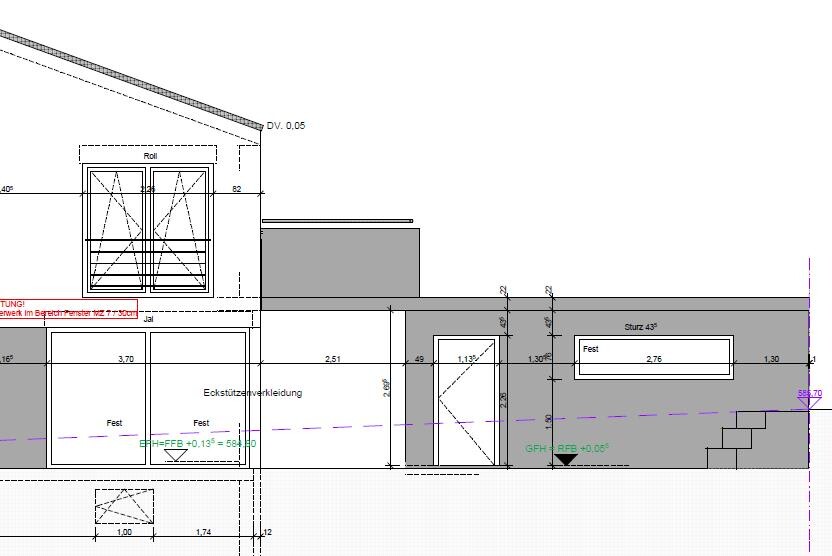
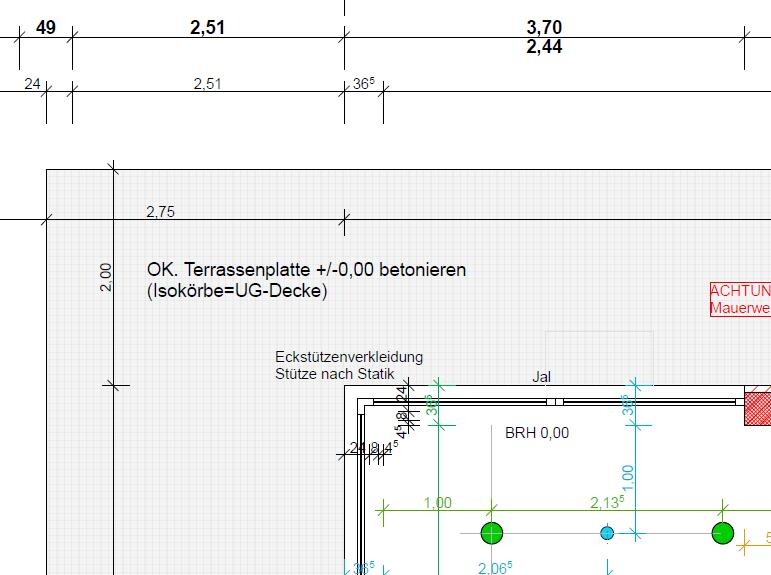
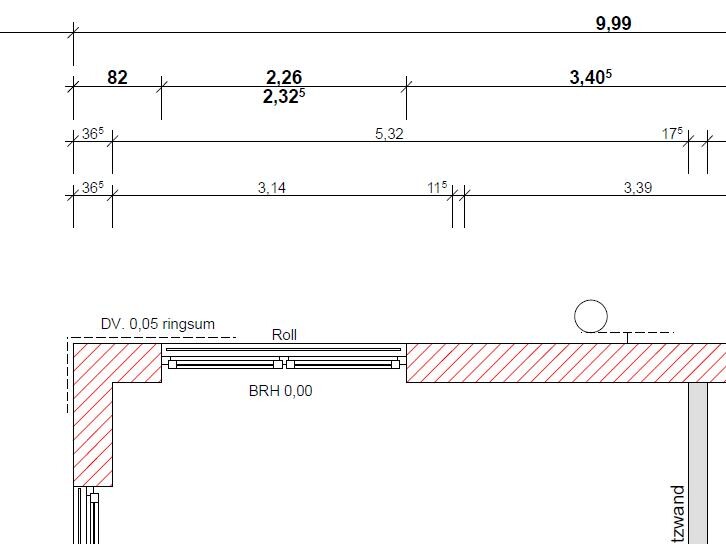
Attached you can see our issue. In the living room (ground floor) we have corner glazing with a corner support cladding. On the front garden side in the living room (ground floor) there are two larger fixed floor-to-ceiling window units. Above them is the children’s room with two smaller windows with tilt-and-turn function. The windows on the ground floor and upper floor, as well as their central window frames, are supposed to be aligned with each other. At least, according to the window plan.
The as-built rough openings actually correspond to the floor plan. However, the windows are not aligned with each other. I don’t like the external appearance because the central frames are not aligned and do not match the elevations or the window plan. From the outside, it looks poorly planned and simply not nice. The floor plan states for the corner glazing in the living room (ground floor), “corner support cladding support depending on structural engineering.” Does this note release the builder from responsibility? Do the upper and lower window units not have to match the window plan or the elevations because the corner support cladding is decisive, or are the elevations and window plan binding?
Shouldn’t the window installer or builder have taken the elevations into account during the measurement of the rough openings (for window production) and manufactured the windows accordingly to ensure that the look of the window plan/elevations is maintained? At that time, the structural engineering for the corner support cladding was already confirmed, wasn’t it?
In other words: Would you insist on the alignment of the two windows, or am I out of luck here?
Thanks in advance!!!
Good luck Manuel
B
Bieber08151 Jun 2016 20:48Bauexperte schrieb:
To me, it looks like the shell builders made a mistake with your 8 cm (3 inches). I would have thought so too, but:
taeps1984 schrieb:
Now the shell openings actually match the floor plan. Besides, it should have been noticed before installing the windows (since measurements are double-checked).
So: Are you sure the shell construction is correct?
B
Bauexperte1 Jun 2016 22:03Bieber0815 schrieb:
I would have thought so too, but:
Besides, it would have been noticed before installing the window (since measurements are double-checked ).
So: Are you sure the shell construction dimensions are correct? I do not doubt that the shell construction dimensions are correct. If that were the case, the original poster would have certainly mentioned it.
I assume that the window opening was left out in the wrong place (measured -8 cm (3 inches) from side x).
Bauexperte
B
Bieber08151 Jun 2016 22:56Bauexperte schrieb:
I do not doubt at all that the shell construction dimensions are correct. [...] I assume that the window opening was omitted in the wrong place [...] To me, that is a contradiction.Bauexperte schrieb:
A defect only becomes one _after_ the final inspection; until then, it is simply an error that needs to be corrected. 1.
Poor workmanship remains poor workmanship – and therefore a "defect." Both before and after the final inspection.
The final inspection is merely the point when the legal nature of a claim regarding "defects" changes from a performance obligation to a warranty obligation.
In other words: With serious defects before final inspection, as the contractor, I may not yet have "fulfilled" the contract; after final inspection, it becomes a warranty claim (where the burden of proof shifts after acceptance).
2.
The first question here is whether extensive corrective work can also be required for (visual) defects – or if that would be disproportionate:
§ 635 III German Construction Code (Baugesetzbuch)
The contractor may refuse to perform remedial work without prejudice to § 275 paragraphs 2 and 3 if it is only possible with disproportionate costs.
This means:
If a contractor refuses to fix defects due to disproportionately high effort (§ 635 paragraph 3 Baugesetzbuch), they are still liable to the client for damages caused by the defect.
However, the client cannot claim damage compensation equivalent to the cost of the defect repair but only for the reduction in the property’s value. To avoid contradiction, case law provides that damages for disproportionately high repair costs should not be claimed based on repair costs (which would also be disproportionate!). Instead, in this case, the client can only calculate damages based on the decrease in market value.
3.
Bauexperte schrieb:
I assume that the window opening was left in the wrong place (8 cm [3 inches] off from side x).If this is the case, it is not a planning error but an execution error.
Then it is not only a visual defect but actually affects measurements: one wall segment is 8 cm (3 inches) too long, the other 8 cm (3 inches) too short. For example, do the 82 cm (32 inches) shown on the first drawing for the upper floor as the wall width at the corner match? Or was the lower floor window shifted to the right? No measurements are given there.
In any case: this is not how the original poster (OP) created the drawings; they show consistent alignment lines.
Does the contract include a clause on the precedence or binding nature of drawings?
4.
The key question is: Is corrective work disproportionate?
It depends....
If the overall balancing of interests shows that appearance is of secondary importance and the defect does not impair function, the contractor can more easily refuse corrective work than if the client’s interest also includes a visually perfect result. This would be the case, for example, with high-end projects or special mention in the contract. For instance, even a slight color variation was considered a defect when purchasing a new car.
B
Bauexperte1 Jun 2016 23:35Bieber0815 schrieb:
For me, this is a contradiction. The opening in the masonry for the window is correct; the element measuring 2.26 m by 2.135 m (7 ft 5 in by 7 ft) can be installed.
According to the manually created attachment, the green window represents the planned design, while the red window shows the actual condition.
Bauexperte
The main issue seems to be that the wall openings were known and presumably correctly made
and
What was not known, and apparently was only determined later by the window installer or someone else ????, is the width of the corner support. In the remaining ground floor section, the window was split again. However, the center point of the two doors shifted further to the right according to the plan (to the left in the view below) due to the widening of the corner support, resulting in this outcome.
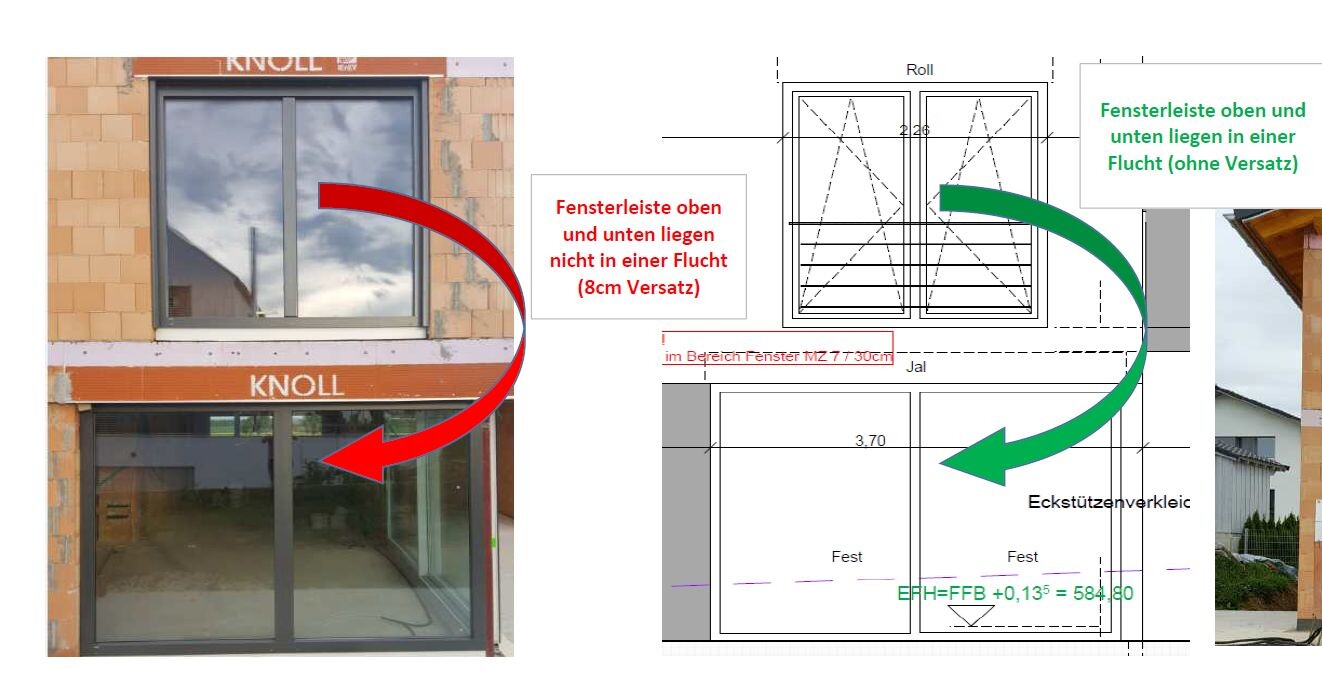
In my opinion, what was missing here was the correct calculation of the corner support and THEN the precise planning of the window opening positions.
The question is, who could have calculated the corner support and when, and whose responsibility it would have been. Based on the drawings, I would say something additional would have needed to be agreed upon, since the drawing explicitly states that the corner support is to be calculated by structural engineering. Therefore, it could be wider or narrower than shown.
and
What was not known, and apparently was only determined later by the window installer or someone else ????, is the width of the corner support. In the remaining ground floor section, the window was split again. However, the center point of the two doors shifted further to the right according to the plan (to the left in the view below) due to the widening of the corner support, resulting in this outcome.
In my opinion, what was missing here was the correct calculation of the corner support and THEN the precise planning of the window opening positions.
The question is, who could have calculated the corner support and when, and whose responsibility it would have been. Based on the drawings, I would say something additional would have needed to be agreed upon, since the drawing explicitly states that the corner support is to be calculated by structural engineering. Therefore, it could be wider or narrower than shown.
Similar topics