
ᐅ Waterproofing of below-ground building components in contact with soil
Created on: 9 Feb 2020 13:34
K
kinderpingui
Hello,
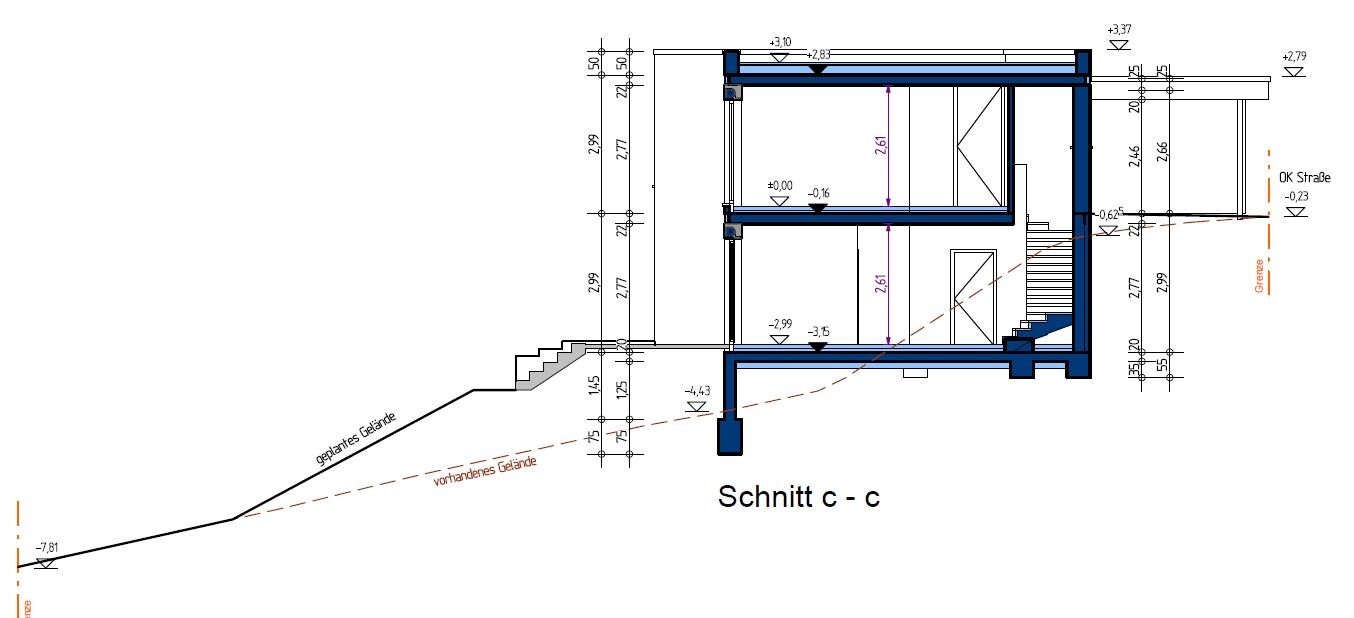
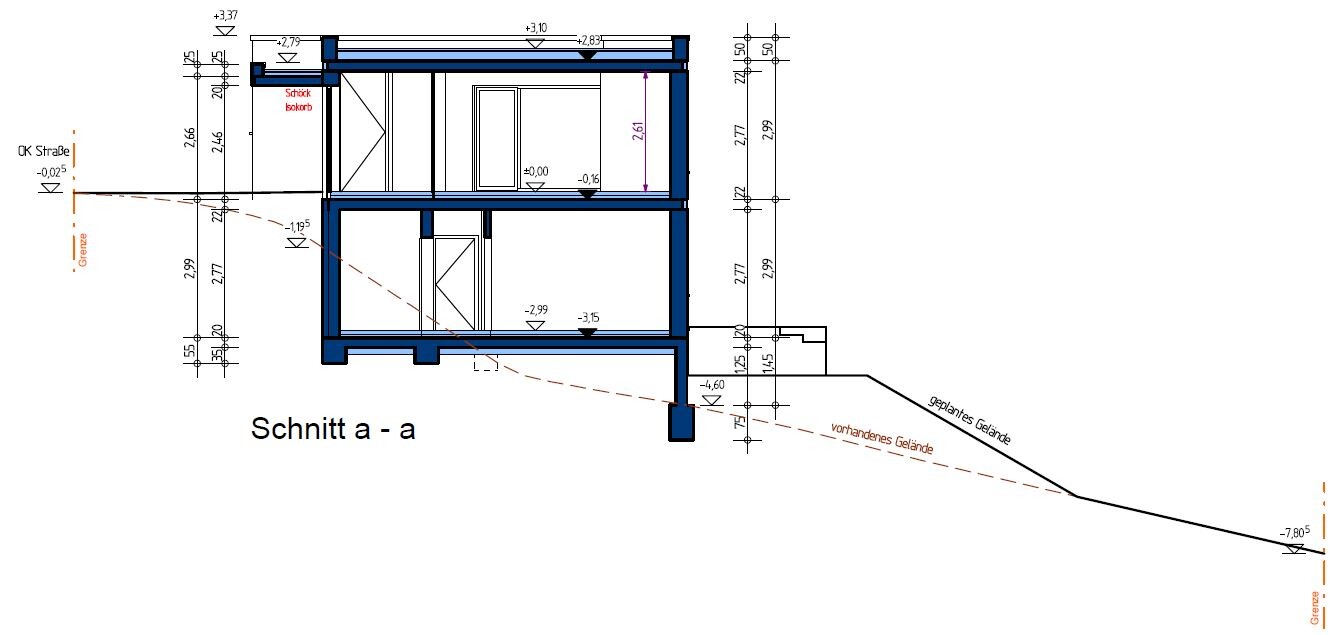
we are building a two-story single-family house on a steep hillside facing the valley, where the basement level is partially underground at the rear. To illustrate, I have attached a cross-section image.
According to an older geotechnical report, the following statement applies:
Notes on building waterproofing:
Building parts that are used intensively and embedded in the soil (basement rooms) must be permanently protected against moisture from the ground. The waterproofing requirements depend on the moisture exposure. The revised version of DIN 18195-4 published in August 2000 introduced a new classification of moisture load cases. A distinction is now made between ground moisture, non-pressurized seepage water, temporarily pressurized seepage water, and groundwater under pressure. The assumption for the “ground moisture” load case according to DIN 18195 Part 4 requires very high permeability (kf > 10-4 m/s) of the natural soil and the backfill in the work area.
Due to the cohesive nature of the soils found in the investigation area (clayey soil) and the significantly lower permeability associated with this, basement buildings must expect surface water accumulation and possibly groundwater buildup in the work area backfill (the so-called “bathtub effect”). In such cases, waterproofing according to DIN 18195 Part 6 is generally required.
If the accumulation of seepage water in the backfilled work area is prevented by drainage conforming to DIN 4095, whose long-term functionality is ensured, the base slab and external walls may also be waterproofed in soils with kf less than or equal to 10-4 m/s according to DIN 18195 Part 4, taking into account the following recommendations:
Surface drainage in front of the wall (e.g., drainage boards made of bitumen-bonded polystyrene beads or drainage mats made of plastic studded sheets) and perimeter drainage at the foundation must be installed with appropriate quality. This also includes:
- Ensuring a functioning discharge system
- Construction of sufficient inspection chambers
- Annual inspection of the drainage system’s functionality
According to the general contractor’s construction description, the following measures are planned:
Horizontal moisture barrier:
- On the concrete floor slab: a complete bitumen torch-on membrane G200 S4 Aluminum or “Knauf waterproofing membrane Katja Sprint” or equivalent.
- Plastic film / bitumen torch-on membrane under masonry walls erected on the floor slab to protect against rising damp.
- Waterproof slurry under concrete walls erected on the floor slab to protect against rising damp.
Vertical moisture barrier against “non-pressurized water”:
At the outside of the earth-contacting, unplastered shell exterior walls (reinforced concrete):
For example, Ceresit BT21 all-weather cold self-adhesive bitumen waterproofing membrane and/or bituminous thick coating; additional protection in the form of a slip sheet, drainage membrane, filter fleece.
In the base area up to 30cm (12 inches) above the planned ground level: plasterable waterproof slurry.
Drainage pipes:
In the basement:
● Material: PVC drainage pipe DN 100
● Wrapped in fleece, covered with lava rock, gravel, etc. as a filter layer
● Positioned in the soil on the uphill and gable sides
Questions:
1. Are the planned measures sufficient in view of the statements in the geotechnical report?
2. The excavated cohesive soil is probably not suitable for backfilling the work area at the rear, so I should expect additional costs for backfilling with suitable material, correct?
Thank you very much
we are building a two-story single-family house on a steep hillside facing the valley, where the basement level is partially underground at the rear. To illustrate, I have attached a cross-section image.
According to an older geotechnical report, the following statement applies:
Notes on building waterproofing:
Building parts that are used intensively and embedded in the soil (basement rooms) must be permanently protected against moisture from the ground. The waterproofing requirements depend on the moisture exposure. The revised version of DIN 18195-4 published in August 2000 introduced a new classification of moisture load cases. A distinction is now made between ground moisture, non-pressurized seepage water, temporarily pressurized seepage water, and groundwater under pressure. The assumption for the “ground moisture” load case according to DIN 18195 Part 4 requires very high permeability (kf > 10-4 m/s) of the natural soil and the backfill in the work area.
Due to the cohesive nature of the soils found in the investigation area (clayey soil) and the significantly lower permeability associated with this, basement buildings must expect surface water accumulation and possibly groundwater buildup in the work area backfill (the so-called “bathtub effect”). In such cases, waterproofing according to DIN 18195 Part 6 is generally required.
If the accumulation of seepage water in the backfilled work area is prevented by drainage conforming to DIN 4095, whose long-term functionality is ensured, the base slab and external walls may also be waterproofed in soils with kf less than or equal to 10-4 m/s according to DIN 18195 Part 4, taking into account the following recommendations:
Surface drainage in front of the wall (e.g., drainage boards made of bitumen-bonded polystyrene beads or drainage mats made of plastic studded sheets) and perimeter drainage at the foundation must be installed with appropriate quality. This also includes:
- Ensuring a functioning discharge system
- Construction of sufficient inspection chambers
- Annual inspection of the drainage system’s functionality
According to the general contractor’s construction description, the following measures are planned:
Horizontal moisture barrier:
- On the concrete floor slab: a complete bitumen torch-on membrane G200 S4 Aluminum or “Knauf waterproofing membrane Katja Sprint” or equivalent.
- Plastic film / bitumen torch-on membrane under masonry walls erected on the floor slab to protect against rising damp.
- Waterproof slurry under concrete walls erected on the floor slab to protect against rising damp.
Vertical moisture barrier against “non-pressurized water”:
At the outside of the earth-contacting, unplastered shell exterior walls (reinforced concrete):
For example, Ceresit BT21 all-weather cold self-adhesive bitumen waterproofing membrane and/or bituminous thick coating; additional protection in the form of a slip sheet, drainage membrane, filter fleece.
In the base area up to 30cm (12 inches) above the planned ground level: plasterable waterproof slurry.
Drainage pipes:
In the basement:
● Material: PVC drainage pipe DN 100
● Wrapped in fleece, covered with lava rock, gravel, etc. as a filter layer
● Positioned in the soil on the uphill and gable sides
Questions:
1. Are the planned measures sufficient in view of the statements in the geotechnical report?
2. The excavated cohesive soil is probably not suitable for backfilling the work area at the rear, so I should expect additional costs for backfilling with suitable material, correct?
Thank you very much
Experts have been debating this for years. Some refer to the bathtub effect, while others prefer to backfill with clay or crushed mineral aggregate. Drainage systems are often criticized because they seldom function properly or reliably over time. Even DIN standards are not always the definitive solution.
Personally, I believe that regardless of the method, the water must ultimately be able to flow away from the house. We compacted crushed mineral aggregate around the basement and ensured everything was sloped correctly. However, this requires space on the property. We did not install a drainage system.
Personally, I believe that regardless of the method, the water must ultimately be able to flow away from the house. We compacted crushed mineral aggregate around the basement and ensured everything was sloped correctly. However, this requires space on the property. We did not install a drainage system.
W
Wintersonne11 Feb 2020 19:54I believe the issue of soil erosion under the foundation will be less significant for houses with basements compared to those without basements, where the capillary break layer is considerably higher. In this development area, many houses have been standing for 20 years, but they all have basements and no drainage system. I am not aware of any settlement problems.
I could check at two current construction sites tomorrow that are being built without basements and with raised fill to see how the backfilling was done there...
I could check at two current construction sites tomorrow that are being built without basements and with raised fill to see how the backfilling was done there...
K
kinderpingui15 Feb 2020 16:42Bauherr am L schrieb:
@kinderpingui
I would suggest that we keep exchanging ideas here on how this is resolved...As mentioned, I have discussed this again with my site manager, who has few concerns regarding the waterproofing. He sees no reason to proceed according to load case 6 or to use a watertight concrete basement (also known as a “white tank”). He considers load case 4 to be sufficiently covered. He explains his position as follows:
He considers it impossible for water to accumulate at all. Before water could collect behind the foundation wall, it would drain downward into the drainage system and also percolate laterally past the house due to our site slope. Furthermore, he stated that he cannot imagine where enough water would come from in the first place to cause any accumulation. In front of our house, there is a 22m (72 feet) wide strip of land. Within this area, the distance between the house edge and the street is approximately 5m (16 feet). On the right side, this area is covered by the carport. Elsewhere, the area in front of the house is paved with a slope leading to the street. In his opinion, there simply cannot be enough water infiltrating to accumulate against the foundation wall and cause hydrostatic pressure.
Similar topics