
ᐅ Waterproofing of below-ground building components in contact with soil
Created on: 9 Feb 2020 13:34
K
kinderpinguiK
kinderpingui9 Feb 2020 13:34Hello,
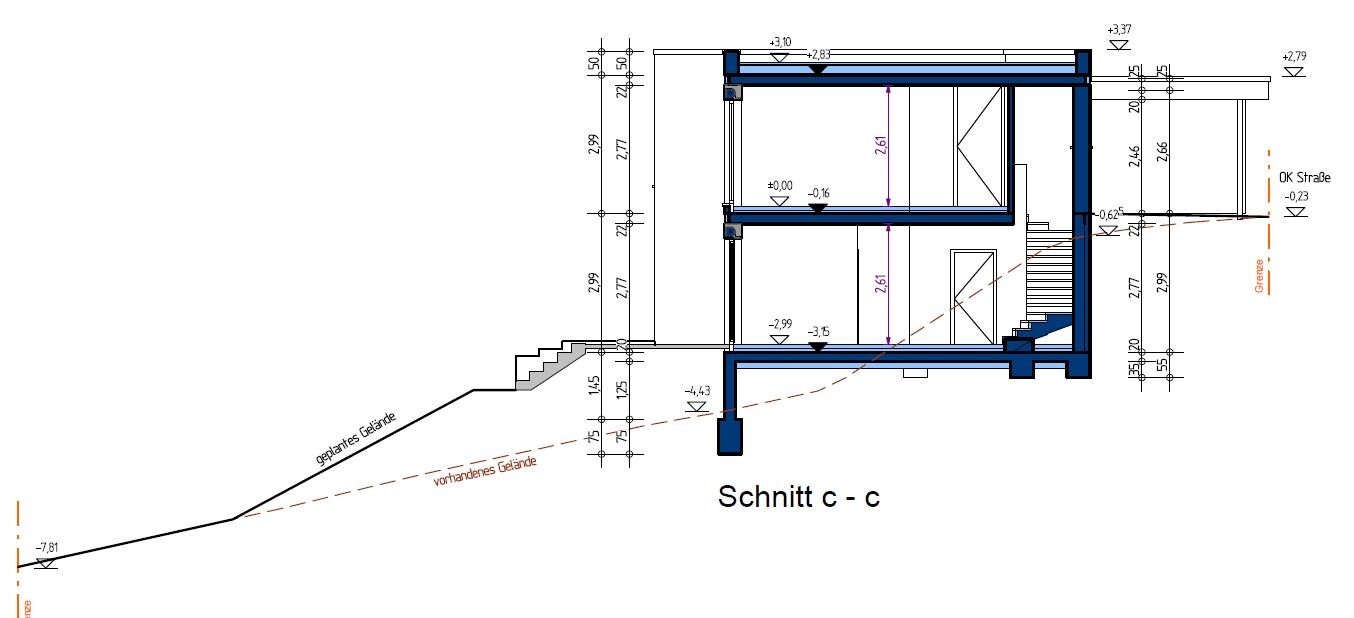
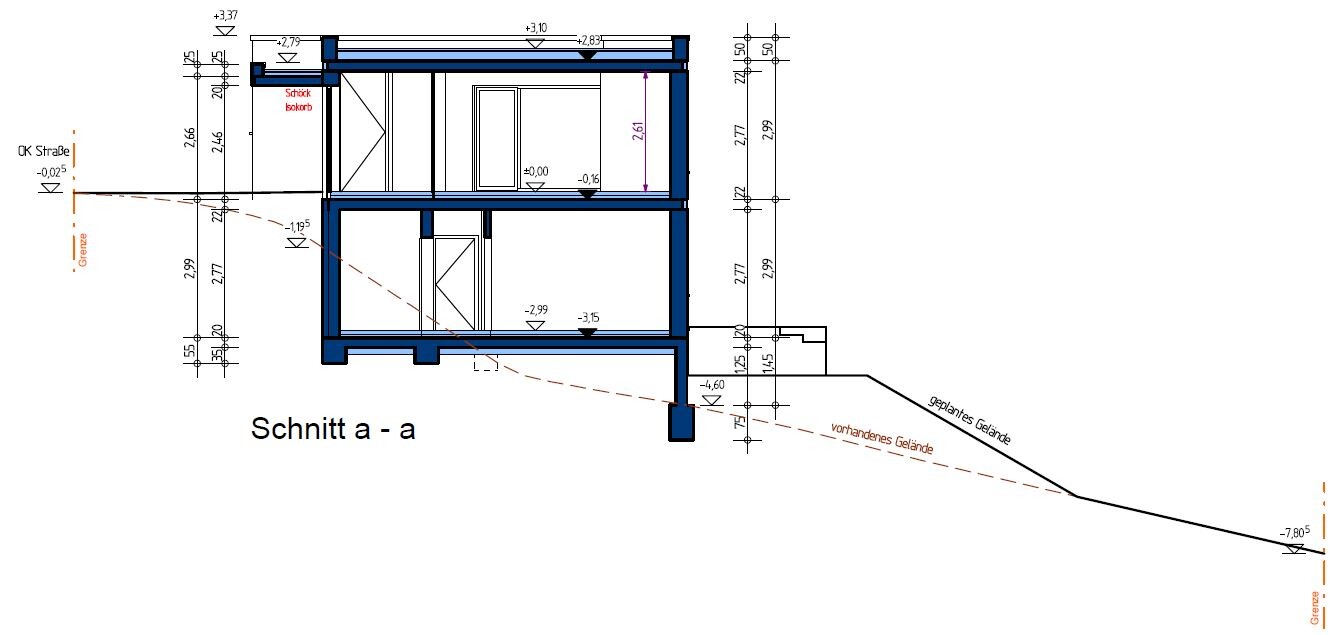
we are building a two-story single-family house on a steep hillside facing the valley, where the basement level is partially underground at the rear. To illustrate, I have attached a cross-section image.
According to an older geotechnical report, the following statement applies:
Notes on building waterproofing:
Building parts that are used intensively and embedded in the soil (basement rooms) must be permanently protected against moisture from the ground. The waterproofing requirements depend on the moisture exposure. The revised version of DIN 18195-4 published in August 2000 introduced a new classification of moisture load cases. A distinction is now made between ground moisture, non-pressurized seepage water, temporarily pressurized seepage water, and groundwater under pressure. The assumption for the “ground moisture” load case according to DIN 18195 Part 4 requires very high permeability (kf > 10-4 m/s) of the natural soil and the backfill in the work area.
Due to the cohesive nature of the soils found in the investigation area (clayey soil) and the significantly lower permeability associated with this, basement buildings must expect surface water accumulation and possibly groundwater buildup in the work area backfill (the so-called “bathtub effect”). In such cases, waterproofing according to DIN 18195 Part 6 is generally required.
If the accumulation of seepage water in the backfilled work area is prevented by drainage conforming to DIN 4095, whose long-term functionality is ensured, the base slab and external walls may also be waterproofed in soils with kf less than or equal to 10-4 m/s according to DIN 18195 Part 4, taking into account the following recommendations:
Surface drainage in front of the wall (e.g., drainage boards made of bitumen-bonded polystyrene beads or drainage mats made of plastic studded sheets) and perimeter drainage at the foundation must be installed with appropriate quality. This also includes:
- Ensuring a functioning discharge system
- Construction of sufficient inspection chambers
- Annual inspection of the drainage system’s functionality
According to the general contractor’s construction description, the following measures are planned:
Horizontal moisture barrier:
- On the concrete floor slab: a complete bitumen torch-on membrane G200 S4 Aluminum or “Knauf waterproofing membrane Katja Sprint” or equivalent.
- Plastic film / bitumen torch-on membrane under masonry walls erected on the floor slab to protect against rising damp.
- Waterproof slurry under concrete walls erected on the floor slab to protect against rising damp.
Vertical moisture barrier against “non-pressurized water”:
At the outside of the earth-contacting, unplastered shell exterior walls (reinforced concrete):
For example, Ceresit BT21 all-weather cold self-adhesive bitumen waterproofing membrane and/or bituminous thick coating; additional protection in the form of a slip sheet, drainage membrane, filter fleece.
In the base area up to 30cm (12 inches) above the planned ground level: plasterable waterproof slurry.
Drainage pipes:
In the basement:
● Material: PVC drainage pipe DN 100
● Wrapped in fleece, covered with lava rock, gravel, etc. as a filter layer
● Positioned in the soil on the uphill and gable sides
Questions:
1. Are the planned measures sufficient in view of the statements in the geotechnical report?
2. The excavated cohesive soil is probably not suitable for backfilling the work area at the rear, so I should expect additional costs for backfilling with suitable material, correct?
Thank you very much
we are building a two-story single-family house on a steep hillside facing the valley, where the basement level is partially underground at the rear. To illustrate, I have attached a cross-section image.
According to an older geotechnical report, the following statement applies:
Notes on building waterproofing:
Building parts that are used intensively and embedded in the soil (basement rooms) must be permanently protected against moisture from the ground. The waterproofing requirements depend on the moisture exposure. The revised version of DIN 18195-4 published in August 2000 introduced a new classification of moisture load cases. A distinction is now made between ground moisture, non-pressurized seepage water, temporarily pressurized seepage water, and groundwater under pressure. The assumption for the “ground moisture” load case according to DIN 18195 Part 4 requires very high permeability (kf > 10-4 m/s) of the natural soil and the backfill in the work area.
Due to the cohesive nature of the soils found in the investigation area (clayey soil) and the significantly lower permeability associated with this, basement buildings must expect surface water accumulation and possibly groundwater buildup in the work area backfill (the so-called “bathtub effect”). In such cases, waterproofing according to DIN 18195 Part 6 is generally required.
If the accumulation of seepage water in the backfilled work area is prevented by drainage conforming to DIN 4095, whose long-term functionality is ensured, the base slab and external walls may also be waterproofed in soils with kf less than or equal to 10-4 m/s according to DIN 18195 Part 4, taking into account the following recommendations:
Surface drainage in front of the wall (e.g., drainage boards made of bitumen-bonded polystyrene beads or drainage mats made of plastic studded sheets) and perimeter drainage at the foundation must be installed with appropriate quality. This also includes:
- Ensuring a functioning discharge system
- Construction of sufficient inspection chambers
- Annual inspection of the drainage system’s functionality
According to the general contractor’s construction description, the following measures are planned:
Horizontal moisture barrier:
- On the concrete floor slab: a complete bitumen torch-on membrane G200 S4 Aluminum or “Knauf waterproofing membrane Katja Sprint” or equivalent.
- Plastic film / bitumen torch-on membrane under masonry walls erected on the floor slab to protect against rising damp.
- Waterproof slurry under concrete walls erected on the floor slab to protect against rising damp.
Vertical moisture barrier against “non-pressurized water”:
At the outside of the earth-contacting, unplastered shell exterior walls (reinforced concrete):
For example, Ceresit BT21 all-weather cold self-adhesive bitumen waterproofing membrane and/or bituminous thick coating; additional protection in the form of a slip sheet, drainage membrane, filter fleece.
In the base area up to 30cm (12 inches) above the planned ground level: plasterable waterproof slurry.
Drainage pipes:
In the basement:
● Material: PVC drainage pipe DN 100
● Wrapped in fleece, covered with lava rock, gravel, etc. as a filter layer
● Positioned in the soil on the uphill and gable sides
Questions:
1. Are the planned measures sufficient in view of the statements in the geotechnical report?
2. The excavated cohesive soil is probably not suitable for backfilling the work area at the rear, so I should expect additional costs for backfilling with suitable material, correct?
Thank you very much
B
Bauherr am L10 Feb 2020 16:00@kinderpingui
Our situation is exactly the same. Slope, clay excavation, etc. The waterproofing of the concrete slab is done the same way as you. However, the reinforced concrete walls are coated with a bituminous thick coating for load case 6 (rising seepage water).
What I do wonder, though, is whether the clay shouldn’t be used for backfilling at least where minor settlements are acceptable, in order to avoid the bathtub effect.
I suggest we continue to exchange ideas here about how this is resolved...
Our situation is exactly the same. Slope, clay excavation, etc. The waterproofing of the concrete slab is done the same way as you. However, the reinforced concrete walls are coated with a bituminous thick coating for load case 6 (rising seepage water).
What I do wonder, though, is whether the clay shouldn’t be used for backfilling at least where minor settlements are acceptable, in order to avoid the bathtub effect.
I suggest we continue to exchange ideas here about how this is resolved...
K
kinderpingui10 Feb 2020 16:08Hey, thanks to everyone for the responses. @Nordlys: Do you mean by your comment that I generally shouldn’t omit them (which I don’t plan to do), or is your post along the same lines as @hegi___?
We are building with a general contractor, so I will clarify this with them.
@Bauherr am L, yes, that’s a very good idea. I have already requested a discussion with my general contractor on this matter. I will report back.
So you mean that by installing the clayey soil, infiltration shouldn’t occur in the first place?
We are building with a general contractor, so I will clarify this with them.
@Bauherr am L, yes, that’s a very good idea. I have already requested a discussion with my general contractor on this matter. I will report back.
So you mean that by installing the clayey soil, infiltration shouldn’t occur in the first place?
B
Bauherr am L10 Feb 2020 16:16kinderpingui schrieb:
@Bauherr am L
So you mean that by installing the clay soil, infiltration shouldn't occur at all?Logically speaking: there is clay all around the house, and water infiltrates there only slowly. Then you backfill the working space with permeable gravel, and the water takes the path of least resistance—so you end up with your bathtub effect.
That’s why, from a gut feeling (not a professional opinion), I think it’s better if the backfill in the working space does not encourage water to accumulate. Unfortunately, clay is hard to compact properly, which means you can expect settlement over a longer period. So in the end, you use expensive crushed stone, sand, or similar materials for the backfill and then have to be very careful with waterproofing and drainage.
Currently, our plan is to install a continuous “relief layer” along the hillside side. This means gravel wrapped in a geotextile fabric at the level of the foundation slab. The idea is to let the water flow around the house. Whether this is the best solution, I don’t know...
Similar topics