
ᐅ Building a House Along a Service Road – Advantages and Disadvantages
Created on: 14 Mar 2018 08:42
Z
Zaba12
Good morning everyone,
The architect will have our initial building plans preliminarily reviewed by the building authority in the coming days. Unfortunately, the zoning plan’s text regulations are quite restrictive, so our first plan last year regarding the embankment and site grading was rejected by the building authority because we had planned 1.55m (5 feet) retaining walls on the south side. To accommodate the building authority, we have lowered the house toward the access road and planned the retaining walls at 1m (3 feet 3 inches). Although this still doesn’t fully comply with the zoning plan, there are already approved plans in this construction phase allowing for exceptions.
By the way, the boundary situation with the eastern neighbor is known. We are slightly higher there and slope down a bit. To the south, see the elevations. To the west, the situation is still unclear. However, due to the slope, the neighbor will face similar challenges :-)
My question: What disadvantages are there to lowering the house by about 70-30cm (28-12 inches)? Are there any disadvantages at all? I have thought about issues such as the washing machine in the basement and drainage; would we need a sump pump? We are currently working on clarifying this topic.
What is not within the scope are suggestions for a possible redesign. It should purely be about potential disadvantages.
I look forward to your feedback :-)
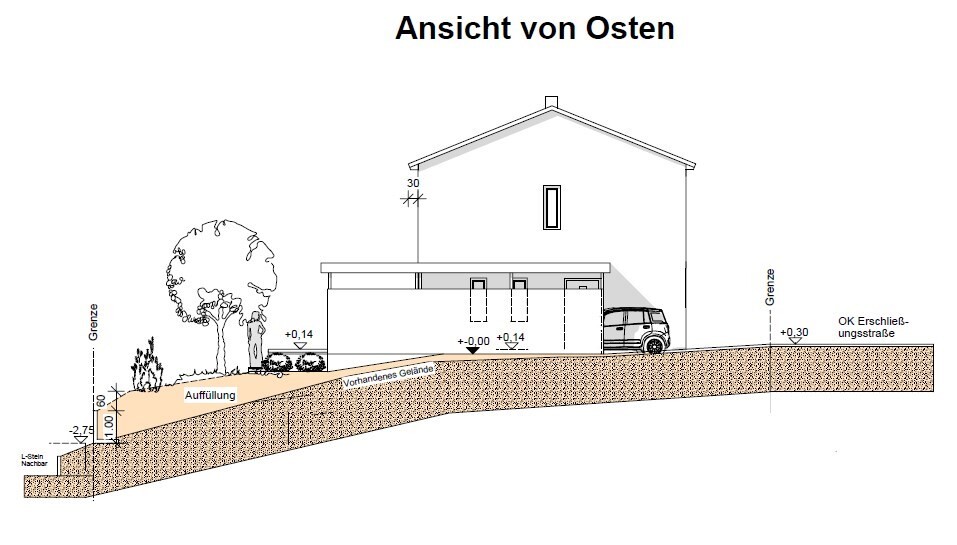
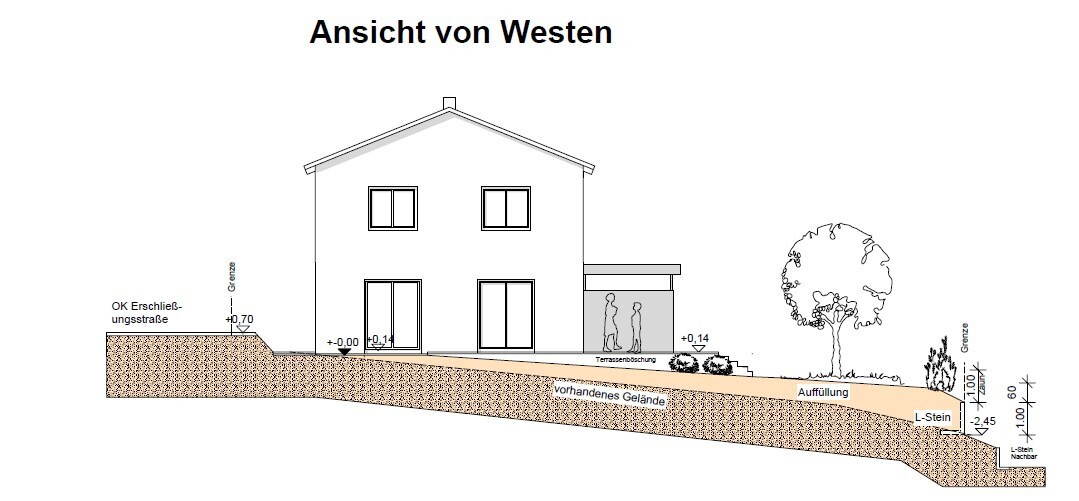
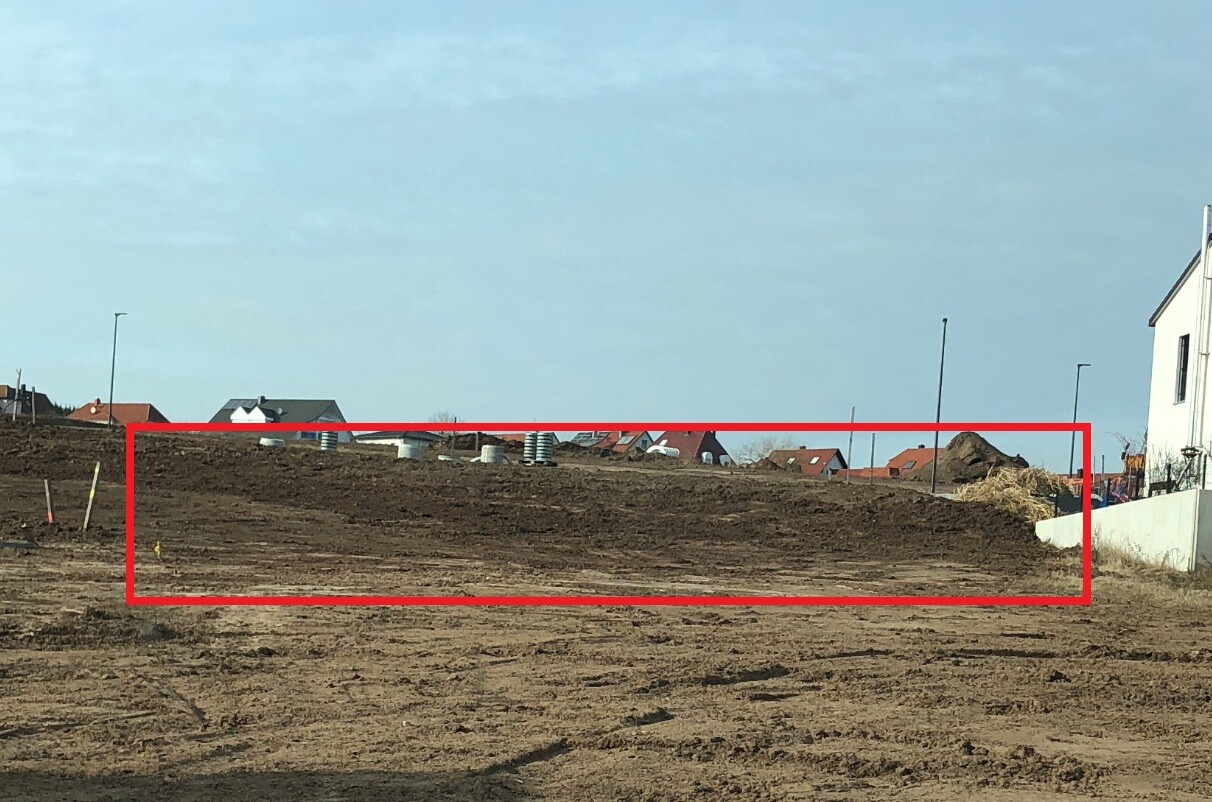
The architect will have our initial building plans preliminarily reviewed by the building authority in the coming days. Unfortunately, the zoning plan’s text regulations are quite restrictive, so our first plan last year regarding the embankment and site grading was rejected by the building authority because we had planned 1.55m (5 feet) retaining walls on the south side. To accommodate the building authority, we have lowered the house toward the access road and planned the retaining walls at 1m (3 feet 3 inches). Although this still doesn’t fully comply with the zoning plan, there are already approved plans in this construction phase allowing for exceptions.
By the way, the boundary situation with the eastern neighbor is known. We are slightly higher there and slope down a bit. To the south, see the elevations. To the west, the situation is still unclear. However, due to the slope, the neighbor will face similar challenges :-)
My question: What disadvantages are there to lowering the house by about 70-30cm (28-12 inches)? Are there any disadvantages at all? I have thought about issues such as the washing machine in the basement and drainage; would we need a sump pump? We are currently working on clarifying this topic.
What is not within the scope are suggestions for a possible redesign. It should purely be about potential disadvantages.
I look forward to your feedback :-)
If I interpret the plan correctly, the access road slopes downward towards the east. Do you think the water would then also flow to the east? Do the neighbors already have experience with this?
Could you raise the ground floor or the terrace a bit higher and, based on that, fill in or step the terrace more compared to YOUR site level?
Or do you have a restriction on the eaves height in the building permit / planning permission that requires keeping the ground floor lower?
Could you raise the ground floor or the terrace a bit higher and, based on that, fill in or step the terrace more compared to YOUR site level?
Or do you have a restriction on the eaves height in the building permit / planning permission that requires keeping the ground floor lower?
Traumfaenger schrieb:
I don’t understand that! In my opinion, it definitely depends on the street level. For example, if your shower on the ground floor is lower than the street drain, you will have a problem in case of a sewage backup. Look up the term “backwater level” online... this is the height of the street surface above the point where the property’s drainage system connects to the public sewer. Local utility companies or municipal wastewater services also provide clear guidelines on this. Here, take a look... this is what I mean by sewer height
Solveigh schrieb:
If I’m reading the plan correctly, the access road slopes down towards the east. Do you think the water would then also flow eastward? Do the neighbors have any experience with this?
Could you raise the ground floor or the terrace a bit more and, as a result, build up or step the terrace more compared to YOUR terrain?
Or do you have a height restriction for the eaves in the development plan, so you have to keep the ground floor lower? Attached is the north side to address the issue of the backwater level. As already shown in the last illustration, whether a lift station is necessary or a backwater valve is enough depends on the depth of the sewer. There will be no bathroom or similar in the basement, only a washing machine.
It still needs to be clarified. The planning is still fresh, because in the first draft there was no height difference, as 1.55m (5 feet) L-shaped retaining walls were planned.
@ It depends on the fill restriction; according to the development plan, we are allowed only 60cm (24 inches). The building authority accepts up to 1m (39 inches), as does the neighbor. Anything more is not possible.
A terrace height of 1m (39 inches) would be the maximum. It is currently 80cm (31 inches). Whether this will be decisive, I strongly doubt (unless the sewer is not deep enough), since the terrain is not exactly flat in any direction.
My eastern neighbor has a continuous height difference of at least 70cm (28 inches) to the access road.
T
Traumfaenger15 Mar 2018 20:37Zaba12 schrieb:
Take a look here... this is what I mean by pipe elevationWhen the sewer pipe is full, the water pushes up to the level of the drain cover. Only then does the pipe overflow, and the water runs onto the street. The water can rise inside your house up to the same height as the drain cover. This means that walk-in showers, toilets, etc., with outlet openings below the street level (drain cover) can overflow. In the above illustration, this would be prevented by a backflow valve or a lifting station. However, if you don’t install anything and only have a drainage pipe, there is nothing stopping the water from rising inside the house.
PS: A lifting station causes ongoing maintenance costs, is prone to clogging, and may require emergency service calls, for example, if a wet wipe is flushed down the toilet. I would think carefully about this.
So, the issue has been clarified as far as possible at this point. The ground floor requires its own sewage backflow valve (either electric or manual). The basement needs at least a small lifting station for greywater (a few hundred euros).
The remaining issue is the front door and heavy rainstorms.
The entire development uses a separated drainage system, meaning two inspection chambers plus mandatory cisterns. For me, that means a lot would have to go wrong before any problems occur.
One more time, are there any personal experiences with a similar situation under comparable conditions?
The remaining issue is the front door and heavy rainstorms.
The entire development uses a separated drainage system, meaning two inspection chambers plus mandatory cisterns. For me, that means a lot would have to go wrong before any problems occur.
One more time, are there any personal experiences with a similar situation under comparable conditions?
Similar topics