
ᐅ Building a House Along a Service Road – Advantages and Disadvantages
Created on: 14 Mar 2018 08:42
Z
Zaba12
Good morning everyone,
The architect will have our initial building plans preliminarily reviewed by the building authority in the coming days. Unfortunately, the zoning plan’s text regulations are quite restrictive, so our first plan last year regarding the embankment and site grading was rejected by the building authority because we had planned 1.55m (5 feet) retaining walls on the south side. To accommodate the building authority, we have lowered the house toward the access road and planned the retaining walls at 1m (3 feet 3 inches). Although this still doesn’t fully comply with the zoning plan, there are already approved plans in this construction phase allowing for exceptions.
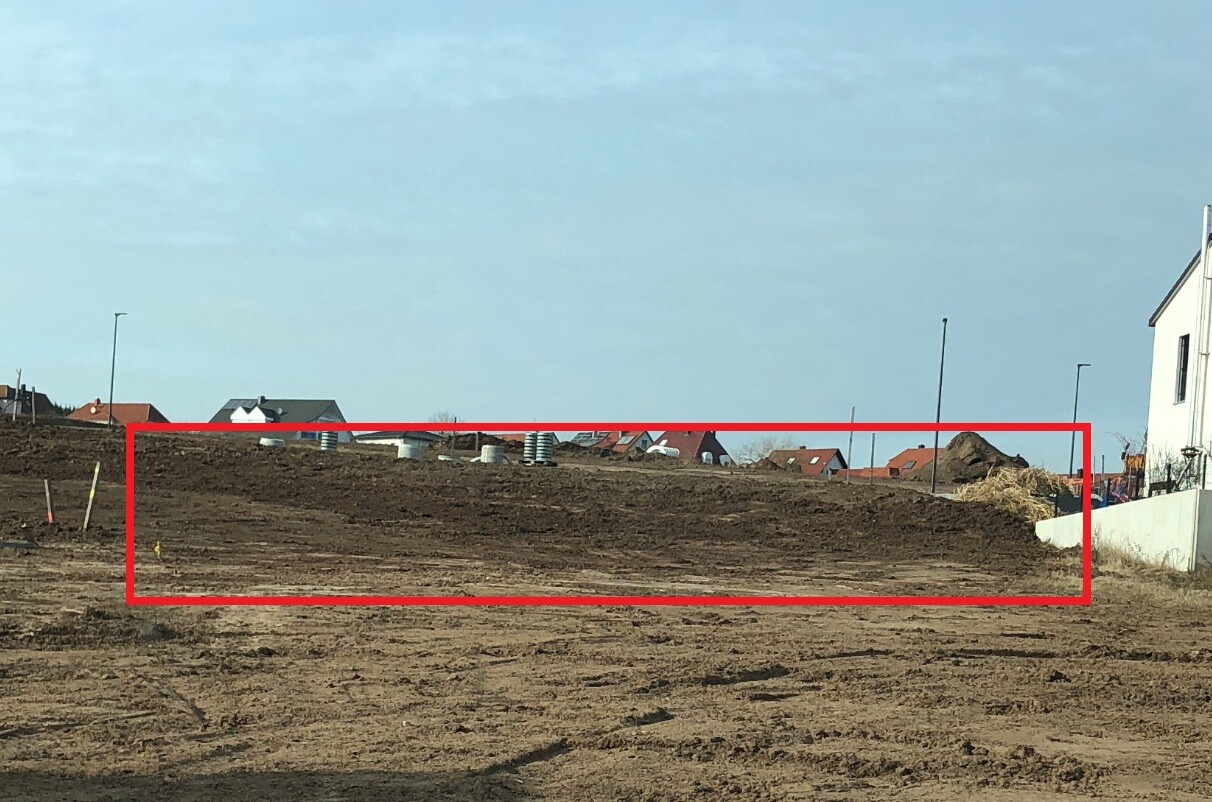
By the way, the boundary situation with the eastern neighbor is known. We are slightly higher there and slope down a bit. To the south, see the elevations. To the west, the situation is still unclear. However, due to the slope, the neighbor will face similar challenges :-)
My question: What disadvantages are there to lowering the house by about 70-30cm (28-12 inches)? Are there any disadvantages at all? I have thought about issues such as the washing machine in the basement and drainage; would we need a sump pump? We are currently working on clarifying this topic.
What is not within the scope are suggestions for a possible redesign. It should purely be about potential disadvantages.
I look forward to your feedback :-)
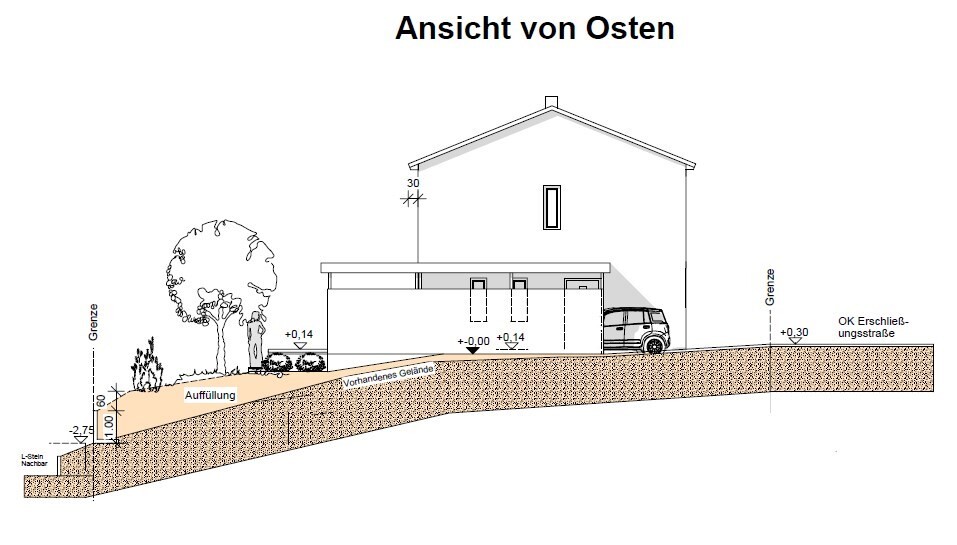
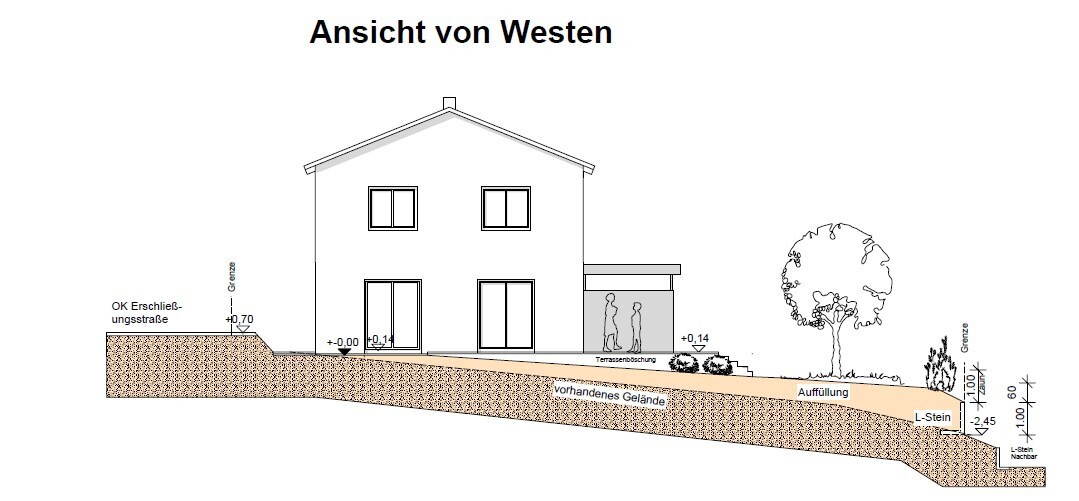
The architect will have our initial building plans preliminarily reviewed by the building authority in the coming days. Unfortunately, the zoning plan’s text regulations are quite restrictive, so our first plan last year regarding the embankment and site grading was rejected by the building authority because we had planned 1.55m (5 feet) retaining walls on the south side. To accommodate the building authority, we have lowered the house toward the access road and planned the retaining walls at 1m (3 feet 3 inches). Although this still doesn’t fully comply with the zoning plan, there are already approved plans in this construction phase allowing for exceptions.
By the way, the boundary situation with the eastern neighbor is known. We are slightly higher there and slope down a bit. To the south, see the elevations. To the west, the situation is still unclear. However, due to the slope, the neighbor will face similar challenges :-)
My question: What disadvantages are there to lowering the house by about 70-30cm (28-12 inches)? Are there any disadvantages at all? I have thought about issues such as the washing machine in the basement and drainage; would we need a sump pump? We are currently working on clarifying this topic.
What is not within the scope are suggestions for a possible redesign. It should purely be about potential disadvantages.
I look forward to your feedback :-)
@Kellerfenster: According to the manufacturer, basement windows are watertight under hydrostatic pressure.
So the front door was on the street-facing side? Was there a depression near the front door?
I find it hard to imagine this. I would understand if the house was the last one on a slope with a depression, but otherwise?
There’s not much that can be done about the elevation. Maybe raising it 10-15 cm (4-6 inches) higher toward the access road (if at all—on the west side at the carport), and only if we use a 1 m (3 ft) L-shaped retaining wall for the terrace instead of 80 cm (2.5 ft). The critical point is the southern boundary. Neither the authority nor the neighbor can offer any more concessions.
andimann schrieb:
My brother’s colleague thought the same: the water pushed in the front door at such a location, flooded through the entire house, and came out again at the living room in the back...
So the front door was on the street-facing side? Was there a depression near the front door?
I find it hard to imagine this. I would understand if the house was the last one on a slope with a depression, but otherwise?
There’s not much that can be done about the elevation. Maybe raising it 10-15 cm (4-6 inches) higher toward the access road (if at all—on the west side at the carport), and only if we use a 1 m (3 ft) L-shaped retaining wall for the terrace instead of 80 cm (2.5 ft). The critical point is the southern boundary. Neither the authority nor the neighbor can offer any more concessions.
S
Sondelgeher1214 Mar 2018 19:32But now just imagine a river... with a rock in the middle... it also gets wet, not only everything at the end of the river...
I would prefer to be slightly above the road with the finished floor level...
And otherwise, you simply have to ensure proper drainage...
I would prefer to be slightly above the road with the finished floor level...
And otherwise, you simply have to ensure proper drainage...
Sondelgeher12 schrieb:
And otherwise, you just have to ensure proper drainage...That's a given.
Has anyone built something similar or the same and has any experience to share?
K
Knallkörper14 Mar 2018 20:59We have a similar situation and built our concrete slab at street level. This means we have a step up to the front door. Of course, we were allowed to do that. The next but one neighbor skipped this step. During the two-day heavy rain last August, water even flowed into their front door because the drain in the street gutter was clogged. If there’s 10cm (4 inches) of water standing or rushing on the asphalt, it doesn’t help much that the terrain slopes away behind your house.
T
Traumfaenger14 Mar 2018 21:15Zaba12 schrieb:
...The lifting station is being clarified. It depends on how deep the sewer pipe is. It doesn’t really follow the street level 🙂
...I don’t understand that! In my opinion, it definitely relates to the street level. For example, if your ground floor shower is lower than the street drain, you could face problems if the sewer system floods. Search online for the term "backwater level" ... this refers to the elevation of the street surface above the connection point of the property’s drainage to the public sewer. There are also clear guidelines from the local utility companies or municipal wastewater authorities regarding this.
Similar topics