
Hello colleagues and everyone involved,
We have finally found a plot for our house. What now? How should we best approach this? Architect or general contractor? With or without a basement? What is truly important and what is just unnecessary?
About us: 2 adults + 2 children
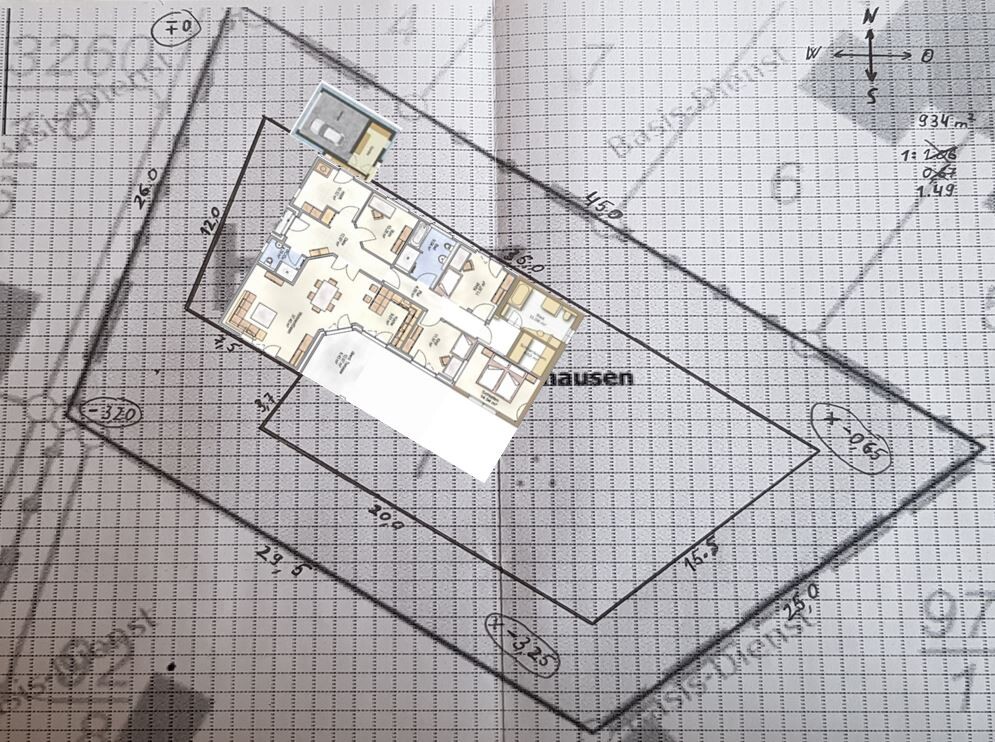
Plot size: 934m² (see attachment)
House: either a 5-room corner bungalow (140m² / 1507 sq ft) or a two-story townhouse (160m² / 1722 sq ft)
Attached is a draft (self-made) of the floor plan. What do you think?
Best regards,
soon-to-be homeowners
P.S. This is our first construction project, so please be patient with us!
We have finally found a plot for our house. What now? How should we best approach this? Architect or general contractor? With or without a basement? What is truly important and what is just unnecessary?
About us: 2 adults + 2 children
Plot size: 934m² (see attachment)
House: either a 5-room corner bungalow (140m² / 1507 sq ft) or a two-story townhouse (160m² / 1722 sq ft)
Attached is a draft (self-made) of the floor plan. What do you think?
Best regards,
soon-to-be homeowners
P.S. This is our first construction project, so please be patient with us!
zerro80 schrieb:
But before involving an architect, I would like to form a fairly clear idea of the "dream house" myself. That’s why I’m trying to get a bit smarter here.zerro80 schrieb:
and then about the house itself:
- Lightweight concrete or aerated concrete
- Building services: what really makes sense?zerro80 schrieb:
Hello Escroda,
What are the usual surveying costs? Who commissions it and when? Does it have to go through the cadastral office?
Best regards- The questions are a bit mixed up here
Check the development plan to see if what you have in mind is feasible.
- I assume the financing question including a rough house cost estimate is settled.
- If there’s no pressure, hire a geotechnical engineer.
- If there is any pressure (time constraints, other buyers, etc.) buy now and then hire the geotechnical engineer.
- After purchase, start searching for a structural engineer, architect, or general contractor… gather ideas and discard some.
Don’t start from the end, and when appropriate, fill out questionnaires in the forum if they are reasonably requested.
Hello community,
It is indeed not always easy to adjust all the questions here to a higher level of understanding.
However, I will continue trying to categorize them.
The questions regarding buildability and financing are mostly settled.
The questions I still have open are as follows:
- House type (bungalow or townhouse/villa);
- With or without basement;
- Building material (lightweight concrete blocks or aerated concrete);
- Building services technology
- Heating (fossil fuel or renewable);
- Controlled ventilation (central or decentralized);
- Fireplace with water circulation or not;
- Photovoltaics and/or solar thermal;
- Smart home systems.
It is clear that, under certain conditions, you can have all of these. But my question is different: what does a reasonable concept for house construction look like?
Only when I have a clear idea myself, I will commission a construction company or architect. That is my plan!
And if I can take away anything sensible from our discussion here, basically from first hand, I would be grateful to you all.
Best regards and sWE
It is indeed not always easy to adjust all the questions here to a higher level of understanding.
However, I will continue trying to categorize them.
The questions regarding buildability and financing are mostly settled.
The questions I still have open are as follows:
- House type (bungalow or townhouse/villa);
- With or without basement;
- Building material (lightweight concrete blocks or aerated concrete);
- Building services technology
- Heating (fossil fuel or renewable);
- Controlled ventilation (central or decentralized);
- Fireplace with water circulation or not;
- Photovoltaics and/or solar thermal;
- Smart home systems.
It is clear that, under certain conditions, you can have all of these. But my question is different: what does a reasonable concept for house construction look like?
Only when I have a clear idea myself, I will commission a construction company or architect. That is my plan!
And if I can take away anything sensible from our discussion here, basically from first hand, I would be grateful to you all.
Best regards and sWE
House type: Bungalow
Heating: Gas
Ventilation: Decentralized using window frame vents and exhaust fans
Material: Stone, pumice, Ytong, or brick – all are fine
Technology: Keep it simple, robust, and reliable to avoid many problems
Fireplace and smart home systems are unnecessary
Basement is too expensive; better to have a walkable floor
Thermosolar is a must with gas; a heat pump is not cost-effective then
If you follow this approach, you will get an affordable, warm, and well-ventilated house without paying for unnecessary trendy gadgets.
Heating: Gas
Ventilation: Decentralized using window frame vents and exhaust fans
Material: Stone, pumice, Ytong, or brick – all are fine
Technology: Keep it simple, robust, and reliable to avoid many problems
Fireplace and smart home systems are unnecessary
Basement is too expensive; better to have a walkable floor
Thermosolar is a must with gas; a heat pump is not cost-effective then
If you follow this approach, you will get an affordable, warm, and well-ventilated house without paying for unnecessary trendy gadgets.
B
boxandroof5 Apr 2019 13:40zerro80 schrieb:
The questions I still have are the following:House type (bungalow or townhouse);decide for yourself
- Basement or not
decide for yourself
- Building material (lightweight concrete blocks or aerated concrete);
doesn’t matter
- Heating system (fossil fuel or renewable)
Of course a heat pump, but only if well planned. Do your own research. Gas is easier to plan, initially cheaper (not necessarily), and with today’s energy prices somewhat more expensive to operate.
- Controlled ventilation (central or decentralized)
Ventilation is a comfort feature and never really pays off. I wouldn’t want to be without our controlled residential ventilation. If then central, decentralized only for a few rooms.
- Fireplace with water heat exchanger or without
Comfort feature, decide for yourself. Not water-heated. If you already have doubts, better leave it out completely.
- Photovoltaic and/or solar thermal
Photovoltaics almost always make sense. With gas, try to replace solar thermal obligation using controlled residential ventilation. Solar thermal rarely pays off, I would avoid it.
- Smart home
decide and plan for yourself. I love gadgets but left it out in the house, no time and no point for the rest of the family.
- Building services engineering
what else is missing?
zerro80 schrieb:
Only when I have a clear idea myself, I will commission a surveyor or architect. That’s my plan!Even if you want to start quickly – take your time for rough planning with different parties and stay open to ideas.There is no one-size-fits-all sensible house concept. You need to find the one that suits you.
Take a look around here. All the discussions about smart homes, building materials, KfW (building subsidies), and more are everywhere. There has never been a “wow, this is how it is” moment where everyone agrees.
In many cases, the budget plays a major role. That’s why questions about KNX and similar systems often don’t even come up.
Take a look around here. All the discussions about smart homes, building materials, KfW (building subsidies), and more are everywhere. There has never been a “wow, this is how it is” moment where everyone agrees.
In many cases, the budget plays a major role. That’s why questions about KNX and similar systems often don’t even come up.
Nordlys schrieb:
House type: bungalow
Heating: gas
Ventilation: decentralized using window frame vents and exhaust fans
Material: stone, pumice, aerated concrete blocks (Ytong), or brick—all fine
Technology: keep it simple, rugged, reliable to avoid a lot of problems
Fireplace and smart home: unnecessary stuff
Basement too expensive; better to make the floor accessible
Thermo-solar is a must with gas; photovoltaic then doesn’t pay off Consistent for Nordlys
2 full stories with a pitched roof
Solid wood construction
Ventilation/heating/hot water via an air-to-water heat pump (field test system)
Passive house standard
Therefore, no underfloor heating, no solar panels
This is also consistent.
Similar topics