
T
Toffifee8810 Mar 2020 08:43Hello everyone,
We are currently planning to purchase a plot of land located in a new development area. It is a corner lot.
We are uncertain whether the lot can be built on well, and if so, how.
Floor area ratio = 0.3
Eaves height = 4.5 m (15 feet)
Ridge height = 9 m (30 feet)
We would like to build a 1.5-story house with a gable facing the garden.
The driveway is planned on the longer street side. This means our driveway would be right next to the neighbor’s garden. However, the neighbor has raised their land much higher (above street level). Our entire lot is currently below street level. We would prefer to raise our land only up to street level and not higher. This is to avoid problems with the ridge height and to be able to position the house as close as possible to the street. On the other side, our other neighbor’s lot has not been raised at all and remains below street level like ours.
I have several questions:
1. Do you think it is a problem that the neighbor has raised their land so much while our driveway next to it will not be raised as high? The neighbor’s land is about 20 cm (8 inches) above street level, and our lot is currently about 70 cm (28 inches) below street level. We would build a concrete wall or something similar along our driveway.
2. The next issue is that our other neighbor’s land along the longer side toward the back is too low. Our lot is therefore between one that is raised and one that is lower. What should we consider in this case? This would basically mean our garden borders their yard.
3. Do you think the orientation of the house makes sense?
4. We are currently considering making the driveway wide enough for two cars side by side or narrower to have a larger garden and instead add a parking space in front of the house, lengthwise. I’m just not sure if parking there would always be practical.
Info about the pictures: The two circles mark the sewage and stormwater shafts.
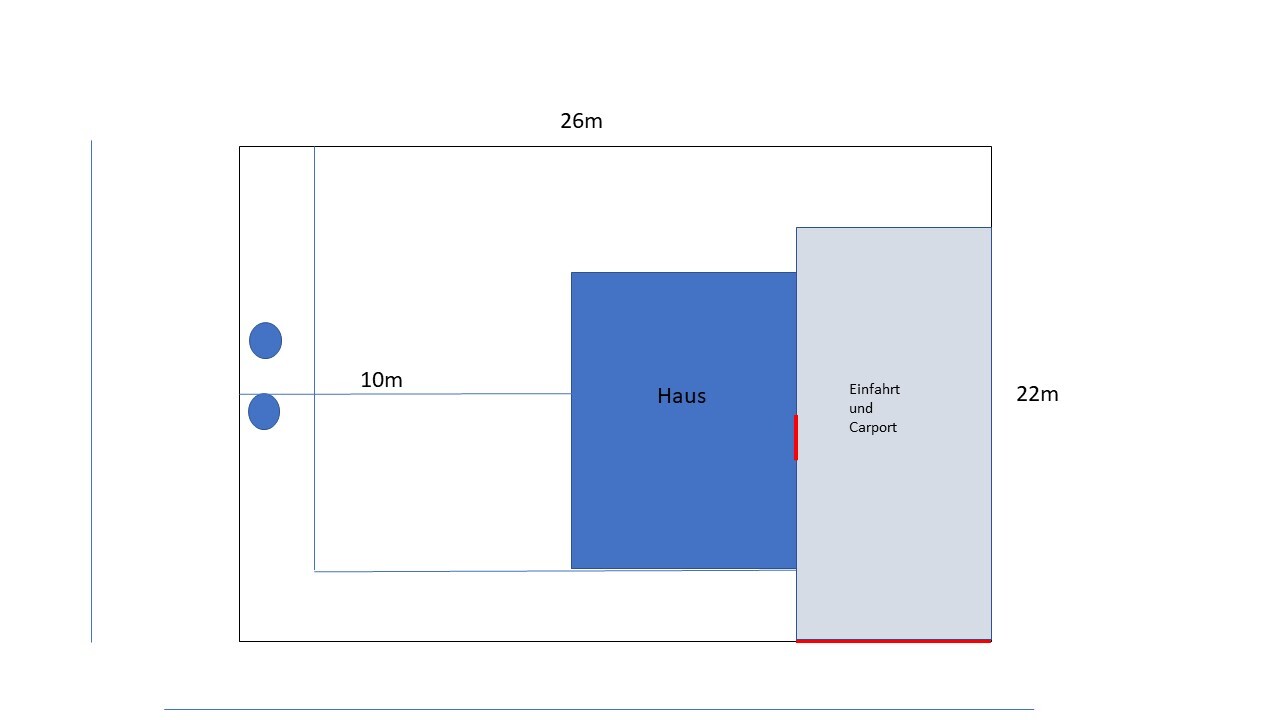
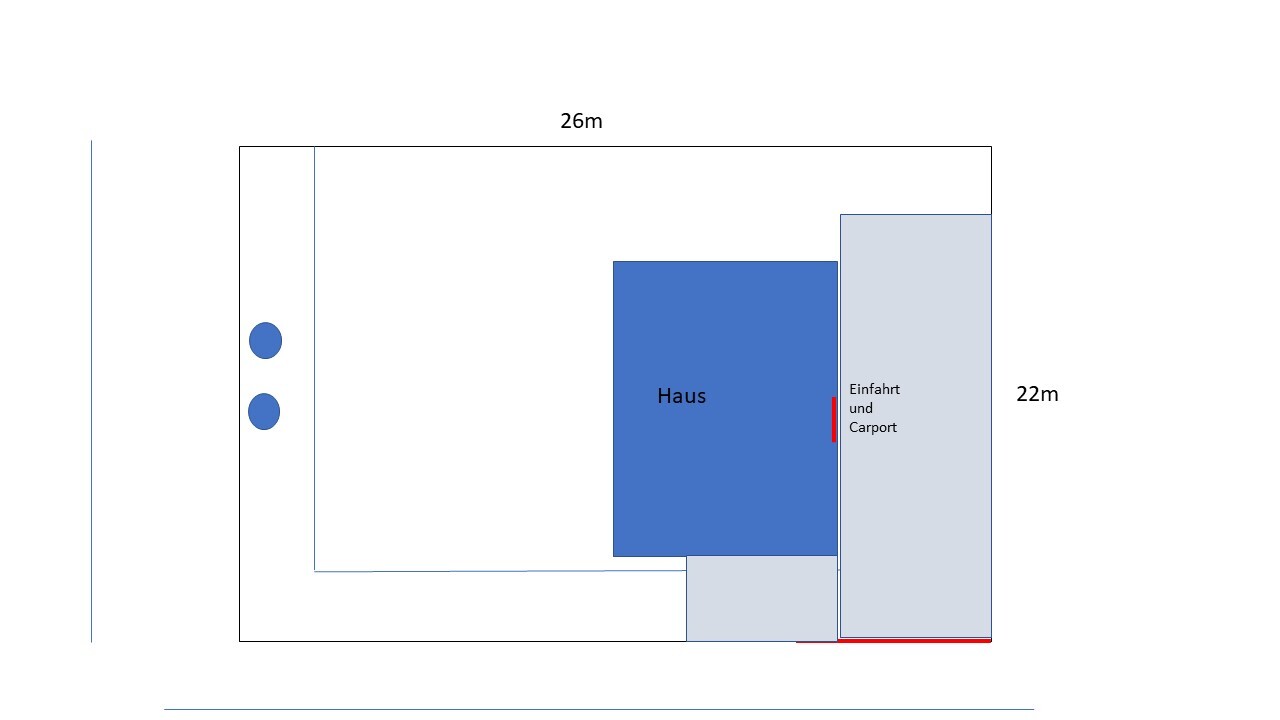
We are currently planning to purchase a plot of land located in a new development area. It is a corner lot.
We are uncertain whether the lot can be built on well, and if so, how.
Floor area ratio = 0.3
Eaves height = 4.5 m (15 feet)
Ridge height = 9 m (30 feet)
We would like to build a 1.5-story house with a gable facing the garden.
The driveway is planned on the longer street side. This means our driveway would be right next to the neighbor’s garden. However, the neighbor has raised their land much higher (above street level). Our entire lot is currently below street level. We would prefer to raise our land only up to street level and not higher. This is to avoid problems with the ridge height and to be able to position the house as close as possible to the street. On the other side, our other neighbor’s lot has not been raised at all and remains below street level like ours.
I have several questions:
1. Do you think it is a problem that the neighbor has raised their land so much while our driveway next to it will not be raised as high? The neighbor’s land is about 20 cm (8 inches) above street level, and our lot is currently about 70 cm (28 inches) below street level. We would build a concrete wall or something similar along our driveway.
2. The next issue is that our other neighbor’s land along the longer side toward the back is too low. Our lot is therefore between one that is raised and one that is lower. What should we consider in this case? This would basically mean our garden borders their yard.
3. Do you think the orientation of the house makes sense?
4. We are currently considering making the driveway wide enough for two cars side by side or narrower to have a larger garden and instead add a parking space in front of the house, lengthwise. I’m just not sure if parking there would always be practical.
Info about the pictures: The two circles mark the sewage and stormwater shafts.

A scaled drawing would be especially helpful. The current representation is distorted, which is not ideal when trying to get an overall impression. For example, the garden at the back should be much smaller compared to the house and driveway, as the 10 m (33 feet) shown on the plan is almost the same length as the distance from the house to the property boundary at the driveway.
T
Toffifee8810 Mar 2020 15:17Sorry, here is another attempt. My main concern is actually about the height differences. I will discuss the question about the orientation with the builder again:
By the way, we are building in Lower Saxony.
Neighbor A, next to our carport, is slightly above the level of our street (about +0.2 meters (8 inches)). Neighbor B (at the upper side along the length) has just started, but our builder believes they are aligned to the other street, since their driveway is there. They are therefore lower than our property.
The current plan is to have the underside of the floor slab at street level under the house. This is about 60 cm (24 inches) higher than it is now. How should we approach the situation with each neighbor?
We then have the issue that our property will be set higher than Neighbor B’s, but we need to be higher because our street is higher and Neighbor A is higher. I once read that you are not allowed to build higher than the neighbor, is that true? Would that mean we can’t build higher than Neighbor B? But isn’t our reference point our street?
Are there any other difficulties with the house if the plot is filled up this much?
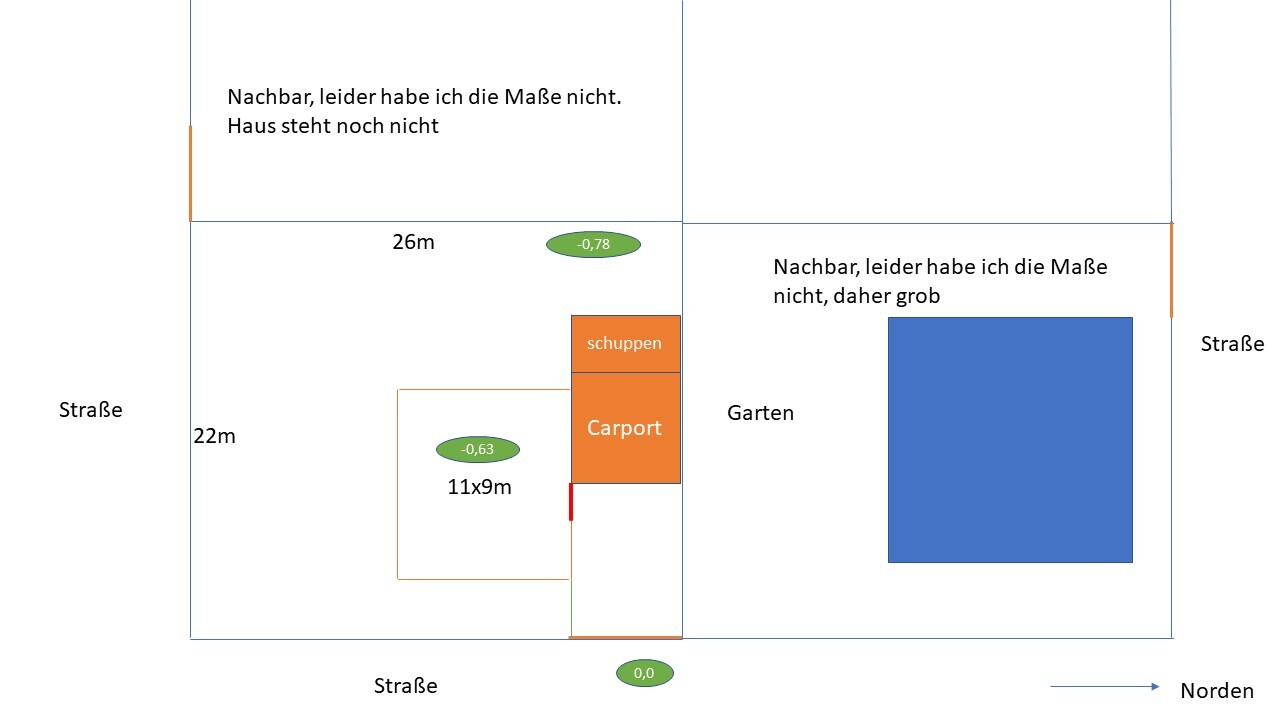
Also, I have a question about the floor area ratio (FAR): Our FAR is 0.3. There are no further restrictions in the development plan. Does that mean we are allowed to exceed the FAR by 50% with secondary structures? The regulation states for all secondary structures "below the railing surface." What exactly does that mean?
By the way, we are building in Lower Saxony.
Neighbor A, next to our carport, is slightly above the level of our street (about +0.2 meters (8 inches)). Neighbor B (at the upper side along the length) has just started, but our builder believes they are aligned to the other street, since their driveway is there. They are therefore lower than our property.
The current plan is to have the underside of the floor slab at street level under the house. This is about 60 cm (24 inches) higher than it is now. How should we approach the situation with each neighbor?
We then have the issue that our property will be set higher than Neighbor B’s, but we need to be higher because our street is higher and Neighbor A is higher. I once read that you are not allowed to build higher than the neighbor, is that true? Would that mean we can’t build higher than Neighbor B? But isn’t our reference point our street?
Are there any other difficulties with the house if the plot is filled up this much?
Also, I have a question about the floor area ratio (FAR): Our FAR is 0.3. There are no further restrictions in the development plan. Does that mean we are allowed to exceed the FAR by 50% with secondary structures? The regulation states for all secondary structures "below the railing surface." What exactly does that mean?
Neighbor A must retain their 70 cm (28 inches) with L-shaped retaining walls, or they need to create a slope or embankment from their property down to yours.
You need to retain your fill towards Neighbor B or create a slope or embankment. What does the local development plan say about this?
Since Neighbor A will likely not be happy and you want to avoid damaging the relationship, it may come down to sharing the costs with Neighbor A.
You need to retain your fill towards Neighbor B or create a slope or embankment. What does the local development plan say about this?
Since Neighbor A will likely not be happy and you want to avoid damaging the relationship, it may come down to sharing the costs with Neighbor A.
Toffifee88 schrieb:You don’t have to do anything specific. It is generally recommended to build at least at street level, but honestly, almost all the houses near the dike on the Elbe are built lower. The reference point is often the street... all of this should be specified in your local development plan (building permit / planning permission).
But we have to build higher because our street is higher and Neighbor A’s property is higher. I read somewhere that you are not allowed to build higher than your neighbor, is that true? Then we wouldn’t be allowed to build higher than Neighbor B? But our reference point is our street, right?
T
Toffifee8810 Mar 2020 17:00ypg schrieb:
You need to retain your fill on neighbor B’s side or slope it down with a berm. What does the building plan / planning permission say about this?
Since neighbor A won’t be happy and you don’t want to upset the neighborhood, it might come down to sharing the costs with neighbor A.The building plan / planning permission doesn’t say anything else about it, only that you can’t be more than 0.5m (20 inches) above the reference point.
But it’s all complicated. I never understand why this isn’t simply defined.
How wide does such a berm need to be?
Similar topics