
Good day,
I need your help.
I have a plot with an old building and now want to construct a semi-detached house there.
It will be a timber frame house, not a solid masonry building. For this, a soil survey was necessary, which I have commissioned.
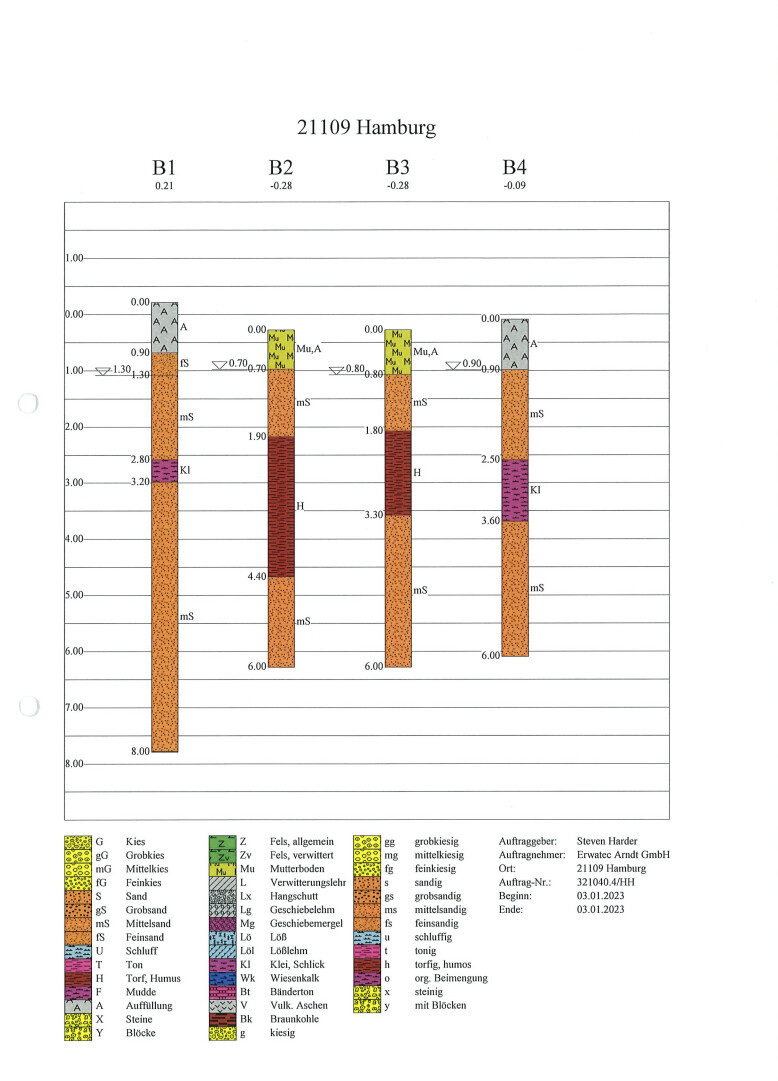
The soil looks like in the picture: one side is quite okay, but the other has significant peat layers.
Are there alternatives to a very expensive pile foundation? In this neighborhood, hardly any house has a pile foundation because most were built in the 1990s, when less attention was paid to this.
I would be grateful for any alternatives. However, soil replacement is not an option, as groundwater is expected from a depth of 1 meter (3 feet).
Thanks in advance for your creative suggestions.
🙂
I need your help.
I have a plot with an old building and now want to construct a semi-detached house there.
It will be a timber frame house, not a solid masonry building. For this, a soil survey was necessary, which I have commissioned.
The soil looks like in the picture: one side is quite okay, but the other has significant peat layers.
Are there alternatives to a very expensive pile foundation? In this neighborhood, hardly any house has a pile foundation because most were built in the 1990s, when less attention was paid to this.
I would be grateful for any alternatives. However, soil replacement is not an option, as groundwater is expected from a depth of 1 meter (3 feet).
Thanks in advance for your creative suggestions.
🙂
W
WilderSueden7 Mar 2023 13:24I find it hard to believe that soil replacement down to 4.5 meters (15 feet) depth is significantly cheaper. In that case, it might be worth considering building a basement in the groundwater. Certainly the most expensive solution, but in the end, you get a basement instead of just burying gravel for 50,000.

Peat lenses are problematic as well. They can actually occur very locally. Everything around can be fine because it’s sand, but right in the middle, there might have been a marshy pond.
Regarding water pumping, @Allthewayup recently gained some experience.
Maybe he can help you, or you could read through his thread...
https://www.hausbau-forum.de/threads/grundwasserabsenkung-laut-bodengutachten-eure-erfahrungen.43117/
Regarding water pumping, @Allthewayup recently gained some experience.
Maybe he can help you, or you could read through his thread...
https://www.hausbau-forum.de/threads/grundwasserabsenkung-laut-bodengutachten-eure-erfahrungen.43117/
Yep, as already mentioned, soil replacement is not economical due to the depth and water management. The peat either needs to be removed or improved through deep soil mixing.
In this case, the only feasible foundation option is unfortunately piles.
I would recommend getting quotes from Keller Grundbau or Menard. They tend to be a bit more affordable.
Menard uses CNC piles, which are not precast concrete piles but are installed using displacement methods.
This can sometimes be a bit cheaper.
Unfortunately, everything is more expensive than a conventional foundation.
In this case, the only feasible foundation option is unfortunately piles.
I would recommend getting quotes from Keller Grundbau or Menard. They tend to be a bit more affordable.
Menard uses CNC piles, which are not precast concrete piles but are installed using displacement methods.
This can sometimes be a bit cheaper.
Unfortunately, everything is more expensive than a conventional foundation.
raven_on schrieb:
The recommendation of course states that a pile foundation should be used.
So I’m asking if you perhaps know of any alternatives? If there are alternatives, they are listed in the BGG.
raven_on schrieb:
or say that you have to take care of everything yourself up to and including the slab, which of course also has some implications for the warranty. In that case, there is none—meaning no warranty for the entire house. I wouldn’t recommend doing that.
raven_on schrieb:
It’s really unfortunate if there is no alternative, and 60 houses around didn’t need pile foundations—but oh well 😀 Structural engineering has existed since the 1990s. My parents also decided against pile foundations and chose to replace the soil instead because of groundwater at one meter depth (3 feet). That was in 1978. Even back then, it was a financial burden.
A
Allthewayup8 Mar 2023 20:07Difficult situation. If I understand correctly, you encountered peat and silt at several boreholes down to a depth of 4.4 meters (14.4 feet). That is really unfortunate but not uncommon for the Hamburg area (if I read that right).
Without having seen the soil report, I can only say in general that soil replacement considering the high (ground)water level is hardly economically feasible. You would effectively need to lower the water column by 3.3 meters (10.8 feet). This is usually avoided; instead, sheet piling is used with only partial water retention. However, the excavation pit for the apartment building is quite large, and the sheet piles must reach down to the impermeable layer; otherwise, there is a risk of hydraulic uplift failure.
That is probably why the geologist named pile foundation as the only option.
A friend had a similar situation. The house was built on 16 precast concrete rings (DN1000), which extend 2.5 meters (8.2 feet) into the ground. Her groundwater was 1 meter (3.3 feet) below ground level, and soil replacement for a small single-family house would have cost around 70,000–80,000 with water retention, excavation, disposal, and backfilling. The precast concrete rings cost about 20,000. Water retention accounted for the largest share of the 80,000.
Did the geologist have the structural plans of your house when preparing the report? I understand you are not building a basement?!
Without having seen the soil report, I can only say in general that soil replacement considering the high (ground)water level is hardly economically feasible. You would effectively need to lower the water column by 3.3 meters (10.8 feet). This is usually avoided; instead, sheet piling is used with only partial water retention. However, the excavation pit for the apartment building is quite large, and the sheet piles must reach down to the impermeable layer; otherwise, there is a risk of hydraulic uplift failure.
That is probably why the geologist named pile foundation as the only option.
A friend had a similar situation. The house was built on 16 precast concrete rings (DN1000), which extend 2.5 meters (8.2 feet) into the ground. Her groundwater was 1 meter (3.3 feet) below ground level, and soil replacement for a small single-family house would have cost around 70,000–80,000 with water retention, excavation, disposal, and backfilling. The precast concrete rings cost about 20,000. Water retention accounted for the largest share of the 80,000.
Did the geologist have the structural plans of your house when preparing the report? I understand you are not building a basement?!
Similar topics