
Hello everyone,
I would like to get your expert opinion on an issue I am currently discussing with the shell construction company. It concerns an obvious thermal bridge that became apparent in January (about 9 months after completion).
Problem:
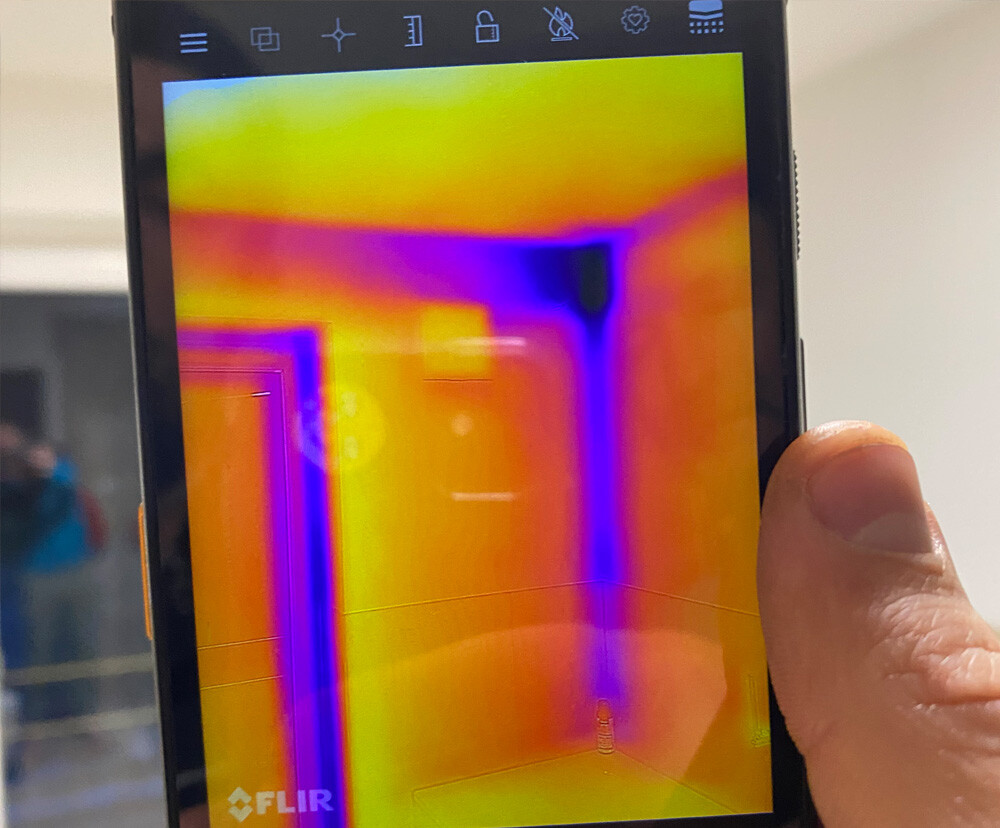
In the corner near the ceiling of the bathroom on the exterior wall, mold has developed. The masonry in that area feels noticeably colder to the touch compared to other places. A thermal imaging camera was used to take a photo, which I have attached below. It clearly shows the presence of a thermal bridge.
This is a room under the roof, above which there is a shallow attic. The intermediate ceiling is insulated, and the roof is fully insulated with external insulation. The other rooms in the attic have exposed rafters, and only in the bathroom was the intermediate ceiling installed to improve ventilation. The attic has no leaks or drafts and its temperature is moderate to cool (since it is not directly heated), but not cold.
The "problem corner" is located directly under the roof on the northwest side of the house. See photos. The masonry consists of 40cm (16 inches) Ytong blocks with a few centimeters of insulating plaster on top.
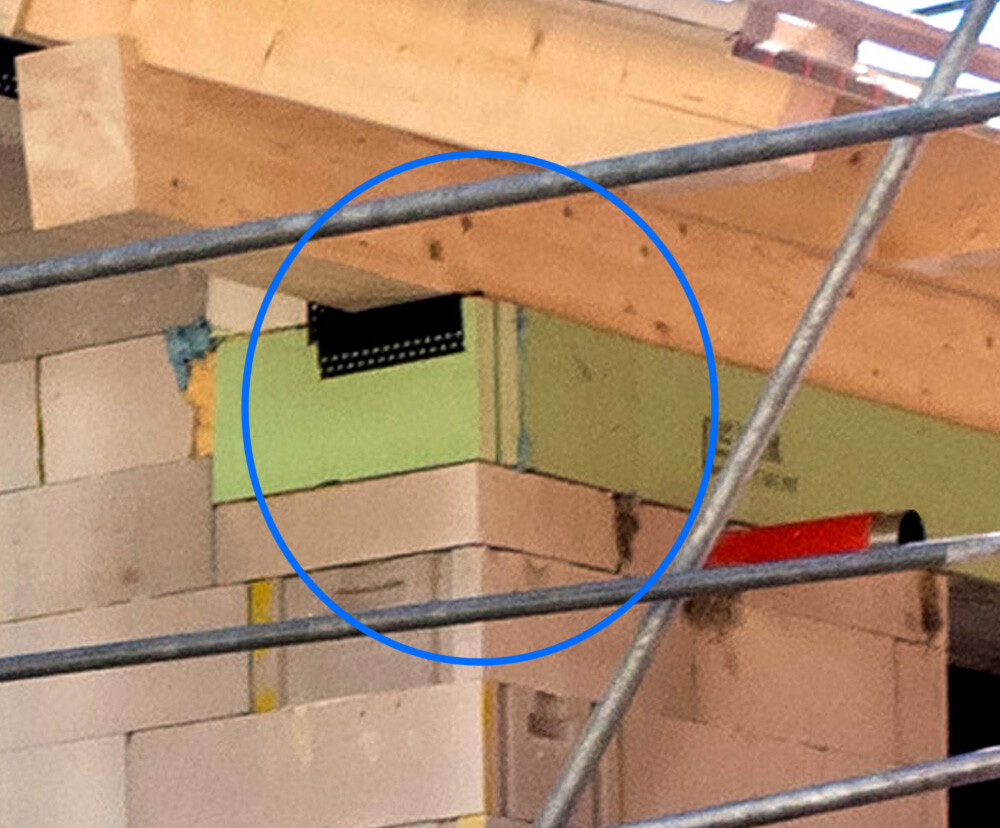
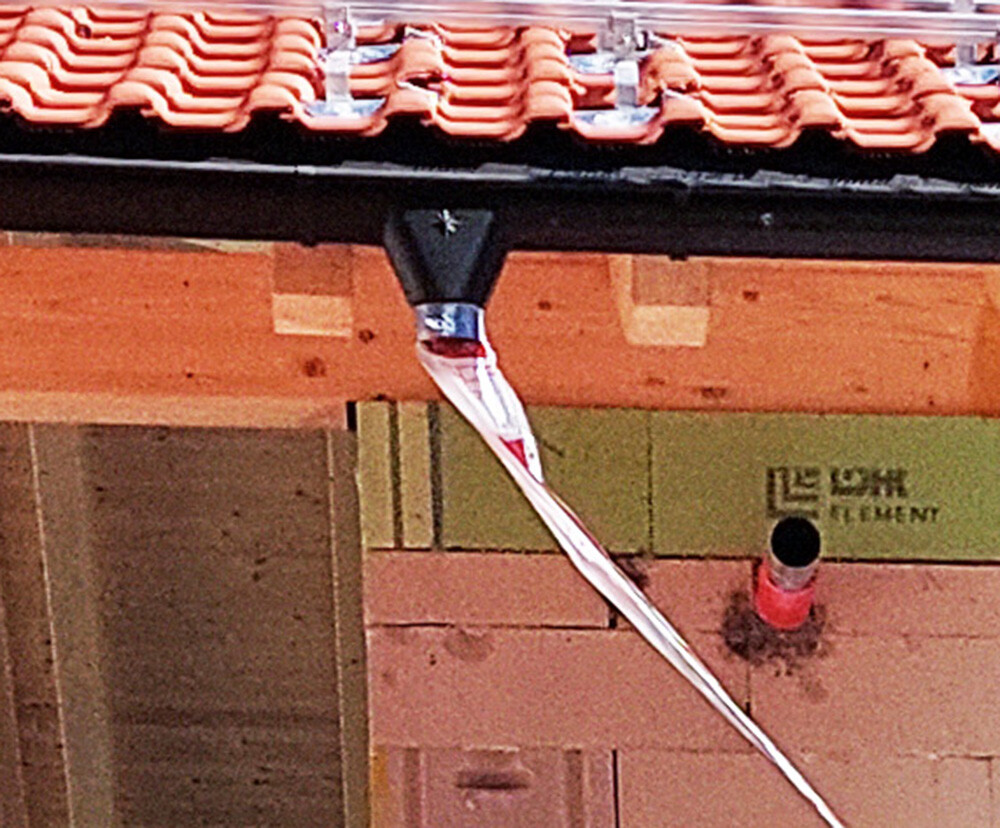
The shell builder acknowledges the issue but suggests it might originate from the roof (understandably trying to shift responsibility). Fortunately, I took photos during the shell construction phase, attached here. My suspicion is that the insulation at the ring beam is not properly installed. The spot is clearly visible in the two photos. The green insulation looks different at other corners of the house, without this gray vertical gap. The builder claims the gap is not continuous but is just the groove of the insulation panels interlocked there, which is normal.
By the way, the bathroom was properly ventilated, morning and evening along with the rest of the house, and after every shower. I have a hygrometer in the room, and the humidity levels stay between 45% and a maximum of 65%.
I don’t have enough knowledge in this area, so my question is: Does anyone have an idea of what else could cause this and what the most likely reason is?
Thank you in advance!!
I would like to get your expert opinion on an issue I am currently discussing with the shell construction company. It concerns an obvious thermal bridge that became apparent in January (about 9 months after completion).
Problem:
In the corner near the ceiling of the bathroom on the exterior wall, mold has developed. The masonry in that area feels noticeably colder to the touch compared to other places. A thermal imaging camera was used to take a photo, which I have attached below. It clearly shows the presence of a thermal bridge.
This is a room under the roof, above which there is a shallow attic. The intermediate ceiling is insulated, and the roof is fully insulated with external insulation. The other rooms in the attic have exposed rafters, and only in the bathroom was the intermediate ceiling installed to improve ventilation. The attic has no leaks or drafts and its temperature is moderate to cool (since it is not directly heated), but not cold.
The "problem corner" is located directly under the roof on the northwest side of the house. See photos. The masonry consists of 40cm (16 inches) Ytong blocks with a few centimeters of insulating plaster on top.
The shell builder acknowledges the issue but suggests it might originate from the roof (understandably trying to shift responsibility). Fortunately, I took photos during the shell construction phase, attached here. My suspicion is that the insulation at the ring beam is not properly installed. The spot is clearly visible in the two photos. The green insulation looks different at other corners of the house, without this gray vertical gap. The builder claims the gap is not continuous but is just the groove of the insulation panels interlocked there, which is normal.
By the way, the bathroom was properly ventilated, morning and evening along with the rest of the house, and after every shower. I have a hygrometer in the room, and the humidity levels stay between 45% and a maximum of 65%.
I don’t have enough knowledge in this area, so my question is: Does anyone have an idea of what else could cause this and what the most likely reason is?
Thank you in advance!!
guckuck2 schrieb:
A structural weakness of monolithic walls lies in the concrete ceilings. For this, ring beam formworks with insulation layers (either inside the formwork or on the outside) are used. Was something like this applied?I did some research. Edge formworks for the ceilings were used, which have tongue and groove joints at the ends (see image below). My assumption is that the groove on the formwork coming in from the right at a right angle was not cut off, and the gap was simply covered with plaster. Otherwise, the second gap (arrow) cannot be explained. The first "gap" to the left is the groove, which is actually correct.
sub-xero schrieb:
The thermal imaging camera did not show any irregularities from the outside. That cannot be true; as the name suggests, heat transmission actually passes through.
sub-xero schrieb:
Unfortunately, I did not take a picture from the inside at the corner, but I did in another room. Then you should make up for that.
sub-xero schrieb:
A cold bridge only exists in the room described above. That is not surprising, as you mentioned that the ceiling is missing in the other rooms.
sub-xero schrieb:
My assumption was that it is due to the insulation attached to the outside of the ring beam. Yes, and as I already said, the ring beam is positioned relatively low. Wrapping it with thicker insulation is hardly possible because it would likely be weakened too much. Your images also suggest that the insulation was applied only on the outside. That would be a mistake. In this case, applying insulation on the inside might have been the better solution.
https://www.instagram.com/11antgmxde/
https://www.linkedin.com/company/bauen-jetzt/
A
Allthewayup19 Feb 2023 20:04sub-xero schrieb:
I did some research. Edge formwork panels were used, featuring tongue and groove joints on the ends (see image below). My assumption is that, at the formwork meeting at a right angle from the right side, the tongue was not trimmed off, and the gap was simply covered over with plaster. This would explain the second gap (arrow). The first "gap" to the left is actually the groove, which is correct. Do you think the gap marked by the arrow remained open and was just plastered over? To verify this, the only option would be to partially open the facade and check whether the gap was indeed "forgotten" and left unsealed. If that is the case, the cause can be quite easily fixed by filling the gap with insulation.
11ant schrieb:
Yes, and as I already mentioned, the ring beam is positioned relatively low. It can hardly be wrapped thicker because adding more insulation would likely weaken it too much. Your images also suggest that the insulation was applied only on the exterior side. That would be a mistake. In this case, applying insulation only on the interior side might actually be the better solution. What do you mean by "too low"? You can’t raise it higher because that would increase the height of the house. I don’t quite understand why the insulation should be installed on the inside of the ring beam. That’s not common practice; see also here:
[IMG width="484px"]https://www.sanier.de/wp-content/uploads/images/ringanker-Dämmung-grafik-us.jpg[/IMG]
Allthewayup schrieb:
Is the gap marked with the arrow an open joint that was just covered with plaster, in your opinion? To check this, the only option would be to partially open the facade and see whether the gap was actually "forgotten" to be closed. If that’s the case, the cause can be quite easily fixed, and the gap can be sealed with insulation. Yes, I suspect that a gap remained that was only covered with plaster. At all other corners of the house, no gap is visible. That would also be my suggestion: the shell construction company should open it up there, inspect, and correct it if necessary.

sub-xero schrieb:
What do you mean by too low? You can’t raise it, otherwise the house would become taller. I don’t quite understand why the insulation of the ring beam should be installed on the inside? I suspect @11ant means this issue:
So "too low" in relation to the upper floor slab or its insulation. The floor slab insulation should connect at the level of, or better below, the ring beam if the ring beam itself is not insulated on all sides, in order to create a fully continuous thermal envelope.
It’s quite similar for me, except that in my case it does not lead to such significant thermal bridges.
More like this:
Because U-shaped blocks were used in my case, and the insulation is placed inside the block and shifted further inward, the thermal bridge at that point is smaller.
The fully correct approach would probably be like this:
Keep in mind, in the end the exact construction does not matter; certain values need to be met.
For example, at 20°C (68°F) indoor temperature and -5°C (23°F) outdoor temperature, the temperature on the inside of the exterior wall must not fall below 12.6°C (54.7°F).
An expert can calculate and prove this for other temperature conditions as well. If the thermal bridge at that point is too large, then there is a defect; otherwise (probably) not. So the defect is not necessarily in the construction itself.
Similar topics