
ᐅ Building to the Energy Saving Ordinance 2016 or to KfW55 standards
Created on: 16 Jun 2021 13:08
R
Raiweired
Hello,
I have been following the forum for a few weeks and have an important question before signing the fixed-price contract.
I am building a turnkey city villa (catalog home) with an air-to-water heat pump, living area approximately 118 sqm (1272 sq ft), and the planning contract has already been awarded. The general contractor offers a standard build according to the Energy Saving Ordinance 2016 and charges an additional approximately 13,000.00 Euro for upgrading to KfW55 standards, which includes improved insulation under the slab and ceiling above the upper floor, as well as exchanging Poroton T12 bricks for Poroton T9 bricks.
The subsidy for KfW55 is 18,000.00 Euro, and the subsidy for KfW55 EE is up to 26,250.00 Euro.
If I build to KfW55 standards, I expect additional costs of 13,000.00 Euro for the improved insulation, 2,000.00 Euro for the energy consultant, and 10,000.00 Euro for a decentralized ventilation system. That would use up the subsidy entirely. According to my research, the annual savings in electricity costs for the air-to-water heat pump compared to the Energy Saving Ordinance 2016 are only about 100.00 Euro per year.
Of course, the higher market value potentially achieved when selling the house speaks in favor of KfW55, but I do not plan to sell.
Otherwise, the savings compared to the Energy Saving Ordinance 2016 to KfW55 are only marginal. Additional ventilation also brings maintenance costs. With KfW55, the building envelope is sealed so tightly that fresh air must be supplied again via fans. You pay for the increased insulation and then for the ventilation needed to compensate. Houses built to the Energy Saving Ordinance 2016 are not as airtight and do not require ventilation systems.
I am opening this topic for discussion.
I look forward to hearing the various opinions.
Regards, Raiweired
I have been following the forum for a few weeks and have an important question before signing the fixed-price contract.
I am building a turnkey city villa (catalog home) with an air-to-water heat pump, living area approximately 118 sqm (1272 sq ft), and the planning contract has already been awarded. The general contractor offers a standard build according to the Energy Saving Ordinance 2016 and charges an additional approximately 13,000.00 Euro for upgrading to KfW55 standards, which includes improved insulation under the slab and ceiling above the upper floor, as well as exchanging Poroton T12 bricks for Poroton T9 bricks.
The subsidy for KfW55 is 18,000.00 Euro, and the subsidy for KfW55 EE is up to 26,250.00 Euro.
If I build to KfW55 standards, I expect additional costs of 13,000.00 Euro for the improved insulation, 2,000.00 Euro for the energy consultant, and 10,000.00 Euro for a decentralized ventilation system. That would use up the subsidy entirely. According to my research, the annual savings in electricity costs for the air-to-water heat pump compared to the Energy Saving Ordinance 2016 are only about 100.00 Euro per year.
Of course, the higher market value potentially achieved when selling the house speaks in favor of KfW55, but I do not plan to sell.
Otherwise, the savings compared to the Energy Saving Ordinance 2016 to KfW55 are only marginal. Additional ventilation also brings maintenance costs. With KfW55, the building envelope is sealed so tightly that fresh air must be supplied again via fans. You pay for the increased insulation and then for the ventilation needed to compensate. Houses built to the Energy Saving Ordinance 2016 are not as airtight and do not require ventilation systems.
I am opening this topic for discussion.
I look forward to hearing the various opinions.
Regards, Raiweired
N
nordanney7 Jul 2021 13:42mete111 schrieb:
The advantage for us is that the house doesn’t have to be wrapped in plastic sheeting, nor does it require a ventilation system. Uh – does that mean your place will be drafty, or how should I understand that? The house is just as airtight as with external thermal insulation composite systems (ETICS), which by the way don’t necessarily have to be plastic—there are plenty of alternatives. It still needs to be ventilated properly. Whether monolithic construction or ETICS, that doesn’t affect the ventilation requirements.
Most general contractors achieve energy efficiency by applying external insulation to the facade. This includes a vapor barrier membrane. To prevent excessive indoor humidity, this is usually combined with a central ventilation system. Such a ventilation system is also more efficient when airing out, as energy does not simply escape through open windows.
For us, this was not an option. I do not want an airtight house (indoor climate) nor external insulation on the facade. I think this solution can work for older buildings, but since I am building new, I choose the masonry so that the bricks provide sufficient insulation properties. We decided on Poroton T8 bricks with a wall thickness of 42.5cm (17 inches). Naturally, this is a cost consideration and only applies if you are building with solid masonry.
But as mentioned, the KfW subsidy covers almost all additional costs, and the improved building quality is your “profit.”
By the way:
I am not generally against ventilation systems. If your budget allows, it can certainly be added as well. I would just make sure that the ventilation system is not required to meet the KfW 55 standards.
Just my 2 cents.
For us, this was not an option. I do not want an airtight house (indoor climate) nor external insulation on the facade. I think this solution can work for older buildings, but since I am building new, I choose the masonry so that the bricks provide sufficient insulation properties. We decided on Poroton T8 bricks with a wall thickness of 42.5cm (17 inches). Naturally, this is a cost consideration and only applies if you are building with solid masonry.
But as mentioned, the KfW subsidy covers almost all additional costs, and the improved building quality is your “profit.”
By the way:
I am not generally against ventilation systems. If your budget allows, it can certainly be added as well. I would just make sure that the ventilation system is not required to meet the KfW 55 standards.
Just my 2 cents.
C
Chris25117 Jul 2021 14:15Here the 2016 Energy Saving Ordinance applies without ventilation; the house has an airtight envelope but no membrane, and of course it had to pass the blower door test.
Basement solid construction with Poroton brick T12 36cm (14 inches),
Ground floor + attic entirely timber frame house with approx. 34.8-38.8cm (14-15 inches) exterior walls, U-value 0.13-0.15 W/m²K
+ exterior plaster
+ 6cm (2.5 inches) wood fiberboard
+ 6/20 and 6/24 dual-lamella timber studs with 20-24cm (8-9.5 inches) blown-in insulation
+ 1.5cm (0.6 inches) OSB
+ 6cm (2.5 inches) installation cavity with wood fiber insulation board
+ 1.5cm (0.6 inches) OSB (joints sealed with airtight tape = airtight envelope)
+ 1.3cm (0.5 inches) gypsum plasterboard
+ painter’s fleece + interior paint
Roof assembly including
+ tiles
+ 3cm (1.2 inches) counter battens
+ 3cm (1.2 inches) counter counter battens
+ 1.6cm (0.6 inches) diffusion-open wood fiberboard
+ 8/24cm (3/9.5 inches) solid timber rafters with 24cm (9.5 inches) blown-in insulation
+ 1.2cm (0.5 inches) OSB board, joints sealed
+ 3cm (1.2 inches) counter battens
+ 1.3cm (0.5 inches) gypsum plasterboard
Temperatures during the first hot weeks were absolutely comfortable. Maximum room temperature in the attic around 24°C (75°F) with 35°C (95°F) outside. The air-to-water heat pump is then used only for hot water.
Here is a temperature comparison from the weather station on the roof outside and, on the same day, inside the ground floor living area. It had already been hot for several days. At night, just always ventilate well.
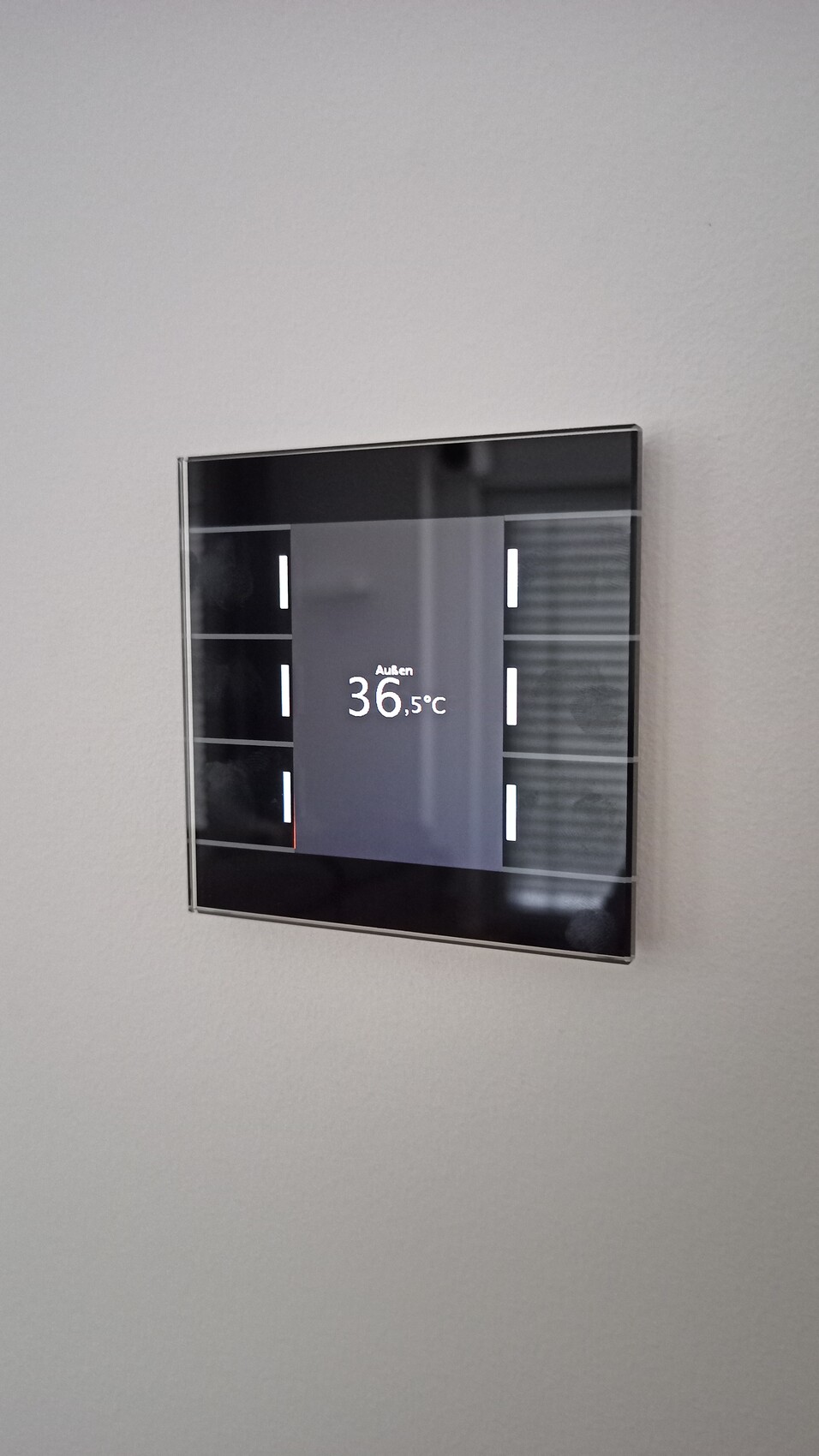
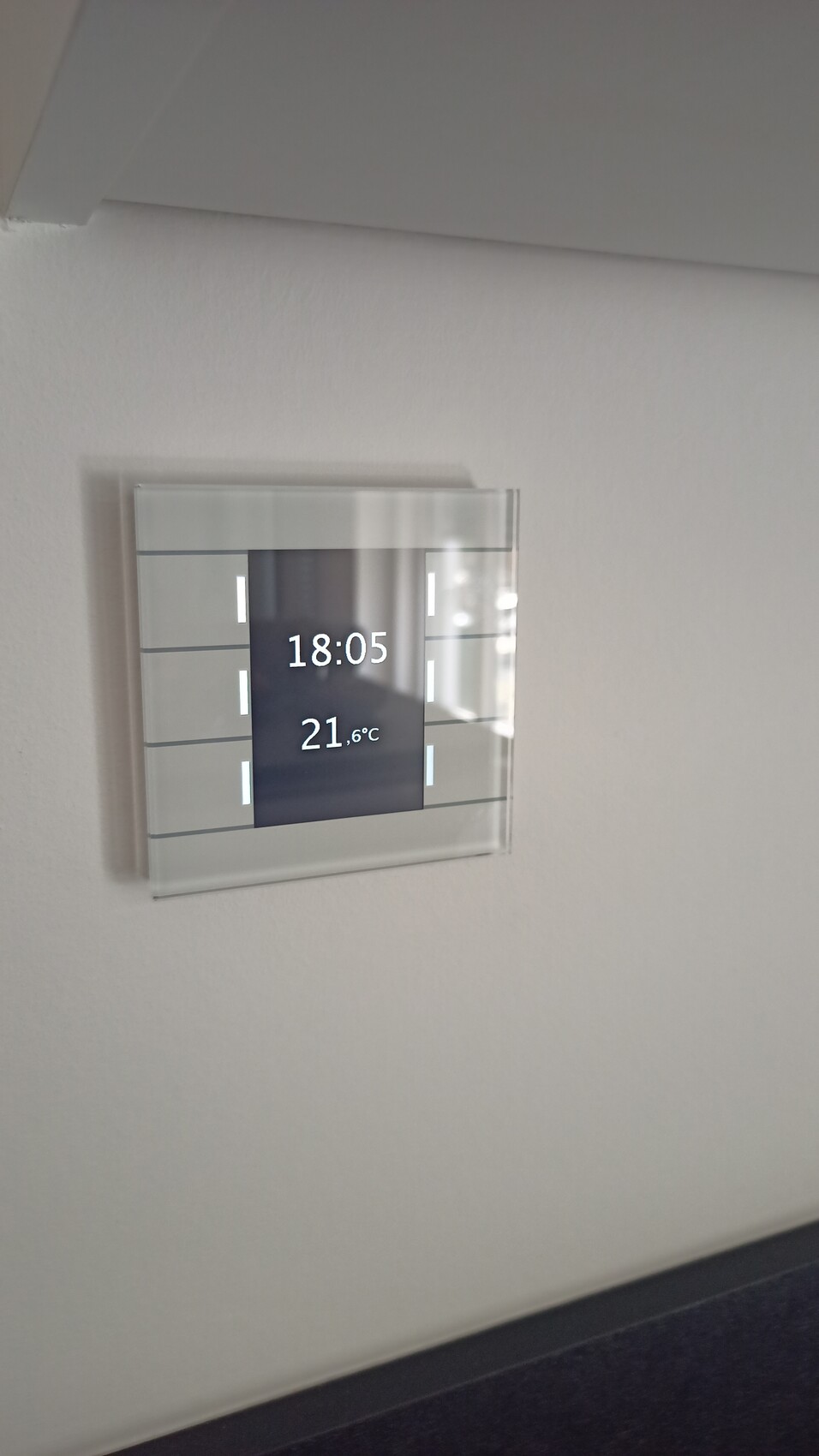
Basement solid construction with Poroton brick T12 36cm (14 inches),
Ground floor + attic entirely timber frame house with approx. 34.8-38.8cm (14-15 inches) exterior walls, U-value 0.13-0.15 W/m²K
+ exterior plaster
+ 6cm (2.5 inches) wood fiberboard
+ 6/20 and 6/24 dual-lamella timber studs with 20-24cm (8-9.5 inches) blown-in insulation
+ 1.5cm (0.6 inches) OSB
+ 6cm (2.5 inches) installation cavity with wood fiber insulation board
+ 1.5cm (0.6 inches) OSB (joints sealed with airtight tape = airtight envelope)
+ 1.3cm (0.5 inches) gypsum plasterboard
+ painter’s fleece + interior paint
Roof assembly including
+ tiles
+ 3cm (1.2 inches) counter battens
+ 3cm (1.2 inches) counter counter battens
+ 1.6cm (0.6 inches) diffusion-open wood fiberboard
+ 8/24cm (3/9.5 inches) solid timber rafters with 24cm (9.5 inches) blown-in insulation
+ 1.2cm (0.5 inches) OSB board, joints sealed
+ 3cm (1.2 inches) counter battens
+ 1.3cm (0.5 inches) gypsum plasterboard
Temperatures during the first hot weeks were absolutely comfortable. Maximum room temperature in the attic around 24°C (75°F) with 35°C (95°F) outside. The air-to-water heat pump is then used only for hot water.
Here is a temperature comparison from the weather station on the roof outside and, on the same day, inside the ground floor living area. It had already been hot for several days. At night, just always ventilate well.
mete111 schrieb:
This includes a vapor barrier membrane.Well, I might have dozed off during the structural engineering lectures, but since when are membranes installed in walls?N
nordanney7 Jul 2021 14:29mete111 schrieb:
This includes a vapor barrier membrane. I have never heard of such a membrane being installed with ETICS (External Thermal Insulation Composite System). That makes no sense.
mete111 schrieb:
I don’t want an airtight house. Then why are you building one? If it’s KfW 55 standard, there will be a blower door test. And the result must be as good as for any other KfW 55 house. So your house will be just as airtight.
mete111 schrieb:
To prevent high indoor humidity, this is usually combined with a central ventilation system. Since we just established that your house is airtight as well, I’m curious what you do about the high humidity.
mete111 schrieb:
Better building fabric is then your “gain.” Better building fabric compared to ETICS?
By the way, my house is also being built to KfW 55 standard. I am getting ETICS as well, but as usual without a membrane. Mineral wool, rigid foam insulation, render.
H
hampshire7 Jul 2021 14:31Chris2511 schrieb:
Here, the 2016 energy saving regulation without ventilation, the house has an airtight envelope but everything without foil, and of course it had to pass the blower door test. I keep hearing that. There was no blower door test for our house.
Similar topics