
ᐅ Building a Sauna Yourself with a Sloped Ceiling – Suggestions, Tips, and Planning Advice
Created on: 24 Nov 2020 10:14
M
matte
Hello! [IMG alt=" 🙂"]https://saunabauen.de/forum/images/smilies/icon_smile.gif[/IMG]
I’d like to start this thread to get help and feedback on my plan to build a sauna myself. Of course, this thread can also be used for any topics related to sauna construction.
We decided to get a sauna, and since a prefabricated kit was not an option and a custom build was too expensive, I decided to take matters into my own hands.
When we built our house three years ago, we reserved space for a sauna at the top near the roof terrace. Unfortunately, instead of a planned flat roof, we had to install a sloped roof to get the building permit / planning permission.
This results in a roof slope with knee wall height of 1.81m (5 ft 11 in) clear height.
There is a floor area of 2.10m (83 inches) wide and 1.91m (75 inches) deep available.
The height is additionally limited by a fresh air vent on the higher side. The bottom edge of the vent is located at 2.05m (6 ft 9 in) above the finished floor level.
My idea is to build the sauna ceiling at 2.05m (6 ft 9 in) height to still be able to access this vent if necessary. According to my plan, the clear interior height inside the sauna would then be about 1.995m (6 ft 6.5 in).
The sauna will be surrounded on three sides by exterior walls (Poroton T9 masonry).
The ceiling is attached directly to the beams and vapor barrier, without counter battens. This was necessary because otherwise the terrace door would not be able to open. The architect missed that... : [IMG alt=":roll:"]https://saunabauen.de/forum/images/smilies/icon_rolleyes.gif[/IMG]
The floor is fine stoneware tiles on a screed layer with underfloor heating.
We have a three-phase power supply with 5x2.5mm² cable and a cable length of about 20m (66 ft). According to an electrician, this line should not restrict the project.
Since space is quite tight, I want to keep the wall construction as thin as possible.
Planned wall build-up:
1. Masonry with plaster
2. Vertical battens (24x48mm / 1x2 inches) with 24mm (1 inch) air gap for ventilation
3. OSB boards 15mm (0.6 inch)
4. KVH timber beams 40x60mm (1.5x2.5 inches), positioned so the 40mm (1.5 inch) side accommodates insulation
5. 40mm (1.5 inch) wood fiber insulation inside
6. No vapor barrier
7. 15mm (0.6 inch) profiled battens mounted horizontally
Now my questions:
1. Is my wall build-up feasible, or am I trying to save too much space? This would leave an interior floor dimension of nearly 1.92m x 1.75m (6 ft 3.5 in x 5 ft 9 in).
I’m 1.84m (6 ft 0.5 in) tall, so I should still have enough room to lie down comfortably.
2. We want to install a full glass door with a side panel to enjoy the outdoor view.
We plan to use 8mm (0.3 inch) tempered safety glass (ESG). Is that okay, or can this cause issues near the heater?
3. How do you connect the glass wall to the sauna structure? I thought about routing a groove around the KVH timber to set the glass in. Is that a good approach?
For the floor, I read that someone placed the glass on a silicone mat which was then trimmed flush. That sounds like a good solution to me.
3. The sauna floor area is 3.34m² (36 ft²) with an interior height of 1.995m (6 ft 6.5 in). Ignoring the slope, that gives a volume of 6.66m³ (235 ft³).
I read that for a glass door you add 1.5m³ (53 ft³) and for a glass wall the area (1.5m² / 16 ft²) multiplied by 1.2 as additional volume.
So, I’d end up with a total volume of 9.66m³ (341 ft³) and chose a 9kW heater accordingly. Does that sound right or oversized? I’m currently leaning towards the "Harvia The Wall" with external control.
4. Due to the heater’s position, there is essentially no room for a heater guard between the glass wall and heater. Is a guard necessary in a private sauna? I’m not too worried about it, but my wife is concerned.
The alternative would be to shift the lower bench slightly under the upper bench and move the heater, which would create space for a guard.
Alternatively, there is a glass protective shield with integrated lighting available that mounts in front of the heater. Would that be enough? I’m not too keen on wooden guards though... [IMG alt=";)"]https://saunabauen.de/forum/images/smilies/icon_wink.gif[/IMG]
5. A coworker recommended bench heights of 60cm and 120cm (24 and 47 inches). That would cause problems with the sauna height. I was thinking about 45cm and 90cm (18 and 35 inches) instead. Since we don’t want it very hot anyway, I see no reason for higher benches.
6. To avoid further reducing the roof slope height, I considered skipping the OSB boards there and mounting the KVH beams directly at a 24mm (1 inch) gap (batten distance) from the ceiling. Any issues with that?
7. We prefer the look of horizontally mounted profiled battens. Any objections? Given the tight space, I would skip additional rear ventilation. From what I’ve read, that’s not strictly necessary.
8. In my case, would it be better to use a different insulation material with a vapor barrier instead of wood fiber insulation?
9. The left wall with the glass door will be clad on the outside with profiled wood boards as well. This way I could install an access panel above the sauna to reach the fresh air vent if needed. Also, I could place the electronics for lighting and audio on the ceiling, making them accessible.
Can I mount the cladding boards directly on the KVH beams, or is an additional counter batten or similar required?
I want the wall to finish flush with the terrace door frame. To prevent the terrace door (especially the handle) from hitting the wall, I plan to install a stopper mounted on the KVH timber there.
That’s it for now. I’m curious what you think about my plan. I hope my post is not too long... [IMG alt=":?"]https://saunabauen.de/forum/images/smilies/icon_confused.gif[/IMG]
I’m attaching some pictures to show the current planning status. If you need more info, just ask.
Looking forward to any feedback [IMG alt=";)"]https://saunabauen.de/forum/images/smilies/icon_wink.gif[/IMG]
Thanks in advance!
Best regards
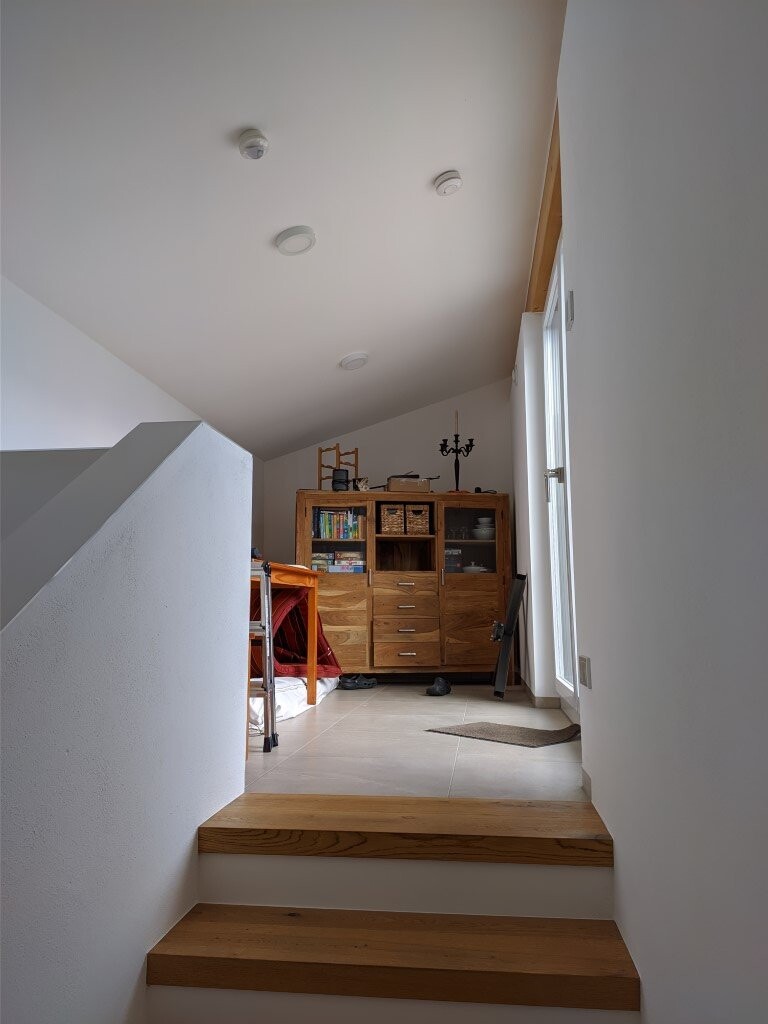
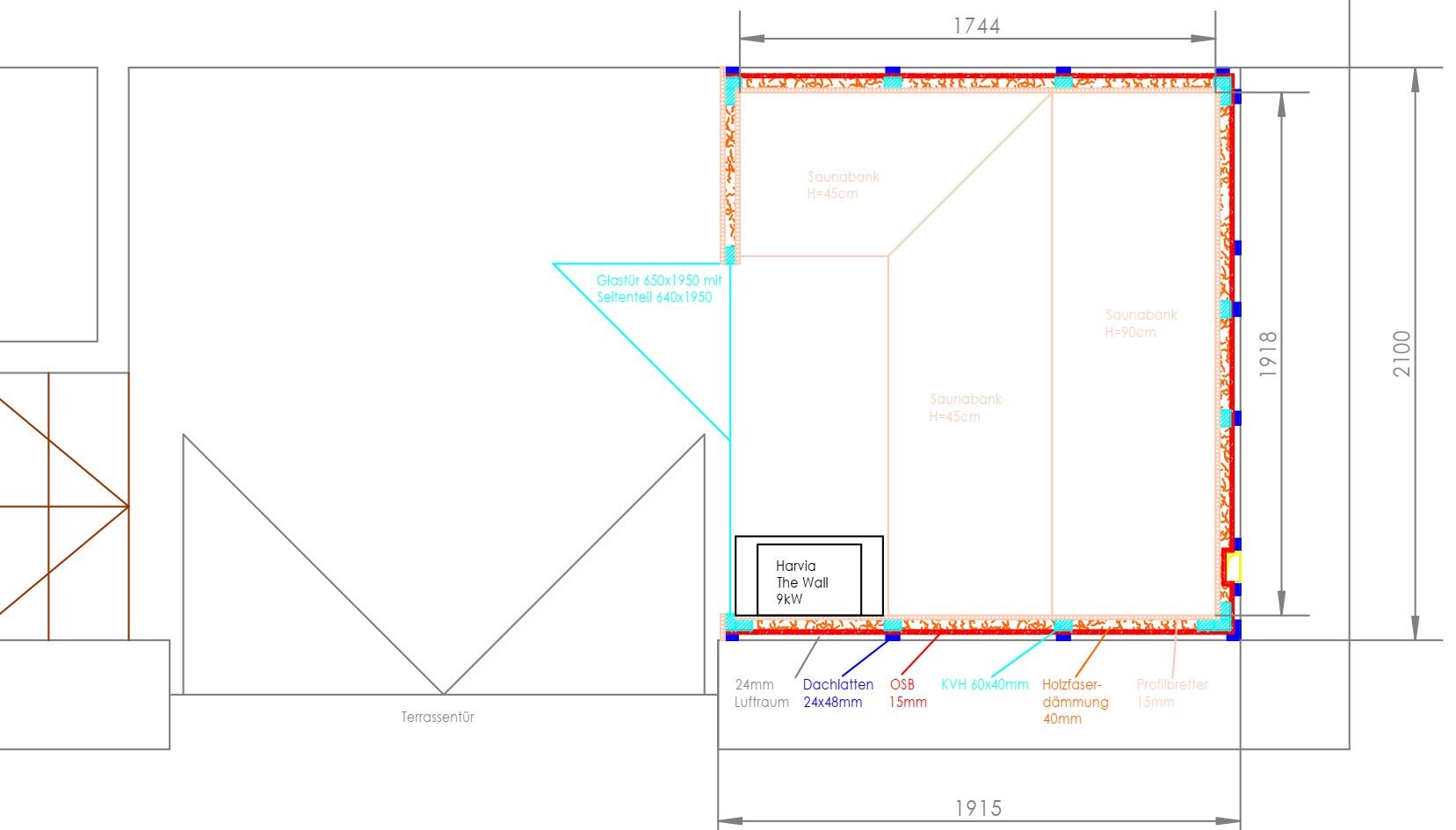
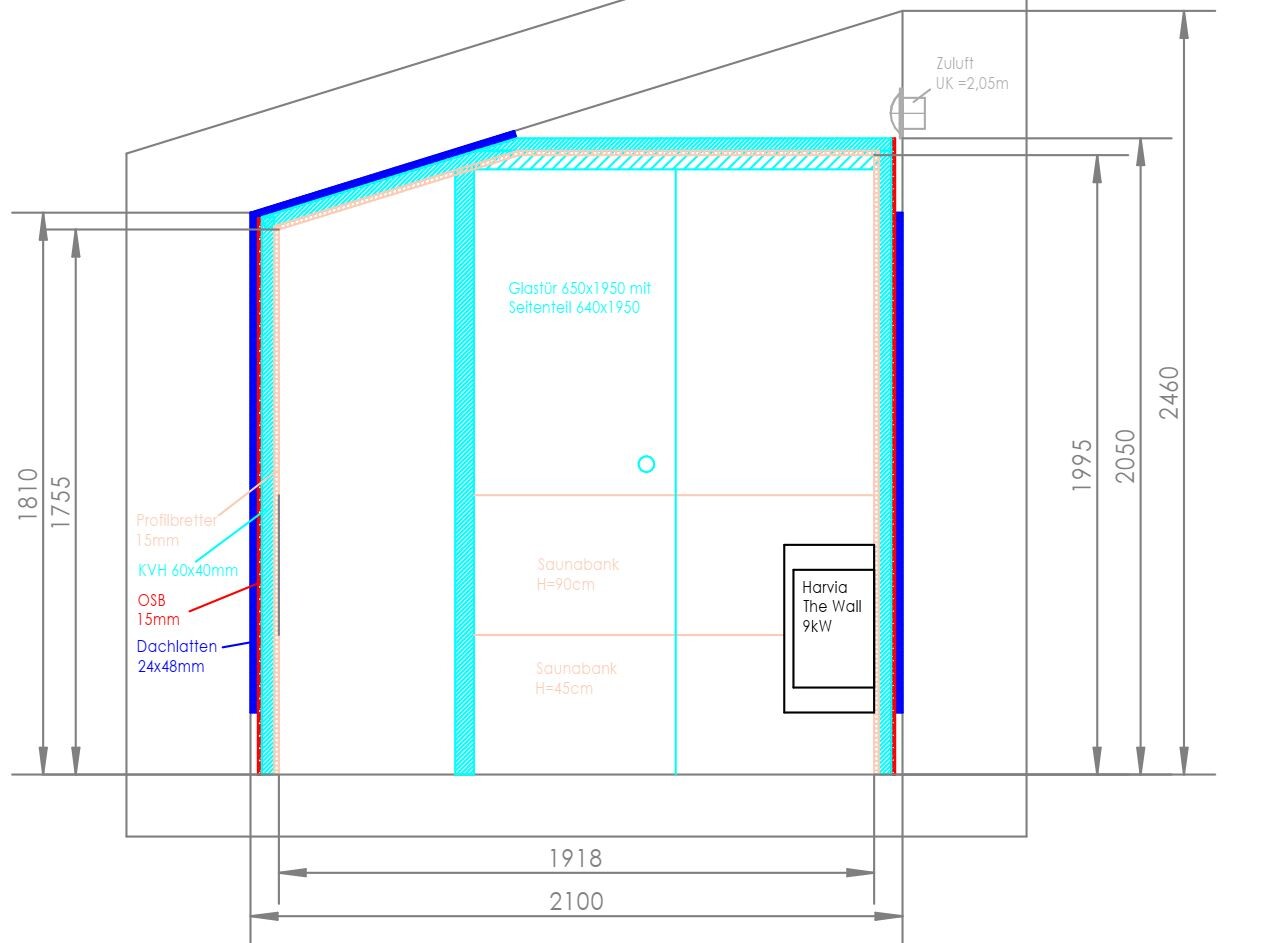
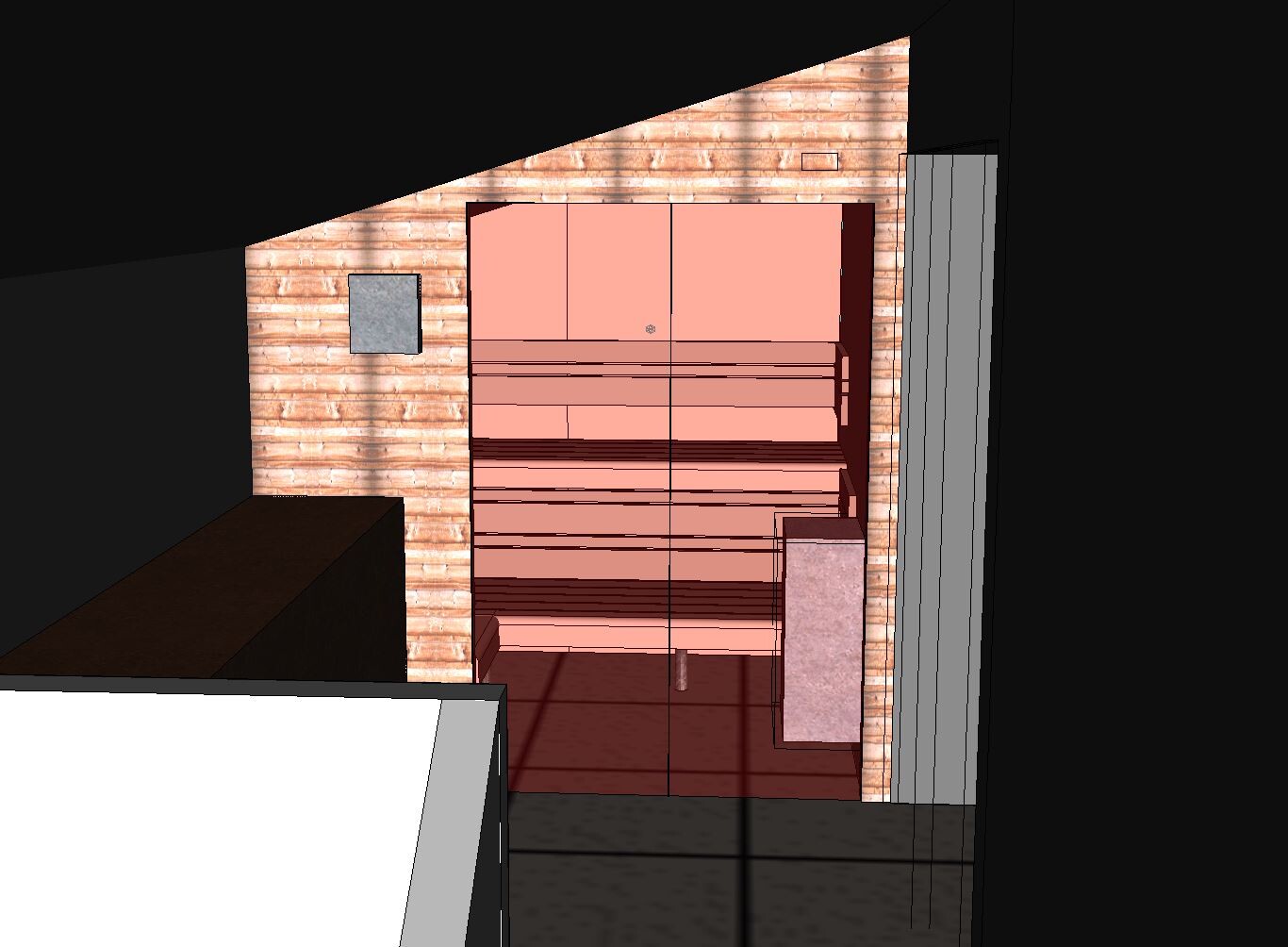
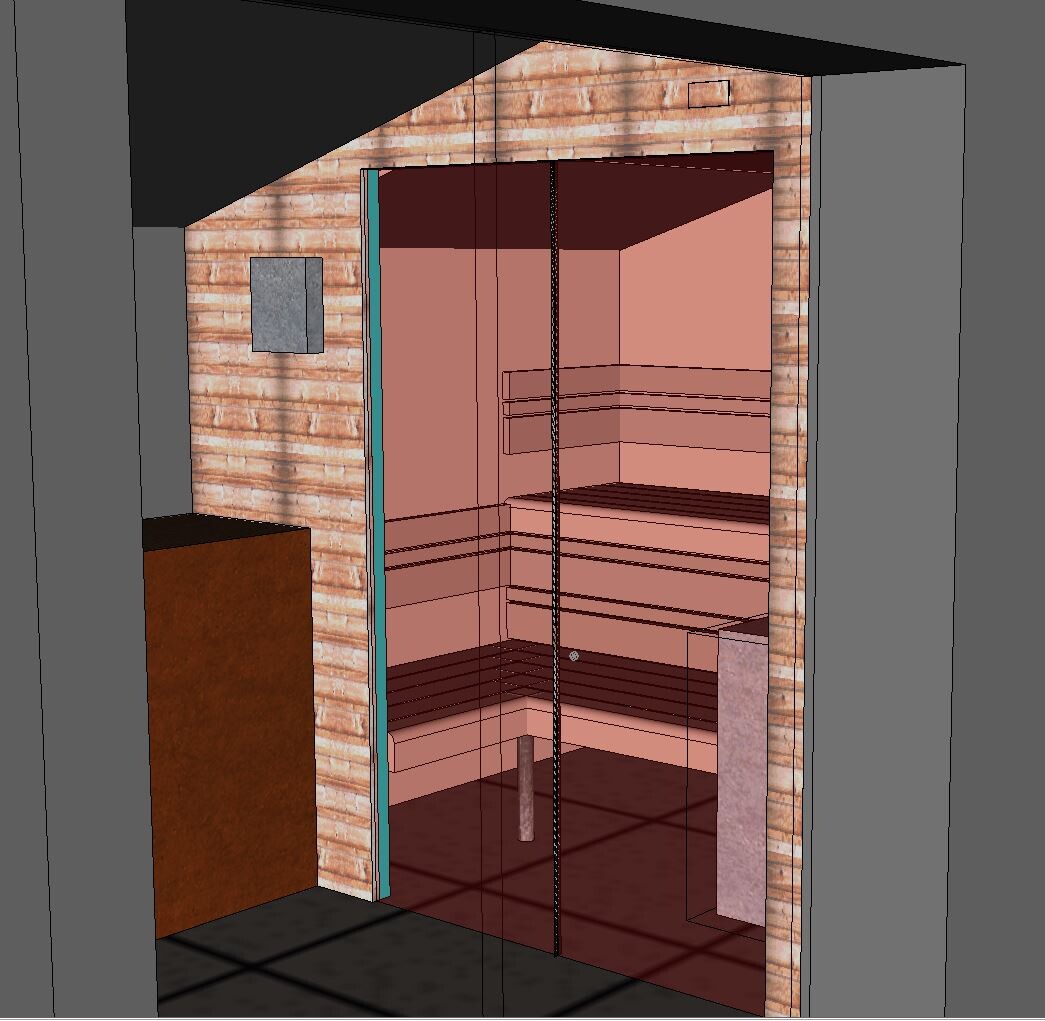
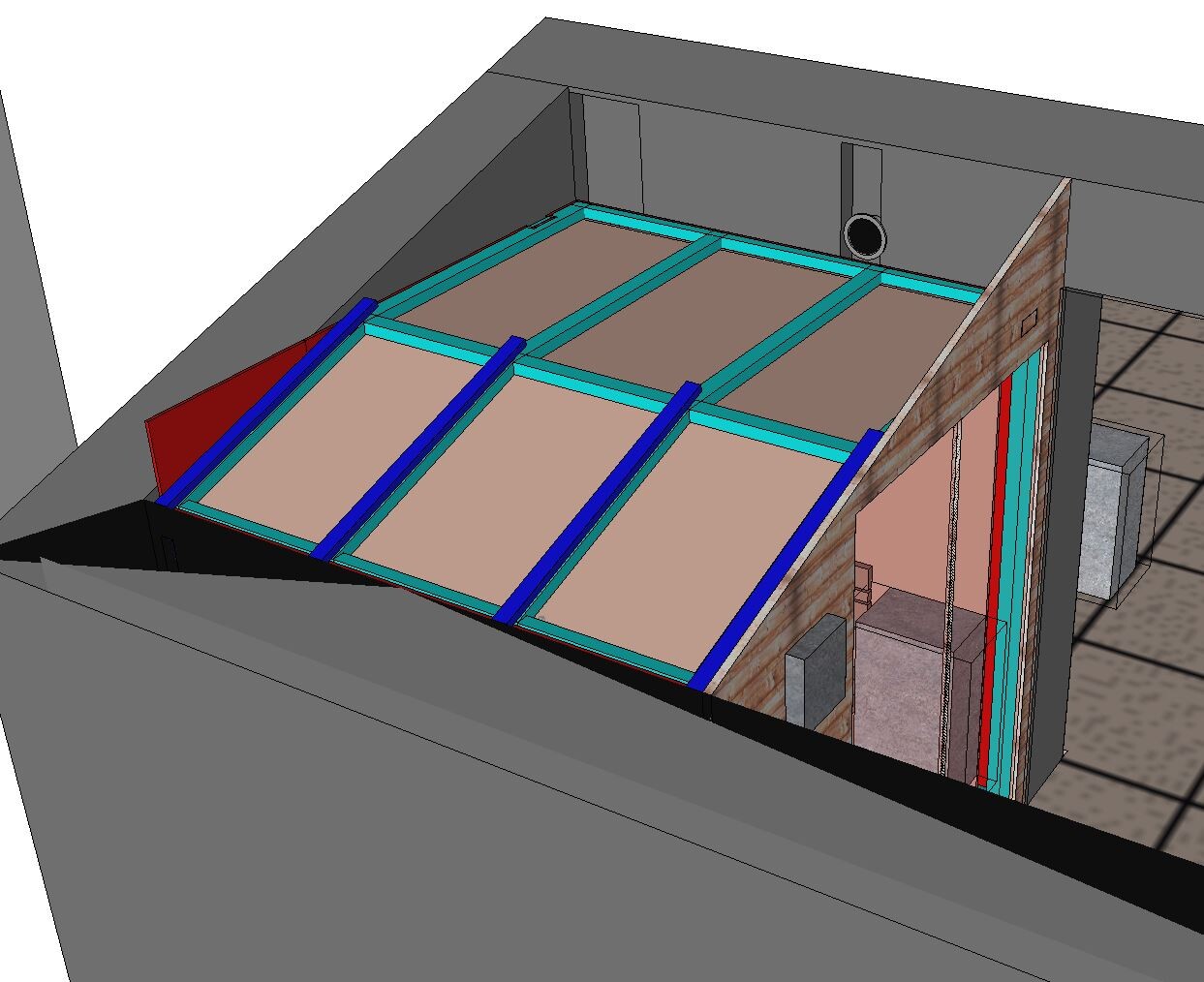
I’d like to start this thread to get help and feedback on my plan to build a sauna myself. Of course, this thread can also be used for any topics related to sauna construction.
We decided to get a sauna, and since a prefabricated kit was not an option and a custom build was too expensive, I decided to take matters into my own hands.
When we built our house three years ago, we reserved space for a sauna at the top near the roof terrace. Unfortunately, instead of a planned flat roof, we had to install a sloped roof to get the building permit / planning permission.
This results in a roof slope with knee wall height of 1.81m (5 ft 11 in) clear height.
There is a floor area of 2.10m (83 inches) wide and 1.91m (75 inches) deep available.
The height is additionally limited by a fresh air vent on the higher side. The bottom edge of the vent is located at 2.05m (6 ft 9 in) above the finished floor level.
My idea is to build the sauna ceiling at 2.05m (6 ft 9 in) height to still be able to access this vent if necessary. According to my plan, the clear interior height inside the sauna would then be about 1.995m (6 ft 6.5 in).
The sauna will be surrounded on three sides by exterior walls (Poroton T9 masonry).
The ceiling is attached directly to the beams and vapor barrier, without counter battens. This was necessary because otherwise the terrace door would not be able to open. The architect missed that... : [IMG alt=":roll:"]https://saunabauen.de/forum/images/smilies/icon_rolleyes.gif[/IMG]
The floor is fine stoneware tiles on a screed layer with underfloor heating.
We have a three-phase power supply with 5x2.5mm² cable and a cable length of about 20m (66 ft). According to an electrician, this line should not restrict the project.
Since space is quite tight, I want to keep the wall construction as thin as possible.
Planned wall build-up:
1. Masonry with plaster
2. Vertical battens (24x48mm / 1x2 inches) with 24mm (1 inch) air gap for ventilation
3. OSB boards 15mm (0.6 inch)
4. KVH timber beams 40x60mm (1.5x2.5 inches), positioned so the 40mm (1.5 inch) side accommodates insulation
5. 40mm (1.5 inch) wood fiber insulation inside
6. No vapor barrier
7. 15mm (0.6 inch) profiled battens mounted horizontally
Now my questions:
1. Is my wall build-up feasible, or am I trying to save too much space? This would leave an interior floor dimension of nearly 1.92m x 1.75m (6 ft 3.5 in x 5 ft 9 in).
I’m 1.84m (6 ft 0.5 in) tall, so I should still have enough room to lie down comfortably.
2. We want to install a full glass door with a side panel to enjoy the outdoor view.
We plan to use 8mm (0.3 inch) tempered safety glass (ESG). Is that okay, or can this cause issues near the heater?
3. How do you connect the glass wall to the sauna structure? I thought about routing a groove around the KVH timber to set the glass in. Is that a good approach?
For the floor, I read that someone placed the glass on a silicone mat which was then trimmed flush. That sounds like a good solution to me.
3. The sauna floor area is 3.34m² (36 ft²) with an interior height of 1.995m (6 ft 6.5 in). Ignoring the slope, that gives a volume of 6.66m³ (235 ft³).
I read that for a glass door you add 1.5m³ (53 ft³) and for a glass wall the area (1.5m² / 16 ft²) multiplied by 1.2 as additional volume.
So, I’d end up with a total volume of 9.66m³ (341 ft³) and chose a 9kW heater accordingly. Does that sound right or oversized? I’m currently leaning towards the "Harvia The Wall" with external control.
4. Due to the heater’s position, there is essentially no room for a heater guard between the glass wall and heater. Is a guard necessary in a private sauna? I’m not too worried about it, but my wife is concerned.
The alternative would be to shift the lower bench slightly under the upper bench and move the heater, which would create space for a guard.
Alternatively, there is a glass protective shield with integrated lighting available that mounts in front of the heater. Would that be enough? I’m not too keen on wooden guards though... [IMG alt=";)"]https://saunabauen.de/forum/images/smilies/icon_wink.gif[/IMG]
5. A coworker recommended bench heights of 60cm and 120cm (24 and 47 inches). That would cause problems with the sauna height. I was thinking about 45cm and 90cm (18 and 35 inches) instead. Since we don’t want it very hot anyway, I see no reason for higher benches.
6. To avoid further reducing the roof slope height, I considered skipping the OSB boards there and mounting the KVH beams directly at a 24mm (1 inch) gap (batten distance) from the ceiling. Any issues with that?
7. We prefer the look of horizontally mounted profiled battens. Any objections? Given the tight space, I would skip additional rear ventilation. From what I’ve read, that’s not strictly necessary.
8. In my case, would it be better to use a different insulation material with a vapor barrier instead of wood fiber insulation?
9. The left wall with the glass door will be clad on the outside with profiled wood boards as well. This way I could install an access panel above the sauna to reach the fresh air vent if needed. Also, I could place the electronics for lighting and audio on the ceiling, making them accessible.
Can I mount the cladding boards directly on the KVH beams, or is an additional counter batten or similar required?
I want the wall to finish flush with the terrace door frame. To prevent the terrace door (especially the handle) from hitting the wall, I plan to install a stopper mounted on the KVH timber there.
That’s it for now. I’m curious what you think about my plan. I hope my post is not too long... [IMG alt=":?"]https://saunabauen.de/forum/images/smilies/icon_confused.gif[/IMG]
I’m attaching some pictures to show the current planning status. If you need more info, just ask.
Looking forward to any feedback [IMG alt=";)"]https://saunabauen.de/forum/images/smilies/icon_wink.gif[/IMG]
Thanks in advance!
Best regards
The planning phase is coming to an end. 😉
After buying a miter saw over the weekend, I went to Hornbach and Bauhaus yesterday. I bought everything needed for the ventilation; however, this also means I have to install the silicone ducts in advance, since I won’t be able to access the high-voltage connection later.
The exhaust air also needs to be installed now, as it will run up the rear wall and then over the sauna to the front. I have now decided to add an inline duct fan that will be controlled via the sauna control system. This should ensure sufficient ventilation after using the sauna.
For the bench arrangement, we have decided to build the upper bench at the same time, while the lower bench will run underneath it.
I was debating for a long time whether to simply use the Philips Hue light strips I already have at home, but that seemed too uncertain to me. I am now strongly leaning towards the lighting solution from Sentiotec, which offers RGBW tubes and ceiling spots that can be operated with a single remote control. These also offer different modes for color transitions, etc. In any case, I want to go all in on this 😀
2x 1.80m (6 feet) tubes: Behind the backrest of the upper bench and under the upper bench.
1x 0.50m (1.6 feet) tube: Under the lower bench.
1x round RGBW spot: Directly above the sauna heater.
After consulting with support, I was advised to run the cables to the driver above the sauna inside conduit pipes. Now my question is, which type of conduit I should use and where exactly to install it? In the ventilation layer or the insulation layer?
Regarding all the ventilation and back-ventilation topics, I spoke again with my colleague, who is now a sworn expert in ventilation technology. So he’s not completely unfamiliar with the subject 😉 He built a sauna in his basement 10 years ago and decided to install small openings of about 5x1cm (2x0.4 inches) at the bottom from the inside sauna wall to the ventilation zone. This should allow better airflow through the back ventilation. He would do it the same way again, even though he hasn’t seen it done anywhere else. So I will probably plan it this way too.
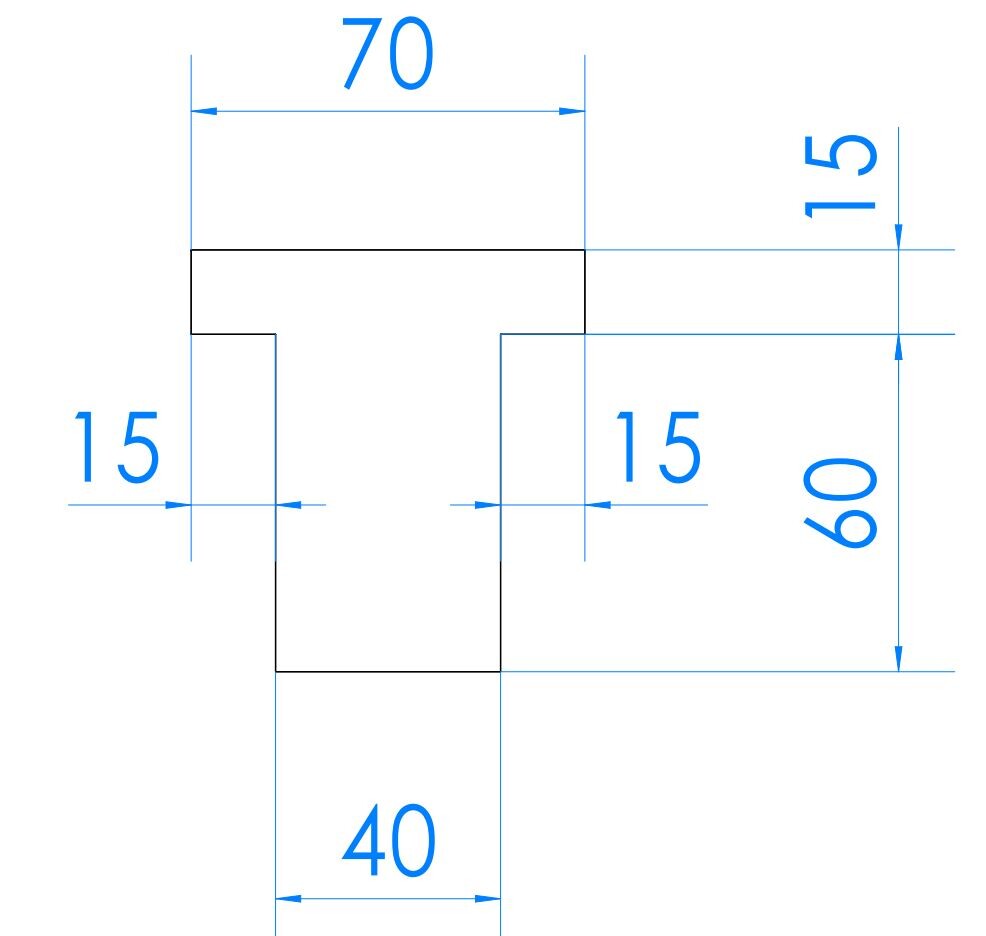
As for mounting the jamb boards, I’m currently asking the timber supplier if he could mill the 60x40mm (2.4x1.6 inches) beam together with the jamb board from one piece of wood. This way, I wouldn’t have to mount the board separately, and I could build the door/window frame exactly from one piece.
Today we plan to clear out the room, so in theory, we can get started. The well-known glazier won’t be available until the new year anyway, but I will definitely need the time. My wife’s wish to inaugurate the sauna by New Year’s Eve was unrealistic anyway... 😀

After buying a miter saw over the weekend, I went to Hornbach and Bauhaus yesterday. I bought everything needed for the ventilation; however, this also means I have to install the silicone ducts in advance, since I won’t be able to access the high-voltage connection later.
The exhaust air also needs to be installed now, as it will run up the rear wall and then over the sauna to the front. I have now decided to add an inline duct fan that will be controlled via the sauna control system. This should ensure sufficient ventilation after using the sauna.
For the bench arrangement, we have decided to build the upper bench at the same time, while the lower bench will run underneath it.
I was debating for a long time whether to simply use the Philips Hue light strips I already have at home, but that seemed too uncertain to me. I am now strongly leaning towards the lighting solution from Sentiotec, which offers RGBW tubes and ceiling spots that can be operated with a single remote control. These also offer different modes for color transitions, etc. In any case, I want to go all in on this 😀
2x 1.80m (6 feet) tubes: Behind the backrest of the upper bench and under the upper bench.
1x 0.50m (1.6 feet) tube: Under the lower bench.
1x round RGBW spot: Directly above the sauna heater.
After consulting with support, I was advised to run the cables to the driver above the sauna inside conduit pipes. Now my question is, which type of conduit I should use and where exactly to install it? In the ventilation layer or the insulation layer?
Regarding all the ventilation and back-ventilation topics, I spoke again with my colleague, who is now a sworn expert in ventilation technology. So he’s not completely unfamiliar with the subject 😉 He built a sauna in his basement 10 years ago and decided to install small openings of about 5x1cm (2x0.4 inches) at the bottom from the inside sauna wall to the ventilation zone. This should allow better airflow through the back ventilation. He would do it the same way again, even though he hasn’t seen it done anywhere else. So I will probably plan it this way too.
As for mounting the jamb boards, I’m currently asking the timber supplier if he could mill the 60x40mm (2.4x1.6 inches) beam together with the jamb board from one piece of wood. This way, I wouldn’t have to mount the board separately, and I could build the door/window frame exactly from one piece.
Today we plan to clear out the room, so in theory, we can get started. The well-known glazier won’t be available until the new year anyway, but I will definitely need the time. My wife’s wish to inaugurate the sauna by New Year’s Eve was unrealistic anyway... 😀
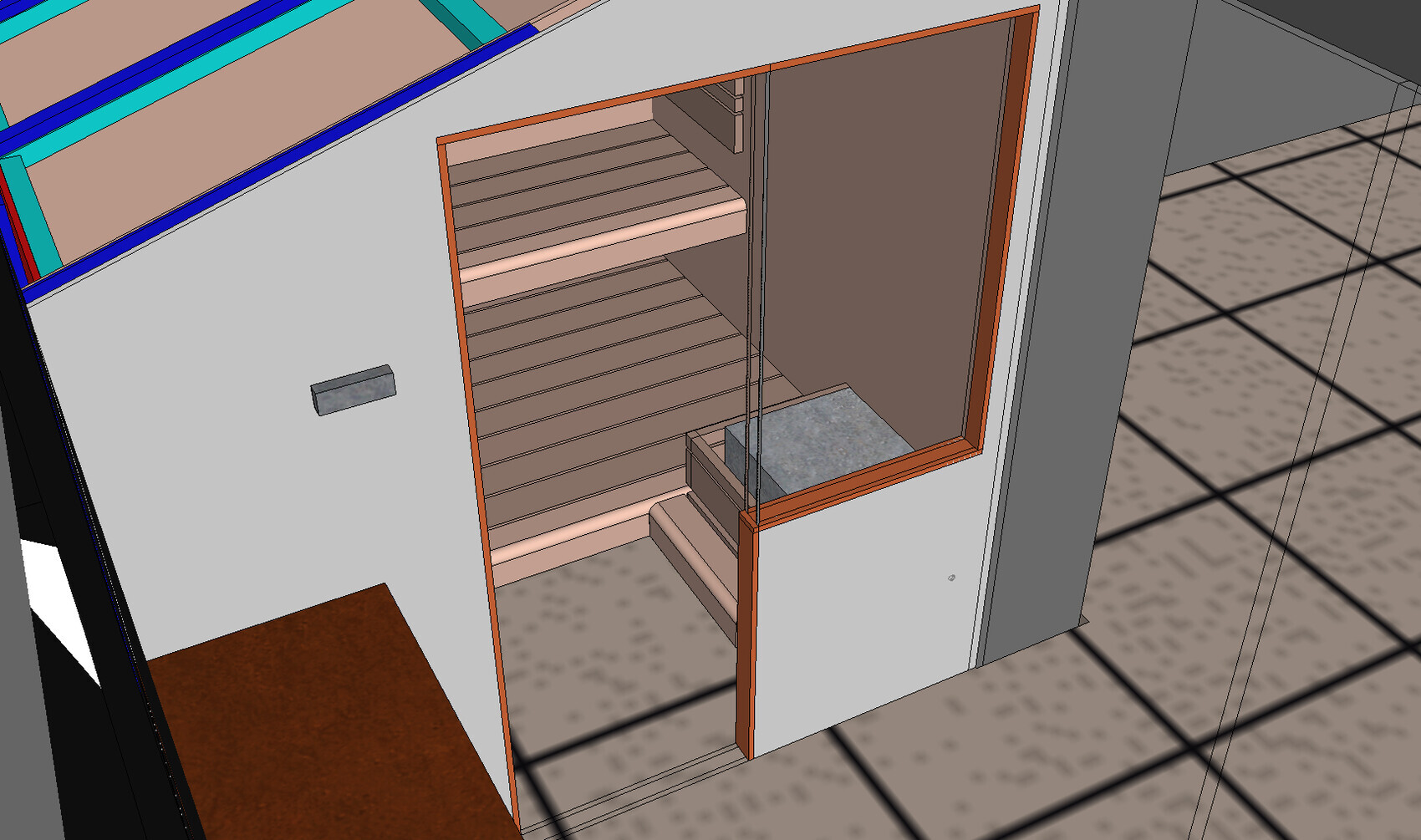
Here is the final version of the plan. I will order the sauna benches tonight.
We have decided not to extend the lower bench all the way to the back after all. You can’t really tuck your feet under there.
The paneling has been set back to make the lower bench width more comfortable. Additionally, this allows me to move the sauna’s exhaust vent further back into the corner behind the paneling, so it aligns diagonally opposite the heater.
The lower bench now has a lying depth of almost 80cm (31.5 inches), while the upper bench offers about 60cm (24 inches) of seating depth.
Could one of the sauna owners here please do me a favor and measure the height of the backrest when you get a chance? That is, from the top of the seating bench to the middle of the backrest. That would help me a lot; for now, I’ve estimated it at 40cm (16 inches).
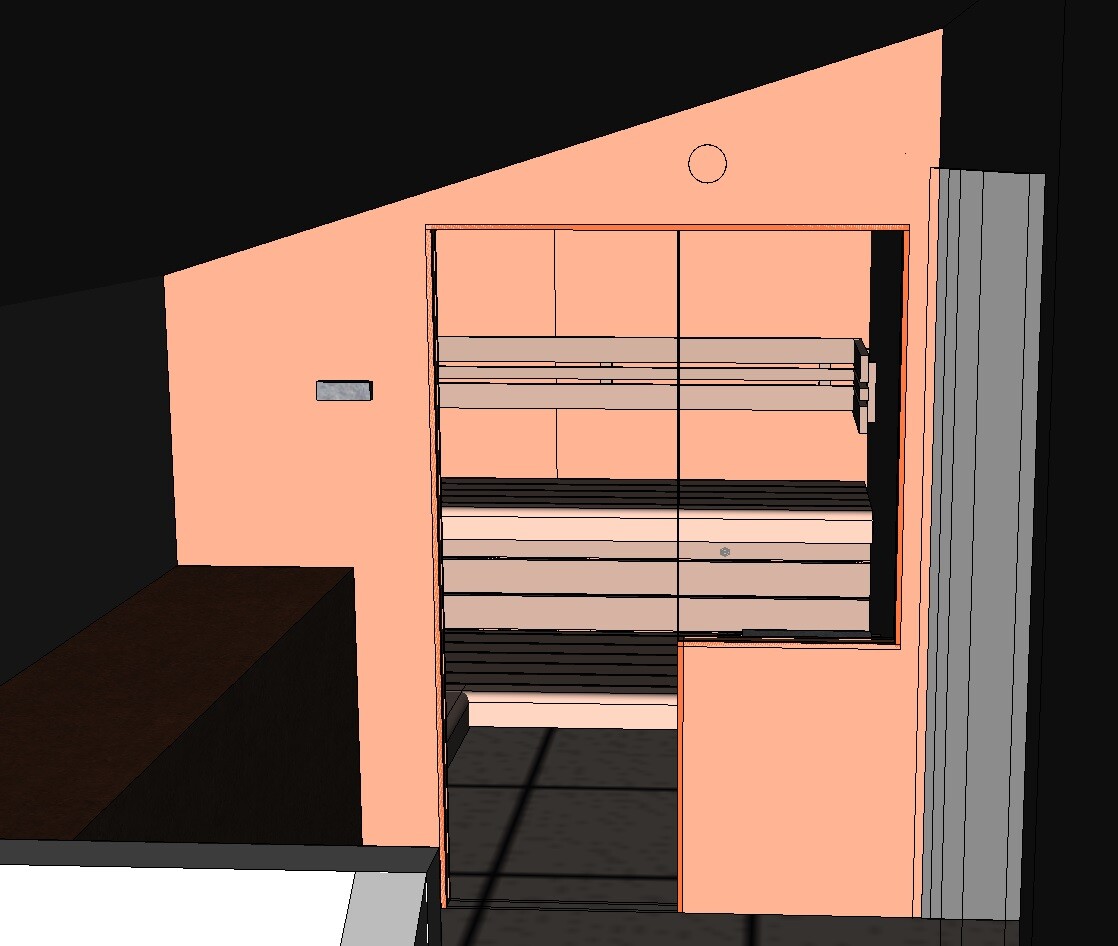
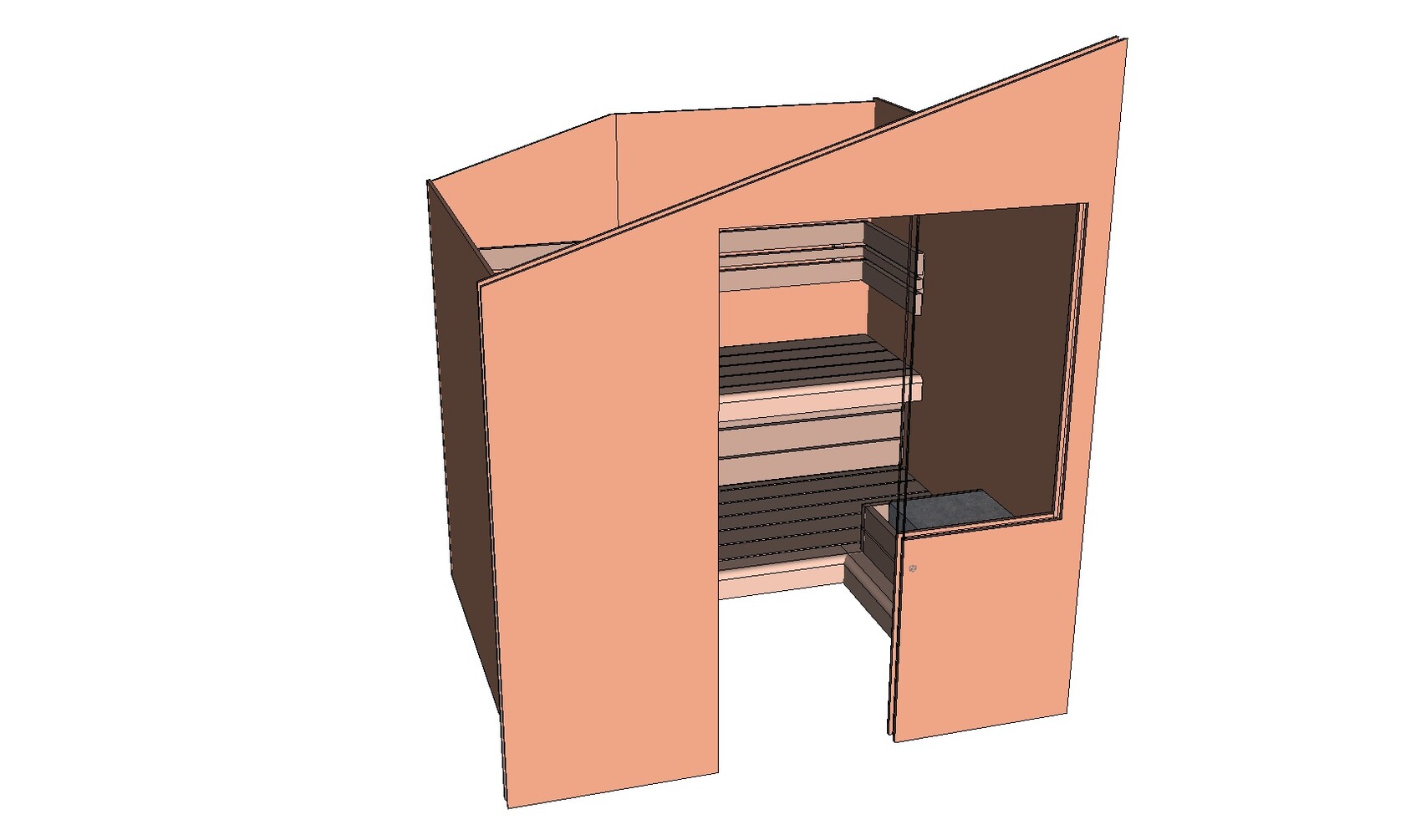
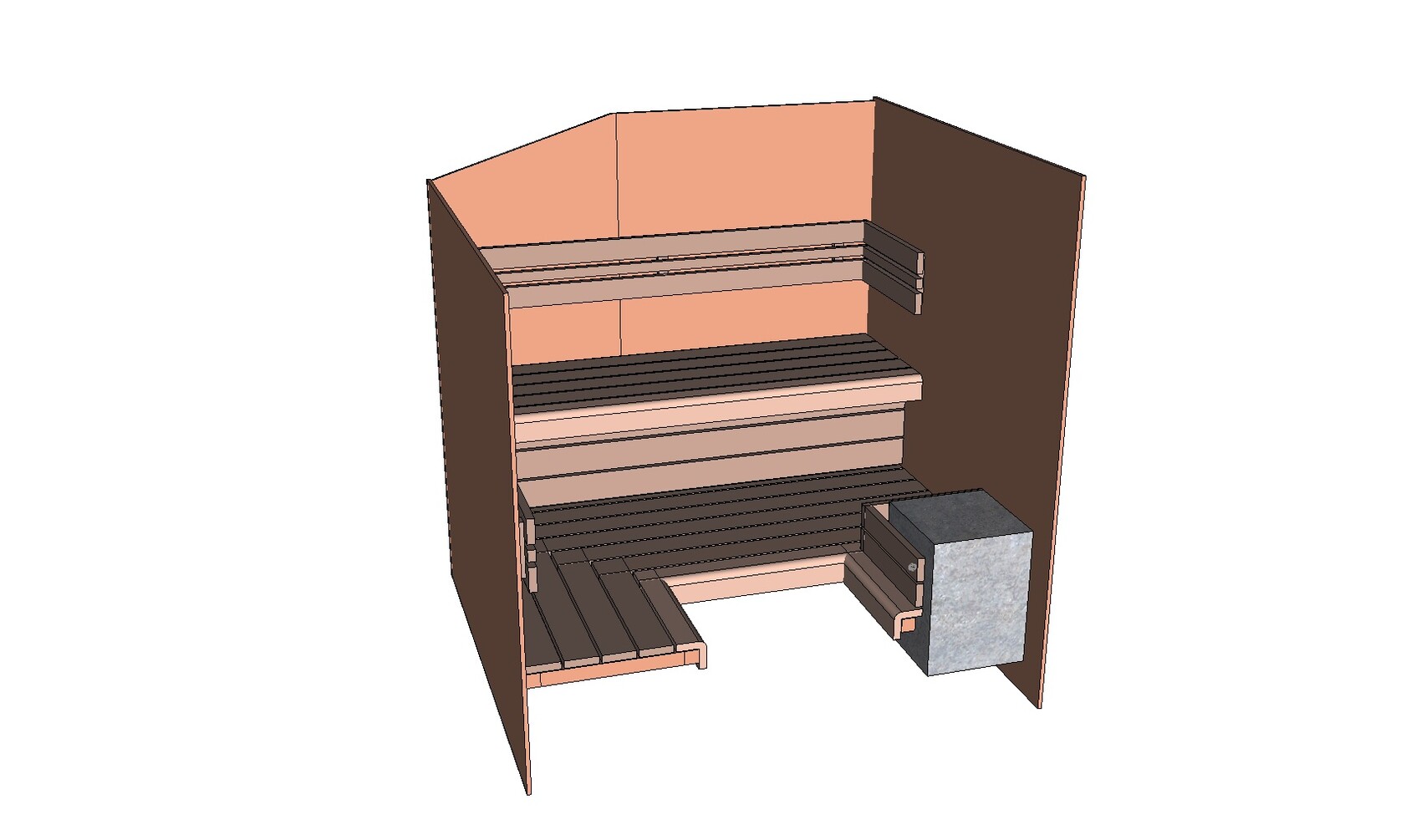
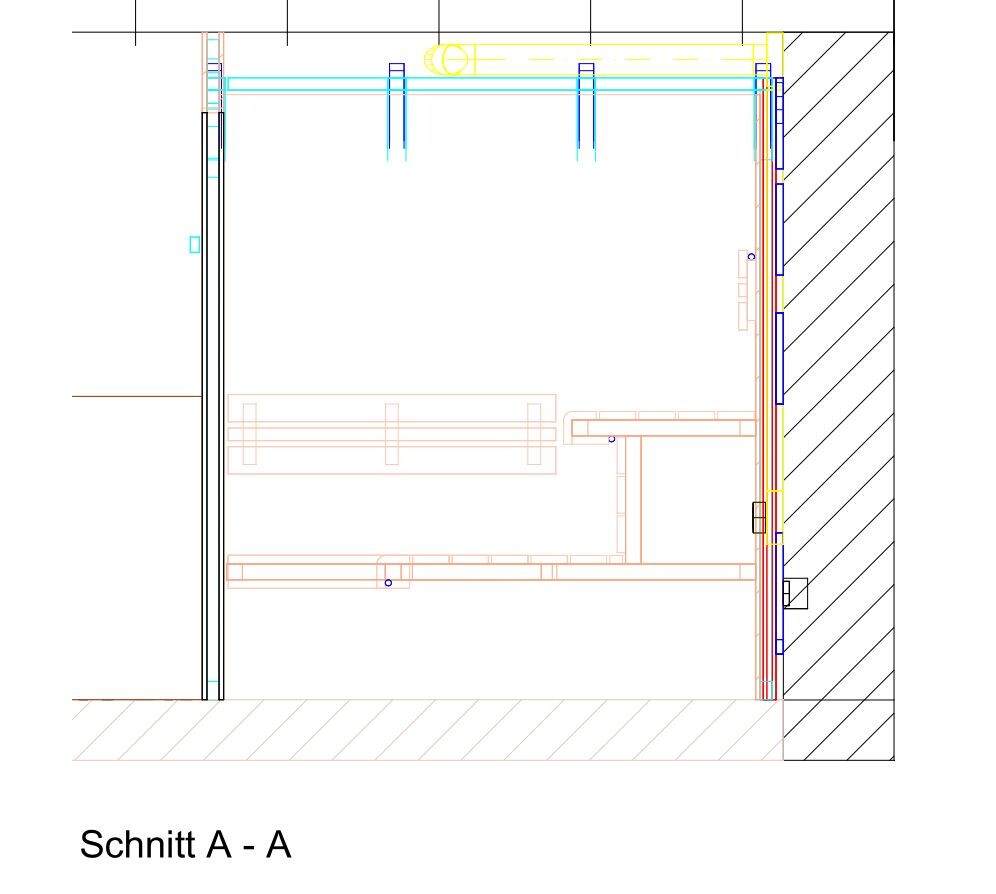
We have decided not to extend the lower bench all the way to the back after all. You can’t really tuck your feet under there.
The paneling has been set back to make the lower bench width more comfortable. Additionally, this allows me to move the sauna’s exhaust vent further back into the corner behind the paneling, so it aligns diagonally opposite the heater.
The lower bench now has a lying depth of almost 80cm (31.5 inches), while the upper bench offers about 60cm (24 inches) of seating depth.
Could one of the sauna owners here please do me a favor and measure the height of the backrest when you get a chance? That is, from the top of the seating bench to the middle of the backrest. That would help me a lot; for now, I’ve estimated it at 40cm (16 inches).

Bottom edge of the backrest 27cm (11 inches), top edge of the backrest 57cm (22 inches), seat height 110cm (43 inches), bench width 60cm (24 inches), bench length 195cm (77 inches) and 200cm (79 inches) around the corner, sauna height 210cm (83 inches) outside, 200cm (79 inches) inside,
air gap under glass door 1.5cm (0.6 inches), fixed glass pane set in a silicone profile, door closes against another silicone profile
air gap under glass door 1.5cm (0.6 inches), fixed glass pane set in a silicone profile, door closes against another silicone profile
Brief Progress Update:
After starting on Saturday, I quickly ran into some setbacks. The company PC where I created the plans was not accessible. So, I only used Saturday to set up a bit and cut the roof battens into 30cm (12 inches) lengths.
Sunday was more productive, and yesterday I temporarily installed the first OSB boards. These will need to be removed again to lay the conduit pipes.
Unfortunately, I mixed up the dimensions: I confused the depth of the roof battens for ventilation (24mm) with the depth of the bench battens (28mm). So, I ordered electrical conduits with a diameter of 26mm (about 1 inch), which probably won’t fit into the ventilation layer. They will be delivered tomorrow, and I will see if they can be squeezed in slightly. Otherwise, they’ll have to be returned, and I’ll have to order a smaller size.
This is annoying because I need one conduit for the control unit’s cable, which has an RJ10 connector. That will be tricky.
On Sunday, I also measured the quantities for the structural timber (KVH) and the bench substructure. The order was sent to the timber supplier yesterday. I have almost three weeks of vacation coming up, so I hope the materials will arrive by then. It should work out, as the estimated delivery time was about one week.
I ordered the bench battens and a few other items from a sauna supplier in Estonia last Friday. This is somewhat urgent because the control unit, which I plan to install above the sauna soon, comes with them. Access to that area will be more limited later on, but technically it could still wait until the new year since that needs to be done before insulation anyway.
What bothers me the most is the inaccuracy of our plasterer. The rear wall, where the exhaust vents upward, is noticeably uneven. At about 2 meters (6.5 feet) height, there is a difference of around 1cm (0.4 inches).
Actually, none of the walls are truly straight. 🙄
I’m not yet sure whether I’ll compensate for this entirely with the structural timber (KVH) or just accept the differences.
Slow and steady wins the race 😉
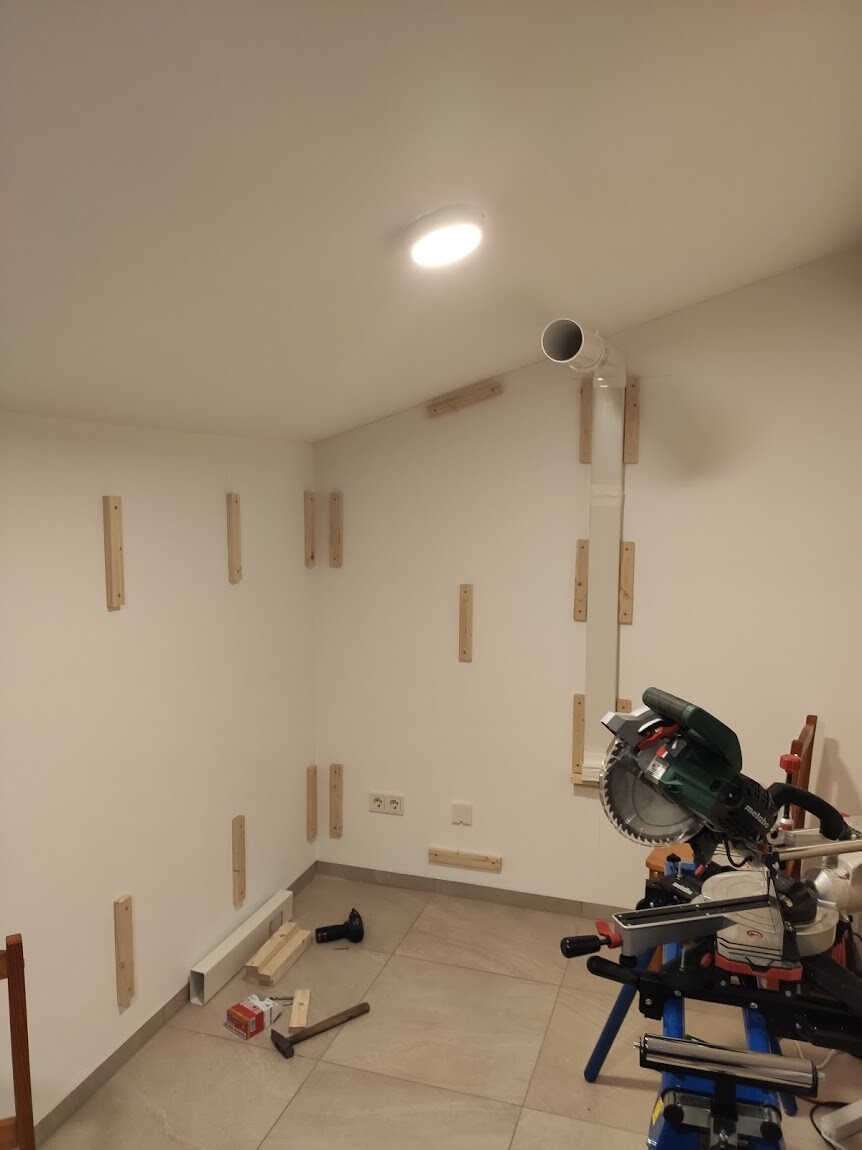
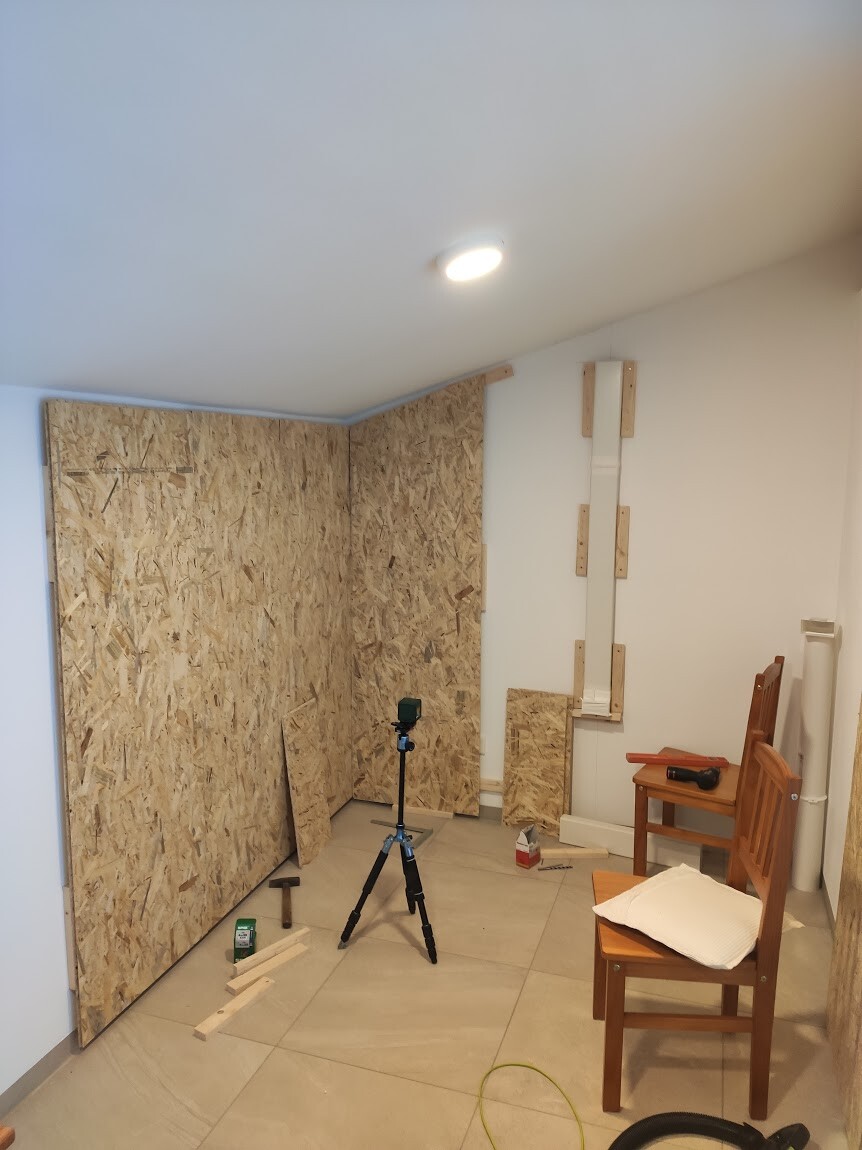
After starting on Saturday, I quickly ran into some setbacks. The company PC where I created the plans was not accessible. So, I only used Saturday to set up a bit and cut the roof battens into 30cm (12 inches) lengths.
Sunday was more productive, and yesterday I temporarily installed the first OSB boards. These will need to be removed again to lay the conduit pipes.
Unfortunately, I mixed up the dimensions: I confused the depth of the roof battens for ventilation (24mm) with the depth of the bench battens (28mm). So, I ordered electrical conduits with a diameter of 26mm (about 1 inch), which probably won’t fit into the ventilation layer. They will be delivered tomorrow, and I will see if they can be squeezed in slightly. Otherwise, they’ll have to be returned, and I’ll have to order a smaller size.
This is annoying because I need one conduit for the control unit’s cable, which has an RJ10 connector. That will be tricky.
On Sunday, I also measured the quantities for the structural timber (KVH) and the bench substructure. The order was sent to the timber supplier yesterday. I have almost three weeks of vacation coming up, so I hope the materials will arrive by then. It should work out, as the estimated delivery time was about one week.
I ordered the bench battens and a few other items from a sauna supplier in Estonia last Friday. This is somewhat urgent because the control unit, which I plan to install above the sauna soon, comes with them. Access to that area will be more limited later on, but technically it could still wait until the new year since that needs to be done before insulation anyway.
What bothers me the most is the inaccuracy of our plasterer. The rear wall, where the exhaust vents upward, is noticeably uneven. At about 2 meters (6.5 feet) height, there is a difference of around 1cm (0.4 inches).
Actually, none of the walls are truly straight. 🙄
I’m not yet sure whether I’ll compensate for this entirely with the structural timber (KVH) or just accept the differences.
Slow and steady wins the race 😉

matte1987 schrieb:
Actually, no wall is completely straight.That's exactly what I always tell people here who dream that their house would be built with the precision of fine mechanics, fitting perfectly around their wardrobe :-)https://www.instagram.com/11antgmxde/
https://www.linkedin.com/company/bauen-jetzt/
Similar topics