
ᐅ Building a Sauna Yourself with a Sloped Ceiling – Suggestions, Tips, and Planning Advice
Created on: 24 Nov 2020 10:14
M
matte
Hello! [IMG alt=" 🙂"]https://saunabauen.de/forum/images/smilies/icon_smile.gif[/IMG]
I’d like to start this thread to get help and feedback on my plan to build a sauna myself. Of course, this thread can also be used for any topics related to sauna construction.
We decided to get a sauna, and since a prefabricated kit was not an option and a custom build was too expensive, I decided to take matters into my own hands.
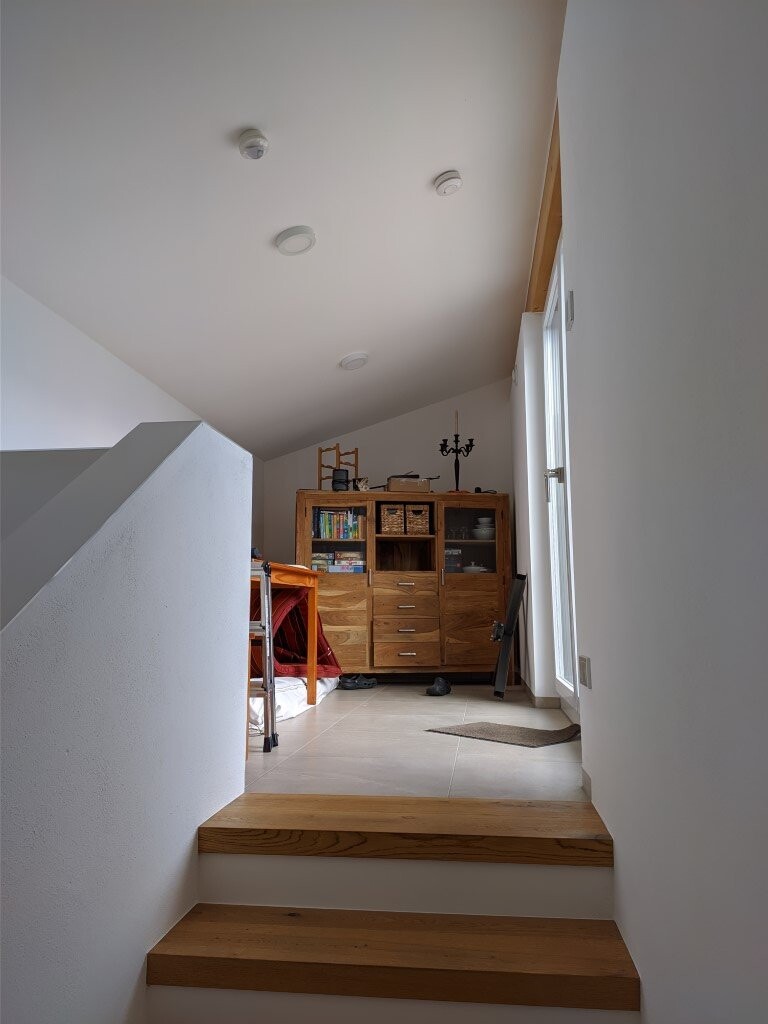
When we built our house three years ago, we reserved space for a sauna at the top near the roof terrace. Unfortunately, instead of a planned flat roof, we had to install a sloped roof to get the building permit / planning permission.
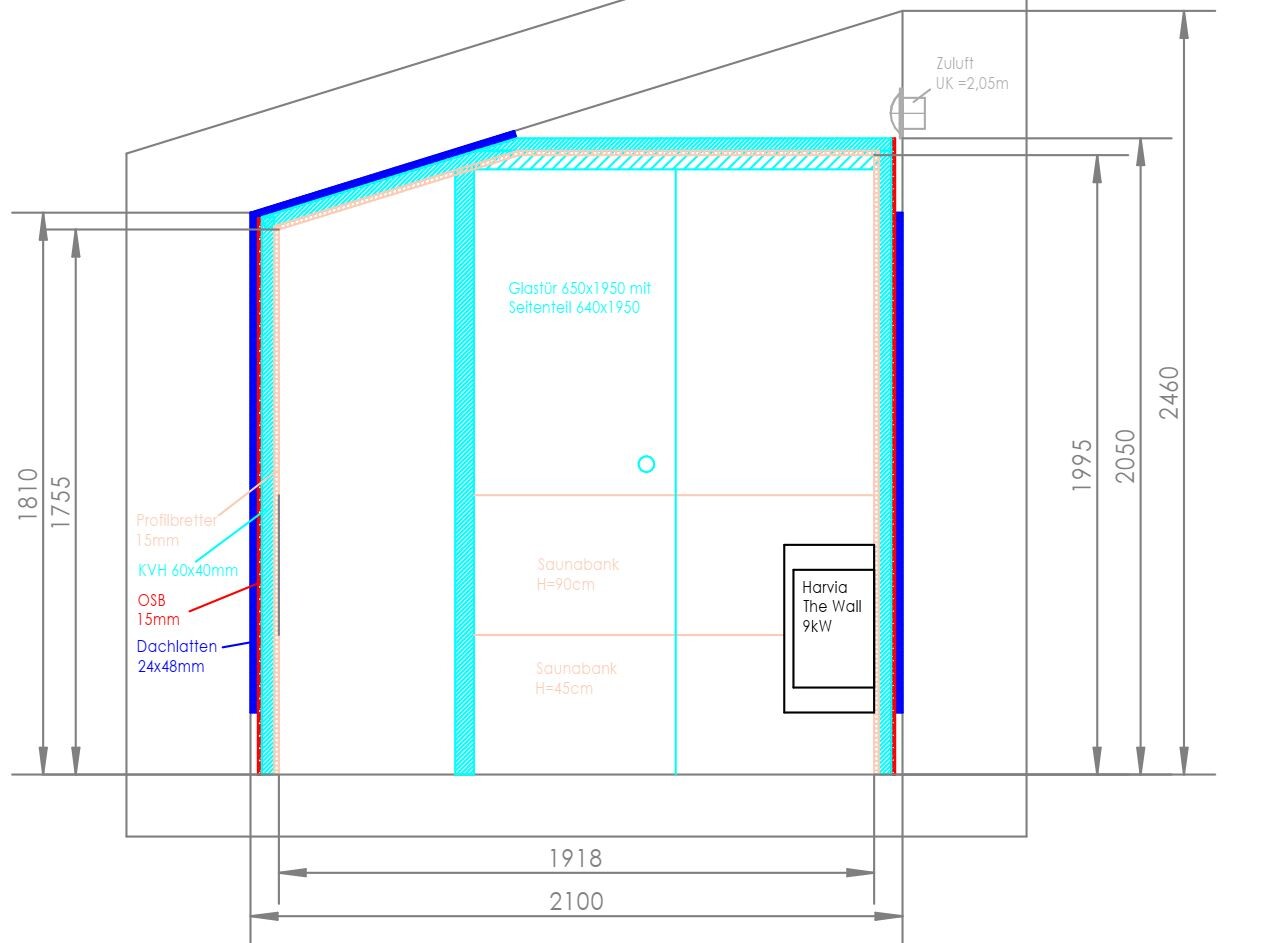
This results in a roof slope with knee wall height of 1.81m (5 ft 11 in) clear height.
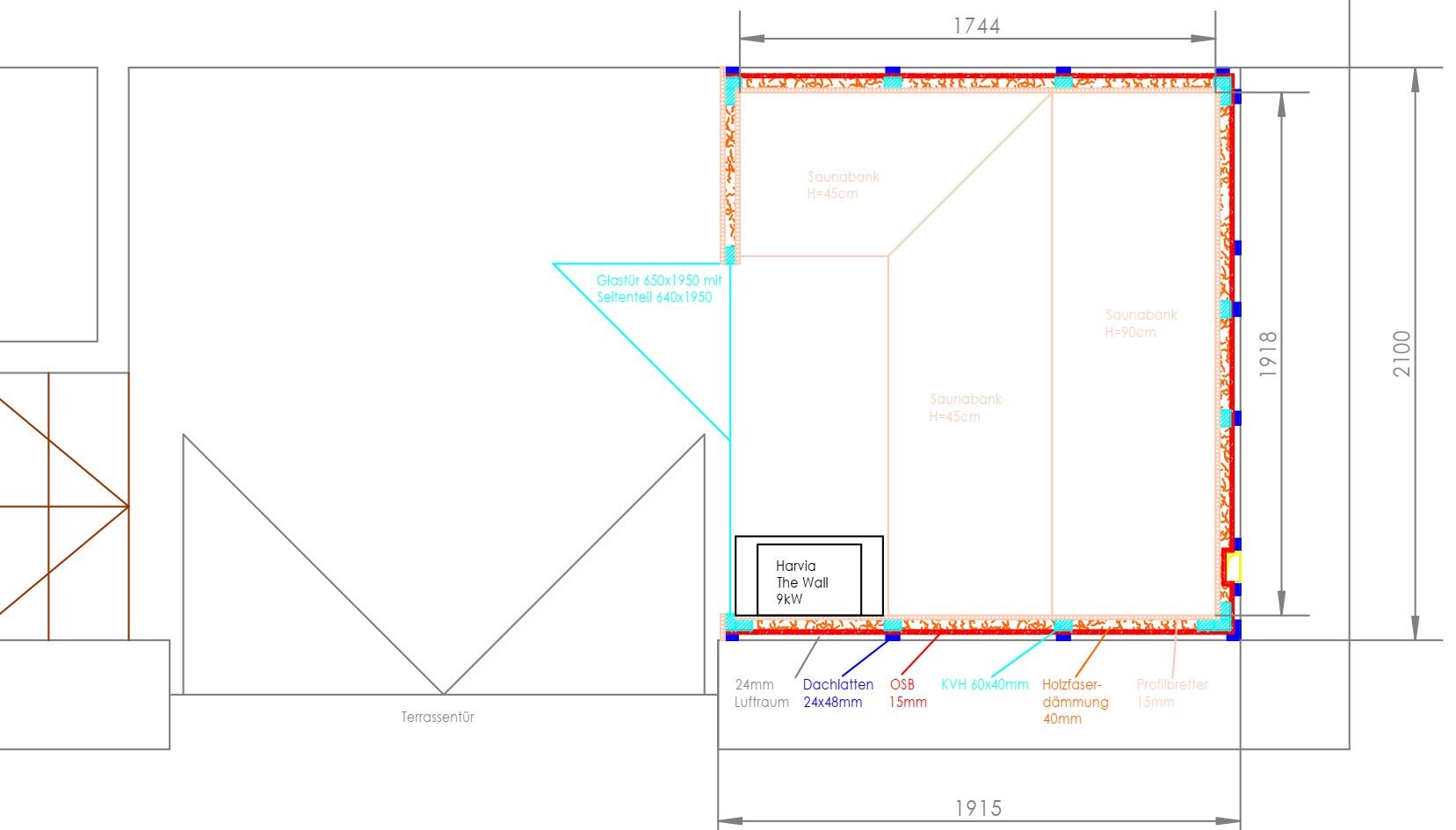
There is a floor area of 2.10m (83 inches) wide and 1.91m (75 inches) deep available.
The height is additionally limited by a fresh air vent on the higher side. The bottom edge of the vent is located at 2.05m (6 ft 9 in) above the finished floor level.
My idea is to build the sauna ceiling at 2.05m (6 ft 9 in) height to still be able to access this vent if necessary. According to my plan, the clear interior height inside the sauna would then be about 1.995m (6 ft 6.5 in).
The sauna will be surrounded on three sides by exterior walls (Poroton T9 masonry).
The ceiling is attached directly to the beams and vapor barrier, without counter battens. This was necessary because otherwise the terrace door would not be able to open. The architect missed that... : [IMG alt=":roll:"]https://saunabauen.de/forum/images/smilies/icon_rolleyes.gif[/IMG]
The floor is fine stoneware tiles on a screed layer with underfloor heating.
We have a three-phase power supply with 5x2.5mm² cable and a cable length of about 20m (66 ft). According to an electrician, this line should not restrict the project.
Since space is quite tight, I want to keep the wall construction as thin as possible.
Planned wall build-up:
1. Masonry with plaster
2. Vertical battens (24x48mm / 1x2 inches) with 24mm (1 inch) air gap for ventilation
3. OSB boards 15mm (0.6 inch)
4. KVH timber beams 40x60mm (1.5x2.5 inches), positioned so the 40mm (1.5 inch) side accommodates insulation
5. 40mm (1.5 inch) wood fiber insulation inside
6. No vapor barrier
7. 15mm (0.6 inch) profiled battens mounted horizontally
Now my questions:
1. Is my wall build-up feasible, or am I trying to save too much space? This would leave an interior floor dimension of nearly 1.92m x 1.75m (6 ft 3.5 in x 5 ft 9 in).
I’m 1.84m (6 ft 0.5 in) tall, so I should still have enough room to lie down comfortably.
2. We want to install a full glass door with a side panel to enjoy the outdoor view.
We plan to use 8mm (0.3 inch) tempered safety glass (ESG). Is that okay, or can this cause issues near the heater?
3. How do you connect the glass wall to the sauna structure? I thought about routing a groove around the KVH timber to set the glass in. Is that a good approach?
For the floor, I read that someone placed the glass on a silicone mat which was then trimmed flush. That sounds like a good solution to me.
3. The sauna floor area is 3.34m² (36 ft²) with an interior height of 1.995m (6 ft 6.5 in). Ignoring the slope, that gives a volume of 6.66m³ (235 ft³).
I read that for a glass door you add 1.5m³ (53 ft³) and for a glass wall the area (1.5m² / 16 ft²) multiplied by 1.2 as additional volume.
So, I’d end up with a total volume of 9.66m³ (341 ft³) and chose a 9kW heater accordingly. Does that sound right or oversized? I’m currently leaning towards the "Harvia The Wall" with external control.
4. Due to the heater’s position, there is essentially no room for a heater guard between the glass wall and heater. Is a guard necessary in a private sauna? I’m not too worried about it, but my wife is concerned.
The alternative would be to shift the lower bench slightly under the upper bench and move the heater, which would create space for a guard.
Alternatively, there is a glass protective shield with integrated lighting available that mounts in front of the heater. Would that be enough? I’m not too keen on wooden guards though... [IMG alt=";)"]https://saunabauen.de/forum/images/smilies/icon_wink.gif[/IMG]
5. A coworker recommended bench heights of 60cm and 120cm (24 and 47 inches). That would cause problems with the sauna height. I was thinking about 45cm and 90cm (18 and 35 inches) instead. Since we don’t want it very hot anyway, I see no reason for higher benches.
6. To avoid further reducing the roof slope height, I considered skipping the OSB boards there and mounting the KVH beams directly at a 24mm (1 inch) gap (batten distance) from the ceiling. Any issues with that?
7. We prefer the look of horizontally mounted profiled battens. Any objections? Given the tight space, I would skip additional rear ventilation. From what I’ve read, that’s not strictly necessary.
8. In my case, would it be better to use a different insulation material with a vapor barrier instead of wood fiber insulation?
9. The left wall with the glass door will be clad on the outside with profiled wood boards as well. This way I could install an access panel above the sauna to reach the fresh air vent if needed. Also, I could place the electronics for lighting and audio on the ceiling, making them accessible.
Can I mount the cladding boards directly on the KVH beams, or is an additional counter batten or similar required?
I want the wall to finish flush with the terrace door frame. To prevent the terrace door (especially the handle) from hitting the wall, I plan to install a stopper mounted on the KVH timber there.
That’s it for now. I’m curious what you think about my plan. I hope my post is not too long... [IMG alt=":?"]https://saunabauen.de/forum/images/smilies/icon_confused.gif[/IMG]
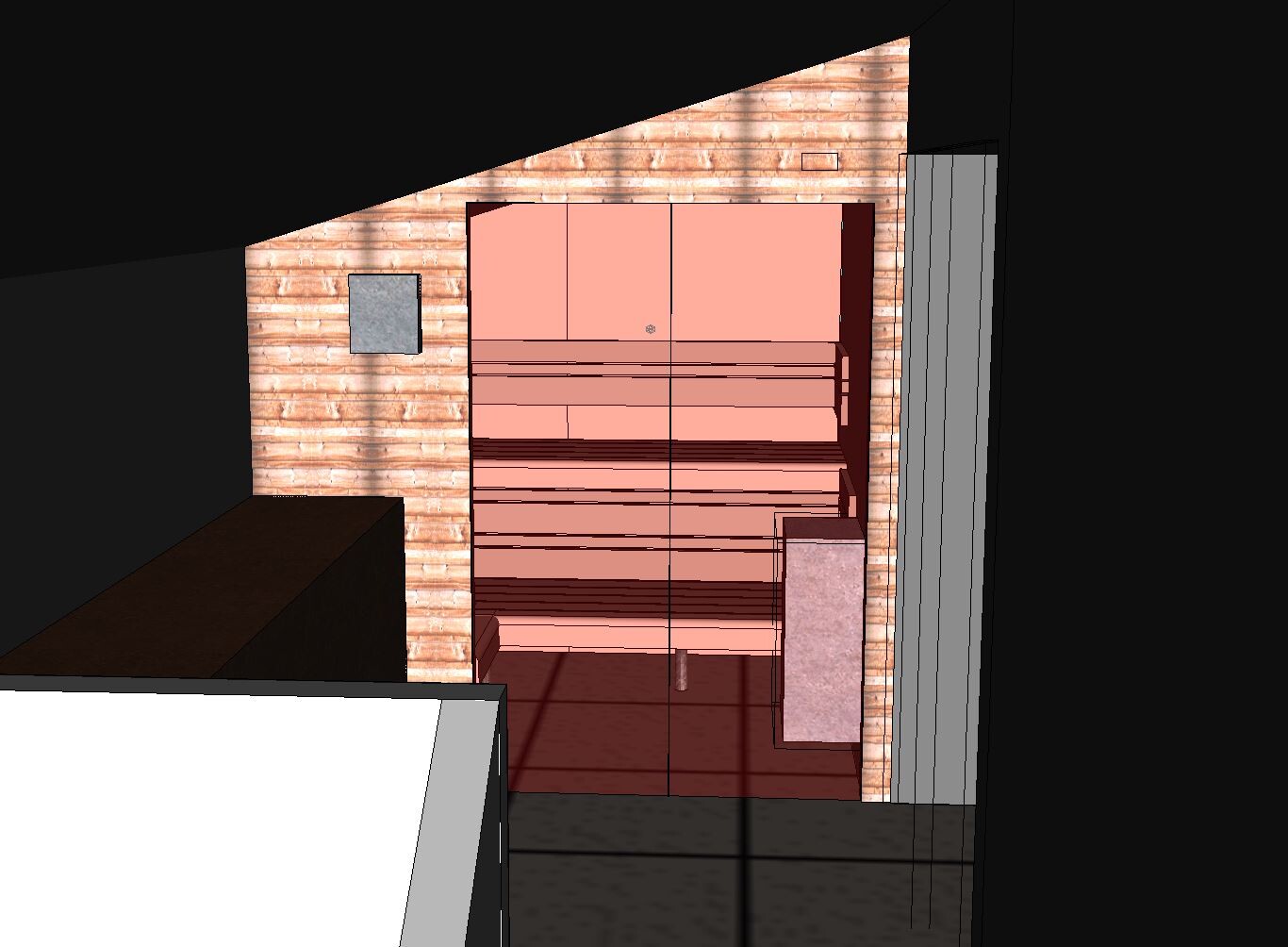
I’m attaching some pictures to show the current planning status. If you need more info, just ask.
Looking forward to any feedback [IMG alt=";)"]https://saunabauen.de/forum/images/smilies/icon_wink.gif[/IMG]
Thanks in advance!
Best regards
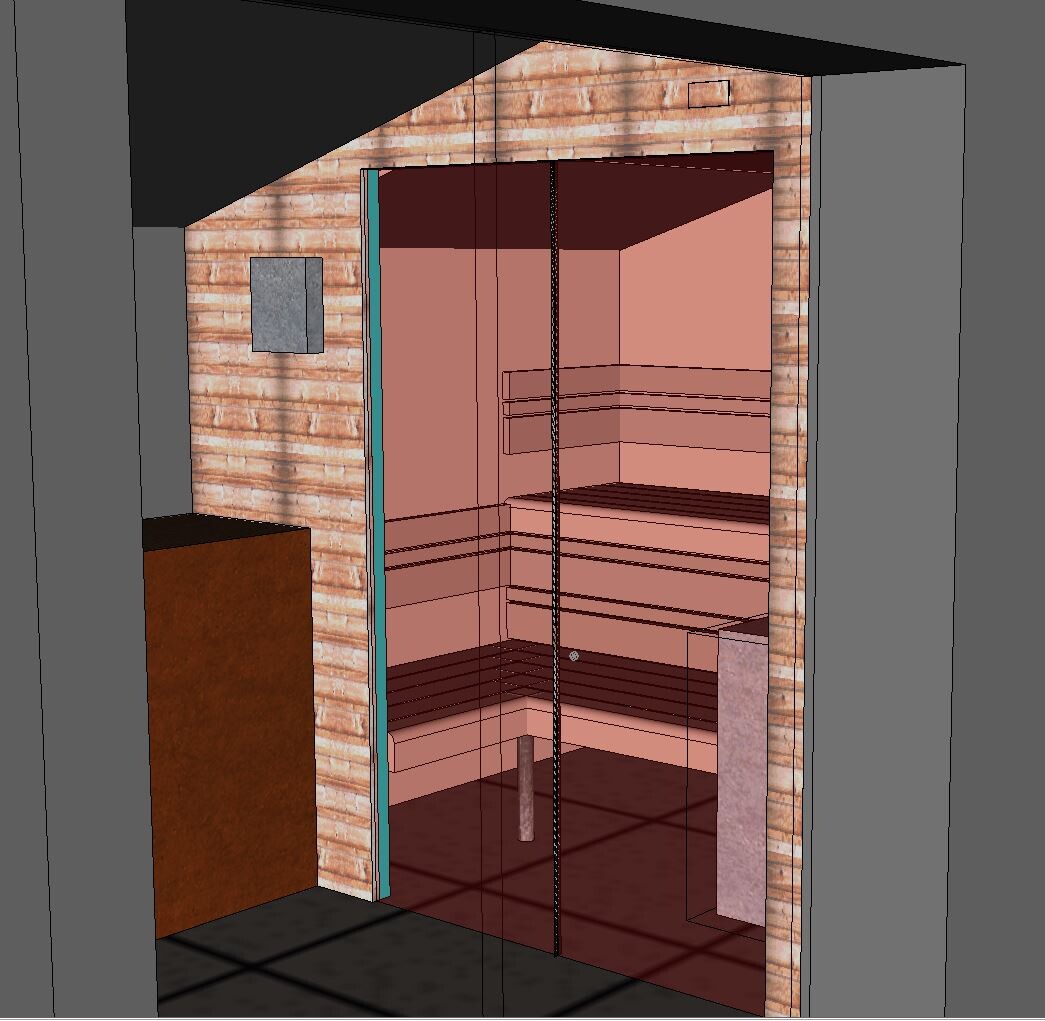
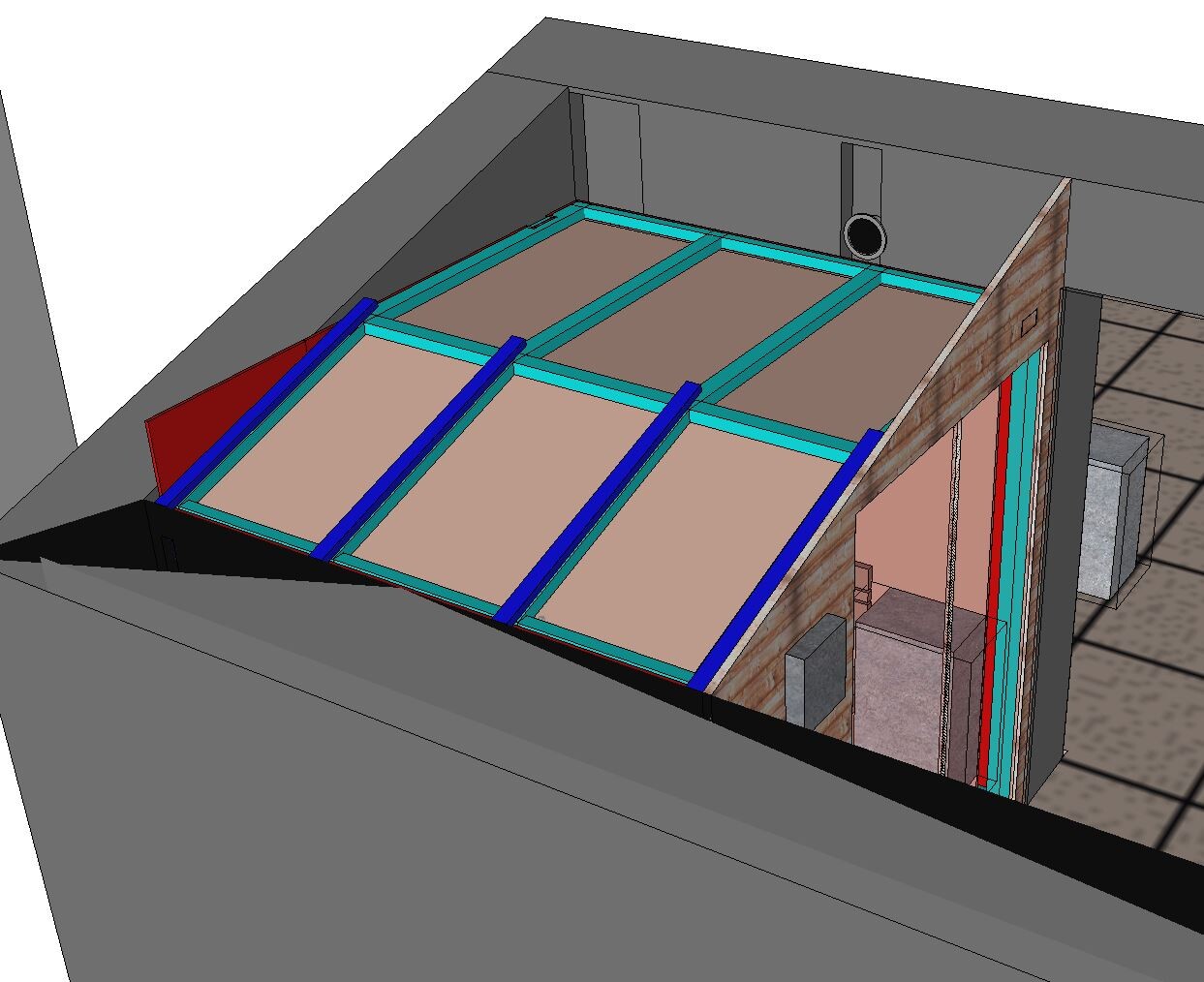
I’d like to start this thread to get help and feedback on my plan to build a sauna myself. Of course, this thread can also be used for any topics related to sauna construction.
We decided to get a sauna, and since a prefabricated kit was not an option and a custom build was too expensive, I decided to take matters into my own hands.
When we built our house three years ago, we reserved space for a sauna at the top near the roof terrace. Unfortunately, instead of a planned flat roof, we had to install a sloped roof to get the building permit / planning permission.
This results in a roof slope with knee wall height of 1.81m (5 ft 11 in) clear height.
There is a floor area of 2.10m (83 inches) wide and 1.91m (75 inches) deep available.
The height is additionally limited by a fresh air vent on the higher side. The bottom edge of the vent is located at 2.05m (6 ft 9 in) above the finished floor level.
My idea is to build the sauna ceiling at 2.05m (6 ft 9 in) height to still be able to access this vent if necessary. According to my plan, the clear interior height inside the sauna would then be about 1.995m (6 ft 6.5 in).
The sauna will be surrounded on three sides by exterior walls (Poroton T9 masonry).
The ceiling is attached directly to the beams and vapor barrier, without counter battens. This was necessary because otherwise the terrace door would not be able to open. The architect missed that... : [IMG alt=":roll:"]https://saunabauen.de/forum/images/smilies/icon_rolleyes.gif[/IMG]
The floor is fine stoneware tiles on a screed layer with underfloor heating.
We have a three-phase power supply with 5x2.5mm² cable and a cable length of about 20m (66 ft). According to an electrician, this line should not restrict the project.
Since space is quite tight, I want to keep the wall construction as thin as possible.
Planned wall build-up:
1. Masonry with plaster
2. Vertical battens (24x48mm / 1x2 inches) with 24mm (1 inch) air gap for ventilation
3. OSB boards 15mm (0.6 inch)
4. KVH timber beams 40x60mm (1.5x2.5 inches), positioned so the 40mm (1.5 inch) side accommodates insulation
5. 40mm (1.5 inch) wood fiber insulation inside
6. No vapor barrier
7. 15mm (0.6 inch) profiled battens mounted horizontally
Now my questions:
1. Is my wall build-up feasible, or am I trying to save too much space? This would leave an interior floor dimension of nearly 1.92m x 1.75m (6 ft 3.5 in x 5 ft 9 in).
I’m 1.84m (6 ft 0.5 in) tall, so I should still have enough room to lie down comfortably.
2. We want to install a full glass door with a side panel to enjoy the outdoor view.
We plan to use 8mm (0.3 inch) tempered safety glass (ESG). Is that okay, or can this cause issues near the heater?
3. How do you connect the glass wall to the sauna structure? I thought about routing a groove around the KVH timber to set the glass in. Is that a good approach?
For the floor, I read that someone placed the glass on a silicone mat which was then trimmed flush. That sounds like a good solution to me.
3. The sauna floor area is 3.34m² (36 ft²) with an interior height of 1.995m (6 ft 6.5 in). Ignoring the slope, that gives a volume of 6.66m³ (235 ft³).
I read that for a glass door you add 1.5m³ (53 ft³) and for a glass wall the area (1.5m² / 16 ft²) multiplied by 1.2 as additional volume.
So, I’d end up with a total volume of 9.66m³ (341 ft³) and chose a 9kW heater accordingly. Does that sound right or oversized? I’m currently leaning towards the "Harvia The Wall" with external control.
4. Due to the heater’s position, there is essentially no room for a heater guard between the glass wall and heater. Is a guard necessary in a private sauna? I’m not too worried about it, but my wife is concerned.
The alternative would be to shift the lower bench slightly under the upper bench and move the heater, which would create space for a guard.
Alternatively, there is a glass protective shield with integrated lighting available that mounts in front of the heater. Would that be enough? I’m not too keen on wooden guards though... [IMG alt=";)"]https://saunabauen.de/forum/images/smilies/icon_wink.gif[/IMG]
5. A coworker recommended bench heights of 60cm and 120cm (24 and 47 inches). That would cause problems with the sauna height. I was thinking about 45cm and 90cm (18 and 35 inches) instead. Since we don’t want it very hot anyway, I see no reason for higher benches.
6. To avoid further reducing the roof slope height, I considered skipping the OSB boards there and mounting the KVH beams directly at a 24mm (1 inch) gap (batten distance) from the ceiling. Any issues with that?
7. We prefer the look of horizontally mounted profiled battens. Any objections? Given the tight space, I would skip additional rear ventilation. From what I’ve read, that’s not strictly necessary.
8. In my case, would it be better to use a different insulation material with a vapor barrier instead of wood fiber insulation?
9. The left wall with the glass door will be clad on the outside with profiled wood boards as well. This way I could install an access panel above the sauna to reach the fresh air vent if needed. Also, I could place the electronics for lighting and audio on the ceiling, making them accessible.
Can I mount the cladding boards directly on the KVH beams, or is an additional counter batten or similar required?
I want the wall to finish flush with the terrace door frame. To prevent the terrace door (especially the handle) from hitting the wall, I plan to install a stopper mounted on the KVH timber there.
That’s it for now. I’m curious what you think about my plan. I hope my post is not too long... [IMG alt=":?"]https://saunabauen.de/forum/images/smilies/icon_confused.gif[/IMG]
I’m attaching some pictures to show the current planning status. If you need more info, just ask.
Looking forward to any feedback [IMG alt=";)"]https://saunabauen.de/forum/images/smilies/icon_wink.gif[/IMG]
Thanks in advance!
Best regards
Well, I don’t have to do that. I just need to make sure it’s really Swiss pine... 😉
Regarding the stove, I’m still quite uncertain. The Sentiotec Home Combi is the one I like best and is affordable for us. Now I’m stuck on the control system.
Do I have to use a control system from Sentiotec, or can I choose from any manufacturer as long as they support the steam function and the stove’s output?
A nice-to-have feature would be integration with KNX or control via an app, as well as connection to IP-Symcon, but that stuff is ridiculously expensive.
What I definitely want is a timer function so the sauna can start heating before you get home.
Can anyone share insights or recommendations? @Mycraft Any thoughts?
Regarding the stove, I’m still quite uncertain. The Sentiotec Home Combi is the one I like best and is affordable for us. Now I’m stuck on the control system.
Do I have to use a control system from Sentiotec, or can I choose from any manufacturer as long as they support the steam function and the stove’s output?
A nice-to-have feature would be integration with KNX or control via an app, as well as connection to IP-Symcon, but that stuff is ridiculously expensive.
What I definitely want is a timer function so the sauna can start heating before you get home.
Can anyone share insights or recommendations? @Mycraft Any thoughts?


We have an app that allows us to start the sauna remotely via our phone whenever needed. It seemed like a great idea to us. In reality, though, we haven’t actually used it that way so far. When we come home and want to use the sauna, we just turn it on as soon as we enter. By the time we’ve undressed, put away our stuff, and taken a shower, it’s usually already nice and warm. It doesn’t make much sense for the sauna to be heating up for half an hour before you actually go in. So, honestly, I would really reconsider if this feature is necessary in the future.
Our heater is an EOS Thermo-Tec, with an EOS Emotec D and H control system, and the sauna control module for the app is the EOS WCI-01. However, it does not have a steam function — we can only pour water on the stones manually.
Our heater is an EOS Thermo-Tec, with an EOS Emotec D and H control system, and the sauna control module for the app is the EOS WCI-01. However, it does not have a steam function — we can only pour water on the stones manually.
Ok, thanks.
I had a feeling it might be like that, and on top of that, the safety aspect shouldn’t be underestimated. In the KNX forum, it’s generally strongly advised against controlling the sauna via the bus system, as there are also legal considerations involved...
Then there’s also the issue of pre-selection time, which is kind of tricky ^^
I had a feeling it might be like that, and on top of that, the safety aspect shouldn’t be underestimated. In the KNX forum, it’s generally strongly advised against controlling the sauna via the bus system, as there are also legal considerations involved...
Then there’s also the issue of pre-selection time, which is kind of tricky ^^
B
borderpuschl26 Nov 2020 11:36For us, it’s the same as with Climbee. The sauna heats up completely in about 20 minutes, so we have only used the remote start feature twice for testing purposes.
In the sauna, I connected only the lighting and sensors to the KNX system. I didn’t want to have the heater connected there.
Regarding Swiss pine, you really have to like the scent. Our holiday home in Austria is also built largely with Swiss pine inside, so it was clear to us from the start that we also wanted Swiss pine in our residential house (but not too much). Of course, Swiss pine can also be found in South Tyrol, France, and Switzerland. It only grows above 1600 m (5200 ft), which makes it difficult to source from Germany, but it’s possible.
For the control system, you’re free to choose as long as you don’t need a power switching device because communication between the controller and the load device usually operates via a dedicated bus.
In the sauna, I connected only the lighting and sensors to the KNX system. I didn’t want to have the heater connected there.
Regarding Swiss pine, you really have to like the scent. Our holiday home in Austria is also built largely with Swiss pine inside, so it was clear to us from the start that we also wanted Swiss pine in our residential house (but not too much). Of course, Swiss pine can also be found in South Tyrol, France, and Switzerland. It only grows above 1600 m (5200 ft), which makes it difficult to source from Germany, but it’s possible.
For the control system, you’re free to choose as long as you don’t need a power switching device because communication between the controller and the load device usually operates via a dedicated bus.