
ᐅ Building a Prefabricated House on an Existing Basement/Foundation?
Created on: 7 May 2017 23:02
B
BartJSimpsonB
BartJSimpson7 May 2017 23:02Good evening,
we have purchased a plot of land in a residential area that includes a 50-year-old prefabricated house with an existing basement. Renovating the house is not worthwhile, but if possible, we would like to keep the basement and then build the new prefabricated single-family house on top of it.
However, the footprint of the existing basement is smaller than that of the prefabricated house we want:
Dimensions of the existing basement (floor plan in the attached file):
10.82 m x 8.58 m (35 ft 6 in x 28 ft 2 in), but with an offset, meaning 4.5 m (15 ft) of the width extends 1.20 m (4 ft) at the front, and the remaining approx. 6.3 m (21 ft) of the width extends 1.20 m (4 ft) at the back.
There is also an additional load-bearing wall in the middle across the entire width of the basement.
Dimensions of the prefabricated house:
12.35 m x 9.10 m (40 ft 6 in x 29 ft 10 in)
+ 4.61 m x 1.20 m (15 ft 1 in x 4 ft) (flat-roofed bay)
A direct connection between the basement and the house is not essential for us, as the basement has an external staircase and is primarily intended to be used as storage space.
Is it possible to fully thermally separate the basement and the prefabricated house and possibly place a slab foundation on top of the basement without structural issues?
What costs should we expect at a minimum, assuming the basement is still very load-bearing and the ground conditions are favorable?
Is this approach worthwhile at all, or would it generally be better to build a new basement from scratch?
Of course, any additional suggestions or advice are very welcome.
Best regards,
Dirk
we have purchased a plot of land in a residential area that includes a 50-year-old prefabricated house with an existing basement. Renovating the house is not worthwhile, but if possible, we would like to keep the basement and then build the new prefabricated single-family house on top of it.
However, the footprint of the existing basement is smaller than that of the prefabricated house we want:
Dimensions of the existing basement (floor plan in the attached file):
10.82 m x 8.58 m (35 ft 6 in x 28 ft 2 in), but with an offset, meaning 4.5 m (15 ft) of the width extends 1.20 m (4 ft) at the front, and the remaining approx. 6.3 m (21 ft) of the width extends 1.20 m (4 ft) at the back.
There is also an additional load-bearing wall in the middle across the entire width of the basement.
Dimensions of the prefabricated house:
12.35 m x 9.10 m (40 ft 6 in x 29 ft 10 in)
+ 4.61 m x 1.20 m (15 ft 1 in x 4 ft) (flat-roofed bay)
A direct connection between the basement and the house is not essential for us, as the basement has an external staircase and is primarily intended to be used as storage space.
Is it possible to fully thermally separate the basement and the prefabricated house and possibly place a slab foundation on top of the basement without structural issues?
What costs should we expect at a minimum, assuming the basement is still very load-bearing and the ground conditions are favorable?
Is this approach worthwhile at all, or would it generally be better to build a new basement from scratch?
Of course, any additional suggestions or advice are very welcome.
Best regards,
Dirk

A fifty-year-old basement would by now definitely show signs if it had been poorly constructed. If there are no indications of damage, I would consider it as "foundation walls." This would already check off the following points:
- Foundation is in place
- Connections (such as plumbing and electrical) are already installed
- Storage space, which can save room upstairs
The load-bearing wall of the basement supports its ceiling. Its position is not crucial for the prefabricated house above. However, adding a second ceiling (in the form of a floor slab) on top is not recommended.
You will have more flexibility in the design upstairs if you don’t have to adopt the location of the staircase opening from the basement floor plan. That opening would still need to be closed.
The most cost-effective approach is when the new house basically “fits” over the basement, following its outline (a few centimeters (inches) of overhang are not problematic).
Prefabricated houses can now be redesigned with centimeter (inch) precision. That should not be a big issue for the house manufacturer’s architects.
If you upload the basement plan here again as an image file (jpgs are preferred over pdfs here), you can even draw in the outline of the new house.
Please include the model name of the house, so others can take a closer look and offer suggestions for redesign.
Such a basement, even if not perfectly sized, is a valuable foundation that shouldn’t be discarded lightly.
I count twelve risers on the interior staircase and ten on the exterior staircase. If they are equally steep, this might indicate that the basement ceiling is just slightly above ground level (?)
https://www.instagram.com/11antgmxde/
https://www.linkedin.com/company/bauen-jetzt/
- Foundation is in place
- Connections (such as plumbing and electrical) are already installed
- Storage space, which can save room upstairs
The load-bearing wall of the basement supports its ceiling. Its position is not crucial for the prefabricated house above. However, adding a second ceiling (in the form of a floor slab) on top is not recommended.
You will have more flexibility in the design upstairs if you don’t have to adopt the location of the staircase opening from the basement floor plan. That opening would still need to be closed.
The most cost-effective approach is when the new house basically “fits” over the basement, following its outline (a few centimeters (inches) of overhang are not problematic).
Prefabricated houses can now be redesigned with centimeter (inch) precision. That should not be a big issue for the house manufacturer’s architects.
If you upload the basement plan here again as an image file (jpgs are preferred over pdfs here), you can even draw in the outline of the new house.
Please include the model name of the house, so others can take a closer look and offer suggestions for redesign.
Such a basement, even if not perfectly sized, is a valuable foundation that shouldn’t be discarded lightly.
I count twelve risers on the interior staircase and ten on the exterior staircase. If they are equally steep, this might indicate that the basement ceiling is just slightly above ground level (?)
https://www.instagram.com/11antgmxde/
https://www.linkedin.com/company/bauen-jetzt/
11ant schrieb:
A basement like that is a foundation you shouldn't casually disregard, even if it's not perfectly sized.I see that quite differently. Building over an old basement with a prefabricated house that has a completely different floor plan results in a Frankenstein house. I also doubt the technical and structural feasibility.
Either a new basement or no basement at all.
apokolok schrieb:
Building over an old basement with a prefabricated house that has a completely different floor plan creates a Frankenstein house. I would agree in cases of large cantilevers. But if you look at both—the old basement and the new house plan—you can see how they could be aligned and also weigh the reasoning behind it.
I deliberately say "not discard carelessly"—I am not saying "insist on keeping it at all costs."
https://www.instagram.com/11antgmxde/
https://www.linkedin.com/company/bauen-jetzt/
B
BartJSimpson8 May 2017 16:01Thank you very much for the initial responses and assessments. I understand that this situation is not without its challenges. Additionally, the current basement is not at ground level (there is a step up to the front entrance and two or three steps at the back to access the garden), and the floor plan of the new prefabricated house would overlap with less than one-third of the existing basement footprint.
Attached is an image showing both floor plans overlaid.
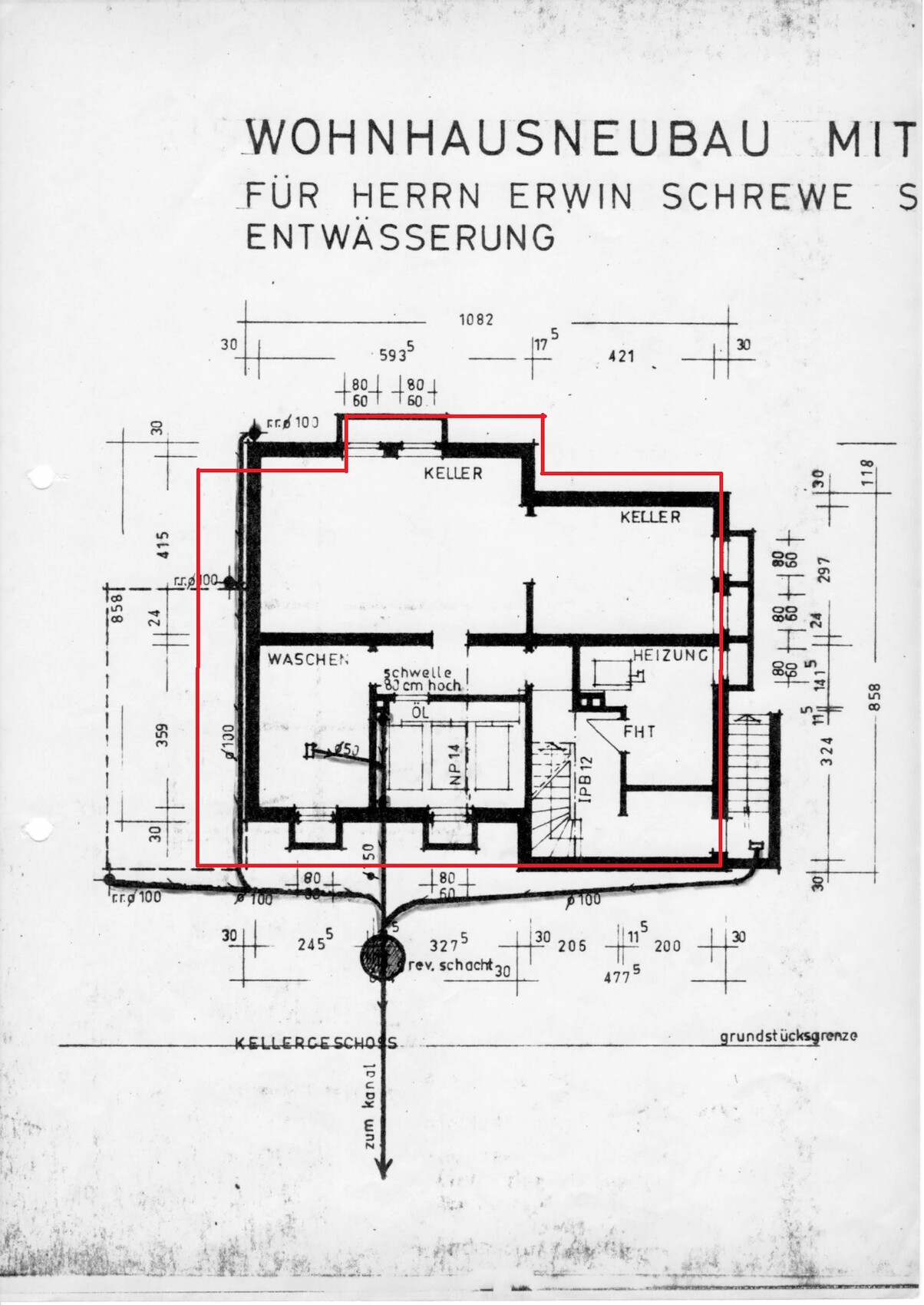
Attached is an image showing both floor plans overlaid.
BartJSimpson schrieb:
and furthermore, the floor plan of the new prefabricated house would cover less than one third of the existing basement footprint.
Attached is also an image with both floor plans overlaid.I see it as less of an issue there. As I said, please provide the model of the desired house, then we can consider it more closely.
https://www.instagram.com/11antgmxde/
https://www.linkedin.com/company/bauen-jetzt/
Similar topics