
For our new build, we originally planned to install an air-source heat pump and generate the electricity for it, as well as part of our other electricity needs, with our own photovoltaic system and battery storage. After receiving two quotes, we now have some doubts. The lowest quote for a heat pump with 5.08 kW, a photovoltaic system with 5.1 kWp, and a battery with 5.12 kWh is €33,000. Should we rather choose a conventional gas heating system instead? That would definitely be cheaper. Or is that completely outdated now?
MayrCh schrieb:
If no fossil fuel heating systems are installed in about 10 years, there will certainly be changes on the demand side from that point onward. In the medium to short term, the start-up of NordStreamII will have a significant impact on the supply situation. Around the nuclear power plants that will soon be shut down, there are currently numerous combined cycle gas power plants in the approval process. These will also influence demand. At the moment, the Russian side does not seem to me to want to reduce gas supply in the medium term, as we are not yet that dependent.I completely agree with @MayrCh.
I am also planning a KFW 55 standard house with a gas boiler and photovoltaic system for hot water. Done, and I can relax.
A gas heating system is now very efficient, space-saving, and technically mature. And there’s no trouble with neighbors concerning the location of a heat pump. Everything else, including battery storage, is still in its infancy and not yet fully developed.
Well, the graphic showing how heating is done in Germany isn’t really that meaningful. It includes heating systems from the last 30 years.
If anything, there should be a graphic showing what is currently installed in new buildings. And yes, gas heating probably still dominates, but I assume heat pumps are becoming quite common as well.
I always look at it from an ecological perspective. Gas is better than oil, but it is still a fossil fuel that releases emissions and contributes to global warming. Heat pumps score big here, especially if the energy comes from renewable sources like solar, wind, or hydropower. In my opinion, the future is headed exactly in this direction—or it must go that way. So why not install and support the more future-proof option?
I would always design and install underfloor heating for low temperatures, as required for heat pumps. Who knows if gas will even be allowed in 30 years? The cost difference between gas and heat pumps isn’t that dramatic anymore, in my view. If possible, I would choose a brine-to-water heat pump, which hardly uses any electricity at all.
But that’s just my opinion.
If anything, there should be a graphic showing what is currently installed in new buildings. And yes, gas heating probably still dominates, but I assume heat pumps are becoming quite common as well.
I always look at it from an ecological perspective. Gas is better than oil, but it is still a fossil fuel that releases emissions and contributes to global warming. Heat pumps score big here, especially if the energy comes from renewable sources like solar, wind, or hydropower. In my opinion, the future is headed exactly in this direction—or it must go that way. So why not install and support the more future-proof option?
I would always design and install underfloor heating for low temperatures, as required for heat pumps. Who knows if gas will even be allowed in 30 years? The cost difference between gas and heat pumps isn’t that dramatic anymore, in my view. If possible, I would choose a brine-to-water heat pump, which hardly uses any electricity at all.
But that’s just my opinion.
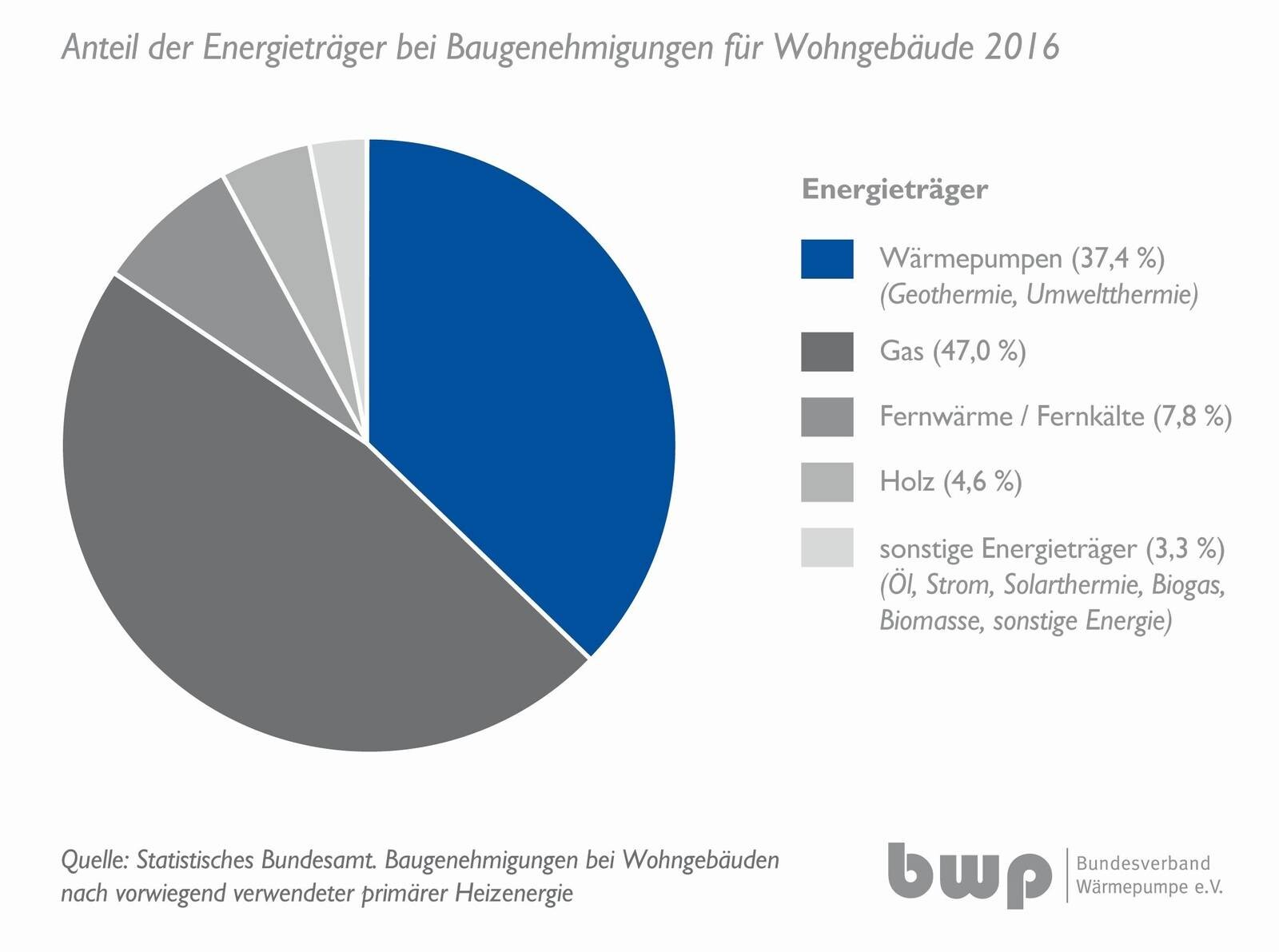
And here is a graphic showing the situation in new buildings. This data is from 2016. I believe the number of heat pumps has increased even more since then. Honestly, I didn’t expect them to already have such a large share; I thought gas heating systems were still a bit more common.
Specki schrieb:
And in my opinion, the future is exactly headed in this direction and must go in this direction. So why not install the more future-proof solution and promote it? Undisputed. However, if the impression is given here that energy costs can be saved in the medium to long term and that insulation is fundamentally economical, this is highly speculative or simply incorrect. There is consensus that moving away from fossil fuels in the medium to long term, as far as reasonable, is necessary.
People will only move away from fossil fuels if there is a change in price. People are generally unwilling to pay more voluntarily for better environmental protection. Everyone mainly focuses on their own benefit and wants the cheapest option, which currently might still be gas.
So, if we want to switch from fossil fuels to renewable energy, prices need to change. A keyword here is, for example, a carbon tax.
That’s why I believe that, in the long run, heat pumps will also be the better financial decision. In my view, they are the better choice for the environment anyway (provided that the electricity used is generated from renewable sources).
So, if we want to switch from fossil fuels to renewable energy, prices need to change. A keyword here is, for example, a carbon tax.
That’s why I believe that, in the long run, heat pumps will also be the better financial decision. In my view, they are the better choice for the environment anyway (provided that the electricity used is generated from renewable sources).
Similar topics