
ᐅ Buffer tank quickly loses temperature during domestic hot water use
Created on: 22 Dec 2025 16:40
B
Birdies
Hello everyone,
We have had a heat pump with a buffer tank "Citrin Solar Heat Pump-SKS 650-1 premium" for almost one and a half years now.
We have been observing the following issue and have been discussing it with the installer for quite some time, who has also involved the manufacturer Citrin. It feels like they are trying to shift the blame to each other, but so far we have not seen a solution.
Effect in WINTER, when the heating is running:
The lower part of the buffer tank is around 30-35°C (86-95°F). All radiators are working properly.
The domestic hot water (DHW) area at the top is heated to 50°C (122°F) starting at 3:30 pm to use photovoltaic electricity if available.
However, we can see and FEEL that the water cools down quite quickly again.
We lose about 15°C (27°F) in the DHW area within a few hours, even without any DHW consumption.
As a result, we have nicely solar-heated water around 3:30/4:00 pm, but by the time you want to shower in the evening, say around 10 pm, the hot water is no longer sufficient.
Not to mention filling a bathtub.
Together with the installer, a test was carried out where all supply and return lines and any other connections to the tank, circulation, solar, etc. were closed.
The DHW was preheated to temperature beforehand.
No DHW was drawn during the entire recording period!
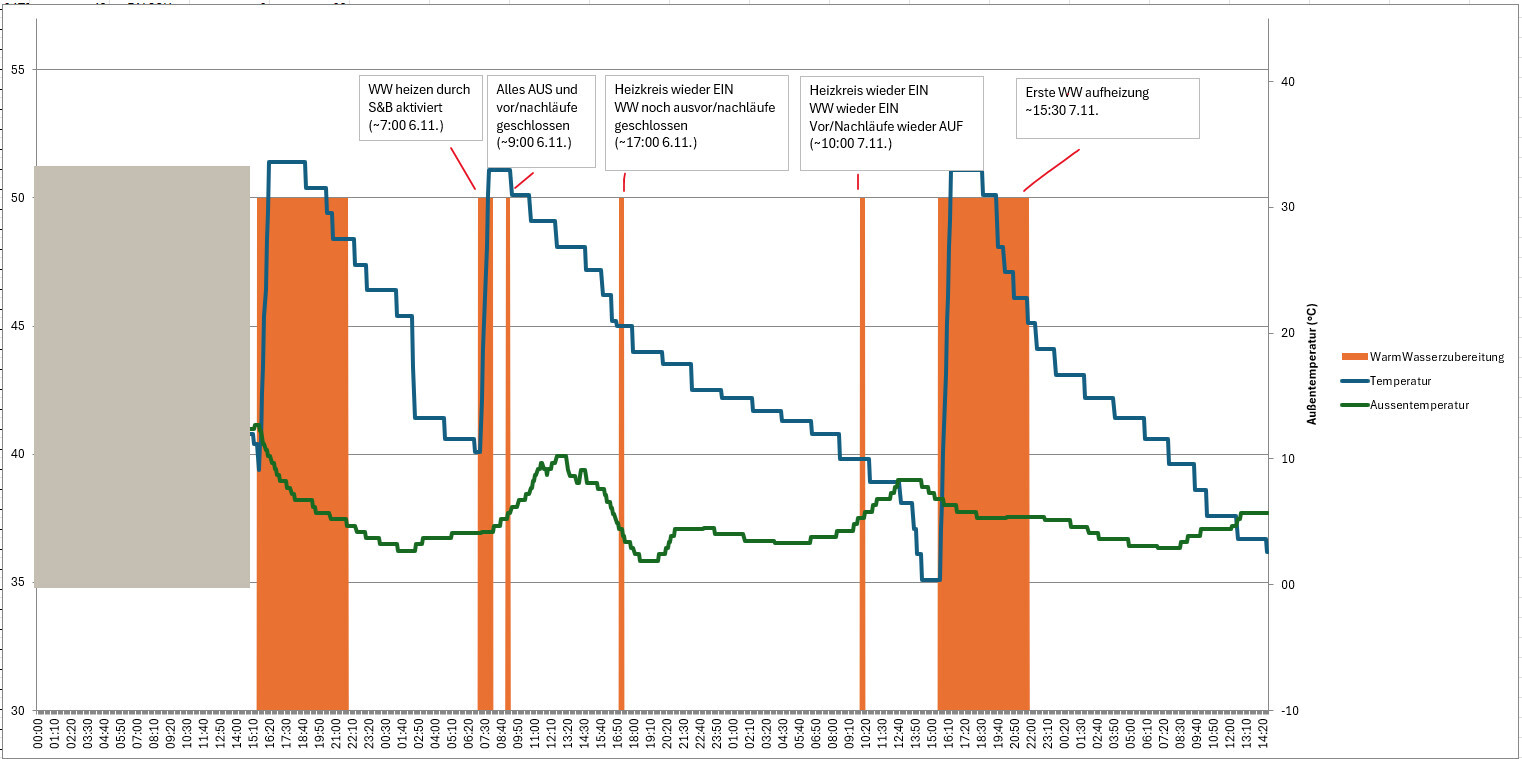
(The three very thin orange bars are only markers, not DHW heating!)
For comparison, in SUMMER:
The entire tank is heated to 55°C (131°F) by the solar thermal system on the roof, both top and bottom.
Heat loss from evening (sunset) until the next midday, when the sun shines on the solar thermal panels again, is only about 3°C (5°F).
Even if there is no sun for a full day after that, the temperature loss of about 8°C (14°F) over TWO days is still reasonable.
My question:
Is such a drastic heat loss of the buffer tank normal and acceptable, or is there a fault here?
Would it make sense to use the tank only for DHW and connect the heating circuit directly to the heat pump? This was a suggestion already discussed with the installer. (My concerns are possibly an increased number of compressor starts, but the installer believes this would not happen because the system "modulates" and instead of on/off would run continuously at a lower required power.)
With this idea, there would be NO buffer in the heating circuit.
Viessmann Vitocal 250 A
The house currently has two heating circuits, which work well with the current settings:
Currently, the system is connected/set up as follows:
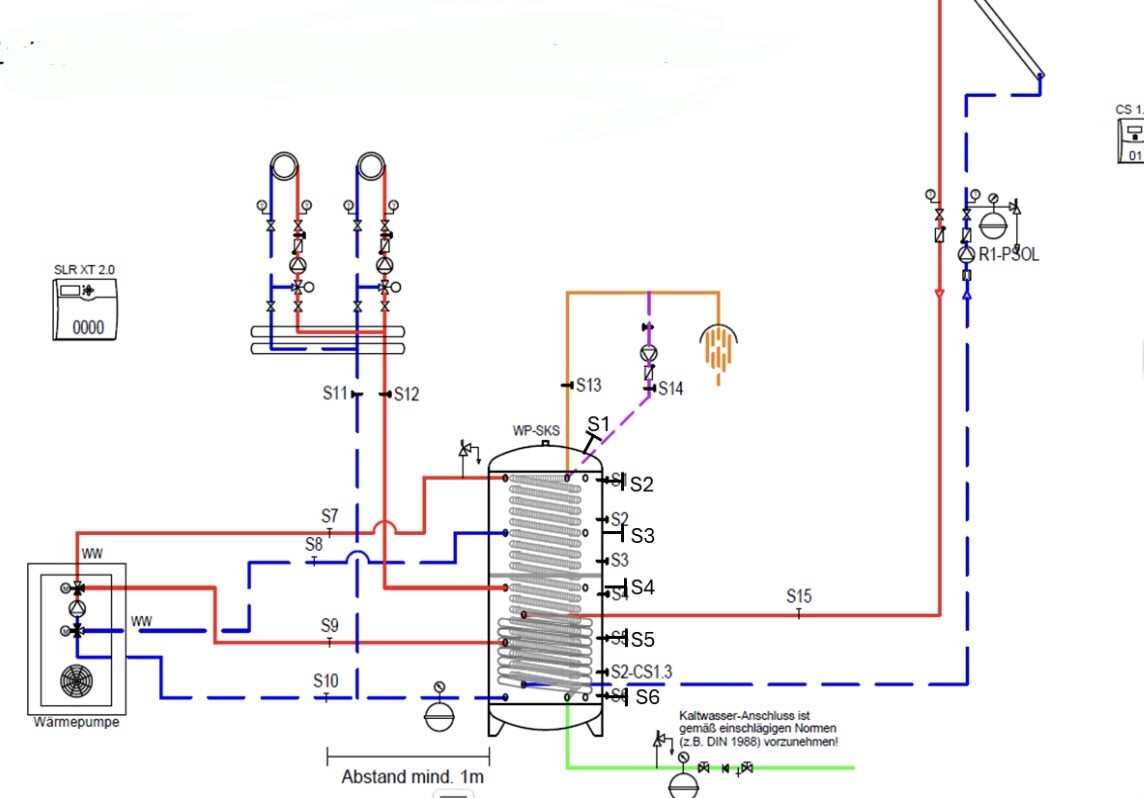
There is a meeting with the installer in early January, and until then I would like to understand whether the proposed solutions make sense, could cause issues, and so on.
They have already stated themselves that such a temperature loss is not normal and have reported it as a defect.
We have had a heat pump with a buffer tank "Citrin Solar Heat Pump-SKS 650-1 premium" for almost one and a half years now.
We have been observing the following issue and have been discussing it with the installer for quite some time, who has also involved the manufacturer Citrin. It feels like they are trying to shift the blame to each other, but so far we have not seen a solution.
Effect in WINTER, when the heating is running:
The lower part of the buffer tank is around 30-35°C (86-95°F). All radiators are working properly.
The domestic hot water (DHW) area at the top is heated to 50°C (122°F) starting at 3:30 pm to use photovoltaic electricity if available.
However, we can see and FEEL that the water cools down quite quickly again.
We lose about 15°C (27°F) in the DHW area within a few hours, even without any DHW consumption.
As a result, we have nicely solar-heated water around 3:30/4:00 pm, but by the time you want to shower in the evening, say around 10 pm, the hot water is no longer sufficient.
Not to mention filling a bathtub.
Together with the installer, a test was carried out where all supply and return lines and any other connections to the tank, circulation, solar, etc. were closed.
The DHW was preheated to temperature beforehand.
No DHW was drawn during the entire recording period!
(The three very thin orange bars are only markers, not DHW heating!)
For comparison, in SUMMER:
The entire tank is heated to 55°C (131°F) by the solar thermal system on the roof, both top and bottom.
Heat loss from evening (sunset) until the next midday, when the sun shines on the solar thermal panels again, is only about 3°C (5°F).
Even if there is no sun for a full day after that, the temperature loss of about 8°C (14°F) over TWO days is still reasonable.
My question:
Is such a drastic heat loss of the buffer tank normal and acceptable, or is there a fault here?
Would it make sense to use the tank only for DHW and connect the heating circuit directly to the heat pump? This was a suggestion already discussed with the installer. (My concerns are possibly an increased number of compressor starts, but the installer believes this would not happen because the system "modulates" and instead of on/off would run continuously at a lower required power.)
With this idea, there would be NO buffer in the heating circuit.
Viessmann Vitocal 250 A
The house currently has two heating circuits, which work well with the current settings:
- Underfloor heating in living/dining area ~40 sqm (heating curve level 4 slope 0.2)
- Radiators ~120 sqm (heating curve level 5 slope 0.4)
Currently, the system is connected/set up as follows:
There is a meeting with the installer in early January, and until then I would like to understand whether the proposed solutions make sense, could cause issues, and so on.
They have already stated themselves that such a temperature loss is not normal and have reported it as a defect.
W
wiltshire23 Dec 2025 21:50A rapid drop in temperature can also result from a (too) high flow rate.
Try reducing the heating circuit pump speed and check if the temperature drop changes.
Try reducing the heating circuit pump speed and check if the temperature drop changes.
That's exactly the point. It doesn’t fit together. Someone is extracting heat from the upper volume. If it stayed in your heating room (instead of escaping through the insulation), you would have a sauna in there. So just check whether the connections are made according to the diagram. Maybe actually take a photo of the heating circuit connections. Otherwise, I can't think of anything else.

Similar topics