
ᐅ Buffer tank quickly loses temperature during domestic hot water use
Created on: 22 Dec 2025 16:40
B
Birdies
Hello everyone,
We have had a heat pump with a buffer tank "Citrin Solar Heat Pump-SKS 650-1 premium" for almost one and a half years now.
We have been observing the following issue and have been discussing it with the installer for quite some time, who has also involved the manufacturer Citrin. It feels like they are trying to shift the blame to each other, but so far we have not seen a solution.
Effect in WINTER, when the heating is running:
The lower part of the buffer tank is around 30-35°C (86-95°F). All radiators are working properly.
The domestic hot water (DHW) area at the top is heated to 50°C (122°F) starting at 3:30 pm to use photovoltaic electricity if available.
However, we can see and FEEL that the water cools down quite quickly again.
We lose about 15°C (27°F) in the DHW area within a few hours, even without any DHW consumption.
As a result, we have nicely solar-heated water around 3:30/4:00 pm, but by the time you want to shower in the evening, say around 10 pm, the hot water is no longer sufficient.
Not to mention filling a bathtub.
Together with the installer, a test was carried out where all supply and return lines and any other connections to the tank, circulation, solar, etc. were closed.
The DHW was preheated to temperature beforehand.
No DHW was drawn during the entire recording period!
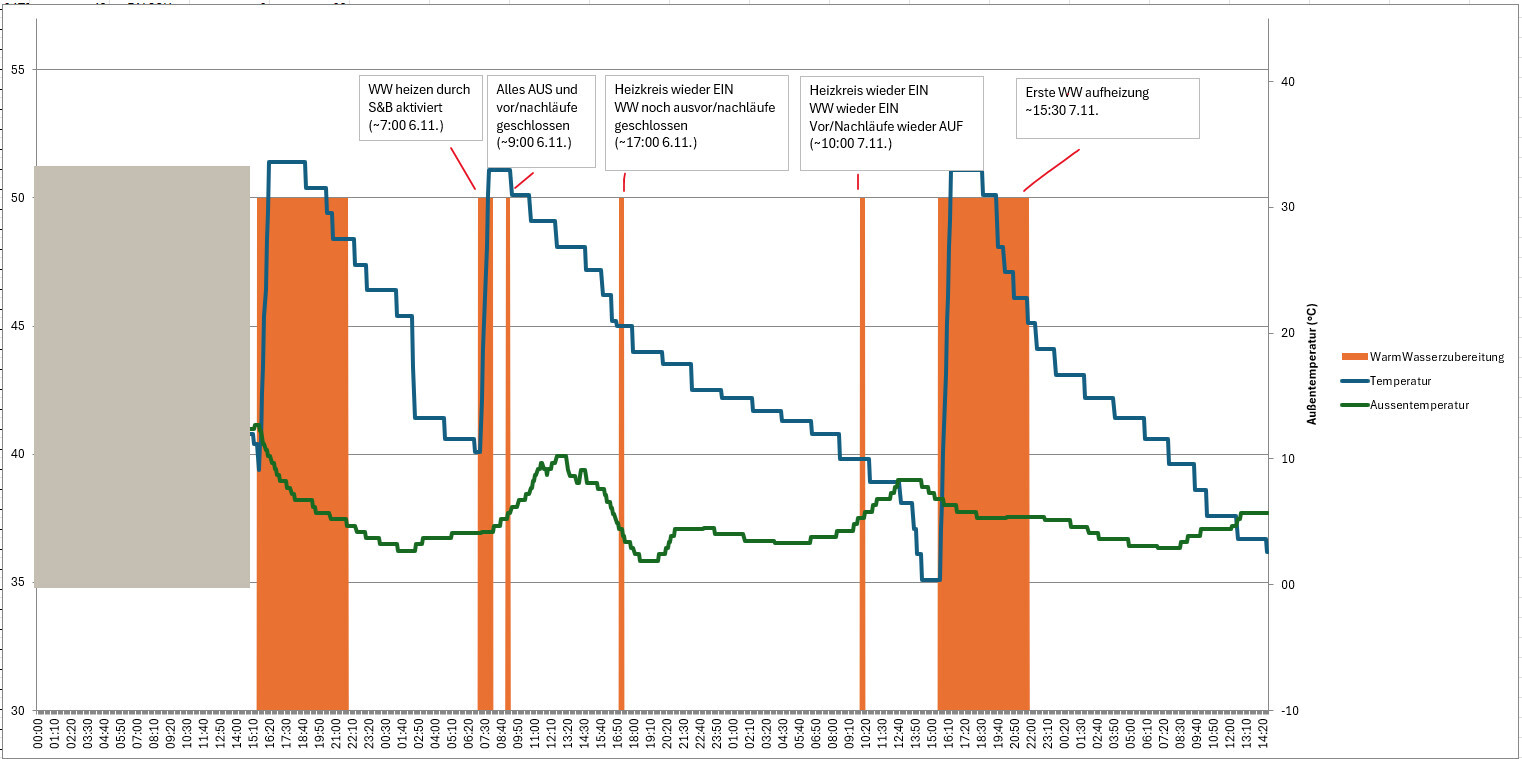
(The three very thin orange bars are only markers, not DHW heating!)
For comparison, in SUMMER:
The entire tank is heated to 55°C (131°F) by the solar thermal system on the roof, both top and bottom.
Heat loss from evening (sunset) until the next midday, when the sun shines on the solar thermal panels again, is only about 3°C (5°F).
Even if there is no sun for a full day after that, the temperature loss of about 8°C (14°F) over TWO days is still reasonable.
My question:
Is such a drastic heat loss of the buffer tank normal and acceptable, or is there a fault here?
Would it make sense to use the tank only for DHW and connect the heating circuit directly to the heat pump? This was a suggestion already discussed with the installer. (My concerns are possibly an increased number of compressor starts, but the installer believes this would not happen because the system "modulates" and instead of on/off would run continuously at a lower required power.)
With this idea, there would be NO buffer in the heating circuit.
Viessmann Vitocal 250 A
The house currently has two heating circuits, which work well with the current settings:
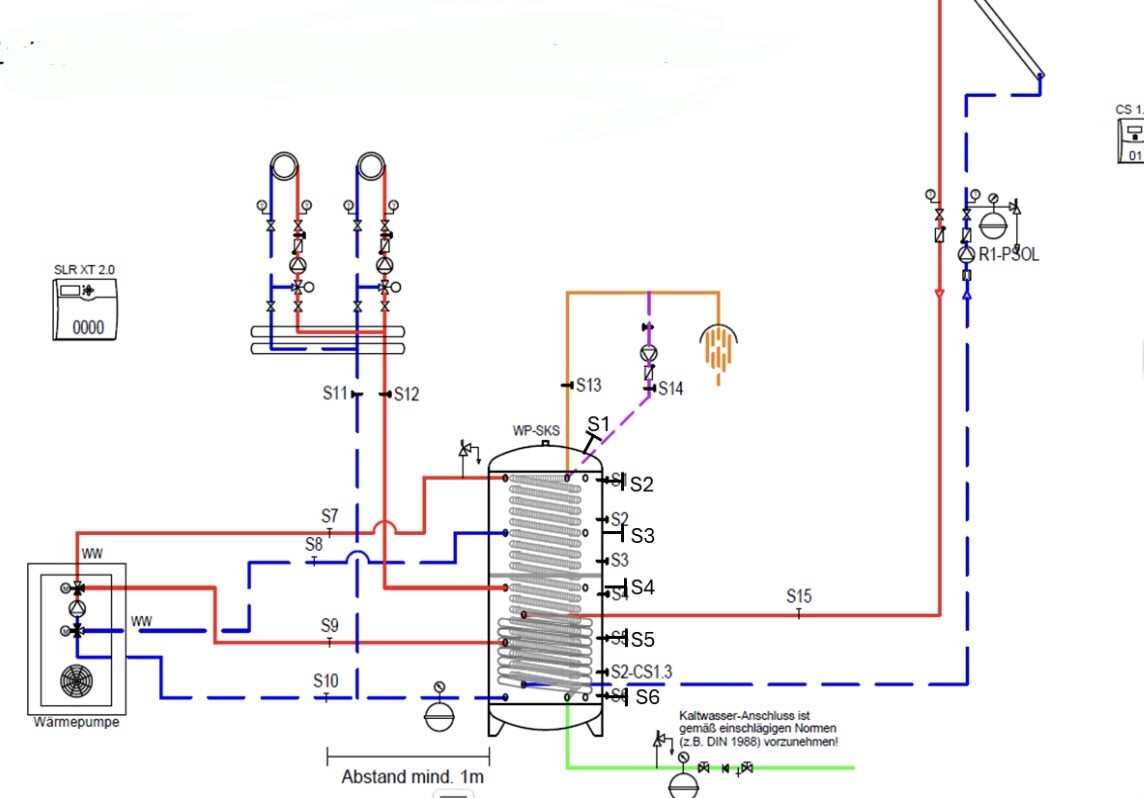
Currently, the system is connected/set up as follows:
There is a meeting with the installer in early January, and until then I would like to understand whether the proposed solutions make sense, could cause issues, and so on.
They have already stated themselves that such a temperature loss is not normal and have reported it as a defect.
We have had a heat pump with a buffer tank "Citrin Solar Heat Pump-SKS 650-1 premium" for almost one and a half years now.
We have been observing the following issue and have been discussing it with the installer for quite some time, who has also involved the manufacturer Citrin. It feels like they are trying to shift the blame to each other, but so far we have not seen a solution.
Effect in WINTER, when the heating is running:
The lower part of the buffer tank is around 30-35°C (86-95°F). All radiators are working properly.
The domestic hot water (DHW) area at the top is heated to 50°C (122°F) starting at 3:30 pm to use photovoltaic electricity if available.
However, we can see and FEEL that the water cools down quite quickly again.
We lose about 15°C (27°F) in the DHW area within a few hours, even without any DHW consumption.
As a result, we have nicely solar-heated water around 3:30/4:00 pm, but by the time you want to shower in the evening, say around 10 pm, the hot water is no longer sufficient.
Not to mention filling a bathtub.
Together with the installer, a test was carried out where all supply and return lines and any other connections to the tank, circulation, solar, etc. were closed.
The DHW was preheated to temperature beforehand.
No DHW was drawn during the entire recording period!
(The three very thin orange bars are only markers, not DHW heating!)
For comparison, in SUMMER:
The entire tank is heated to 55°C (131°F) by the solar thermal system on the roof, both top and bottom.
Heat loss from evening (sunset) until the next midday, when the sun shines on the solar thermal panels again, is only about 3°C (5°F).
Even if there is no sun for a full day after that, the temperature loss of about 8°C (14°F) over TWO days is still reasonable.
My question:
Is such a drastic heat loss of the buffer tank normal and acceptable, or is there a fault here?
Would it make sense to use the tank only for DHW and connect the heating circuit directly to the heat pump? This was a suggestion already discussed with the installer. (My concerns are possibly an increased number of compressor starts, but the installer believes this would not happen because the system "modulates" and instead of on/off would run continuously at a lower required power.)
With this idea, there would be NO buffer in the heating circuit.
Viessmann Vitocal 250 A
The house currently has two heating circuits, which work well with the current settings:
- Underfloor heating in living/dining area ~40 sqm (heating curve level 4 slope 0.2)
- Radiators ~120 sqm (heating curve level 5 slope 0.4)
Currently, the system is connected/set up as follows:
There is a meeting with the installer in early January, and until then I would like to understand whether the proposed solutions make sense, could cause issues, and so on.
They have already stated themselves that such a temperature loss is not normal and have reported it as a defect.
J
Jesse Custer23 Dec 2025 11:54I also think sensors aren’t really the issue here – the domestic hot water actually cools down naturally.
Based on that, let’s analyze the circuit diagram:
- On the left is the heat pump – okay. Cold water enters at the bottom from the return line, and warm water flows out at the top from the supply line into the heating buffer and hot water tank – fine.
- At the top left are the two heating circuits – also fine. They are heated from the heating buffer, and the return flows back into the heating system, which fits.
- The expansion vessel is located on the heating return line – okay.
- The heat pump’s SKS (sorry again) receives cold water from below – okay, so the heating tank is also heating the domestic hot water.
- That would explain why the water gets warm in summer despite the sheet metal... the water is already heated from below, but then… this kind of acts more like a tankless water heater, doesn’t it?
… I’m having trouble understanding how this thing works… it seems exactly the opposite of what would logically make sense… am I missing something here?
Based on that, let’s analyze the circuit diagram:
- On the left is the heat pump – okay. Cold water enters at the bottom from the return line, and warm water flows out at the top from the supply line into the heating buffer and hot water tank – fine.
- At the top left are the two heating circuits – also fine. They are heated from the heating buffer, and the return flows back into the heating system, which fits.
- The expansion vessel is located on the heating return line – okay.
- The heat pump’s SKS (sorry again) receives cold water from below – okay, so the heating tank is also heating the domestic hot water.
- That would explain why the water gets warm in summer despite the sheet metal... the water is already heated from below, but then… this kind of acts more like a tankless water heater, doesn’t it?
… I’m having trouble understanding how this thing works… it seems exactly the opposite of what would logically make sense… am I missing something here?
In the end, the hot water storage tank actually functions as an instantaneous water heater. The solar thermal system heats from the bottom, and in summer, I can see that the temperature at the bottom is around 55°C (131°F), and the top is roughly the same. Since the entire tank is more or less at the same temperature, this isn’t an issue.
However, in winter, the solar thermal system at best only supplements the heating circuit. I get minimal support, if any. The bottom stays around 30–36°C (86–97°F), while theoretically, the top should be around 50°C (122°F).
The domestic hot water is preheated at the bottom coil and then brought up to the desired temperature at the top. This works well as long as the top temperature is about 45°C (113°F) or higher. If it falls below that, washing hands is still fine, but it’s not enough for showering or filling a bathtub. Currently, for example, the top of the tank is at 37.5°C (99.5°F), with the last water heating cycle reaching 50°C (122°F) at 3:30 PM yesterday (with no significant hot water usage since then).
What the installer’s test showed, though, is that the tank mixes more than it should, and the layers don’t stay sufficiently separated.
Honestly, I am skeptical of the entire layering concept. The metal sheet is permeable, which makes sense in summer because you want the solar thermal system to heat the whole tank.
But in winter, you don’t want this, as you want the top to stay warm and the bottom to be cooler.
Physics is harsh—the heat in the different areas WILL equalize, sooner or later! Since this divider sheet isn’t actually sealed—I'm guessing there are holes or similar—it’s even more so. But even if the sheet were completely sealed, the temperatures would eventually equalize over time, just more slowly, depending on how well the sheet conducts heat.
However, in winter, the solar thermal system at best only supplements the heating circuit. I get minimal support, if any. The bottom stays around 30–36°C (86–97°F), while theoretically, the top should be around 50°C (122°F).
The domestic hot water is preheated at the bottom coil and then brought up to the desired temperature at the top. This works well as long as the top temperature is about 45°C (113°F) or higher. If it falls below that, washing hands is still fine, but it’s not enough for showering or filling a bathtub. Currently, for example, the top of the tank is at 37.5°C (99.5°F), with the last water heating cycle reaching 50°C (122°F) at 3:30 PM yesterday (with no significant hot water usage since then).
What the installer’s test showed, though, is that the tank mixes more than it should, and the layers don’t stay sufficiently separated.
Honestly, I am skeptical of the entire layering concept. The metal sheet is permeable, which makes sense in summer because you want the solar thermal system to heat the whole tank.
But in winter, you don’t want this, as you want the top to stay warm and the bottom to be cooler.
Physics is harsh—the heat in the different areas WILL equalize, sooner or later! Since this divider sheet isn’t actually sealed—I'm guessing there are holes or similar—it’s even more so. But even if the sheet were completely sealed, the temperatures would eventually equalize over time, just more slowly, depending on how well the sheet conducts heat.

What is the recommendation for domestic hot water (DHW) production? I also have a stratified storage tank with a heat pump, and I was advised back then to produce the hot water as it is needed. In our case, that tends to be mainly in the morning and evening. I have followed this approach for the past 11 years.
Since we installed photovoltaic panels this year, I have switched to heating the water during the day. However, when my wife and child take long showers in the evening, I only have lukewarm water in the morning. To fill a full bathtub, I would need to heat the water specifically. However, nobody here really uses the bathtub as everyone prefers to shower. Perhaps it would help not to fill the tub with the tap fully open, but to allow the “instant water heater” a bit more time to heat up.
Since we installed photovoltaic panels this year, I have switched to heating the water during the day. However, when my wife and child take long showers in the evening, I only have lukewarm water in the morning. To fill a full bathtub, I would need to heat the water specifically. However, nobody here really uses the bathtub as everyone prefers to shower. Perhaps it would help not to fill the tub with the tap fully open, but to allow the “instant water heater” a bit more time to heat up.
Similar topics