
Hello,
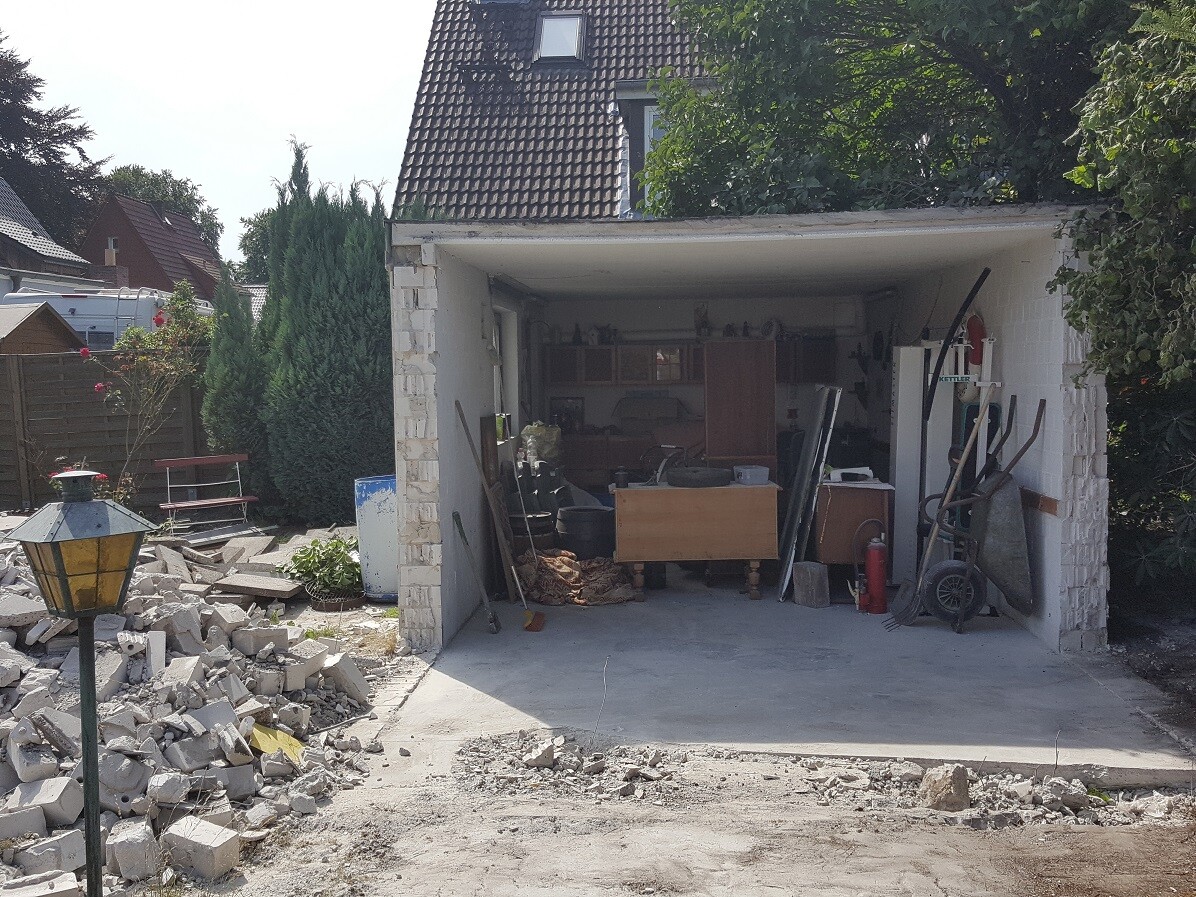
we had a 9 x 4 m (30 x 13 ft) garage shortened to 7 x 4 m (23 x 13 ft). Now the garage needs to be bricked up again. It’s already frustrating that I couldn’t do the demolition myself... Now, as the future homeowner, I want to at least build a wall myself! However, I have never done this before...
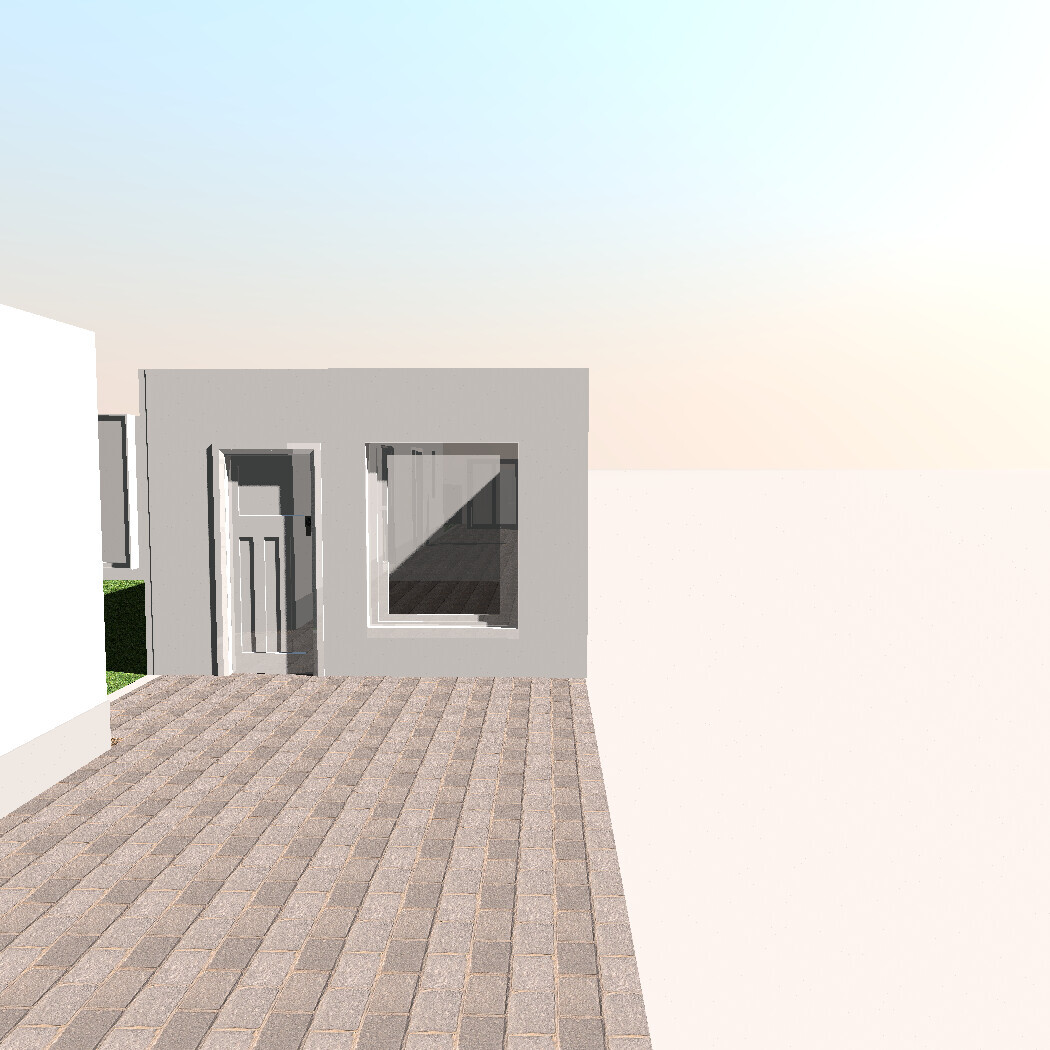
Additionally, a window and a door are to be installed.
The garage was built in 1981. It has a thick foundation with reinforcement and a frost skirt at a depth of 80 cm (31 inches). The walls are made of calcium silicate bricks (2DF). At the top there is a wall tie, which is currently hanging free on two sides due to the demolition. The ceiling consists of 4 m (13 ft) long aerated concrete slabs with steel reinforcement. These rest on the walls.
Now I want to brick up the front wall, where the garage door used to be and which has now been removed, by myself. Also, a standard door and a window should be installed.
In my mind, I had planned to simply build the new wall at a right angle to the existing wall so that it aligns with the aerated concrete ceiling on top. I would install a lintel above the door and window, and that’s it. However, I was told that I should interlock the corners of the walls for stability. Also, the wall tie should be continued?

Perhaps some of you can give me good advice on how to best get started, which approach is the right one, and whether it might be better to just hire a mason to do everything.
For clarification, I have attached photos of both the current state and the planned state.
Thank you in advance!
Good luck,
Manu
we had a 9 x 4 m (30 x 13 ft) garage shortened to 7 x 4 m (23 x 13 ft). Now the garage needs to be bricked up again. It’s already frustrating that I couldn’t do the demolition myself... Now, as the future homeowner, I want to at least build a wall myself! However, I have never done this before...
Additionally, a window and a door are to be installed.
The garage was built in 1981. It has a thick foundation with reinforcement and a frost skirt at a depth of 80 cm (31 inches). The walls are made of calcium silicate bricks (2DF). At the top there is a wall tie, which is currently hanging free on two sides due to the demolition. The ceiling consists of 4 m (13 ft) long aerated concrete slabs with steel reinforcement. These rest on the walls.
Now I want to brick up the front wall, where the garage door used to be and which has now been removed, by myself. Also, a standard door and a window should be installed.
In my mind, I had planned to simply build the new wall at a right angle to the existing wall so that it aligns with the aerated concrete ceiling on top. I would install a lintel above the door and window, and that’s it. However, I was told that I should interlock the corners of the walls for stability. Also, the wall tie should be continued?
Perhaps some of you can give me good advice on how to best get started, which approach is the right one, and whether it might be better to just hire a mason to do everything.
For clarification, I have attached photos of both the current state and the planned state.
Thank you in advance!
Good luck,
Manu
toxicmolotow schrieb:
As if I had a feeling.
A cellar replacement room is not the same as a garage.
And presumably only a garage is allowed there.
If everything is to be done correctly, you need to have the change of use approved. And I can’t judge if your building can be approved at that location.
And yes, the building authority visited me unannounced three times during the roughly nine-month construction phase.According to the State Building Code of Schleswig-Holstein, both a garage and other buildings without habitable rooms are permitted directly on the property boundary. So that is not an issue.
Furthermore, the State Building Code states: “Garages are buildings or parts of buildings for parking motor vehicles.” From my point of view, this means that if I simply use the “garage” to park my motor scooter, it counts as a garage according to the definition. However, I will check this more precisely.
Nordlys schrieb:
I think it has already happened. The gate is gone. But I would have left it in place. And just wouldn’t have parked the car inside. My garage will never actually house a car; it’s a cheap workshop, garden shed, etc. And as long as there is a gate, it’s a garage. And as long as our car isn’t parked on the street, nobody will care. Whether the lawn mower or the VW is in there is the neighbor’s concern… We removed the garage door because, firstly, it was broken and, secondly, because unlike before, now only a pedestrian path passes by there, no driveway anymore. A garage door would therefore not be visually appropriate. It also takes up parking space inside.
11ant schrieb:
What do you expect? — seriously, that they would recommend a different material?
How does one even come up with the idea to shorten a garage “in length with cellar replacement” to “if cellar replacement, then only long enough for a second car,” and then even want to replace the gate that gives it the appearance of a garage? — I would at least reinstall the gate and try my first masonry attempts with a barbecue. Not everyone has one made from calcium silicate brick.
Then the garage would simply be shortened like a pair of pants and all peace restored. No building authority will mind a few wine bottles in the garage. And with a gate, you can carry bulky waste out much more comfortably. No, I don’t expect that. On the one hand, I want them to clarify the load-bearing capacity of the ceiling joists; on the other hand, it’s worth hearing their suggestion for the new wall.
I feel like I’ve gotten 15 different tips from 10 different users. On MyHammer, I received one offer to build the wall for just under €2,700 (without material) within a week...
I will probably try it myself anyway. Removing it is always an option.

Forza... schrieb:
First of all, you should be informed about the load-bearing capacity of the ceiling joists, As you can see, this precast ceiling panel is self-supporting—and, as you probably also notice, with minimal deflection. The reinforcement is likely the same in intermediate elements as in end elements with the same span. Therefore, it shouldn’t matter for the current front end element that it was previously an intermediate element. In other words: it is not “load-bearing” regarding what is underneath it. Still, I would recommend building walls 24 cm (9.5 inches) thick. By the way, becoming a mason is a serious vocational training— you’ll realize in practice that it’s not as easy as playing in a sandbox. You’ll be surprised how a 12 mm (0.5 inch) bed joint is enough to make the wall crooked. Maybe as a hobby mason, you’d better use aerated concrete plan blocks and save the nice sand-lime bricks for the barbecue.
https://www.instagram.com/11antgmxde/
https://www.linkedin.com/company/bauen-jetzt/
Thanks again for all your opinions and answers! I have now found a mason who will at least provide me with some assistance.
What is your opinion regarding the frost protection strip? Does it absolutely have to be placed beneath the new wall? And if so, is this only for protection against frost and moisture, or also for stability reasons? Currently, at the location where the new wall is planned, there is about 20cm (8 inches) of reinforced concrete.
Good luck
What is your opinion regarding the frost protection strip? Does it absolutely have to be placed beneath the new wall? And if so, is this only for protection against frost and moisture, or also for stability reasons? Currently, at the location where the new wall is planned, there is about 20cm (8 inches) of reinforced concrete.
Good luck
Forza... schrieb:
Currently, there is a reinforced concrete wall about 20 cm (8 inches) thick where the new wall is planned. A foundation alone does not replace that. You can't shorten a garage as easily as a pair of pants (or you would need to "hem" the garage again).
https://www.instagram.com/11antgmxde/
https://www.linkedin.com/company/bauen-jetzt/
Similar topics