
Hello,
We are planning to build next year in a new development area, which is currently completely empty. We will probably be among the first to build there.
I have a question regarding building a garage on the property boundary. Originally, I wanted a flat-roof garage, but unfortunately, this is not allowed.
Since I want a rather large garage (8 × 9 meters (26 × 30 feet), with the 9 meters (30 feet) along the boundary), a gable roof is hardly feasible given an average wall height of 3 meters (10 feet). So I thought about building a hipped roof, where the fourth roof plane is created because the garage is directly attached to the house. Now I have two questions:
A) How is the gutter treated when it is on the boundary? I would have to set the building back so the gutter does not cross the boundary. Is that possible, or must the building be placed directly on the boundary?
B) How does this affect the neighbor? The administration writes: "It is also possible to set the garage back from the neighbor’s boundary. An obligation to match the neighbor’s boundary garage only exists if the new building is to be attached seamlessly to it." Does this mean that "first come, first served" applies? If I place my garage first and my neighbor builds afterward, must they either build a hipped roof garage next to mine (which is also problematic, e.g., snow accumulation and frozen gutters) or set their building back from the boundary?
Thank you very much,
Sebastian
We are planning to build next year in a new development area, which is currently completely empty. We will probably be among the first to build there.
I have a question regarding building a garage on the property boundary. Originally, I wanted a flat-roof garage, but unfortunately, this is not allowed.
Since I want a rather large garage (8 × 9 meters (26 × 30 feet), with the 9 meters (30 feet) along the boundary), a gable roof is hardly feasible given an average wall height of 3 meters (10 feet). So I thought about building a hipped roof, where the fourth roof plane is created because the garage is directly attached to the house. Now I have two questions:
A) How is the gutter treated when it is on the boundary? I would have to set the building back so the gutter does not cross the boundary. Is that possible, or must the building be placed directly on the boundary?
B) How does this affect the neighbor? The administration writes: "It is also possible to set the garage back from the neighbor’s boundary. An obligation to match the neighbor’s boundary garage only exists if the new building is to be attached seamlessly to it." Does this mean that "first come, first served" applies? If I place my garage first and my neighbor builds afterward, must they either build a hipped roof garage next to mine (which is also problematic, e.g., snow accumulation and frozen gutters) or set their building back from the boundary?
Thank you very much,
Sebastian
B
Bauexperte2 Sep 2012 11:29Hello Sebastian,
Your architect should be able to answer this for you.
In my opinion, you will have to set this rather large garage back a good distance from the boundary with the neighbor due to the roof design, otherwise there will be issues with setback requirements. Alternatively, you could ask your neighbor if they agree to register a building easement (Baulast) on their property.
"Setback regulations are primarily designed to protect neighbors. This means the neighbor generally has a subjective right to the observance of setback rules and can successfully challenge a building permit granted for a project that does not comply with these rules. It is not necessary to additionally prove actual impairment; the violation of the neighbor-protecting regulation alone constitutes an infringement of the neighbor’s rights (OVG NRW, ruling of 22.1.1996 - 10 A 1464/92)."
Best regards
Boergi schrieb:
B) What about the neighbor? The administration writes: "It is also possible to set the garage back from the boundary with the neighbor. An obligation to match the neighbor’s garage boundary only applies if the new garage is built directly adjoining it." So is it a case of first come, first served? If I build my garage first and my neighbor comes afterward, do they have to build a hipped roof garage next to mine (which can also cause problems like snow loads or frozen gutters) or set it back from the boundary?
Your architect should be able to answer this for you.
In my opinion, you will have to set this rather large garage back a good distance from the boundary with the neighbor due to the roof design, otherwise there will be issues with setback requirements. Alternatively, you could ask your neighbor if they agree to register a building easement (Baulast) on their property.
"Setback regulations are primarily designed to protect neighbors. This means the neighbor generally has a subjective right to the observance of setback rules and can successfully challenge a building permit granted for a project that does not comply with these rules. It is not necessary to additionally prove actual impairment; the violation of the neighbor-protecting regulation alone constitutes an infringement of the neighbor’s rights (OVG NRW, ruling of 22.1.1996 - 10 A 1464/92)."
Best regards
At the moment, unfortunately, we still don’t have an architect involved. In my opinion, it’s simply too early because we haven’t yet agreed on what exactly we want. There are still fundamental questions open, such as about the basement, roof shape, rooms, etc., and I think even an architect would find it difficult to create a design without at least these basic specifications.
Can you explain why we have to set the building back? Building garages up to a length of 9.0 m (29.5 ft) on the boundary line is allowed (Bavaria), the roof shape is also permitted in the development plan, and the average wall height of 3.0 meters (9.8 ft) is being observed.
Regards,
Sebastian
Can you explain why we have to set the building back? Building garages up to a length of 9.0 m (29.5 ft) on the boundary line is allowed (Bavaria), the roof shape is also permitted in the development plan, and the average wall height of 3.0 meters (9.8 ft) is being observed.
Regards,
Sebastian
B
Bauexperte2 Sep 2012 13:44Hello Sebastian,
The longer you postpone this conversation, the more time will be wasted… and you will no longer be among the first to build in the new development area. Comfort and, for me, the top priority is of course financing. If you know how much money you can access, it is easy to determine how much money you want to spend. A good architect must take this into account!
Kind regards
Boergi schrieb:It is by no means too early; precisely those questions, along with their advantages, disadvantages, and costs, can be clarified through discussions with a competent architect. Since you—as far as I understand—already own the plot, the development plan and the textual regulations are fixed. With these basic framework conditions, you can work with an architect towards the final planning. He will ask about your living situation and based on that, make proposals.
At the moment there still isn’t an architect involved, unfortunately, which I think is simply because it’s currently too early as we still haven’t agreed on what we actually want. There are still very basic questions open about things like the basement, roof shape, rooms, etc. And I think without at least these specifications, even an architect would find it difficult to create a design for me.
The longer you postpone this conversation, the more time will be wasted… and you will no longer be among the first to build in the new development area. Comfort and, for me, the top priority is of course financing. If you know how much money you can access, it is easy to determine how much money you want to spend. A good architect must take this into account!
Boergi schrieb:If you actually comply with the average height, I missed that, sorry. Although I am not sure if this dimension can be maintained with a hip roof. A prefabricated garage already has a height of about 2.45 m (8 feet), plus the hip roof structure—what roof pitch?—this will be tight. Again, an architect is needed here to develop solutions.
Can you explain why we have to move back? The boundary construction for garages up to a length of 9.0 meters (29.5 feet) (Bavaria) is allowed, the roof shape is also permitted in the development plan, and the average wall height of 3.0 meters (9.8 feet) is observed.
Kind regards
Good morning, building expert
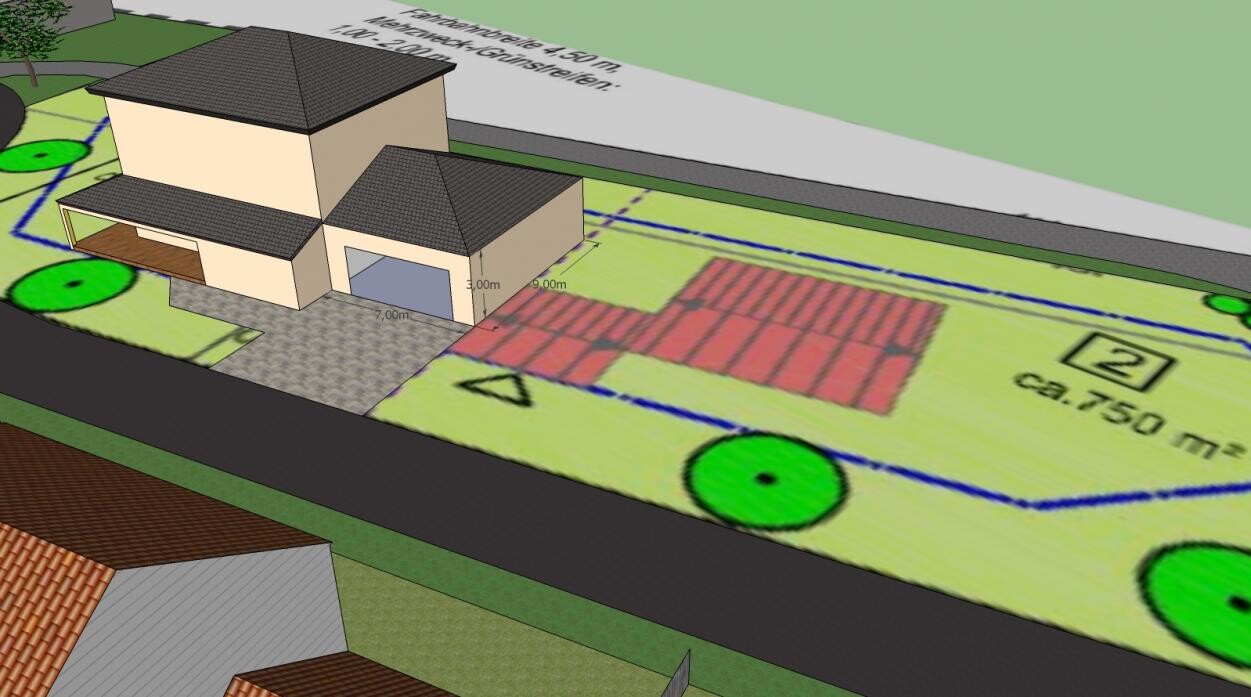
I tried to draw everything to help visualize it better.
First, the gable roof option, which exceeds the middle wall height of 3.00 m (10 feet) and would definitely not be allowed. In this case, I would need to set back the building or register an easement.
Then the version as I imagined it. I have often seen this in new development areas. Ideally, for this size, I would have preferred a flat roof with green roofing, but unfortunately, the development plan does not permit this.

Best regards,
Sebastian
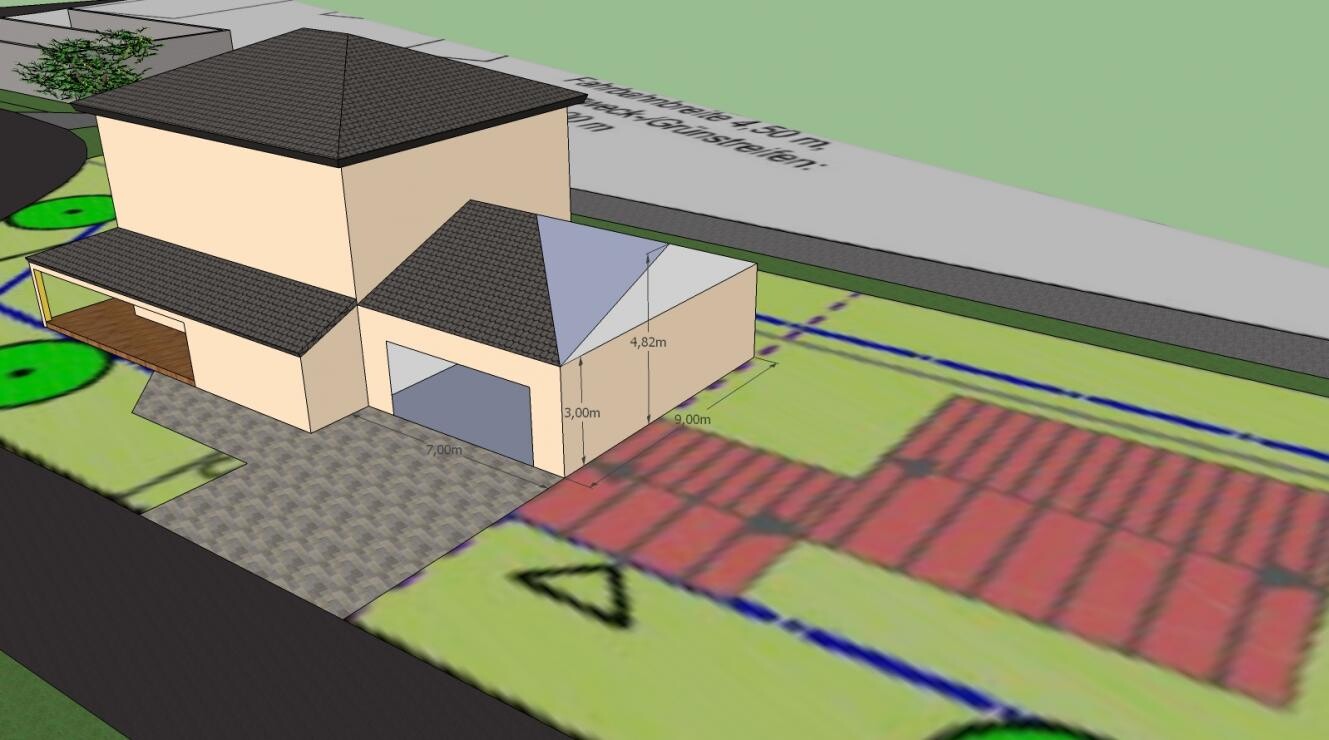
I tried to draw everything to help visualize it better.
First, the gable roof option, which exceeds the middle wall height of 3.00 m (10 feet) and would definitely not be allowed. In this case, I would need to set back the building or register an easement.
Then the version as I imagined it. I have often seen this in new development areas. Ideally, for this size, I would have preferred a flat roof with green roofing, but unfortunately, the development plan does not permit this.
Best regards,
Sebastian
B
Bauexperte3 Sep 2012 14:44Good afternoon
You have illustrated very clearly the problem I see.
Average wall height:
The dimensions for wall length and wall height always refer to the boundary wall. Average wall height means that the averaged height of the boundary wall is decisive. For example, if a garage boundary wall has a height of 2.75 meters (9 feet) at the front corner of the building and 3.25 meters (10 feet 8 inches) at the rear corner, the allowed average wall height would be 3 meters (9 feet 10 inches).
In your “washing machine” version, the house certainly has a height around 4.80 meters (15 feet 9 inches) — this would result in an average height of 3.90 meters (12 feet 10 inches), which is 90 centimeters (35 inches) too high. So you need to adjust the roof pitch of the pitched roof (WD), and as I mentioned in my initial post, this is still best done by the architect.
Of course, it is possible that the zoning plan — which I am not familiar with — allows an exception to the 3.00 meters (9 feet 10 inches) limit. However, as a rule, the above regulation applies.
Kind regards
Boergi schrieb:
And here is the version as I imagined it; I have often seen something like this in new development areas. For this size, I would have preferred a flat roof with greenery, but unfortunately the zoning plan does not permit it.
You have illustrated very clearly the problem I see.
Average wall height:
The dimensions for wall length and wall height always refer to the boundary wall. Average wall height means that the averaged height of the boundary wall is decisive. For example, if a garage boundary wall has a height of 2.75 meters (9 feet) at the front corner of the building and 3.25 meters (10 feet 8 inches) at the rear corner, the allowed average wall height would be 3 meters (9 feet 10 inches).
In your “washing machine” version, the house certainly has a height around 4.80 meters (15 feet 9 inches) — this would result in an average height of 3.90 meters (12 feet 10 inches), which is 90 centimeters (35 inches) too high. So you need to adjust the roof pitch of the pitched roof (WD), and as I mentioned in my initial post, this is still best done by the architect.
Of course, it is possible that the zoning plan — which I am not familiar with — allows an exception to the 3.00 meters (9 feet 10 inches) limit. However, as a rule, the above regulation applies.
Kind regards
Similar topics