
ᐅ Bought an old basement. Is it supported only by wooden studs, or does it also have solid masonry construction?
Created on: 9 Sep 2020 22:44
O
OlliQueck
Hello everyone, a few weeks ago we purchased a plot of land with a basement (built in 1989). The house above it was removed after a fire last year. Apart from the fire-fighting water, the basement was not affected and is in good condition. Previously, there was a 1.5-story wooden house on it. We would prefer to build another 1.5-story house and are currently in discussions with various home builders (solid construction & light-frame construction). One of the solid construction builders has pointed out that the foundation would only support one floor (ground floor) if we go with solid construction, meaning the attic floor could not be developed.
Are heavily insulating pumice or Poroton bricks really that much heavier?
The basement is a prefabricated reinforced concrete basement, but only 14 cm (5.5 inches) thick throughout. The overall exterior dimensions are 11.5 m x 11.5 m (38 feet x 38 feet). The foundations are unreinforced strip footings B 15, measuring 30 x 50 cm (12 x 20 inches). Concrete slab B 15.
We have all the structural engineering plans ready but I don’t know what to look for.
Before contacting more solid construction builders, I would like to know if solid construction is even an option for us. Is it possible to roughly determine this from the plans without immediately hiring a structural engineer?
Best regards from the Pfalz
Are heavily insulating pumice or Poroton bricks really that much heavier?
The basement is a prefabricated reinforced concrete basement, but only 14 cm (5.5 inches) thick throughout. The overall exterior dimensions are 11.5 m x 11.5 m (38 feet x 38 feet). The foundations are unreinforced strip footings B 15, measuring 30 x 50 cm (12 x 20 inches). Concrete slab B 15.
We have all the structural engineering plans ready but I don’t know what to look for.
Before contacting more solid construction builders, I would like to know if solid construction is even an option for us. Is it possible to roughly determine this from the plans without immediately hiring a structural engineer?
Best regards from the Pfalz

OlliQueck schrieb:
A contractor told us that concrete has a higher load-bearing capacity, so back then in the planning phase they probably swapped the originally brick walls for thinner concrete walls. I tend to agree – for the house at that time, it was likely a suitable replacement for the originally planned brick basement. Whether that would also be the case for a larger (taller) house, well, that’s a question for the structural engineer. As a precaution, I would assume that they would recommend aligning the load-bearing walls of the ground floor roughly with the basement wall layout.
https://www.instagram.com/11antgmxde/
https://www.linkedin.com/company/bauen-jetzt/
O
OlliQueck10 Sep 2020 14:17Okay, well I don’t have a structural engineer lined up individually since we didn’t want to contract the trades separately but planned to build with a general contractor.
I’m worried that I’ll end up paying for structural engineering twice – first to have an engineer calculate which houses can be built on the plot, and then again the contractor will do all the structural planning for the actual house construction.
I’m worried that I’ll end up paying for structural engineering twice – first to have an engineer calculate which houses can be built on the plot, and then again the contractor will do all the structural planning for the actual house construction.
O
OlliQueck10 Sep 2020 14:1911ant schrieb:
I see it similarly – for the house back then, it was probably an adequate alternative to the originally planned masonry basement. Whether it is the same for a larger (taller) house now, well, ask the structural engineer. I would cautiously assume that they will recommend positioning the load-bearing walls of the ground floor essentially aligned with the wall layout of the basement. Well, the new house wouldn’t be larger or taller, just a different construction method – solid (masonry) instead of wood.
You mentioned that a structural engineer was concerned that the basement would only support a single floor without an attic conversion. My point is that if the original structural design was intended for a one-and-a-half-story prefabricated house of that era, you should expect that a modern prefabricated house would be heavier and would require a load reduction. The days when timber frame panel houses were lightweight are over. An energy-efficient prefabricated house nowadays has a wall thickness of about 29 cm (11.5 inches), not the 16 cm (6.3 inches) typical back then.
https://www.instagram.com/11antgmxde/
https://www.linkedin.com/company/bauen-jetzt/
https://www.instagram.com/11antgmxde/
https://www.linkedin.com/company/bauen-jetzt/
O
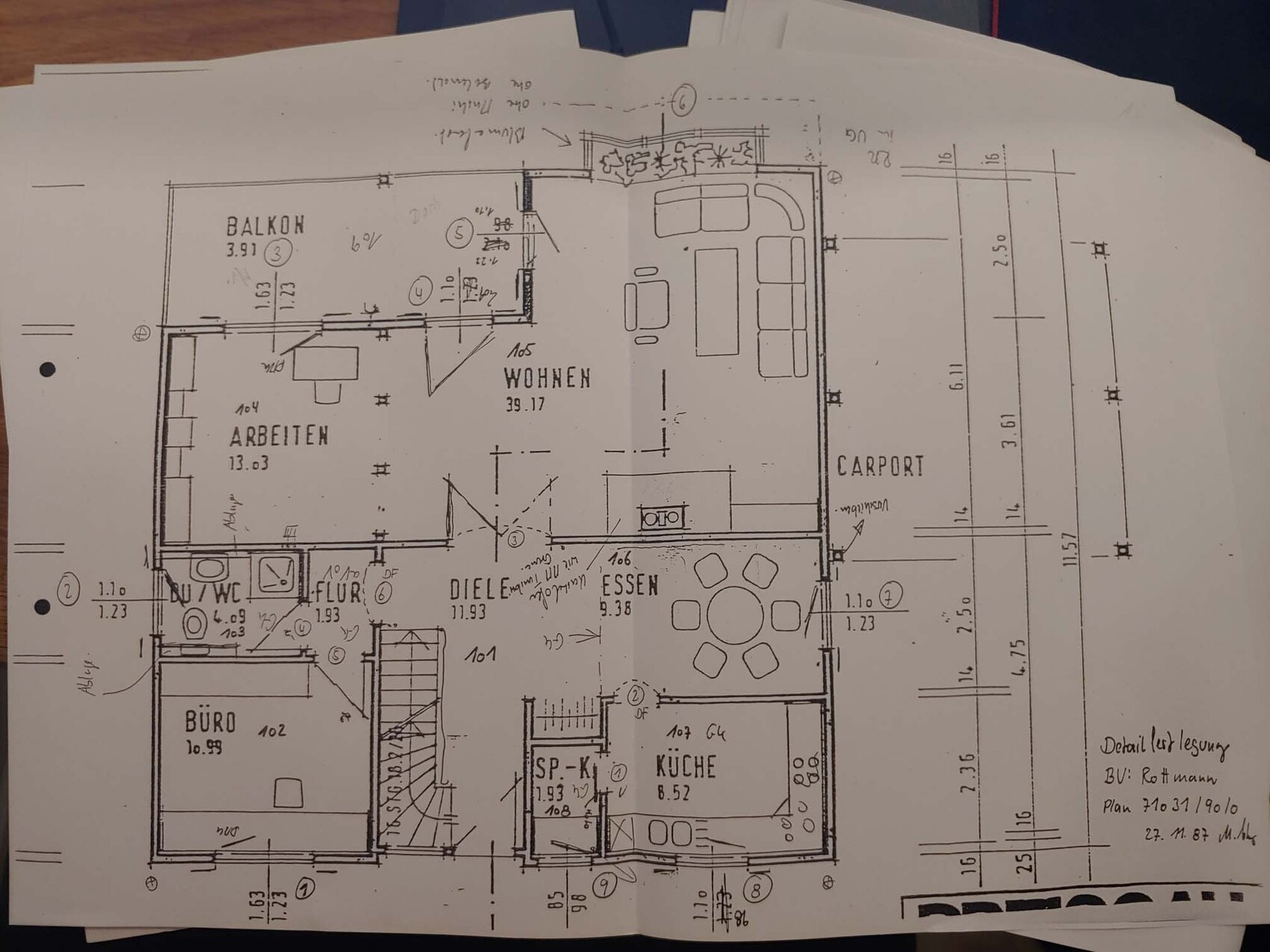
OlliQueck10 Sep 2020 16:00Hm, okay, we hadn’t really considered that before. I wasn’t even aware that timber stud walls have developed that way! Good point. It’s true that in the ground floor plan (see attachment), the walls back then were specified as 16cm (6 inches) thick.
Oh well… If that thickness is only sufficient for a ground floor, then I’m sure we can find something suitable!
Now I’m curious to hear what the first prefabricated house suppliers have to say about this. So far, only this solid construction builder has commented on it.
Oh well… If that thickness is only sufficient for a ground floor, then I’m sure we can find something suitable!
Now I’m curious to hear what the first prefabricated house suppliers have to say about this. So far, only this solid construction builder has commented on it.
Similar topics