

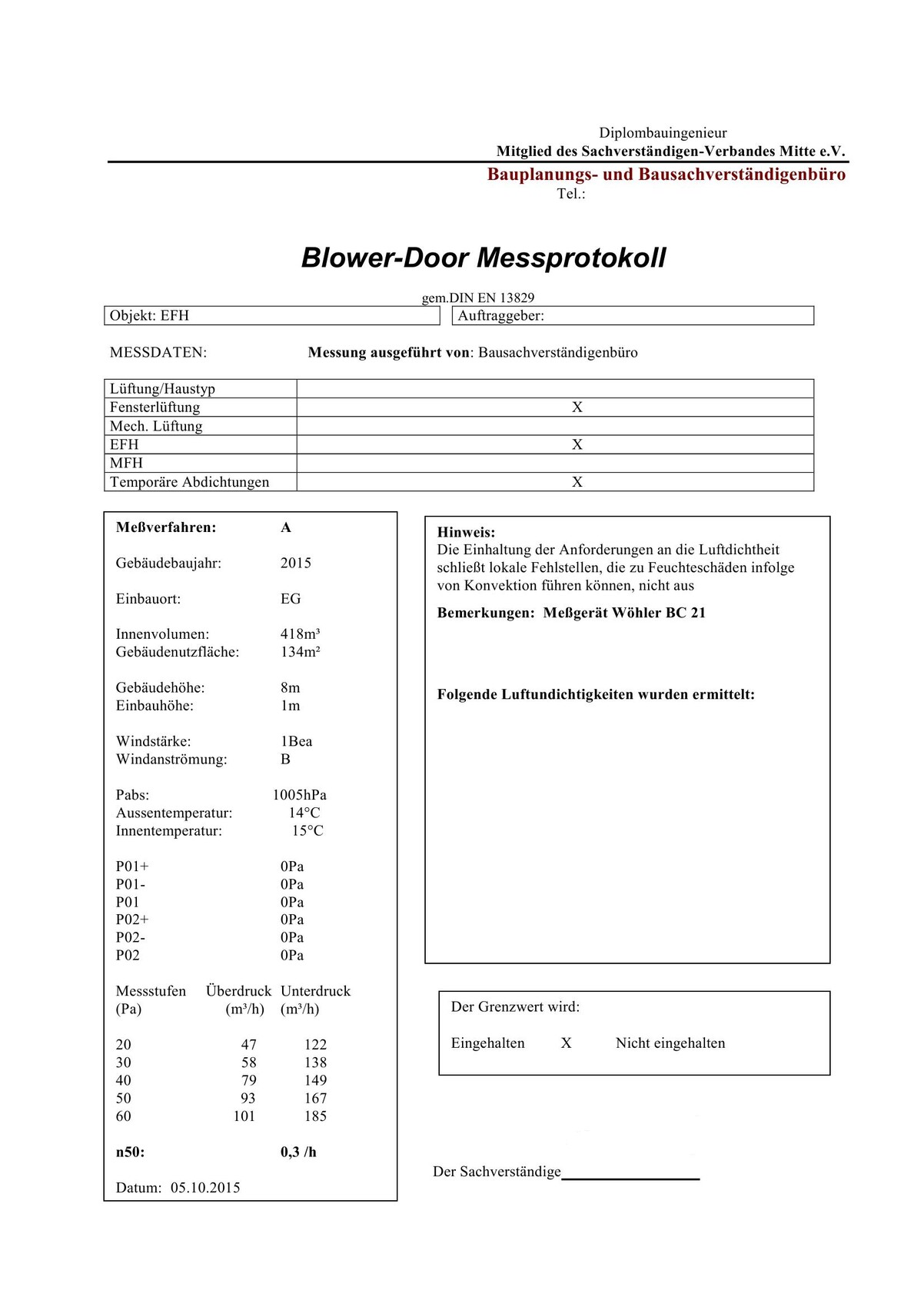
At the beginning of the month, we conducted a blower door test. After researching the achieved value (n50 = 0.3/h) online, it seems to be very good... but how meaningful is this value given the conditions described below?
At the time of the test, the building's interior was fully plastered, and the drywall installation was already completed. The screed had not yet been poured, and the window sills were also not yet installed. The building will still receive external insulation as well as plaster and paint.
At the time of the test, the building's interior was fully plastered, and the drywall installation was already completed. The screed had not yet been poured, and the window sills were also not yet installed. The building will still receive external insulation as well as plaster and paint.
The BDT initially indicates that with a pressure difference (from inside to outside) of 50 Pascal, you have an air exchange rate of your total air volume of 0.3 per hour (in your case, 167 m³ per hour (5900 ft³ per hour) under negative pressure). This is an excellent value and confirms a high level of airtightness in your building. As long as your airtightness layer is not damaged by the remaining work to be done (be careful when installing window sills), only a minimal improvement in airtightness from exterior insulation and rendering can be expected.
The BDT is relevant in three ways:
1) Quality control of all trades involved in the building’s airtightness (plasterers, window installers, etc.).
2) With a passed BDT, the air exchange rate required for the energy saving regulation proof can be reduced from 0.7/h to 0.6/h, which can slightly reduce costs for building services and insulation if, for example, a specific KfW standard is targeted, as your ventilation heat losses will be lower.
3) The BDT is a mandatory requirement for certain KfW subsidies.
The BDT is relevant in three ways:
1) Quality control of all trades involved in the building’s airtightness (plasterers, window installers, etc.).
2) With a passed BDT, the air exchange rate required for the energy saving regulation proof can be reduced from 0.7/h to 0.6/h, which can slightly reduce costs for building services and insulation if, for example, a specific KfW standard is targeted, as your ventilation heat losses will be lower.
3) The BDT is a mandatory requirement for certain KfW subsidies.
Similar topics