
ᐅ Between the brick facade and the roof: Hornets are looking to settle in
Created on: 14 Feb 2022 11:14
P
Pianist
Good day!
Last autumn, hornets began to settle in a gap just above the last row of bricks, practically right at the eave line. However, winter intervened, so nothing was done at that time. It is not certain that the insects will try again this year, but insect experts have advised me that it would be a good idea to seal this area to prevent new habitation. It is located directly above the front door, which poses too high a risk.
How would you suggest sealing this gap? Of course, I could prepare and nail a strip for each section, but I believe that the vertical joints between the bricks might still allow insects to get in. I assume a weatherstripping tape or foam seal should be applied to the strips before installation.
Or should it rather be sealed with a filler? If yes, with what material? I am wondering if there was a reason why we did not seal it completely back then. Maybe some airflow is intended. Perhaps I will look for a brown, mesh-like plastic fabric that I can staple to the wood at the top and let it run down behind the cladding. But I’m not sure if that will be sufficient...
Thank you for any helpful tips.
Matthias
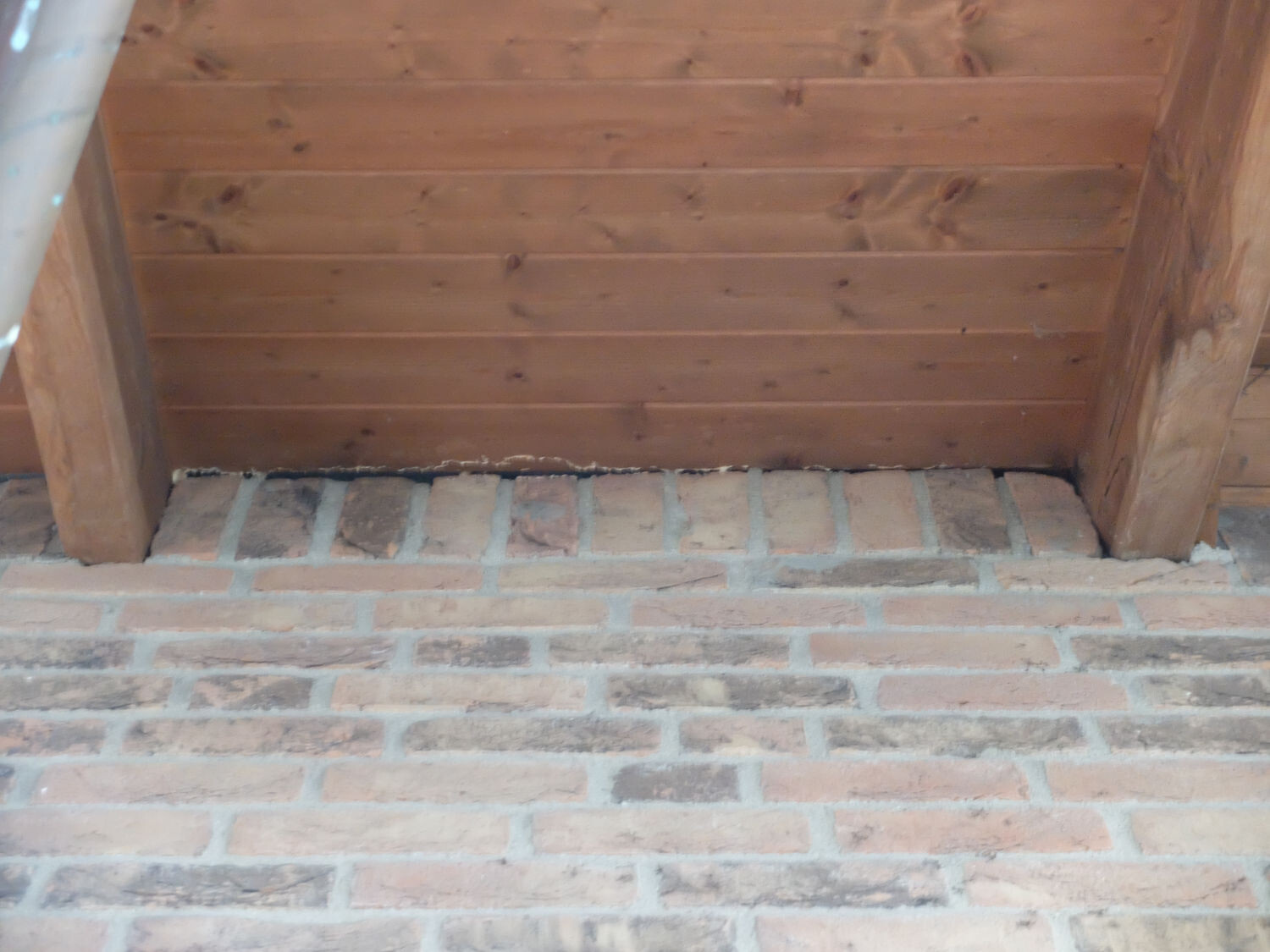
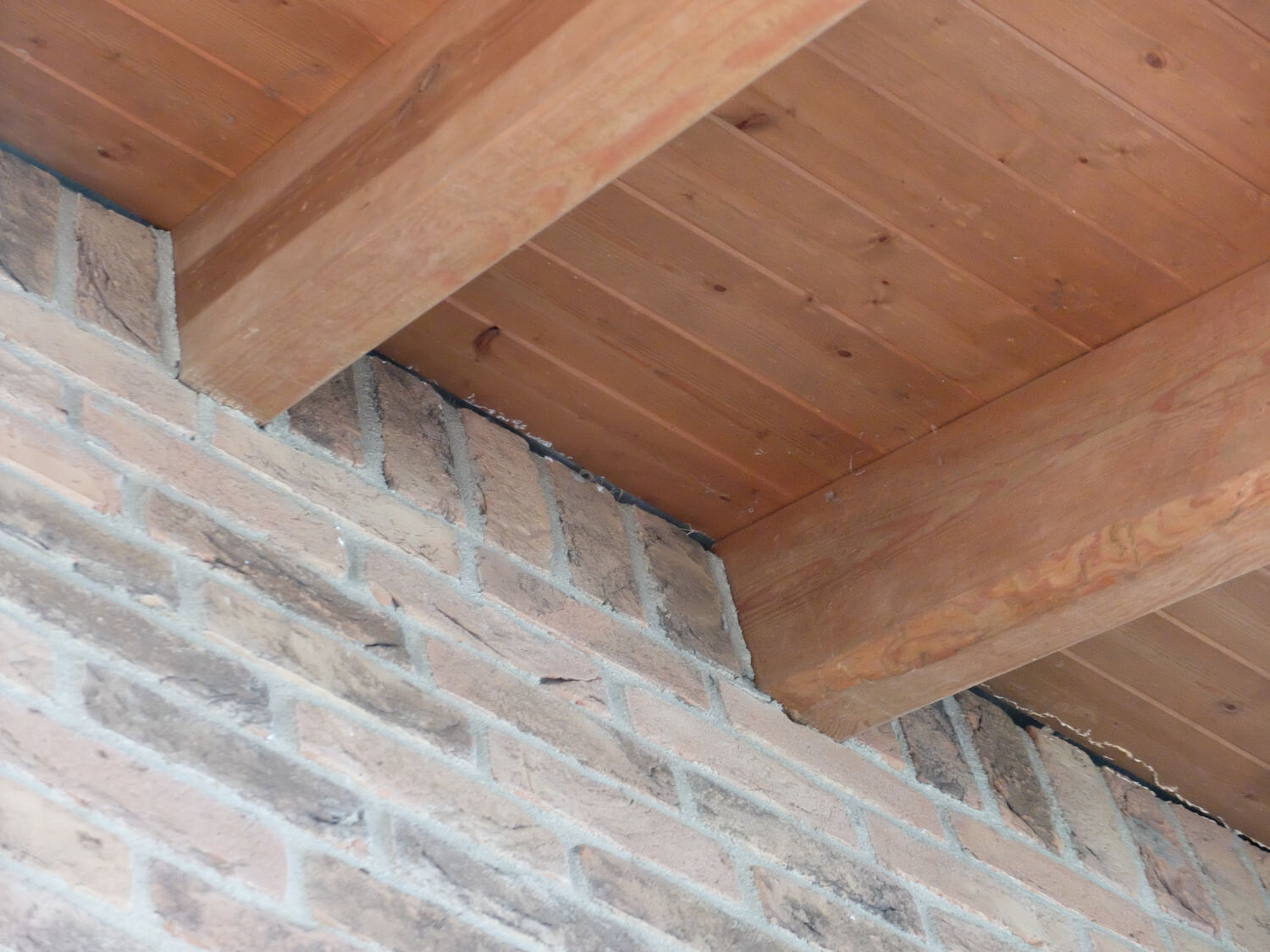
Last autumn, hornets began to settle in a gap just above the last row of bricks, practically right at the eave line. However, winter intervened, so nothing was done at that time. It is not certain that the insects will try again this year, but insect experts have advised me that it would be a good idea to seal this area to prevent new habitation. It is located directly above the front door, which poses too high a risk.
How would you suggest sealing this gap? Of course, I could prepare and nail a strip for each section, but I believe that the vertical joints between the bricks might still allow insects to get in. I assume a weatherstripping tape or foam seal should be applied to the strips before installation.
Or should it rather be sealed with a filler? If yes, with what material? I am wondering if there was a reason why we did not seal it completely back then. Maybe some airflow is intended. Perhaps I will look for a brown, mesh-like plastic fabric that I can staple to the wood at the top and let it run down behind the cladding. But I’m not sure if that will be sufficient...
Thank you for any helpful tips.
Matthias
To be honest, I didn’t really give much thought to the roof ventilation. Basically, the mineral insulation should be placed directly behind the bricks, and the mineral insulation should also start there in the roof. I’m not sure if air needs to be able to flow in anywhere. Where would it even move? Above the insulation, there is the roofing underlay. From the inside, we definitely prioritized airtightness.
If I now staple perforated mats there, I probably wouldn’t gain anything because the hornets would likely build their nest right on top of them — it’s definitely the perfect surface. You can already see from the bricks that they had apparently started there.
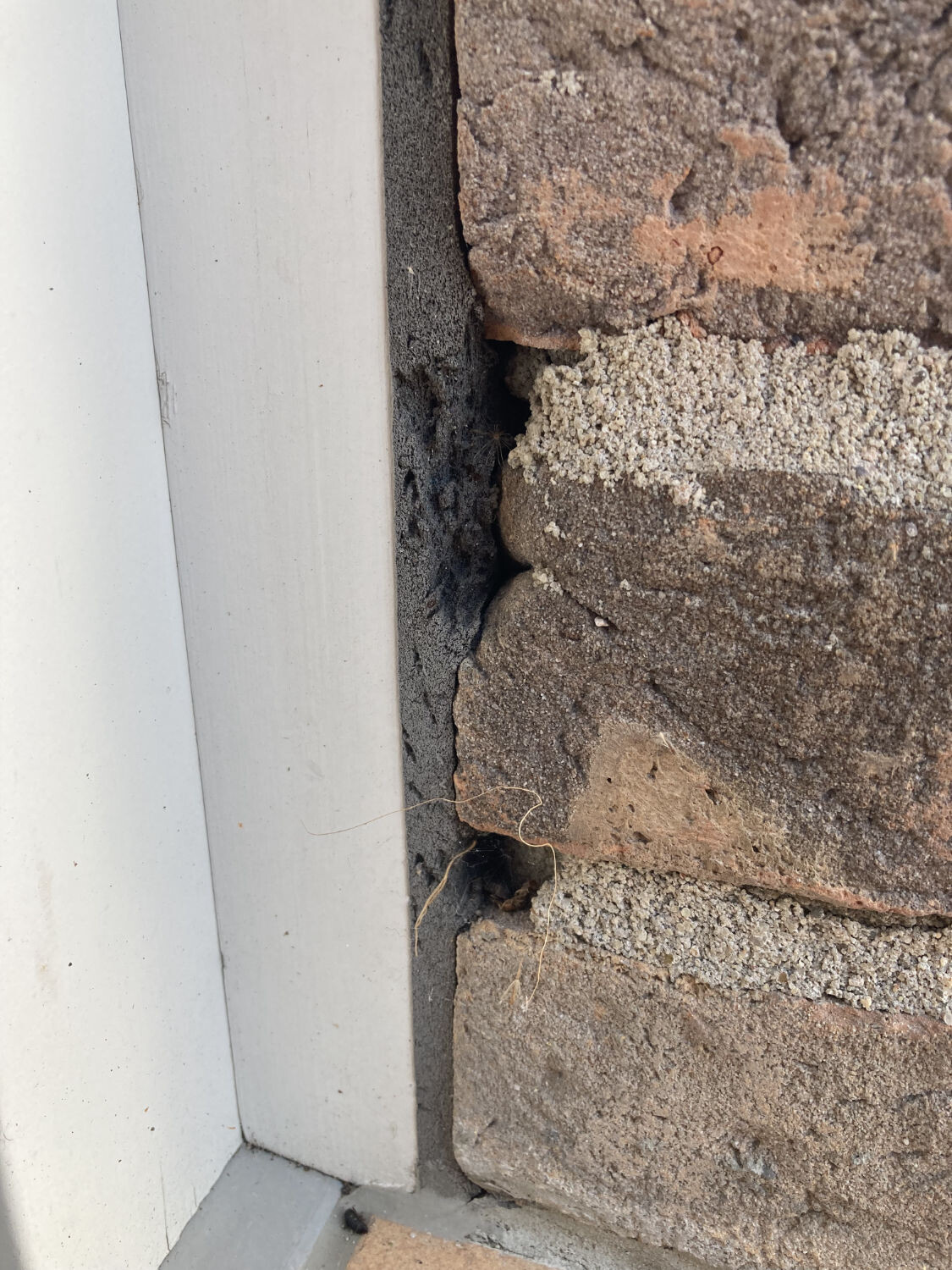
Regarding the “expansion tape,” I can also mention that insects have already gained access around the patio door (see photo).
If I ever build a house again in this life, I probably wouldn’t go with brick facing again. It’s too complicated a construction with too many weak points. To bridge the insulation and the air gap, all the windows had to be placed very far out, so they barely overlap with the shell construction, and then they also added these white strips. Elsewhere, people have already tried to pry the window out with a crowbar but only damaged the bricks because they didn’t realize that the windows are anchored in the shell construction and the bricks are just a facing layer. Very frustrating...
If I now staple perforated mats there, I probably wouldn’t gain anything because the hornets would likely build their nest right on top of them — it’s definitely the perfect surface. You can already see from the bricks that they had apparently started there.
Regarding the “expansion tape,” I can also mention that insects have already gained access around the patio door (see photo).
If I ever build a house again in this life, I probably wouldn’t go with brick facing again. It’s too complicated a construction with too many weak points. To bridge the insulation and the air gap, all the windows had to be placed very far out, so they barely overlap with the shell construction, and then they also added these white strips. Elsewhere, people have already tried to pry the window out with a crowbar but only damaged the bricks because they didn’t realize that the windows are anchored in the shell construction and the bricks are just a facing layer. Very frustrating...
These are certainly annoying issues you mention, but:
1. Most people probably don’t have a problem with the "defects/weaknesses" you describe.
2. I would always choose brick veneer construction and see many more disadvantages with rendered (plastered) houses.
3. Regarding your photo, I honestly doubt the damage shown was caused by insects. These appear to be clearly (?) "cutting injuries" in the swelling tape, likely caused by someone or something else rather than insects. The latter may have only taken advantage of the damaged/open areas afterward.
As for roof ventilation, I’m probably not the best person to provide detailed comments. But even if you insulate from the inside and pay attention to airtightness, there can still be a "ventilated gap" in the structure beneath the roof tiles.
1. Most people probably don’t have a problem with the "defects/weaknesses" you describe.
2. I would always choose brick veneer construction and see many more disadvantages with rendered (plastered) houses.
3. Regarding your photo, I honestly doubt the damage shown was caused by insects. These appear to be clearly (?) "cutting injuries" in the swelling tape, likely caused by someone or something else rather than insects. The latter may have only taken advantage of the damaged/open areas afterward.
As for roof ventilation, I’m probably not the best person to provide detailed comments. But even if you insulate from the inside and pay attention to airtightness, there can still be a "ventilated gap" in the structure beneath the roof tiles.
Someone must have nibbled away at the material...
Regarding the roof: The mineral insulation is installed between the rafters. On top of the rafters lies the roofing underlay, and on top of the underlay are the battens. The roof tiles rest on the battens, with verge tiles at both ends. As for whether and where air circulates or needs to circulate there, I can’t say for sure. In my opinion, we did everything correctly back then, but that was over 20 years ago.
Regarding the windows again: What alternative solution could there have been, assuming that the gap between the structural wall and the brick facade needs to be bridged by ten centimeters (six centimeters mineral insulation and four centimeters air cavity)?
Regarding the roof: The mineral insulation is installed between the rafters. On top of the rafters lies the roofing underlay, and on top of the underlay are the battens. The roof tiles rest on the battens, with verge tiles at both ends. As for whether and where air circulates or needs to circulate there, I can’t say for sure. In my opinion, we did everything correctly back then, but that was over 20 years ago.
Regarding the windows again: What alternative solution could there have been, assuming that the gap between the structural wall and the brick facade needs to be bridged by ten centimeters (six centimeters mineral insulation and four centimeters air cavity)?

Look up joint mesh online. It shouldn’t provide a nesting site for hornets or other wasps.
So, your roof is already the insulation layer (not the ceiling). Is it heated?
In my opinion, the attic, if not heated, should not be airtight because warm, moist air trapped there would condense, causing moisture and eventually mold. To prevent this, a cold roof is usually ventilated somehow. Not only is the insulation ventilated, but the entire attic space is ventilated as well.
I’m not sure if that gap at the top could be responsible. When in doubt, it’s better to close it with joint mesh. If you can find out from a qualified professional whether the gap even serves a technical purpose, then you could consider sealing it properly. But I wouldn’t just seal it airtight without knowing more.
So, your roof is already the insulation layer (not the ceiling). Is it heated?
In my opinion, the attic, if not heated, should not be airtight because warm, moist air trapped there would condense, causing moisture and eventually mold. To prevent this, a cold roof is usually ventilated somehow. Not only is the insulation ventilated, but the entire attic space is ventilated as well.
I’m not sure if that gap at the top could be responsible. When in doubt, it’s better to close it with joint mesh. If you can find out from a qualified professional whether the gap even serves a technical purpose, then you could consider sealing it properly. But I wouldn’t just seal it airtight without knowing more.
My upper floor is a knee wall with a 1.50-meter (5-foot) knee wall height. Above that is a purlin roof with two wall plates, two intermediate purlins, and one ridge purlin. The collar beams above the intermediate purlins are visible inside the room. Everything is sealed on the interior side, and of course, it is heated inside.
I have such joint mesh in the lower area of the brickwork and again at the top, each time in several vertical joints. But here we are talking about horizontal areas between the rafters, each about 60 cm (24 inches).
I have such joint mesh in the lower area of the brickwork and again at the top, each time in several vertical joints. But here we are talking about horizontal areas between the rafters, each about 60 cm (24 inches).
Similar topics