
ᐅ Modernist Concrete Villa with Cavity Wall Insulation – Experiences
Created on: 11 Sep 2018 07:32
R
rick2018
Hello everyone,
I just wanted to briefly introduce myself and say thank you.
For about a year and a half, I have been a silent reader here to gather inspiration and especially to gain more knowledge about construction technology.
Now a bit about me:
After more than a year of searching for a plot of land, I was able to purchase one from a developer who couldn’t move forward quickly with his plans.
So we found our dream plot (good location, 2500 m² (0.62 acres), slight slope, underground private spring that we have to preserve and are allowed to use).
There was an old house on the property, which we have since demolished.
There is no zoning plan, so §34 applies. During an initial informal inquiry at the building authority, almost everything we planned was rejected.
So we submitted an official preliminary building inquiry, involved the right people, and had lengthy discussions. In the end, we received a positive decision.
Therefore, there is nothing standing in the way of the building permit. The building permit should be granted within the next few weeks as there are no changes from the preliminary inquiry.
My wife (37) and I (36) want to build a Bauhaus-style villa in southern Baden-Württemberg.
It will be constructed from concrete (with core insulation) or in combination with insulated precast elements.
A lot of glass (full-glass system), textile shading, KNX, fast network both wired and wireless, strong mechanical ventilation with additional cooling coils, stainless steel pool, large cistern, and more.
The electrical planning must be 100% spot on since it’s almost impossible to make changes afterward.
Since I am friends with an architect from a larger firm, it was clear which route we would take. Such a house can basically only be realized with an architect.
I also personally know the electrician and KNX system integrator, as well as the owners and work approach of the heating, plumbing, and ventilation companies involved.
Some trades have already been contracted, and part of the equipment has already been ordered.
I’m really looking forward to getting started and to the final result. The goal is to move in by the end of 2019.
Once again, many thanks for the information I have received from you so far.
If you have any questions, just let me know.
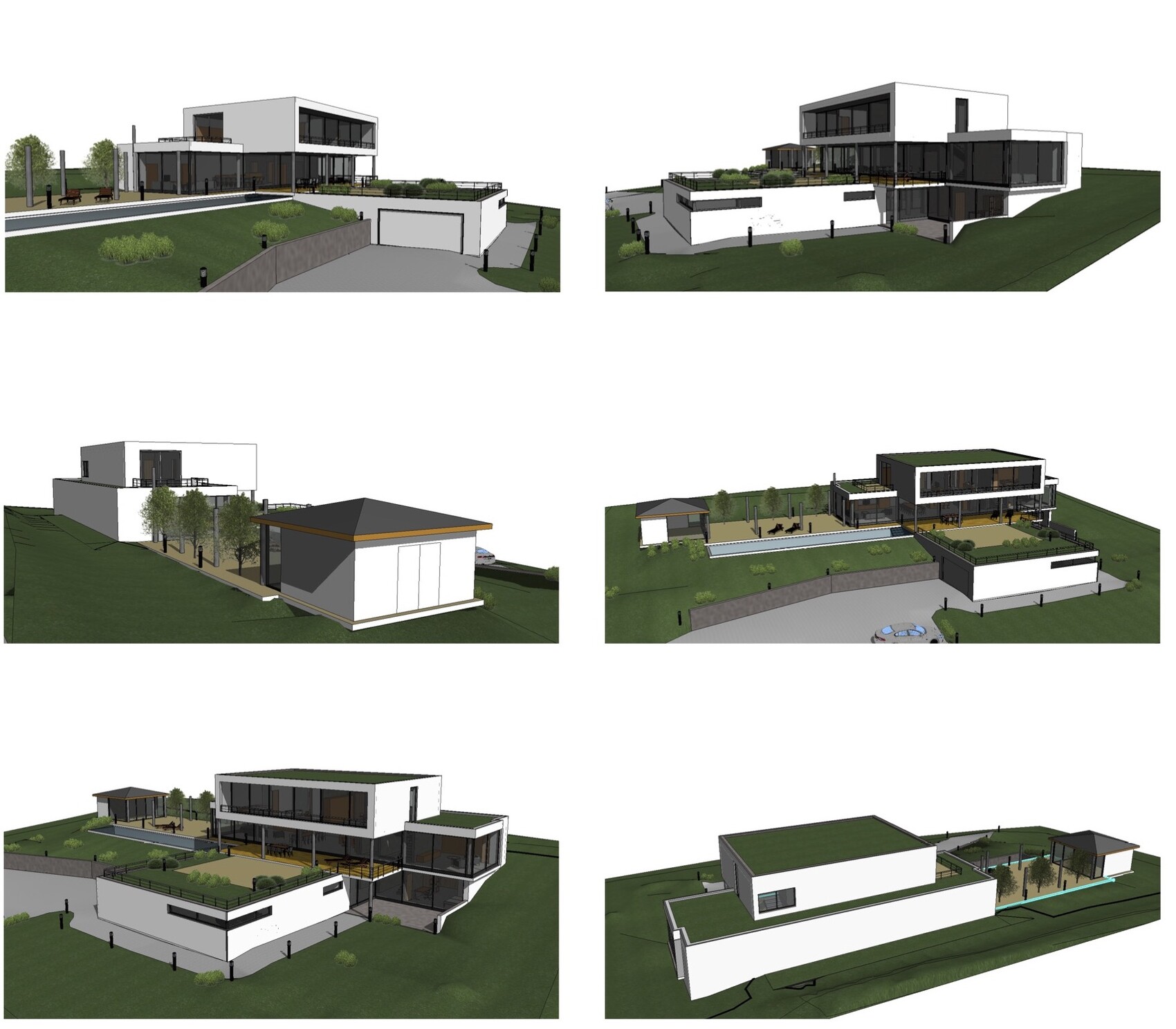
Attached is the design, though not the final version. There have been a few minor changes.
Greetings from Swabia
I just wanted to briefly introduce myself and say thank you.
For about a year and a half, I have been a silent reader here to gather inspiration and especially to gain more knowledge about construction technology.
Now a bit about me:
After more than a year of searching for a plot of land, I was able to purchase one from a developer who couldn’t move forward quickly with his plans.
So we found our dream plot (good location, 2500 m² (0.62 acres), slight slope, underground private spring that we have to preserve and are allowed to use).
There was an old house on the property, which we have since demolished.
There is no zoning plan, so §34 applies. During an initial informal inquiry at the building authority, almost everything we planned was rejected.
So we submitted an official preliminary building inquiry, involved the right people, and had lengthy discussions. In the end, we received a positive decision.
Therefore, there is nothing standing in the way of the building permit. The building permit should be granted within the next few weeks as there are no changes from the preliminary inquiry.
My wife (37) and I (36) want to build a Bauhaus-style villa in southern Baden-Württemberg.
It will be constructed from concrete (with core insulation) or in combination with insulated precast elements.
A lot of glass (full-glass system), textile shading, KNX, fast network both wired and wireless, strong mechanical ventilation with additional cooling coils, stainless steel pool, large cistern, and more.
The electrical planning must be 100% spot on since it’s almost impossible to make changes afterward.
Since I am friends with an architect from a larger firm, it was clear which route we would take. Such a house can basically only be realized with an architect.
I also personally know the electrician and KNX system integrator, as well as the owners and work approach of the heating, plumbing, and ventilation companies involved.
Some trades have already been contracted, and part of the equipment has already been ordered.
I’m really looking forward to getting started and to the final result. The goal is to move in by the end of 2019.
Once again, many thanks for the information I have received from you so far.
If you have any questions, just let me know.
Attached is the design, though not the final version. There have been a few minor changes.
Greetings from Swabia

Bauherr am L schrieb:
For a fan of exposed concrete, the combination of concrete + core insulation + concrete is probably a dream. But here in Germany, it is hardly known… at least that’s my impression. [...] The clinker brick curtain wall alone costs around 300€ net per square meter (approximately $320) ... The 201X decade will go down in history as the era of fakes. A true exposed concrete* enthusiast would only consider solid concrete. This is no longer common in Germany, because its heyday ended roughly between 1975 and 1980, when environmental awareness entered the construction world. If someone wanted an interior "exposed concrete" look combined with a clinker brick curtain wall on the outside, it would be best to use the external layer as a clinker brick panel. However, the overlap between admirers of clinker bricks and fans of raw concrete is probably nonexistent.
*) The prefix "exposed" in front of concrete means that the material actually used structurally is visible on the surface—essentially "what you see is what you get." An "original fake" is naturally nonsense or only exists as a current trend. This should make everyone think, because according to history books, decadence is a sure indicator of the decline of a culture.
https://www.instagram.com/11antgmxde/
https://www.linkedin.com/company/bauen-jetzt/

11ant put it very well. Solid in-situ concrete is a completely different matter than precast elements.
With precast, you have joints and no continuous surface. Molds used for in-situ concrete can also be used for precast, but a double hollow-wall that is later filled is not the same.
Our walls are also made of concrete, but cast in multiple stages, have joints, and are more uniform (unlike in-situ concrete). We like this appearance and have had long discussions with the manufacturers, casting samples...
In-situ concrete was ruled out due to cost and the complex window connections.
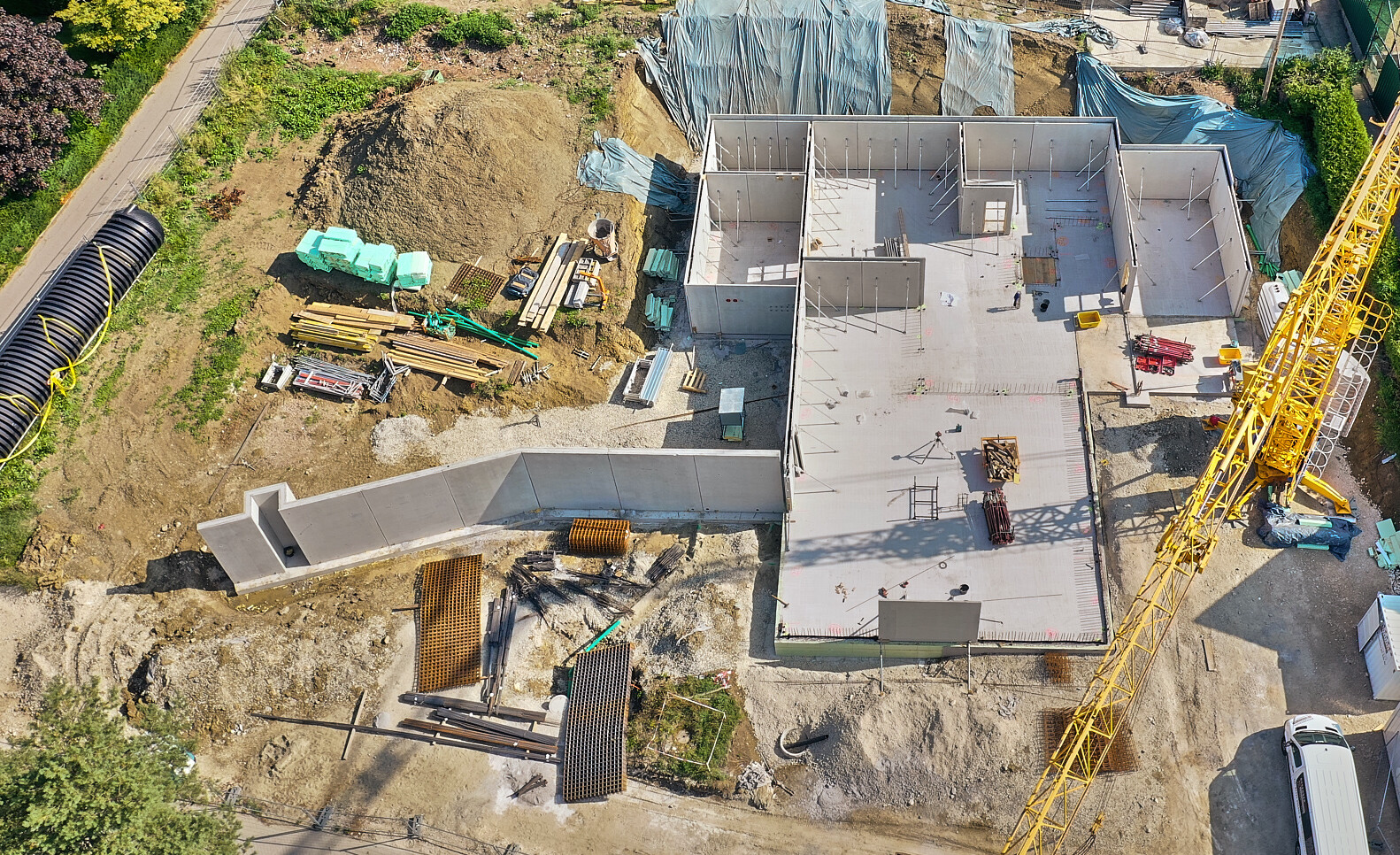
This morning, already half of the walls were in place. By tomorrow, all basement walls should be set. Things are progressing well currently )
With precast, you have joints and no continuous surface. Molds used for in-situ concrete can also be used for precast, but a double hollow-wall that is later filled is not the same.
Our walls are also made of concrete, but cast in multiple stages, have joints, and are more uniform (unlike in-situ concrete). We like this appearance and have had long discussions with the manufacturers, casting samples...
In-situ concrete was ruled out due to cost and the complex window connections.
This morning, already half of the walls were in place. By tomorrow, all basement walls should be set. Things are progressing well currently )
rick2018 schrieb:
11ant put it very well. Solid in-situ concrete is a completely different matter than precast elements. Here, you have joints and no continuous appearance.In-situ concrete or ready-mix concrete is a different topic; you probably mean site-cast concrete elements here. What I mainly meant is that "exposed" concrete refers to a solid cross-section, not just a cladding. The latter should rather be called "facing" concrete.I'm too lazy to look it up right now: what is that "slot" shortly after the start of the retaining wall – is a gate meant to roll into it?
https://www.instagram.com/11antgmxde/
https://www.linkedin.com/company/bauen-jetzt/
S
Steffen8030 Aug 2019 17:1811ant schrieb:
The 201X decade will be remembered as the era of fakes. A true exposed concrete* enthusiast would only accept solid concrete. This is no longer common in Germany because its heyday ended around 1975 to 1980, when environmental awareness entered the construction world. If someone wanted an "exposed concrete" look indoors but with a brick curtain wall façade, it would be best to simply use the outer layer as a brick wall panel. But the overlap between fans of bricks on one hand and raw concrete on the other is probably nonexistent anyway.
*) The prefix "exposed" before concrete means that the actual structural material is visible on the surface — basically "what you see is what you get." An "authentic fake" is inherently nonsense or only exists as a current trend. This should actually make everyone think, because according to history books, decadence is a reliable indicator of a culture’s decline. A very expensive building in our area is constructed entirely of concrete plus insulation (some phased material... I’m not sure what it’s called) with huge ceramic tiles in concrete look mounted on top. The façade alone is probably more expensive than our entire house, and they have been working on just the façade for several months already... BUT it looks amazing!!!
@Steffen80 On our exterior, we are also installing a curtain wall facade (Aluminum Cubond) with a concrete look.
The ceramic panels are probably Eternit. It’s somewhat more affordable than other options.
@11ant The parcel mailbox will be installed in the recess/corner of the retaining wall.
The ceramic panels are probably Eternit. It’s somewhat more affordable than other options.
@11ant The parcel mailbox will be installed in the recess/corner of the retaining wall.
Similar topics