
ᐅ Modernist Concrete Villa with Cavity Wall Insulation – Experiences
Created on: 11 Sep 2018 07:32
R
rick2018
Hello everyone,
I just wanted to briefly introduce myself and say thank you.
For about a year and a half, I have been a silent reader here to gather inspiration and especially to gain more knowledge about construction technology.
Now a bit about me:
After more than a year of searching for a plot of land, I was able to purchase one from a developer who couldn’t move forward quickly with his plans.
So we found our dream plot (good location, 2500 m² (0.62 acres), slight slope, underground private spring that we have to preserve and are allowed to use).
There was an old house on the property, which we have since demolished.
There is no zoning plan, so §34 applies. During an initial informal inquiry at the building authority, almost everything we planned was rejected.
So we submitted an official preliminary building inquiry, involved the right people, and had lengthy discussions. In the end, we received a positive decision.
Therefore, there is nothing standing in the way of the building permit. The building permit should be granted within the next few weeks as there are no changes from the preliminary inquiry.
My wife (37) and I (36) want to build a Bauhaus-style villa in southern Baden-Württemberg.
It will be constructed from concrete (with core insulation) or in combination with insulated precast elements.
A lot of glass (full-glass system), textile shading, KNX, fast network both wired and wireless, strong mechanical ventilation with additional cooling coils, stainless steel pool, large cistern, and more.
The electrical planning must be 100% spot on since it’s almost impossible to make changes afterward.
Since I am friends with an architect from a larger firm, it was clear which route we would take. Such a house can basically only be realized with an architect.
I also personally know the electrician and KNX system integrator, as well as the owners and work approach of the heating, plumbing, and ventilation companies involved.
Some trades have already been contracted, and part of the equipment has already been ordered.
I’m really looking forward to getting started and to the final result. The goal is to move in by the end of 2019.
Once again, many thanks for the information I have received from you so far.
If you have any questions, just let me know.
Attached is the design, though not the final version. There have been a few minor changes.
Greetings from Swabia
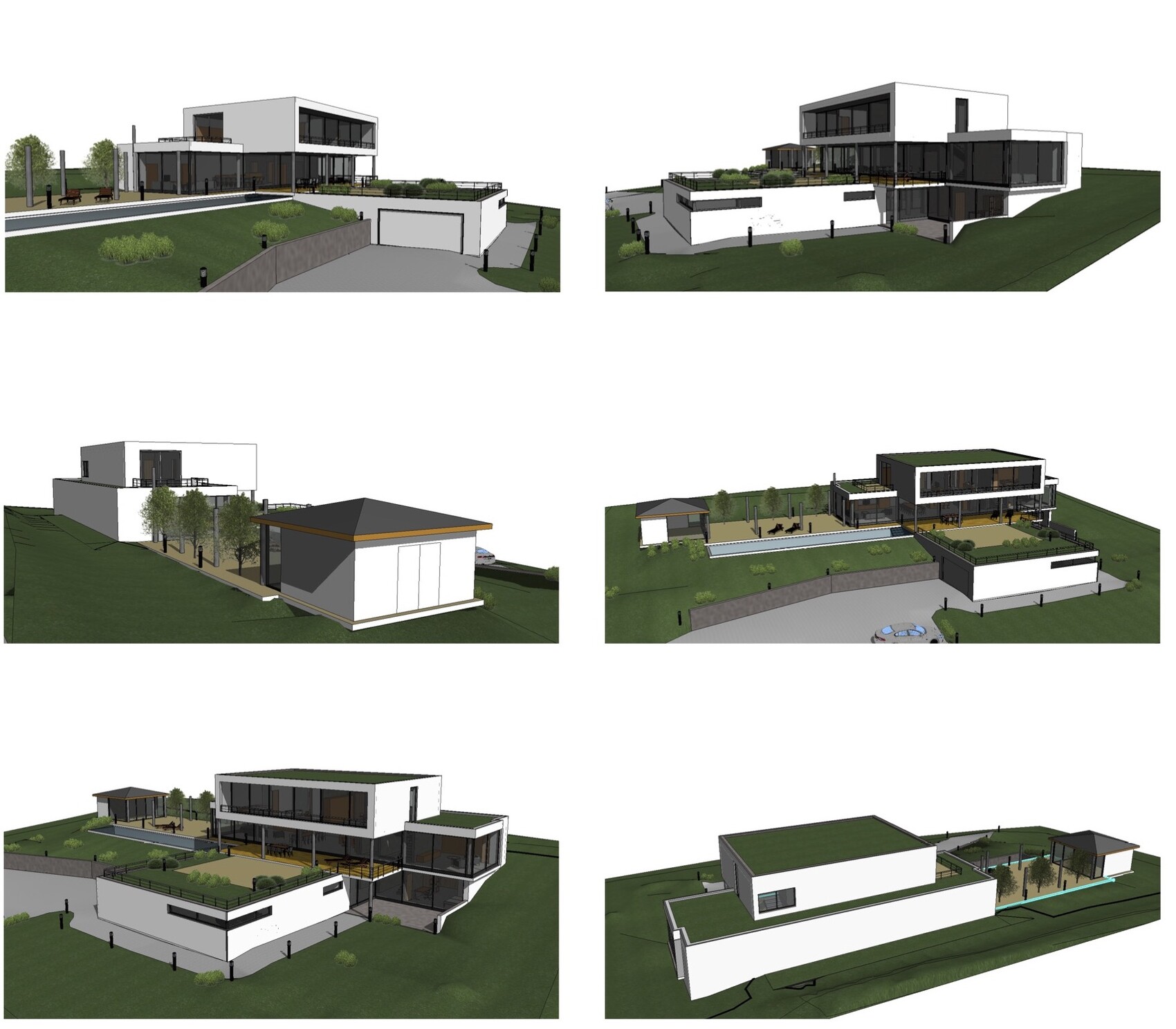
I just wanted to briefly introduce myself and say thank you.
For about a year and a half, I have been a silent reader here to gather inspiration and especially to gain more knowledge about construction technology.
Now a bit about me:
After more than a year of searching for a plot of land, I was able to purchase one from a developer who couldn’t move forward quickly with his plans.
So we found our dream plot (good location, 2500 m² (0.62 acres), slight slope, underground private spring that we have to preserve and are allowed to use).
There was an old house on the property, which we have since demolished.
There is no zoning plan, so §34 applies. During an initial informal inquiry at the building authority, almost everything we planned was rejected.
So we submitted an official preliminary building inquiry, involved the right people, and had lengthy discussions. In the end, we received a positive decision.
Therefore, there is nothing standing in the way of the building permit. The building permit should be granted within the next few weeks as there are no changes from the preliminary inquiry.
My wife (37) and I (36) want to build a Bauhaus-style villa in southern Baden-Württemberg.
It will be constructed from concrete (with core insulation) or in combination with insulated precast elements.
A lot of glass (full-glass system), textile shading, KNX, fast network both wired and wireless, strong mechanical ventilation with additional cooling coils, stainless steel pool, large cistern, and more.
The electrical planning must be 100% spot on since it’s almost impossible to make changes afterward.
Since I am friends with an architect from a larger firm, it was clear which route we would take. Such a house can basically only be realized with an architect.
I also personally know the electrician and KNX system integrator, as well as the owners and work approach of the heating, plumbing, and ventilation companies involved.
Some trades have already been contracted, and part of the equipment has already been ordered.
I’m really looking forward to getting started and to the final result. The goal is to move in by the end of 2019.
Once again, many thanks for the information I have received from you so far.
If you have any questions, just let me know.
Attached is the design, though not the final version. There have been a few minor changes.
Greetings from Swabia
I have 400 square meters (about 4,300 square feet) of decades-old overgrowth. Last year, one bush didn’t survive, but the rest have come back.
I think a watering ban during the first 1–2 years can be tough since some plants will inevitably die. This also means spending a lot of time and possibly money. After that period, it should be manageable.
Rainwater tanks are now mandatory in our new housing developments. The water is returned to the cycle and nature, just with a delay. For example, there was a storm on Wednesday night, but today watering is still necessary.
Whether rainwater tanks have any negative effects on water quality remains to be seen. I could imagine that in areas with heavy rainfall, tanks might even have a positive impact.
I think a watering ban during the first 1–2 years can be tough since some plants will inevitably die. This also means spending a lot of time and possibly money. After that period, it should be manageable.
Rainwater tanks are now mandatory in our new housing developments. The water is returned to the cycle and nature, just with a delay. For example, there was a storm on Wednesday night, but today watering is still necessary.
Whether rainwater tanks have any negative effects on water quality remains to be seen. I could imagine that in areas with heavy rainfall, tanks might even have a positive impact.

In our new development areas, not only are cisterns required, but also retention cisterns. These release a certain percentage of water back into the sewer system within a few days, so they serve only as a buffer and this percentage is not available for the property owner’s use.
Well-established plants can generally tolerate some drought. I observed this last year with a nearly 100-year-old hedge. However, it depends on the type of plants and the soil conditions.
When planting trees (meaning large ones rather than those that provide shade only to future generations), it usually takes 5-10 years for them to survive such drought conditions. Lawns (not meadows) do not cope well with drought.
We receive sufficient rainfall here (between 800-1000 liters per square meter (32-39 inches per square yard)). Excess rainfall runs downhill, so fortunately, this is not a flood-prone area.
The water source was also used by the neighbor. Before construction began, I had him refill his IBC containers. He grows various vegetables and salads in his greenhouses. If needed, he is welcome to use water from my cistern again. In return, he sometimes shares some of his harvest with me...
Well-established plants can generally tolerate some drought. I observed this last year with a nearly 100-year-old hedge. However, it depends on the type of plants and the soil conditions.
When planting trees (meaning large ones rather than those that provide shade only to future generations), it usually takes 5-10 years for them to survive such drought conditions. Lawns (not meadows) do not cope well with drought.
We receive sufficient rainfall here (between 800-1000 liters per square meter (32-39 inches per square yard)). Excess rainfall runs downhill, so fortunately, this is not a flood-prone area.
The water source was also used by the neighbor. Before construction began, I had him refill his IBC containers. He grows various vegetables and salads in his greenhouses. If needed, he is welcome to use water from my cistern again. In return, he sometimes shares some of his harvest with me...
H
hampshire21 Jun 2019 17:11rick2018 schrieb:
Unfortunately, the rest is not going so smoothly. Despite the geological survey, we are having some bad luck with the ground conditions. We also learned that soil is not that predictable. The risks have been factored in, and it’s manageable. Hopefully, after the earthworks, everything will be not only within the planned range but also meet our expectations.H
hampshire21 Jun 2019 17:13Müllerin schrieb:
Last year, I was in OWL as well as in (Central) Franconia, where there is generally less rainfall, and during the summer, this happens more often too.
(Freshwater watering ban for lawn sprinklers).
I find it annoying anyway; you can manage lawns and perennials again – but shrubs and trees might occasionally need supplemental watering. What do you find annoying – the ban itself or watering with freshwater?

And until just now, I thought our 5,000-liter (1,320-gallon) rainwater cistern was quite innovative *cry*
But the rest with the soil is frustrating...
We now also have to deal with the neighbor on the north side. His second wife wanted a rhododendron mound years ago in a corner of the garden that had been unused until then. So they nicely piled up soil — but without supporting it on our side. That wasn’t a problem until now because the land on our side wasn’t being used there. But now that we have built there, and after the recent storms (if anyone wants to check: hail at Ammersee and storms in Landsberg made the news), the soil is sliding onto our property.
We’re not happy about that. And we believe that whoever piles up soil should also provide proper support. You can’t just make a pile of earth that, over time and with certain weather conditions, shifts onto the neighbor’s land. Years ago, my brother tried to somewhat contain it with concrete slabs held in place by steel rods. But that no longer holds. And the laurel cherry bushes they planted there now have larger and larger roots, which are pushing this temporary solution away.
Now we want to suggest to them that we build a wall from our side, with costs split 50/50. Their advantage: the construction equipment would come from our side, and their garden would remain untouched.
Otherwise, we’d have to go through the building authority / planning permission office — which we’d rather avoid. But we also don’t want to pay for a wall we wouldn’t need if they hadn’t piled up the soil. And it absolutely can’t remain as it is.
Well...
Let me know how your neighbor reacts.
But the rest with the soil is frustrating...
We now also have to deal with the neighbor on the north side. His second wife wanted a rhododendron mound years ago in a corner of the garden that had been unused until then. So they nicely piled up soil — but without supporting it on our side. That wasn’t a problem until now because the land on our side wasn’t being used there. But now that we have built there, and after the recent storms (if anyone wants to check: hail at Ammersee and storms in Landsberg made the news), the soil is sliding onto our property.
We’re not happy about that. And we believe that whoever piles up soil should also provide proper support. You can’t just make a pile of earth that, over time and with certain weather conditions, shifts onto the neighbor’s land. Years ago, my brother tried to somewhat contain it with concrete slabs held in place by steel rods. But that no longer holds. And the laurel cherry bushes they planted there now have larger and larger roots, which are pushing this temporary solution away.
Now we want to suggest to them that we build a wall from our side, with costs split 50/50. Their advantage: the construction equipment would come from our side, and their garden would remain untouched.
Otherwise, we’d have to go through the building authority / planning permission office — which we’d rather avoid. But we also don’t want to pay for a wall we wouldn’t need if they hadn’t piled up the soil. And it absolutely can’t remain as it is.
Well...
Let me know how your neighbor reacts.
Similar topics