
ᐅ Modernist Concrete Villa with Cavity Wall Insulation – Experiences
Created on: 11 Sep 2018 07:32
R
rick2018
Hello everyone,
I just wanted to briefly introduce myself and say thank you.
For about a year and a half, I have been a silent reader here to gather inspiration and especially to gain more knowledge about construction technology.
Now a bit about me:
After more than a year of searching for a plot of land, I was able to purchase one from a developer who couldn’t move forward quickly with his plans.
So we found our dream plot (good location, 2500 m² (0.62 acres), slight slope, underground private spring that we have to preserve and are allowed to use).
There was an old house on the property, which we have since demolished.
There is no zoning plan, so §34 applies. During an initial informal inquiry at the building authority, almost everything we planned was rejected.
So we submitted an official preliminary building inquiry, involved the right people, and had lengthy discussions. In the end, we received a positive decision.
Therefore, there is nothing standing in the way of the building permit. The building permit should be granted within the next few weeks as there are no changes from the preliminary inquiry.
My wife (37) and I (36) want to build a Bauhaus-style villa in southern Baden-Württemberg.
It will be constructed from concrete (with core insulation) or in combination with insulated precast elements.
A lot of glass (full-glass system), textile shading, KNX, fast network both wired and wireless, strong mechanical ventilation with additional cooling coils, stainless steel pool, large cistern, and more.
The electrical planning must be 100% spot on since it’s almost impossible to make changes afterward.
Since I am friends with an architect from a larger firm, it was clear which route we would take. Such a house can basically only be realized with an architect.
I also personally know the electrician and KNX system integrator, as well as the owners and work approach of the heating, plumbing, and ventilation companies involved.
Some trades have already been contracted, and part of the equipment has already been ordered.
I’m really looking forward to getting started and to the final result. The goal is to move in by the end of 2019.
Once again, many thanks for the information I have received from you so far.
If you have any questions, just let me know.
Attached is the design, though not the final version. There have been a few minor changes.
Greetings from Swabia
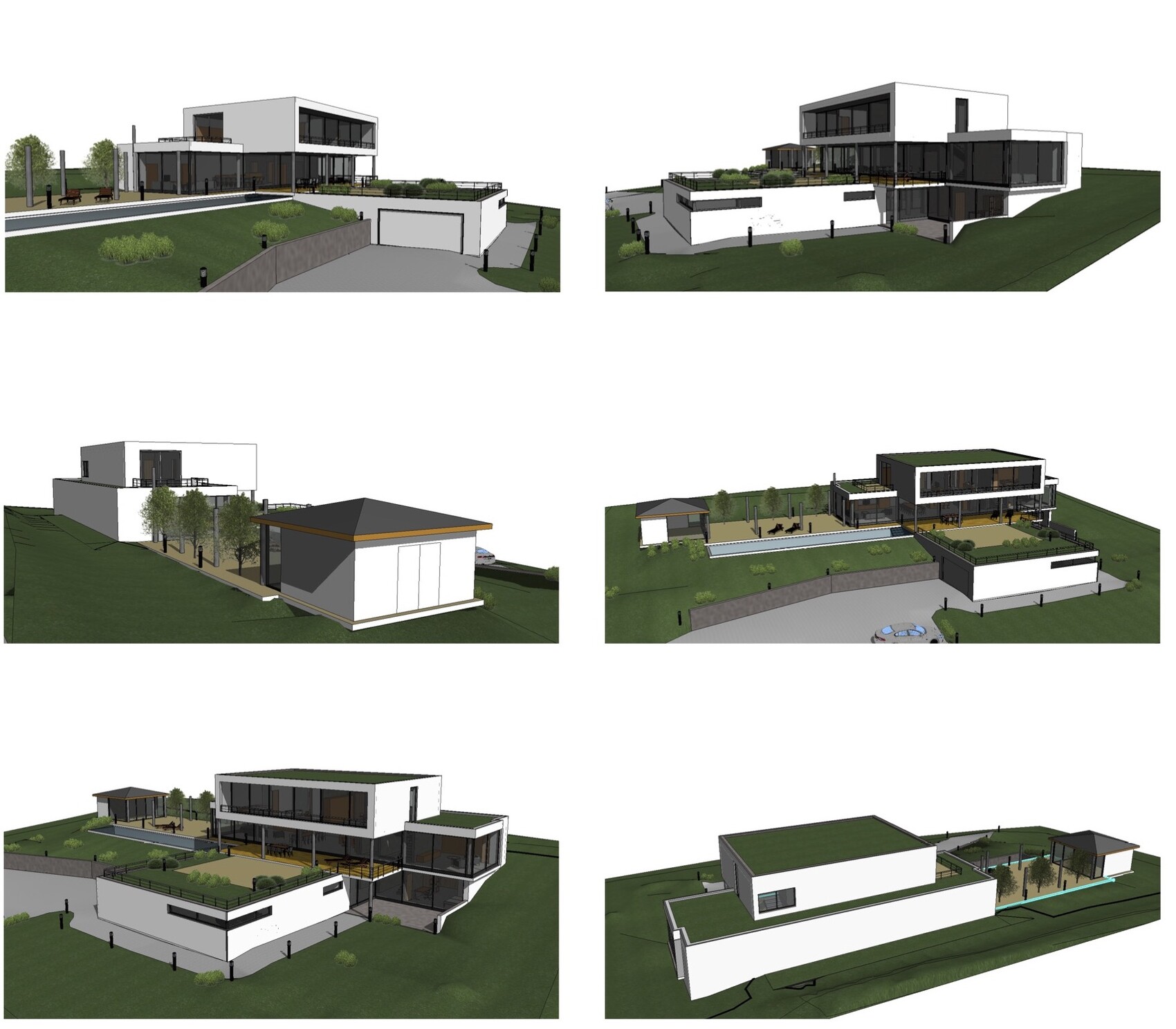
I just wanted to briefly introduce myself and say thank you.
For about a year and a half, I have been a silent reader here to gather inspiration and especially to gain more knowledge about construction technology.
Now a bit about me:
After more than a year of searching for a plot of land, I was able to purchase one from a developer who couldn’t move forward quickly with his plans.
So we found our dream plot (good location, 2500 m² (0.62 acres), slight slope, underground private spring that we have to preserve and are allowed to use).
There was an old house on the property, which we have since demolished.
There is no zoning plan, so §34 applies. During an initial informal inquiry at the building authority, almost everything we planned was rejected.
So we submitted an official preliminary building inquiry, involved the right people, and had lengthy discussions. In the end, we received a positive decision.
Therefore, there is nothing standing in the way of the building permit. The building permit should be granted within the next few weeks as there are no changes from the preliminary inquiry.
My wife (37) and I (36) want to build a Bauhaus-style villa in southern Baden-Württemberg.
It will be constructed from concrete (with core insulation) or in combination with insulated precast elements.
A lot of glass (full-glass system), textile shading, KNX, fast network both wired and wireless, strong mechanical ventilation with additional cooling coils, stainless steel pool, large cistern, and more.
The electrical planning must be 100% spot on since it’s almost impossible to make changes afterward.
Since I am friends with an architect from a larger firm, it was clear which route we would take. Such a house can basically only be realized with an architect.
I also personally know the electrician and KNX system integrator, as well as the owners and work approach of the heating, plumbing, and ventilation companies involved.
Some trades have already been contracted, and part of the equipment has already been ordered.
I’m really looking forward to getting started and to the final result. The goal is to move in by the end of 2019.
Once again, many thanks for the information I have received from you so far.
If you have any questions, just let me know.
Attached is the design, though not the final version. There have been a few minor changes.
Greetings from Swabia
K
k-man202125 Apr 2026 10:47Thank you very much for your detailed response; it fully confirms our considerations!
We have planned a concrete shaft in the usual dimensions within the house (including entrance and exit), and our architect is also well versed in elevators. Regarding the inspection/maintenance and emergency call issues—using a key safe is absolutely out of the question for us—we have also contacted home lift providers. There are the typical L-shaped lifts (without internal doors, without a roof, in their own shaft, with dead man’s operation) as well as an Austrian provider offering a genuine elevator operating at 0.15 m/s (approximately 0.5 ft/s), which falls under the home lift regulations. All home lift offers, even after negotiation, are 15,000–20,000 EUR (approx. 16,000–22,000 USD) more expensive than the higher-quality and faster real elevators. Meanwhile, we received from one of the major, real elevator manufacturers, in addition to an attractive purchase price, a maintenance offer for under 500 EUR (approx. 540 USD) per year, and if we sign a 5-year contract including a warranty extension to 5 years, it’s really unbeatable. According to the manufacturer, a call center for emergencies is not required if you install a telephone module that calls a sequence of private phones and the people are trained—which is no problem for us. Our main remaining question was regarding the inspection (TÜV). Our preferred elevator type does not have backup batteries; in the event of a power failure, it moves either down or up by its own weight—one less maintenance topic. In addition, we want to connect the elevator to the photovoltaic battery system.
Okay, then we will proceed similarly to you: a 5-year maintenance contract, inspection on acceptance (which is already included in the price), and then maybe inspections every 2–3 years, we’ll see. We have also abandoned the idea of installing it later; when you really need the elevator, you won’t have the time/opportunity/money to install it. We have also planned the rest of the house to be age-appropriate in terms of widths, etc. :-)
Thanks again and best regards
k-man
We have planned a concrete shaft in the usual dimensions within the house (including entrance and exit), and our architect is also well versed in elevators. Regarding the inspection/maintenance and emergency call issues—using a key safe is absolutely out of the question for us—we have also contacted home lift providers. There are the typical L-shaped lifts (without internal doors, without a roof, in their own shaft, with dead man’s operation) as well as an Austrian provider offering a genuine elevator operating at 0.15 m/s (approximately 0.5 ft/s), which falls under the home lift regulations. All home lift offers, even after negotiation, are 15,000–20,000 EUR (approx. 16,000–22,000 USD) more expensive than the higher-quality and faster real elevators. Meanwhile, we received from one of the major, real elevator manufacturers, in addition to an attractive purchase price, a maintenance offer for under 500 EUR (approx. 540 USD) per year, and if we sign a 5-year contract including a warranty extension to 5 years, it’s really unbeatable. According to the manufacturer, a call center for emergencies is not required if you install a telephone module that calls a sequence of private phones and the people are trained—which is no problem for us. Our main remaining question was regarding the inspection (TÜV). Our preferred elevator type does not have backup batteries; in the event of a power failure, it moves either down or up by its own weight—one less maintenance topic. In addition, we want to connect the elevator to the photovoltaic battery system.
Okay, then we will proceed similarly to you: a 5-year maintenance contract, inspection on acceptance (which is already included in the price), and then maybe inspections every 2–3 years, we’ll see. We have also abandoned the idea of installing it later; when you really need the elevator, you won’t have the time/opportunity/money to install it. We have also planned the rest of the house to be age-appropriate in terms of widths, etc. :-)
Thanks again and best regards
k-man
K
k-man202125 Apr 2026 10:5211ant schrieb:
A home lift is not intended as a competing product for applications where a regular cabin elevator could just as well be used. However, the customer benefit in a single-family house is the same: transport to another floor. Since a home lift is simpler in design, I expected it to be significantly cheaper – but that is not the case... probably because the production volumes are much smaller and so is the competition.


rick2018 schrieb:
Yes, we have a "real" elevator. Oh, how nice that you’re still on board :-)
k-man2021 schrieb:
The customer benefit is the same in a single-family home: transport between floors... Since a home lift is simpler in design, I would have expected it to be significantly cheaper – but that is not the case… probably because the production volumes are much smaller and competition too. The customer benefit is actually “smaller” (only personal transport, less load capacity, and no freight transport at all individually). More expensive than the higher unit costs due to smaller regulations is the fact that the development costs for the engineering behind the basic technology have not been amortized over a hundred years yet, whereas the “classical cabin elevator” product only experiences innovations in details (apart from multi-directional travel, which, however, would exceed the budget for a private household, even for billionaires).
https://www.instagram.com/11antgmxde/
https://www.linkedin.com/company/bauen-jetzt/

I can’t believe a home lift would be so expensive. What kind of elevator did you compare it to? Even 5-6 years ago, our elevator cost almost €50,000.
You don’t really need a technical inspection (e.g., TÜV) for it. Maintenance is much more important. Personally, I would install a proper elevator because it’s much faster and has a higher load capacity.
The elevator also has an emergency lowering function. Backup batteries are only for the emergency call and control systems. Our entire system is connected to the photovoltaic system. We significantly expanded it and also updated the batteries and so on.
@11ant yes, I check in here from time to time. SWR and Tatort have asked before, but we politely declined. We were fairly right after all.
You don’t really need a technical inspection (e.g., TÜV) for it. Maintenance is much more important. Personally, I would install a proper elevator because it’s much faster and has a higher load capacity.
The elevator also has an emergency lowering function. Backup batteries are only for the emergency call and control systems. Our entire system is connected to the photovoltaic system. We significantly expanded it and also updated the batteries and so on.
@11ant yes, I check in here from time to time. SWR and Tatort have asked before, but we politely declined. We were fairly right after all.
K
k-man202125 Apr 2026 19:45rick2018 schrieb:
I really can’t believe that home lifts are supposed to be so expensive. What kind of elevator did you compare them to? Even 5-6 years ago, our elevator cost nearly €50,000. All elevator quotes are for standard elevators from well-known companies, like those you find in parking garages, high-rise buildings, etc., with a capacity of 630 kg, speed of 1 m/s (3.3 ft/s), telescopic sliding doors inside and outside with light curtains, cabin dimensions 1100 x 1400 mm (43 x 55 inches), stainless steel, display, LED lights, mirror, and so on—basically what you see every day, no special simplified home version... For home lifts, I have three offers ranging from a simple L-shaped platform without walls, without ceiling, and without inner doors (with a dead man’s control, where you have to keep pressing the button during the ride to avoid hitting the passing wall) and a manual revolving door, up to an elevator-like version similar to the one above but with a speed of only 0.15 m/s (0.5 ft/s). The load capacities of the home lifts are all around 400 kg or less, with prices depending on the version at roughly €50,000 to €60,000, while the elevators are significantly cheaper. With home lifts, you have to buy the shaft as well, but the concrete shaft doesn’t interest them, so we could save on that. I assume elevator manufacturers make their margin through maintenance/service, and since construction activity isn’t very high at the moment, they are offering attractive deals. I could imagine home lifts are more of a retrofit market than a new build business and may not be as dependent on construction cycles.
@rick2018 Are you still happy with your house? Is there anything you would change today? I read your thread a few years ago, followed the conclusion, and I’m impressed with what you have created!
Similar topics