
ᐅ Modernist Concrete Villa with Cavity Wall Insulation – Experiences
Created on: 11 Sep 2018 07:32
R
rick2018
Hello everyone,
I just wanted to briefly introduce myself and say thank you.
For about a year and a half, I have been a silent reader here to gather inspiration and especially to gain more knowledge about construction technology.
Now a bit about me:
After more than a year of searching for a plot of land, I was able to purchase one from a developer who couldn’t move forward quickly with his plans.
So we found our dream plot (good location, 2500 m² (0.62 acres), slight slope, underground private spring that we have to preserve and are allowed to use).
There was an old house on the property, which we have since demolished.
There is no zoning plan, so §34 applies. During an initial informal inquiry at the building authority, almost everything we planned was rejected.
So we submitted an official preliminary building inquiry, involved the right people, and had lengthy discussions. In the end, we received a positive decision.
Therefore, there is nothing standing in the way of the building permit. The building permit should be granted within the next few weeks as there are no changes from the preliminary inquiry.
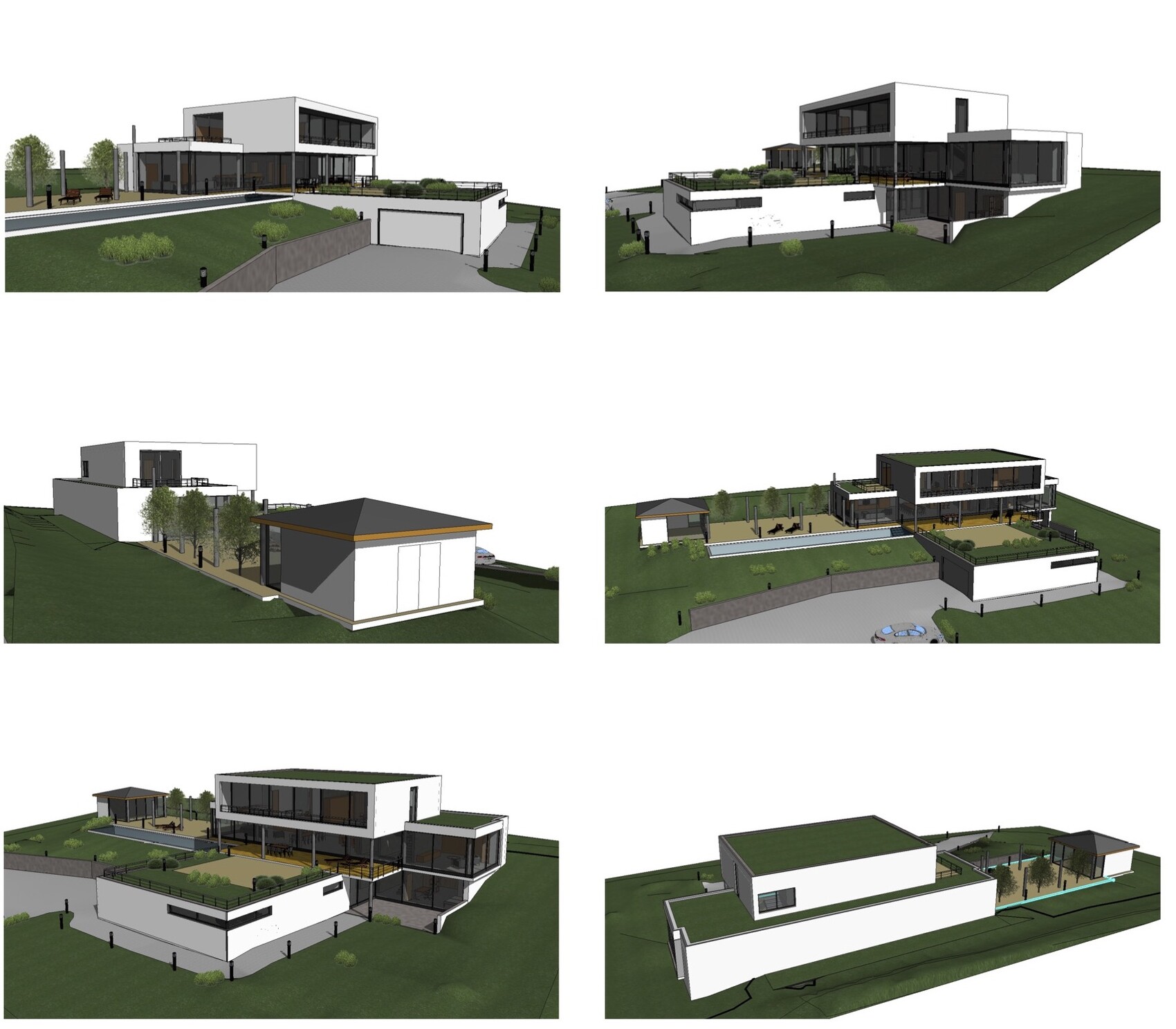
My wife (37) and I (36) want to build a Bauhaus-style villa in southern Baden-Württemberg.
It will be constructed from concrete (with core insulation) or in combination with insulated precast elements.
A lot of glass (full-glass system), textile shading, KNX, fast network both wired and wireless, strong mechanical ventilation with additional cooling coils, stainless steel pool, large cistern, and more.
The electrical planning must be 100% spot on since it’s almost impossible to make changes afterward.
Since I am friends with an architect from a larger firm, it was clear which route we would take. Such a house can basically only be realized with an architect.
I also personally know the electrician and KNX system integrator, as well as the owners and work approach of the heating, plumbing, and ventilation companies involved.
Some trades have already been contracted, and part of the equipment has already been ordered.
I’m really looking forward to getting started and to the final result. The goal is to move in by the end of 2019.
Once again, many thanks for the information I have received from you so far.
If you have any questions, just let me know.
Attached is the design, though not the final version. There have been a few minor changes.
Greetings from Swabia
I just wanted to briefly introduce myself and say thank you.
For about a year and a half, I have been a silent reader here to gather inspiration and especially to gain more knowledge about construction technology.
Now a bit about me:
After more than a year of searching for a plot of land, I was able to purchase one from a developer who couldn’t move forward quickly with his plans.
So we found our dream plot (good location, 2500 m² (0.62 acres), slight slope, underground private spring that we have to preserve and are allowed to use).
There was an old house on the property, which we have since demolished.
There is no zoning plan, so §34 applies. During an initial informal inquiry at the building authority, almost everything we planned was rejected.
So we submitted an official preliminary building inquiry, involved the right people, and had lengthy discussions. In the end, we received a positive decision.
Therefore, there is nothing standing in the way of the building permit. The building permit should be granted within the next few weeks as there are no changes from the preliminary inquiry.
My wife (37) and I (36) want to build a Bauhaus-style villa in southern Baden-Württemberg.
It will be constructed from concrete (with core insulation) or in combination with insulated precast elements.
A lot of glass (full-glass system), textile shading, KNX, fast network both wired and wireless, strong mechanical ventilation with additional cooling coils, stainless steel pool, large cistern, and more.
The electrical planning must be 100% spot on since it’s almost impossible to make changes afterward.
Since I am friends with an architect from a larger firm, it was clear which route we would take. Such a house can basically only be realized with an architect.
I also personally know the electrician and KNX system integrator, as well as the owners and work approach of the heating, plumbing, and ventilation companies involved.
Some trades have already been contracted, and part of the equipment has already been ordered.
I’m really looking forward to getting started and to the final result. The goal is to move in by the end of 2019.
Once again, many thanks for the information I have received from you so far.
If you have any questions, just let me know.
Attached is the design, though not the final version. There have been a few minor changes.
Greetings from Swabia

@schwalbe Thank you for your contribution and for taking the time to read through the entire thread. Sorry that you missed part of the action 😉 By definition, I am financially independent. That means I don’t have a regular job and I’m not employed anywhere. However, I do engage in regular activities that generate income directly or indirectly. My main tasks include shareholder duties within the company group, as well as managing (private) investments and monitoring them, among other things. I also need to take care of my mother. My days are very scheduled—actually, I have less “free time” than if I were working a typical 9-to-5 job. And that applies not only Monday through Friday. But I like it the way it is. Have you already started a thread for your renovation project?

Thanks for your reply. The game was really bad anyway, so I didn’t miss anything 😉
Yes, I have a thread running here, which should be renamed once the work begins. I’m thinking of sharing progress updates like you do, since other homeowners with similar experience might benefit from it. On the other hand, I’m probably a bit more "sensitive" than you and tend to be influenced more by others’ opinions, so this might not do me any favors. We’ll see…
Yes, I have a thread running here, which should be renamed once the work begins. I’m thinking of sharing progress updates like you do, since other homeowners with similar experience might benefit from it. On the other hand, I’m probably a bit more "sensitive" than you and tend to be influenced more by others’ opinions, so this might not do me any favors. We’ll see…
I have a few technical questions for @rick2018.
Is mastic asphalt installed everywhere? How did you handle it on the bathroom wall? I don’t think tiles with grout joints match well with asphalt, so you probably used a different solution there. You don’t have to post a picture; just explaining the wall structure is enough.
You have a saltwater pool, right? Have you noticed any changes or stunted growth in the surrounding grass? Saltwater can affect the soil.
Regarding networking: What simple and cost-effective cable installation would you recommend if fiber optic cable comes from underground and you want to run five LAN sockets inside the house without KNX or other control systems?
Is mastic asphalt installed everywhere? How did you handle it on the bathroom wall? I don’t think tiles with grout joints match well with asphalt, so you probably used a different solution there. You don’t have to post a picture; just explaining the wall structure is enough.
You have a saltwater pool, right? Have you noticed any changes or stunted growth in the surrounding grass? Saltwater can affect the soil.
Regarding networking: What simple and cost-effective cable installation would you recommend if fiber optic cable comes from underground and you want to run five LAN sockets inside the house without KNX or other control systems?
@Rumbi441 the thread is huge, so you probably haven’t gone through all of it yet.
In the bathrooms, we have a seamless system from the company Dold. The joints between floor and wall are sealed with PU (polyurethane) sealant.
We don’t have a saltwater pool, but a chlorine pool. I also explained the reasons for this. The water flows into the overflow. Nothing reaches the lawn. A few splashes won’t harm the grass, whether it’s from chlorine, salt, or bromine—the concentration in a private pool is much too low for that. It just needs to be planned properly…
I don’t understand what you mean by the network. Do you have a fiber optic connection or fiber installed throughout the house? In the first case, simply use an all-in-one box, for example a FritzBox. Inside the house, cable with CAT7 or CAT8 cables. Please plan for one access point per floor.
In the bathrooms, we have a seamless system from the company Dold. The joints between floor and wall are sealed with PU (polyurethane) sealant.
We don’t have a saltwater pool, but a chlorine pool. I also explained the reasons for this. The water flows into the overflow. Nothing reaches the lawn. A few splashes won’t harm the grass, whether it’s from chlorine, salt, or bromine—the concentration in a private pool is much too low for that. It just needs to be planned properly…
I don’t understand what you mean by the network. Do you have a fiber optic connection or fiber installed throughout the house? In the first case, simply use an all-in-one box, for example a FritzBox. Inside the house, cable with CAT7 or CAT8 cables. Please plan for one access point per floor.
Thank you for your quick replies. I must have misread that—260 pages is quite a lot! 🙂
Do you have an alternative or low-budget solution for the system from the company Dold? It seems too complex and expensive to me. Something along the lines of: screw OSB boards to the wall, seal the joints with paint X, and that’s it.
I only have a fiber optic connection and am now planning which cables need to go inside the wall—Cat7 and the Fritzbox will probably be sufficient.
Do you have an alternative or low-budget solution for the system from the company Dold? It seems too complex and expensive to me. Something along the lines of: screw OSB boards to the wall, seal the joints with paint X, and that’s it.
I only have a fiber optic connection and am now planning which cables need to go inside the wall—Cat7 and the Fritzbox will probably be sufficient.
There are certainly other manufacturers who offer such systems. Waterproofing is only necessary in the shower and possibly behind the washbasins. For the rest, for example, latex paint can be used. In the shower, materials like glass, aluminum, stone, etc., could also be used.
Similar topics