
ᐅ Modernist Concrete Villa with Cavity Wall Insulation – Experiences
Created on: 11 Sep 2018 07:32
R
rick2018
Hello everyone,
I just wanted to briefly introduce myself and say thank you.
For about a year and a half, I have been a silent reader here to gather inspiration and especially to gain more knowledge about construction technology.
Now a bit about me:
After more than a year of searching for a plot of land, I was able to purchase one from a developer who couldn’t move forward quickly with his plans.
So we found our dream plot (good location, 2500 m² (0.62 acres), slight slope, underground private spring that we have to preserve and are allowed to use).
There was an old house on the property, which we have since demolished.
There is no zoning plan, so §34 applies. During an initial informal inquiry at the building authority, almost everything we planned was rejected.
So we submitted an official preliminary building inquiry, involved the right people, and had lengthy discussions. In the end, we received a positive decision.
Therefore, there is nothing standing in the way of the building permit. The building permit should be granted within the next few weeks as there are no changes from the preliminary inquiry.
My wife (37) and I (36) want to build a Bauhaus-style villa in southern Baden-Württemberg.
It will be constructed from concrete (with core insulation) or in combination with insulated precast elements.
A lot of glass (full-glass system), textile shading, KNX, fast network both wired and wireless, strong mechanical ventilation with additional cooling coils, stainless steel pool, large cistern, and more.
The electrical planning must be 100% spot on since it’s almost impossible to make changes afterward.
Since I am friends with an architect from a larger firm, it was clear which route we would take. Such a house can basically only be realized with an architect.
I also personally know the electrician and KNX system integrator, as well as the owners and work approach of the heating, plumbing, and ventilation companies involved.
Some trades have already been contracted, and part of the equipment has already been ordered.
I’m really looking forward to getting started and to the final result. The goal is to move in by the end of 2019.
Once again, many thanks for the information I have received from you so far.
If you have any questions, just let me know.
Attached is the design, though not the final version. There have been a few minor changes.
Greetings from Swabia
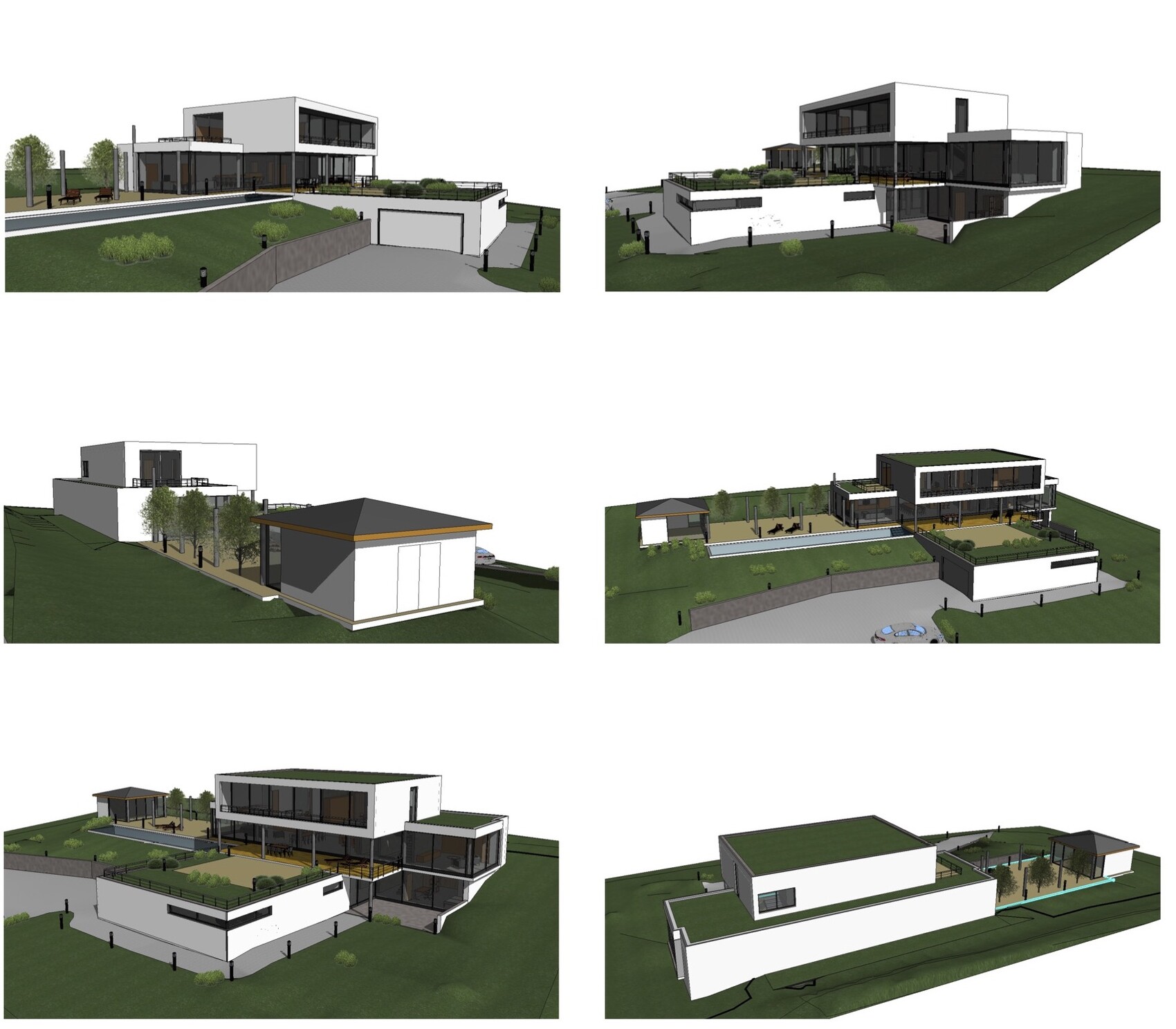
I just wanted to briefly introduce myself and say thank you.
For about a year and a half, I have been a silent reader here to gather inspiration and especially to gain more knowledge about construction technology.
Now a bit about me:
After more than a year of searching for a plot of land, I was able to purchase one from a developer who couldn’t move forward quickly with his plans.
So we found our dream plot (good location, 2500 m² (0.62 acres), slight slope, underground private spring that we have to preserve and are allowed to use).
There was an old house on the property, which we have since demolished.
There is no zoning plan, so §34 applies. During an initial informal inquiry at the building authority, almost everything we planned was rejected.
So we submitted an official preliminary building inquiry, involved the right people, and had lengthy discussions. In the end, we received a positive decision.
Therefore, there is nothing standing in the way of the building permit. The building permit should be granted within the next few weeks as there are no changes from the preliminary inquiry.
My wife (37) and I (36) want to build a Bauhaus-style villa in southern Baden-Württemberg.
It will be constructed from concrete (with core insulation) or in combination with insulated precast elements.
A lot of glass (full-glass system), textile shading, KNX, fast network both wired and wireless, strong mechanical ventilation with additional cooling coils, stainless steel pool, large cistern, and more.
The electrical planning must be 100% spot on since it’s almost impossible to make changes afterward.
Since I am friends with an architect from a larger firm, it was clear which route we would take. Such a house can basically only be realized with an architect.
I also personally know the electrician and KNX system integrator, as well as the owners and work approach of the heating, plumbing, and ventilation companies involved.
Some trades have already been contracted, and part of the equipment has already been ordered.
I’m really looking forward to getting started and to the final result. The goal is to move in by the end of 2019.
Once again, many thanks for the information I have received from you so far.
If you have any questions, just let me know.
Attached is the design, though not the final version. There have been a few minor changes.
Greetings from Swabia
rick2018 schrieb:
@k-man2021
You’re mistaken about the wall construction.
The precast concrete cavity walls are filled with concrete on site, so there is no cavity insulation. However, there are cavity walls with insulation. That didn’t work for structural and other reasons. The main reason was our floor-to-ceiling windows that extend to the ceiling. Each pane weighs nearly 2 tons…
With “normal” windows, we would have chosen that method.
Now we have a ventilated rainscreen facade with mineral insulation.
So with “normal” windows, you can skip that.
Every elevator has specific shaft dimensions. Retrofitting one is very complicated. I don’t know anyone who has ever activated the planned shaft. Either install it right away or don’t bother. Please keep in mind that the bureaucracy around elevators can be annoying. You must comply with all requirements at least for commissioning: emergency call system, access, mirror, inspection, emergency plans, elevator attendant… Maintaining this is expensive. If you don’t, you’re liable in case something happens to a third party (e.g., a cleaner). Most people I know disable the emergency call system anyway since nobody comes into the building. And they can’t shut down the elevator because they have no access. They just leave it inactive…
We don’t have a residential-type elevator. Generally, elevators with hydraulic drives are not used for low-frequency operation. These constantly position at a defined floor level, meaning pumps run continuously and maintenance is more complex. Instead, elevators with electric motors and belts are used.
Of course, there are also safety doors for elevators, but I don’t quite understand the question. Our elevator is inside the security zone within the house.
There is a very secure door from the garage to the house. All areas are furthermore monitored with motion detectors, presence sensors, and cameras. This area is the most vulnerable since a garage door provides very little security.
I can’t give you an exact figure. It’s roughly around the KfW 55 standard. Actual values are not yet reliably available.
What you use to heat the house doesn’t really matter. We could also heat our house with wood or electricity. Do you happen to have a tunnel plan like the one in Money Heist? I need to figure out how to get underground to the pool party if the invitation doesn’t arrive. :P
@k-man2021: If you later face similar structural challenges as Rick, and if you’re brave enough, you might consider using double walls made of carbon concrete reinforced with fiberglass rebar. This allows you to carry much higher loads with similar wall and bearing plate thicknesses, or conversely, to build significantly slimmer structures. However, this technology is still under development (especially in the single-family home sector).
If you also insulate the cavity with Slentite, you’ll (probably) have no budget left for an elevator, and thus one less problem. 😉
If you also insulate the cavity with Slentite, you’ll (probably) have no budget left for an elevator, and thus one less problem. 😉
K
k-man202113 May 2021 18:37rick2018 schrieb:
You’re mistaken about the wall construction. The concrete hollow core panels are filled with concrete on site. So, there is no cavity insulation ... weight of a single panel is nearly 2 tons… Great, thanks, I understand now. We’ll probably need some kind of sky frame or similar as well... but not necessarily in resistance class BR7 😉 ... we’ll see.
rick2018 schrieb:
Every elevator has specific shaft dimensions. Retrofitting is very complicated. I don’t know anyone who has ever activated the intended shaft afterward. Either install it from the start or not at all. Please keep in mind that the bureaucracy around an elevator will be frustrating. You must (at least for commissioning) meet all requirements, such as emergency call system, access, mirrors, inspections, emergency plans, elevator attendants... Maintaining this will cost a lot of money. If you don’t, you’re liable if anything happens involving a third party (e.g., cleaner). Most people I know disable the emergency call since no one is actually entering the building. And they can’t shut down the elevator because they can’t access it. They just let it sit idle...
Our elevator is inside the building’s secure area. Thanks, that’s valuable information! I wasn’t clear about the elevator, but you answered my questions: your elevator is within the secured area and does not itself provide access, just like the garage door.
rick2018 schrieb:
What type of heating you use doesn’t matter. Actually, it does... no gas here, and our land is in a water protection zone, so deep drilling is prohibited. That means only ground collectors remain an option, but they are limited or constrained by existing buildings and vegetation. But that’s a topic for a separate thread...

Heat pump, pellets, gas tank… there are many options.
I hope you know the prices for Skyframe and similar products. Ours are from Swissfinline.
You can easily pay 10 times more than for "standard" windows.
Soon there will also be a major photo shoot here for the reference projects….
I hope you know the prices for Skyframe and similar products. Ours are from Swissfinline.
You can easily pay 10 times more than for "standard" windows.
Soon there will also be a major photo shoot here for the reference projects….
K
k-man202113 May 2021 19:12Yes, I can imagine that. We also don’t have standard windows and ours have a high resistance class... It doesn’t have to be SkyFrame everywhere in our case either... and if the elevator is removed, as @Harakiri suggests 😎, maybe the budget will allow for one more window...
Similar topics