
ᐅ Modernist Concrete Villa with Cavity Wall Insulation – Experiences
Created on: 11 Sep 2018 07:32
R
rick2018
Hello everyone,
I just wanted to briefly introduce myself and say thank you.
For about a year and a half, I have been a silent reader here to gather inspiration and especially to gain more knowledge about construction technology.
Now a bit about me:
After more than a year of searching for a plot of land, I was able to purchase one from a developer who couldn’t move forward quickly with his plans.
So we found our dream plot (good location, 2500 m² (0.62 acres), slight slope, underground private spring that we have to preserve and are allowed to use).
There was an old house on the property, which we have since demolished.
There is no zoning plan, so §34 applies. During an initial informal inquiry at the building authority, almost everything we planned was rejected.
So we submitted an official preliminary building inquiry, involved the right people, and had lengthy discussions. In the end, we received a positive decision.
Therefore, there is nothing standing in the way of the building permit. The building permit should be granted within the next few weeks as there are no changes from the preliminary inquiry.
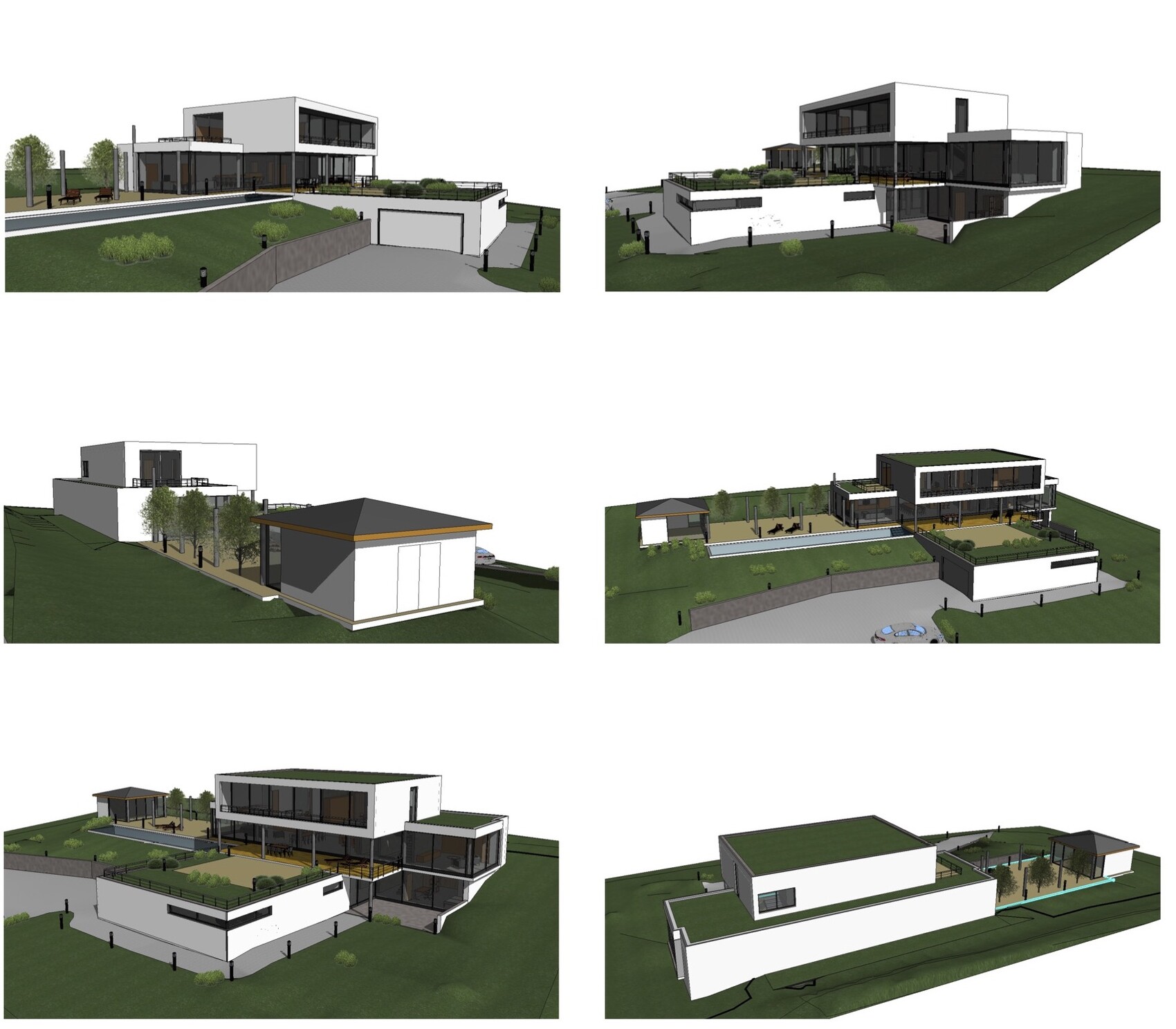
My wife (37) and I (36) want to build a Bauhaus-style villa in southern Baden-Württemberg.
It will be constructed from concrete (with core insulation) or in combination with insulated precast elements.
A lot of glass (full-glass system), textile shading, KNX, fast network both wired and wireless, strong mechanical ventilation with additional cooling coils, stainless steel pool, large cistern, and more.
The electrical planning must be 100% spot on since it’s almost impossible to make changes afterward.
Since I am friends with an architect from a larger firm, it was clear which route we would take. Such a house can basically only be realized with an architect.
I also personally know the electrician and KNX system integrator, as well as the owners and work approach of the heating, plumbing, and ventilation companies involved.
Some trades have already been contracted, and part of the equipment has already been ordered.
I’m really looking forward to getting started and to the final result. The goal is to move in by the end of 2019.
Once again, many thanks for the information I have received from you so far.
If you have any questions, just let me know.
Attached is the design, though not the final version. There have been a few minor changes.
Greetings from Swabia
I just wanted to briefly introduce myself and say thank you.
For about a year and a half, I have been a silent reader here to gather inspiration and especially to gain more knowledge about construction technology.
Now a bit about me:
After more than a year of searching for a plot of land, I was able to purchase one from a developer who couldn’t move forward quickly with his plans.
So we found our dream plot (good location, 2500 m² (0.62 acres), slight slope, underground private spring that we have to preserve and are allowed to use).
There was an old house on the property, which we have since demolished.
There is no zoning plan, so §34 applies. During an initial informal inquiry at the building authority, almost everything we planned was rejected.
So we submitted an official preliminary building inquiry, involved the right people, and had lengthy discussions. In the end, we received a positive decision.
Therefore, there is nothing standing in the way of the building permit. The building permit should be granted within the next few weeks as there are no changes from the preliminary inquiry.
My wife (37) and I (36) want to build a Bauhaus-style villa in southern Baden-Württemberg.
It will be constructed from concrete (with core insulation) or in combination with insulated precast elements.
A lot of glass (full-glass system), textile shading, KNX, fast network both wired and wireless, strong mechanical ventilation with additional cooling coils, stainless steel pool, large cistern, and more.
The electrical planning must be 100% spot on since it’s almost impossible to make changes afterward.
Since I am friends with an architect from a larger firm, it was clear which route we would take. Such a house can basically only be realized with an architect.
I also personally know the electrician and KNX system integrator, as well as the owners and work approach of the heating, plumbing, and ventilation companies involved.
Some trades have already been contracted, and part of the equipment has already been ordered.
I’m really looking forward to getting started and to the final result. The goal is to move in by the end of 2019.
Once again, many thanks for the information I have received from you so far.
If you have any questions, just let me know.
Attached is the design, though not the final version. There have been a few minor changes.
Greetings from Swabia

S
Schlenk-Bär13 Aug 2020 20:59Climbee schrieb:
What I really drool over: the Gaggenau appliances. Now that I see them again, I could really kick myself for ultimately choosing Miele.Why exactly? What’s so bad about Miele? Thanks.S
sichtbeton8214 Aug 2020 09:06Climbee schrieb:
sichtbeton82, did Covid catch you? My condolences, I hope you are feeling better now!Only indirectly, but thanks for the kind words! @rick2018 I have posted some recent pictures. Best regards

Schlenk-Bär schrieb:
Why exactly? What’s so bad about Miele? Thanks.Sorry, I haven’t answered that yet:
Overall, I am very dissatisfied with the menu navigation via the touch screen. You can tap away all you want, but it just doesn’t work reliably. Especially when cooking without perfectly clean and dry fingers, I often have to tap the desired function four or five times before the appliance actually does what I want. Many things are simply impractical and hardly usable as intended.
My worst example is setting a timer. First, you tap “timer,” then you have to choose between “alarm” or “timer,” then tap “timer” again. A screen opens with settings for hours, minutes, and seconds. Each of these fields must be selected individually, scrolling the numbers up or down, waiting for the hours value to be accepted before you can set minutes, and then seconds. Even if you mostly don’t need to set hours, you’ve already lost about 30–60 seconds by then. If, as is often the case, the touch doesn’t register right away, you fiddle with it even longer. Finally, confirm with “OK,” and the timer starts. This makes the whole idea of a quick timer absurd.
There is a second option to enter hours, minutes, and seconds via a number keypad rather than scrolling, by tapping a small icon below the scroll field—which opens a numeric keypad. You enter a number (and hope it works the first time without dozens of taps), then confirm with “OK,” and do this separately for hours, minutes, and seconds. That takes even longer. Completely ridiculous.
I’ve never understood why selecting “timer” can’t just show a “00:00:00” display that you fill in from the right (for example, typing “230” on the keypad to set 2 minutes and 30 seconds, then pressing “OK”).
This is useless if, for example, you want to sear a steak for exactly 1:30 minutes on each side—the time is almost up before you manage to set it.
My biggest frustration, however, is the combination steam oven. We got one with a direct water connection and drain because we didn’t want to keep cleaning water reservoirs. At Gaggenau, the steam chamber is bigger for this version since there are no reservoirs (the descaling reservoir is only in the bottom, strictly for descaling).
For Miele, the device is identical to the one with fresh and used water reservoirs—no enlarged cooking chamber. I could live with that. But instead of drawing fresh water directly from the line, Miele pumps the fresh water into the reservoir and then into the cooking cavity. In other words: they basically took the model without water connection and drain, removed the pump and reservoir for used water (cost saving!), and for the fresh water inflow just added an inlet to fill the fresh water reservoir from the line. So the function is exactly the same as the model without fresh water supply.
After cooking, you still have to clean this fresh water reservoir like on a combi-steam oven without water connection. This makes the advantage of a direct water connection pointless—just like the timer. Filling the tank manually is less work, and we could have managed that as well.
Unfortunately, we didn’t pay attention to this because for us it was clear: with water supply and drain you don’t have reservoirs anymore. Not so with Miele!
On top of that, we chose the model with black glass front and stainless steel handles—when we decided, there was no stainless steel front option; now there is. The downside is that every single fingerprint shows up clearly on the black glass. And what do you do with a touchscreen menu? Exactly—you tap the glass repeatedly. I now find myself cleaning the menu area several times a day because the fingerprints on the black glass just look grimy.
Therefore: in the future, only models with knobs as controls and stainless steel fronts for me. And I’ll watch very closely if we ever replace our Miele appliances, especially if I buy a new combination steam oven with water supply and drain. Anything that doesn’t really deliver the benefits of a direct water connection will be ruled out immediately. But, like I said, that’s our fault—we didn’t pay attention because it seemed so obvious to us.
Sorry, Rick, for hijacking your thread!
You did everything right.
Climbee schrieb:
Miele criticism Please send this directly to Miele’s customer service. Even if it no longer helps you in this case, such matters are taken seriously and will not just be filed away.
S
Schlenk-Bär17 Aug 2020 21:14Climbee schrieb:
Sorry, I haven’t answered this yet:
Overall, I am very dissatisfied with the menu navigation via the touchscreen. You can tap endlessly, but it just doesn’t work reliably. Especially when cooking and your fingers aren’t clean and dry, I often have to tap the desired function four or five times before the device finally does what I want. This makes many features impractical and barely usable as intended.
My worst example: setting a timer. First, you tap on “timer,” then you get a choice between “alarm” or “timer.” You tap “timer” again, then a screen appears with settings for hours, minutes, and seconds. You have to select each field individually and scroll the numbers up or down, wait until the value for hours is accepted, then you can set the minutes, then the seconds. Even when you usually don’t need to adjust the hours, you’ve already lost about 30 to 60 seconds by this point. If, as often happens, the touchscreen doesn’t register the first tap, you end up fiddling even longer. Finally, you have to confirm with “ok,” and then the time starts. This completely defeats the purpose of a SHORT timer. There is also the option to enter the required hours, minutes, and seconds via a keypad rather than scrolling. You tap a small icon below the scroll field to open the number pad, enter the number (and hope it works on the first try without tapping repeatedly), confirm with “ok,” and do this separately for hours, minutes, and seconds. That takes even longer. It’s totally ridiculous. I will never understand why there isn’t simply a “00:00:00” display when you select the timer that you can fill from behind using the keypad (for example, I enter 230 if I want 2 minutes 30 seconds, then confirm with “ok”).
I can forget about it when I want to sear a steak for exactly 1:30 minutes on each side—the time is almost up by the time the timer is set.
My biggest frustration is the combi steam oven. We have the model with direct water connection including drain because we didn’t want to clean reservoirs all the time. In Gaggenau models, the cooking space was enlarged because there are no longer any reservoirs (there is a descaling reservoir at the bottom, but that is only used for descaling).
The Miele model is identical to the one with reservoirs for fresh water and wastewater, so the cooking space is not enlarged. I could live with that. But instead of taking fresh water directly from the mains, Miele pumps fresh water into a reservoir and then supplies it to the cooking chamber. In other words, they simply took the model without a direct water connection, removed the pump for wastewater and the wastewater reservoir (cost saving!), the wastewater drain still works, but the fresh water inlet is just an inlet device that pumps fresh water into the fresh water reservoir. So the function is basically the same as the model without a direct fresh water supply.
After cooking, you still have to clean the fresh water reservoir, just like a combi steam oven without a water supply. This completely negates the advantage of a direct water connection (like the timer situation). Filling the tank manually is less work anyway, so we could have handled that.
Unfortunately, we didn’t pay close attention because we assumed that with water supply and drain, there would be no reservoirs. That’s not the case with Miele!
Additionally, we have the model with a black glass front and stainless steel handles. When we made our choice, the version with a stainless steel front wasn’t available; now it is. As a result, every single fingerprint shows up on the black glass. And what do you do with a menu controlled by touchscreen? Exactly—you tap the glass constantly. I now clean the menu area several times a day because it looks dirty with all the fingerprints on the black glass.
Therefore, in the future, only models with rotary knobs as controls and stainless steel fronts for me. And I will be very careful—like a hawk—if we ever replace our Miele appliances, especially if I buy a new combi steam oven with water supply and drain. A device that doesn’t really deliver the advantage of a direct water connection will be eliminated right away. But, as I said, that’s our own fault. We didn’t pay attention because it seemed so absurd to us.
Sorry, Rick, for hijacking your thread!
You did everything right Great, thanks for your effort. And now, no more off-topic... Sorry, Rick
Similar topics