
ᐅ Modernist Concrete Villa with Cavity Wall Insulation – Experiences
Created on: 11 Sep 2018 07:32
R
rick2018
Hello everyone,
I just wanted to briefly introduce myself and say thank you.
For about a year and a half, I have been a silent reader here to gather inspiration and especially to gain more knowledge about construction technology.
Now a bit about me:
After more than a year of searching for a plot of land, I was able to purchase one from a developer who couldn’t move forward quickly with his plans.
So we found our dream plot (good location, 2500 m² (0.62 acres), slight slope, underground private spring that we have to preserve and are allowed to use).
There was an old house on the property, which we have since demolished.
There is no zoning plan, so §34 applies. During an initial informal inquiry at the building authority, almost everything we planned was rejected.
So we submitted an official preliminary building inquiry, involved the right people, and had lengthy discussions. In the end, we received a positive decision.
Therefore, there is nothing standing in the way of the building permit. The building permit should be granted within the next few weeks as there are no changes from the preliminary inquiry.
My wife (37) and I (36) want to build a Bauhaus-style villa in southern Baden-Württemberg.
It will be constructed from concrete (with core insulation) or in combination with insulated precast elements.
A lot of glass (full-glass system), textile shading, KNX, fast network both wired and wireless, strong mechanical ventilation with additional cooling coils, stainless steel pool, large cistern, and more.
The electrical planning must be 100% spot on since it’s almost impossible to make changes afterward.
Since I am friends with an architect from a larger firm, it was clear which route we would take. Such a house can basically only be realized with an architect.
I also personally know the electrician and KNX system integrator, as well as the owners and work approach of the heating, plumbing, and ventilation companies involved.
Some trades have already been contracted, and part of the equipment has already been ordered.
I’m really looking forward to getting started and to the final result. The goal is to move in by the end of 2019.
Once again, many thanks for the information I have received from you so far.
If you have any questions, just let me know.
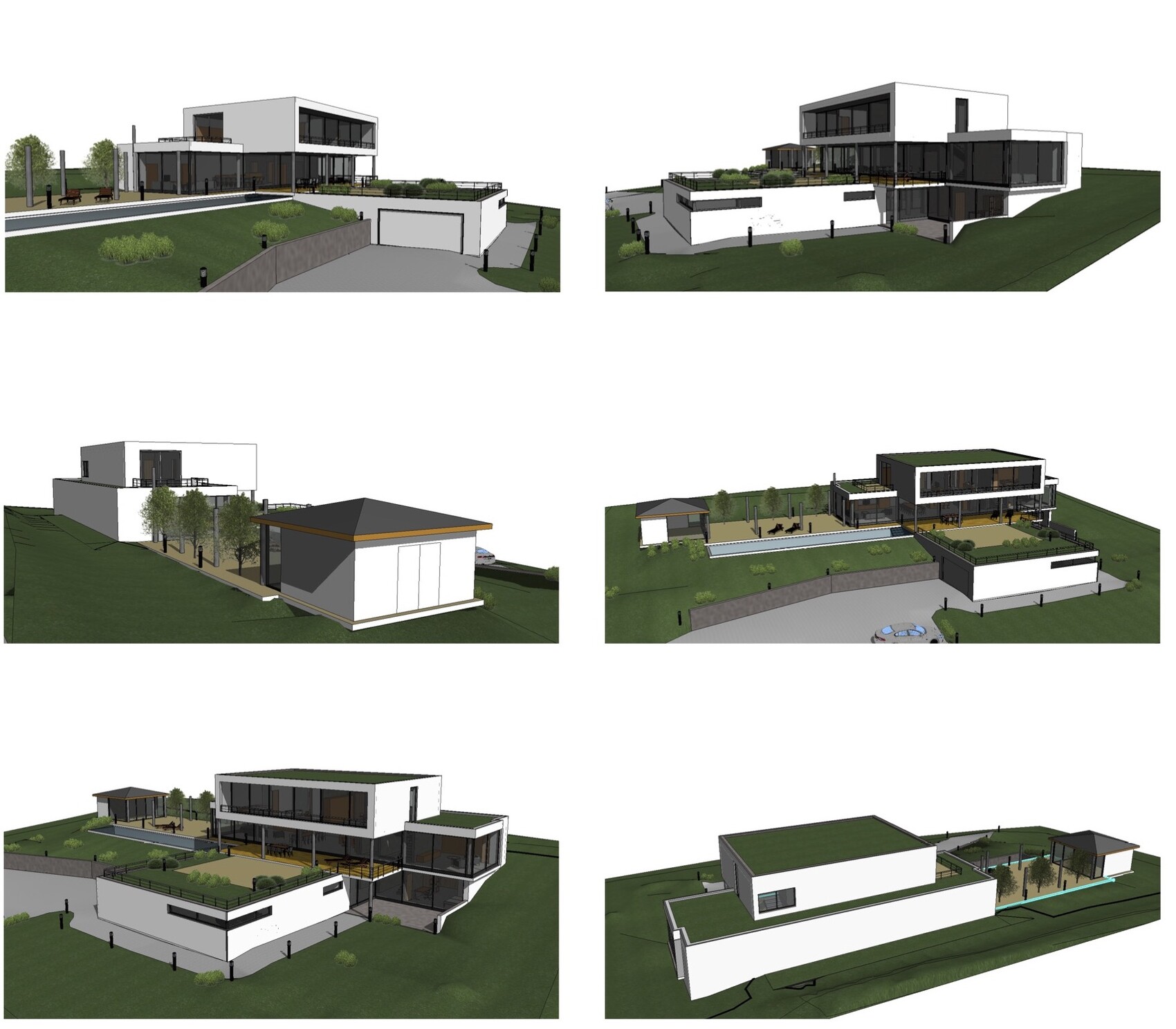
Attached is the design, though not the final version. There have been a few minor changes.
Greetings from Swabia
I just wanted to briefly introduce myself and say thank you.
For about a year and a half, I have been a silent reader here to gather inspiration and especially to gain more knowledge about construction technology.
Now a bit about me:
After more than a year of searching for a plot of land, I was able to purchase one from a developer who couldn’t move forward quickly with his plans.
So we found our dream plot (good location, 2500 m² (0.62 acres), slight slope, underground private spring that we have to preserve and are allowed to use).
There was an old house on the property, which we have since demolished.
There is no zoning plan, so §34 applies. During an initial informal inquiry at the building authority, almost everything we planned was rejected.
So we submitted an official preliminary building inquiry, involved the right people, and had lengthy discussions. In the end, we received a positive decision.
Therefore, there is nothing standing in the way of the building permit. The building permit should be granted within the next few weeks as there are no changes from the preliminary inquiry.
My wife (37) and I (36) want to build a Bauhaus-style villa in southern Baden-Württemberg.
It will be constructed from concrete (with core insulation) or in combination with insulated precast elements.
A lot of glass (full-glass system), textile shading, KNX, fast network both wired and wireless, strong mechanical ventilation with additional cooling coils, stainless steel pool, large cistern, and more.
The electrical planning must be 100% spot on since it’s almost impossible to make changes afterward.
Since I am friends with an architect from a larger firm, it was clear which route we would take. Such a house can basically only be realized with an architect.
I also personally know the electrician and KNX system integrator, as well as the owners and work approach of the heating, plumbing, and ventilation companies involved.
Some trades have already been contracted, and part of the equipment has already been ordered.
I’m really looking forward to getting started and to the final result. The goal is to move in by the end of 2019.
Once again, many thanks for the information I have received from you so far.
If you have any questions, just let me know.
Attached is the design, though not the final version. There have been a few minor changes.
Greetings from Swabia
P
pagoni20209 Jul 2020 00:09Müllerin schrieb:
Great, still not really my style but definitely a visual highlight. The panes look quite reflective – how do you deal with the issue of bird collisions?That doesn’t really happen, or at least not any more than anywhere else… it’s better to skip the plastic bird decals.I
Ideensucher9 Jul 2020 00:51Müllerin schrieb:
The glass looks quite reflective; how do you deal with the issue of bird strikes? I assume that if anything, the birds have the problem with the glass, not the glass itself. The rest is taken care of overnight by the fox.
Very interesting and impressive house. Somewhere in the 150 pages you wrote, "we had to make compromises as well." You have some quite unique features, for example your asphalt screed.
Could you maybe share what you would have done differently if you had allowed the build to cost 10% more? (I deliberately don’t write "could spend 10% more" – I would find your answer all the more interesting).

@11ant: No idea. A standard insurance policy doesn't cover this. Better to set aside a reserve fund and replace it if a defect occurs...
@Müllerin: Bird strikes shouldn’t be a problem. The panes are not mirrored. My mother has a large conservatory and feeds birds year-round. In the first year, there were a few strikes. Now there aren’t any. Only when young birds are around does one occasionally hit the glass. Rarely with fatal consequences.
@Bauherr am L: Cavity insulation was not possible due to the glass system.
@Ideensucher: The poured asphalt floor isn’t really more expensive. You save on screed and floor covering. However, this requires a metal underfloor heating system…
We splurged on some things, like the glass system, the ceilings, etc., which significantly increased costs.
What I would have done, if money wasn’t an issue (before construction started):
- Solid concrete, thick enough to require no insulation. Preferably with a company from Switzerland. After seeing the result, I wouldn’t consider this anymore.
- Property boundary: retaining wall buried in the ground and finished with natural stone and corten steel in visible areas. I asked for an offer but declined politely.
- Possibly made more glass elements motorized and movable.
- Installed shower-toilets everywhere from the start.
- Terrace flooring in a very large tile format.
- Lifting floor for the pool.
- Flocculation system for the pool.
- Larger elevator.
- Possibly a kitchen from a different manufacturer.
- Also plaster and paint the technical rooms to Q3 standard and install flooring.
- Insulated and centrally heated pool pavilion.
Many decisions were made with maintenance in mind. I don’t want to constantly check, clean, or refill here and there… nor do I want permanent staff in the house.
We already have much more than we need.
@Müllerin: Bird strikes shouldn’t be a problem. The panes are not mirrored. My mother has a large conservatory and feeds birds year-round. In the first year, there were a few strikes. Now there aren’t any. Only when young birds are around does one occasionally hit the glass. Rarely with fatal consequences.
@Bauherr am L: Cavity insulation was not possible due to the glass system.
@Ideensucher: The poured asphalt floor isn’t really more expensive. You save on screed and floor covering. However, this requires a metal underfloor heating system…
We splurged on some things, like the glass system, the ceilings, etc., which significantly increased costs.
What I would have done, if money wasn’t an issue (before construction started):
- Solid concrete, thick enough to require no insulation. Preferably with a company from Switzerland. After seeing the result, I wouldn’t consider this anymore.
- Property boundary: retaining wall buried in the ground and finished with natural stone and corten steel in visible areas. I asked for an offer but declined politely.
- Possibly made more glass elements motorized and movable.
- Installed shower-toilets everywhere from the start.
- Terrace flooring in a very large tile format.
- Lifting floor for the pool.
- Flocculation system for the pool.
- Larger elevator.
- Possibly a kitchen from a different manufacturer.
- Also plaster and paint the technical rooms to Q3 standard and install flooring.
- Insulated and centrally heated pool pavilion.
Many decisions were made with maintenance in mind. I don’t want to constantly check, clean, or refill here and there… nor do I want permanent staff in the house.
We already have much more than we need.
A
Alessandro9 Jul 2020 07:18I’m looking forward to the interior work and the furnishing (if you want to show that).
I just like everything about the project!
I just like everything about the project!
B
Bauherr am L9 Jul 2020 09:11@rick2018
- What kind of kitchen do you have or are you going to get?
- By "solid concrete," do you mean something like lightweight concrete that provides insulation and structural support at the same time? I read something about that a while ago from a homeowner in southern Germany. He is also an architect and built his house using that method. I think it’s really cool, but you definitely need a specialist or architect who knows about it. The walls also end up being quite thick.
What I’m generally wondering is how the Swiss manage to achieve such high-quality exposed concrete both inside and outside while keeping it relatively affordable. I’m thinking of the architects Marte Marte as an example. By the way, who is your architect, or is that confidential?
- What kind of kitchen do you have or are you going to get?
- By "solid concrete," do you mean something like lightweight concrete that provides insulation and structural support at the same time? I read something about that a while ago from a homeowner in southern Germany. He is also an architect and built his house using that method. I think it’s really cool, but you definitely need a specialist or architect who knows about it. The walls also end up being quite thick.
What I’m generally wondering is how the Swiss manage to achieve such high-quality exposed concrete both inside and outside while keeping it relatively affordable. I’m thinking of the architects Marte Marte as an example. By the way, who is your architect, or is that confidential?
Similar topics