
ᐅ Modernist Concrete Villa with Cavity Wall Insulation – Experiences
Created on: 11 Sep 2018 07:32
R
rick2018
Hello everyone,
I just wanted to briefly introduce myself and say thank you.
For about a year and a half, I have been a silent reader here to gather inspiration and especially to gain more knowledge about construction technology.
Now a bit about me:
After more than a year of searching for a plot of land, I was able to purchase one from a developer who couldn’t move forward quickly with his plans.
So we found our dream plot (good location, 2500 m² (0.62 acres), slight slope, underground private spring that we have to preserve and are allowed to use).
There was an old house on the property, which we have since demolished.
There is no zoning plan, so §34 applies. During an initial informal inquiry at the building authority, almost everything we planned was rejected.
So we submitted an official preliminary building inquiry, involved the right people, and had lengthy discussions. In the end, we received a positive decision.
Therefore, there is nothing standing in the way of the building permit. The building permit should be granted within the next few weeks as there are no changes from the preliminary inquiry.
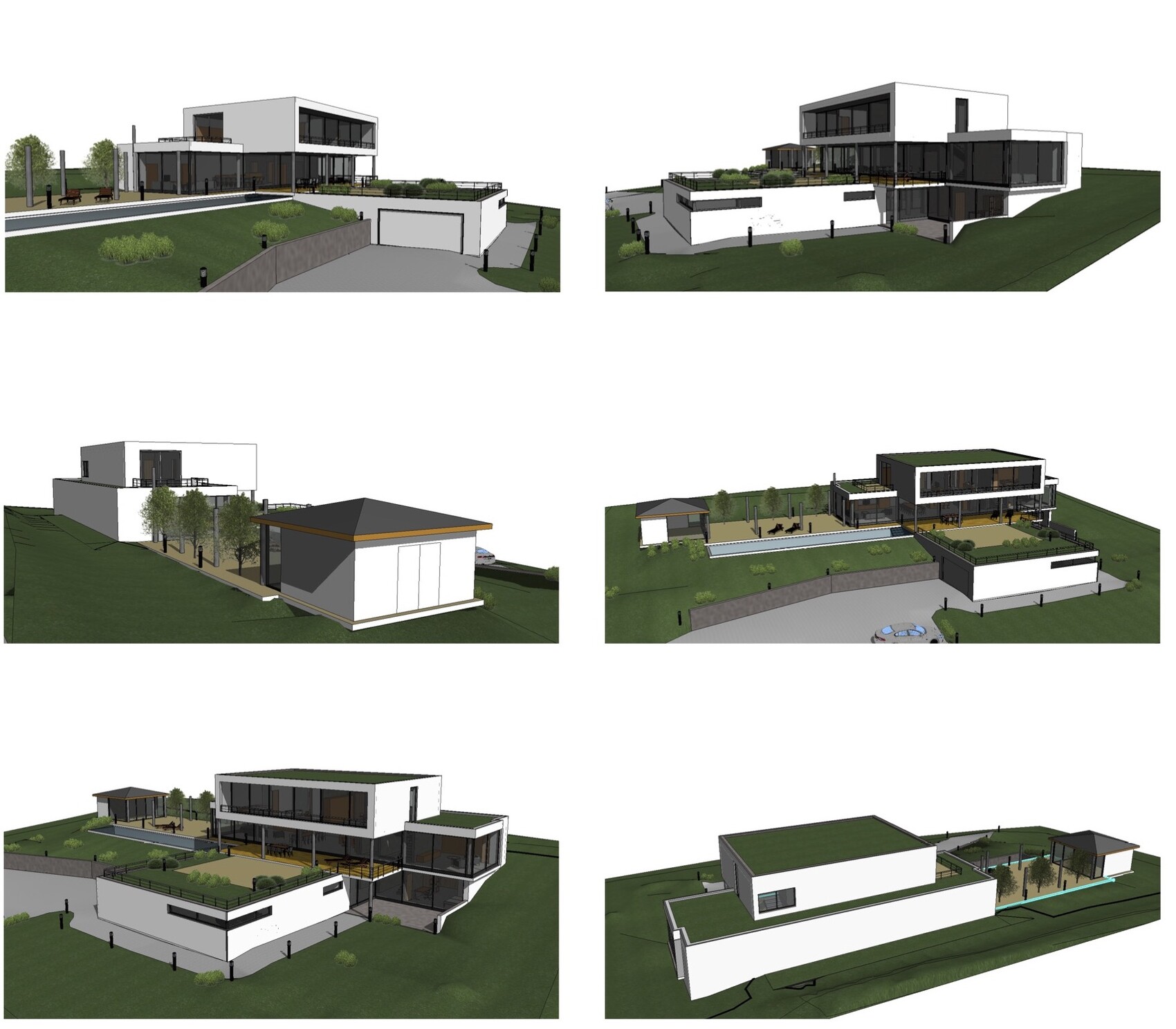
My wife (37) and I (36) want to build a Bauhaus-style villa in southern Baden-Württemberg.
It will be constructed from concrete (with core insulation) or in combination with insulated precast elements.
A lot of glass (full-glass system), textile shading, KNX, fast network both wired and wireless, strong mechanical ventilation with additional cooling coils, stainless steel pool, large cistern, and more.
The electrical planning must be 100% spot on since it’s almost impossible to make changes afterward.
Since I am friends with an architect from a larger firm, it was clear which route we would take. Such a house can basically only be realized with an architect.
I also personally know the electrician and KNX system integrator, as well as the owners and work approach of the heating, plumbing, and ventilation companies involved.
Some trades have already been contracted, and part of the equipment has already been ordered.
I’m really looking forward to getting started and to the final result. The goal is to move in by the end of 2019.
Once again, many thanks for the information I have received from you so far.
If you have any questions, just let me know.
Attached is the design, though not the final version. There have been a few minor changes.
Greetings from Swabia
I just wanted to briefly introduce myself and say thank you.
For about a year and a half, I have been a silent reader here to gather inspiration and especially to gain more knowledge about construction technology.
Now a bit about me:
After more than a year of searching for a plot of land, I was able to purchase one from a developer who couldn’t move forward quickly with his plans.
So we found our dream plot (good location, 2500 m² (0.62 acres), slight slope, underground private spring that we have to preserve and are allowed to use).
There was an old house on the property, which we have since demolished.
There is no zoning plan, so §34 applies. During an initial informal inquiry at the building authority, almost everything we planned was rejected.
So we submitted an official preliminary building inquiry, involved the right people, and had lengthy discussions. In the end, we received a positive decision.
Therefore, there is nothing standing in the way of the building permit. The building permit should be granted within the next few weeks as there are no changes from the preliminary inquiry.
My wife (37) and I (36) want to build a Bauhaus-style villa in southern Baden-Württemberg.
It will be constructed from concrete (with core insulation) or in combination with insulated precast elements.
A lot of glass (full-glass system), textile shading, KNX, fast network both wired and wireless, strong mechanical ventilation with additional cooling coils, stainless steel pool, large cistern, and more.
The electrical planning must be 100% spot on since it’s almost impossible to make changes afterward.
Since I am friends with an architect from a larger firm, it was clear which route we would take. Such a house can basically only be realized with an architect.
I also personally know the electrician and KNX system integrator, as well as the owners and work approach of the heating, plumbing, and ventilation companies involved.
Some trades have already been contracted, and part of the equipment has already been ordered.
I’m really looking forward to getting started and to the final result. The goal is to move in by the end of 2019.
Once again, many thanks for the information I have received from you so far.
If you have any questions, just let me know.
Attached is the design, though not the final version. There have been a few minor changes.
Greetings from Swabia

tumaa schrieb:
There are lesbians, but the majority of women are straight... so what?! And now the chauvinistic stereotype is thoroughly confirmed: assuming "woman and not technophobic" means lesbian :-(
https://www.instagram.com/11antgmxde/
https://www.linkedin.com/company/bauen-jetzt/

@superzapp
There are 6 patch panels with 24 ports each, probably not fully populated. About 10 more cables will be added. These are strictly network cables, so nothing misused for KNX. The house and property aren’t large enough to have cable runs of 100 meters (330 feet). Around 60 meters (197 feet) should be the maximum. The distance to the office is considerably shorter, so 10 GbE won’t be an issue.
The cables were already labeled pretty well by the electrician by hand. There were only a few cables where I needed to double-check. Now, with the right printer, the installation cables are labeled with position/function and the patch panel plus port. The router and switch are programmed accordingly. Patch cables are labeled as well—pretty meticulous. I don’t want to have to search later. Since this is not a dynamic setup, I can basically define everything fixed.
I’ll move the cabinet in next week. It will be placed right next to the cable tray in the middle of the room, so I can access it from all sides. If I don’t like that, it will go underneath to the side. It has enough cable entry options (Stengel cabinet). It is also a double-depth cabinet. With my equipment, that’s no problem (thermally and with opposing fans…). There’s still plenty of room inside.
The floor will remain as is. It might get coated later. If it stays raw, there will be fewer discussions about floor space regarding property tax...
Yes, at the back wall is the Unitymedia connection (now Vodafone). Since I don’t need a telephone comfort option, they provided the annoying (new) Vodafone Station. It was planned anyway to replace it regardless of what they supplied. The station is located in the locked outdoor box at the back right. During construction, it provides Wi-Fi for the workers and me. Mobile reception on the property is poor and nonexistent inside the building.
I already have the power upload and native Dual Stack.
The Telekom connection is also there, though with a max of 12 Mbit/s download and 2.5 Mbit/s upload 🙄.
There is also an empty conduit in case fiber optic is installed in the future.
Thanks for the compliments. I’m tech-savvy and quite proficient for a non-professional. But connecting modules isn’t that complicated; you just need to be careful. Part of it will be done by the electrician; I’ll handle the patch panels. All cables will be tested and documented at the terminations.
My TC4400 with the latest firmware (.42) was delivered within 30 minutes. I’ll play around with it in the next few days. I won’t provision it until my server rack is fully installed.
There are 6 patch panels with 24 ports each, probably not fully populated. About 10 more cables will be added. These are strictly network cables, so nothing misused for KNX. The house and property aren’t large enough to have cable runs of 100 meters (330 feet). Around 60 meters (197 feet) should be the maximum. The distance to the office is considerably shorter, so 10 GbE won’t be an issue.
The cables were already labeled pretty well by the electrician by hand. There were only a few cables where I needed to double-check. Now, with the right printer, the installation cables are labeled with position/function and the patch panel plus port. The router and switch are programmed accordingly. Patch cables are labeled as well—pretty meticulous. I don’t want to have to search later. Since this is not a dynamic setup, I can basically define everything fixed.
I’ll move the cabinet in next week. It will be placed right next to the cable tray in the middle of the room, so I can access it from all sides. If I don’t like that, it will go underneath to the side. It has enough cable entry options (Stengel cabinet). It is also a double-depth cabinet. With my equipment, that’s no problem (thermally and with opposing fans…). There’s still plenty of room inside.
The floor will remain as is. It might get coated later. If it stays raw, there will be fewer discussions about floor space regarding property tax...
Yes, at the back wall is the Unitymedia connection (now Vodafone). Since I don’t need a telephone comfort option, they provided the annoying (new) Vodafone Station. It was planned anyway to replace it regardless of what they supplied. The station is located in the locked outdoor box at the back right. During construction, it provides Wi-Fi for the workers and me. Mobile reception on the property is poor and nonexistent inside the building.
I already have the power upload and native Dual Stack.
The Telekom connection is also there, though with a max of 12 Mbit/s download and 2.5 Mbit/s upload 🙄.
There is also an empty conduit in case fiber optic is installed in the future.
Thanks for the compliments. I’m tech-savvy and quite proficient for a non-professional. But connecting modules isn’t that complicated; you just need to be careful. Part of it will be done by the electrician; I’ll handle the patch panels. All cables will be tested and documented at the terminations.
My TC4400 with the latest firmware (.42) was delivered within 30 minutes. I’ll play around with it in the next few days. I won’t provision it until my server rack is fully installed.
rick2018 schrieb:
There are 6 x 24-port patch panels. Probably not fully populated.Still: why are they all yellow? - Color coding helps with organization.https://www.instagram.com/11antgmxde/
https://www.linkedin.com/company/bauen-jetzt/
K
knalltüte2 May 2020 15:1711ant schrieb:
Still: why are they all yellow? – color helps with organization.... this is usually not done. Otherwise, the electrician would have to buy two different 1000m (3280 feet) rolls... It’s custom-length cable that you don’t just change the color of. Also, not every manufacturer offers every quality in every color. Is that Leoni Yellow cable rated for more than 1000 MHz?
The patch cables are probably color-coded according to their function – right?
@11ant These are the installation cables.
They are connected to the patch panels.
There are hardly any other colors unless the cables are specifically fire-resistant or are only CAT 5 or 6, etc.
The patch cables are then colored. Additionally, everything is assigned within the software.
They are connected to the patch panels.
There are hardly any other colors unless the cables are specifically fire-resistant or are only CAT 5 or 6, etc.
The patch cables are then colored. Additionally, everything is assigned within the software.
Similar topics