
ᐅ Modernist Concrete Villa with Cavity Wall Insulation – Experiences
Created on: 11 Sep 2018 07:32
R
rick2018
Hello everyone,
I just wanted to briefly introduce myself and say thank you.
For about a year and a half, I have been a silent reader here to gather inspiration and especially to gain more knowledge about construction technology.
Now a bit about me:
After more than a year of searching for a plot of land, I was able to purchase one from a developer who couldn’t move forward quickly with his plans.
So we found our dream plot (good location, 2500 m² (0.62 acres), slight slope, underground private spring that we have to preserve and are allowed to use).
There was an old house on the property, which we have since demolished.
There is no zoning plan, so §34 applies. During an initial informal inquiry at the building authority, almost everything we planned was rejected.
So we submitted an official preliminary building inquiry, involved the right people, and had lengthy discussions. In the end, we received a positive decision.
Therefore, there is nothing standing in the way of the building permit. The building permit should be granted within the next few weeks as there are no changes from the preliminary inquiry.
My wife (37) and I (36) want to build a Bauhaus-style villa in southern Baden-Württemberg.
It will be constructed from concrete (with core insulation) or in combination with insulated precast elements.
A lot of glass (full-glass system), textile shading, KNX, fast network both wired and wireless, strong mechanical ventilation with additional cooling coils, stainless steel pool, large cistern, and more.
The electrical planning must be 100% spot on since it’s almost impossible to make changes afterward.
Since I am friends with an architect from a larger firm, it was clear which route we would take. Such a house can basically only be realized with an architect.
I also personally know the electrician and KNX system integrator, as well as the owners and work approach of the heating, plumbing, and ventilation companies involved.
Some trades have already been contracted, and part of the equipment has already been ordered.
I’m really looking forward to getting started and to the final result. The goal is to move in by the end of 2019.
Once again, many thanks for the information I have received from you so far.
If you have any questions, just let me know.
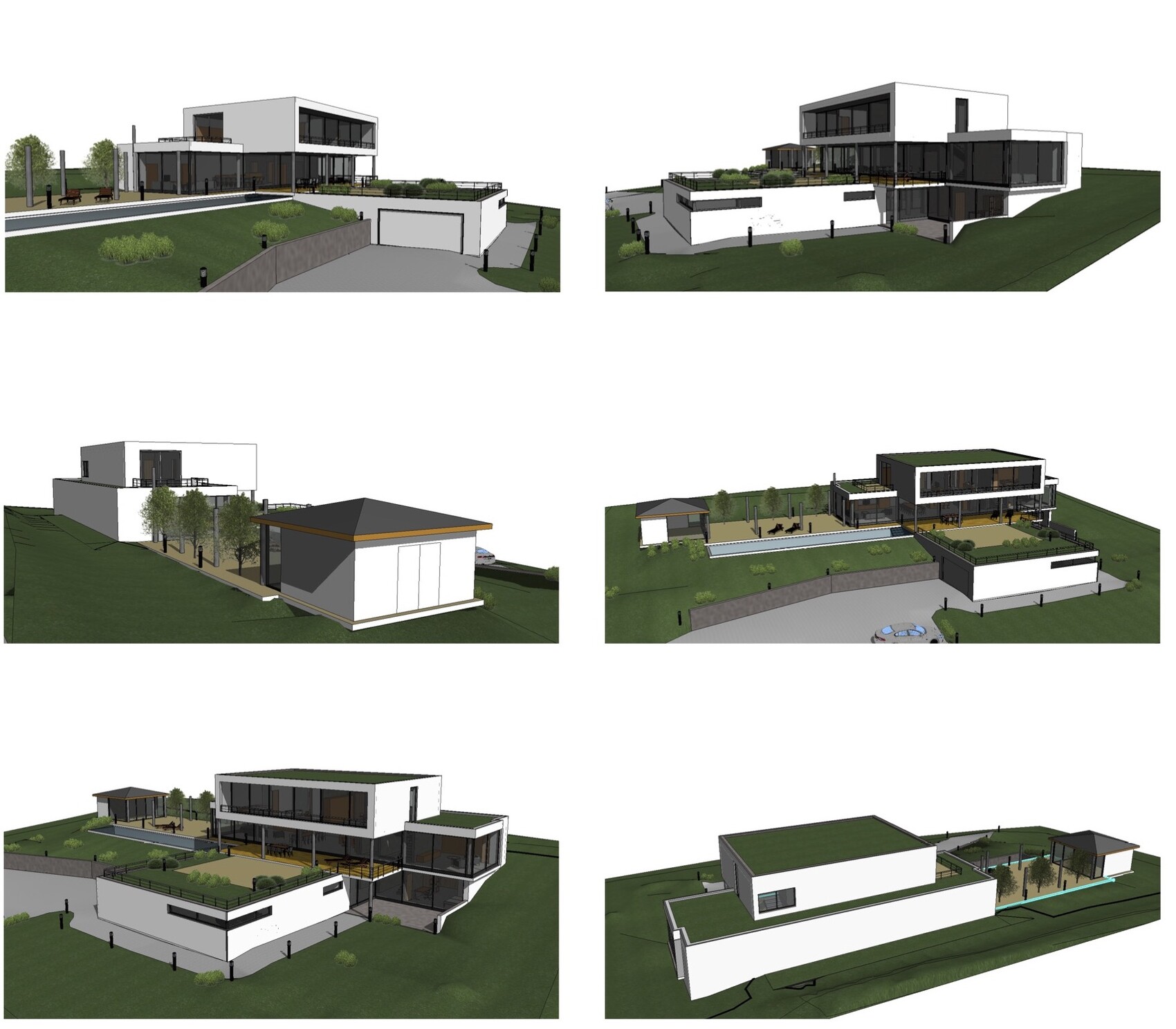
Attached is the design, though not the final version. There have been a few minor changes.
Greetings from Swabia
I just wanted to briefly introduce myself and say thank you.
For about a year and a half, I have been a silent reader here to gather inspiration and especially to gain more knowledge about construction technology.
Now a bit about me:
After more than a year of searching for a plot of land, I was able to purchase one from a developer who couldn’t move forward quickly with his plans.
So we found our dream plot (good location, 2500 m² (0.62 acres), slight slope, underground private spring that we have to preserve and are allowed to use).
There was an old house on the property, which we have since demolished.
There is no zoning plan, so §34 applies. During an initial informal inquiry at the building authority, almost everything we planned was rejected.
So we submitted an official preliminary building inquiry, involved the right people, and had lengthy discussions. In the end, we received a positive decision.
Therefore, there is nothing standing in the way of the building permit. The building permit should be granted within the next few weeks as there are no changes from the preliminary inquiry.
My wife (37) and I (36) want to build a Bauhaus-style villa in southern Baden-Württemberg.
It will be constructed from concrete (with core insulation) or in combination with insulated precast elements.
A lot of glass (full-glass system), textile shading, KNX, fast network both wired and wireless, strong mechanical ventilation with additional cooling coils, stainless steel pool, large cistern, and more.
The electrical planning must be 100% spot on since it’s almost impossible to make changes afterward.
Since I am friends with an architect from a larger firm, it was clear which route we would take. Such a house can basically only be realized with an architect.
I also personally know the electrician and KNX system integrator, as well as the owners and work approach of the heating, plumbing, and ventilation companies involved.
Some trades have already been contracted, and part of the equipment has already been ordered.
I’m really looking forward to getting started and to the final result. The goal is to move in by the end of 2019.
Once again, many thanks for the information I have received from you so far.
If you have any questions, just let me know.
Attached is the design, though not the final version. There have been a few minor changes.
Greetings from Swabia

rick2018 schrieb:
There is a 70% rule or active power reduction for photovoltaic systems.Yes, but: what is the purpose of that? I am satisfied with a four-cylinder engine, so I drive a four-cylinder. Why would I buy a six-cylinder from a car dealer and then ask them to deactivate two cylinders? — I don’t understand this point: designing a system from the start to be 40% oversized for the demand and then cutting off the excess; wouldn’t it be better to simply leave out the excess in the first place?
https://www.instagram.com/11antgmxde/
https://www.linkedin.com/company/bauen-jetzt/
11ant schrieb:
Yes, but: what is it actually good for?
A four-cylinder engine is enough for me, so I drive a four-cylinder. Why would I buy a six-cylinder from a car dealer and then tell them to shut off two cylinders? I don’t understand this point: designing a system from the start to be 40% over capacity and then cutting back the surplus—wouldn’t it be better to just leave out the surplus in the first place? That’s a misconception. The more photovoltaic capacity is installed overall, the more electricity is available even during times when the sun isn’t shining at full strength and the output is lower. That’s exactly what you want.
At peak sunlight, ideally across the entire country, the grid could face problems if all photovoltaic systems operate at maximum power simultaneously. That’s why the maximum production is limited here.

11ant schrieb:
Yes, but: what is it actually good for? It is the lesser evil. Officially, it is about grid stability and avoiding high peaks, but in my opinion, it is simply the result of lobbying.
Since 2012, the Renewable Energy Act requires that small systems under 30 kWp (kilowatt peak) must also be grid-friendly controllable. The typically used ripple control receiver (RCR) and the additional effort required in the home installation, however, significantly reduce the economic viability of such small systems. Therefore, there is an alternative to limit feed-in to a fixed 70% of the generator’s capacity at the inverter ("70% hard," as known in photovoltaic jargon).
That means 30% of the generator capacity is simply discarded.
Alternatively, there is the possibility of implementing "70% soft." In this case, an additional measurement of the household’s current consumption is taken, so the photovoltaic system can feed in the fixed 70% of generator capacity plus the household’s current consumption. This way, less production is wasted.
research86 correctly pointed out that with an east/west system, the 70% soft regulation is usually not needed because this type of system does not produce high peak power anyway.
A south-facing system has a strong midday peak, whereas an east/west system shows a flatter power curve throughout the day—flatten the curve.
If you install a 10 kWp system facing south, you can roughly expect up to 10 kW from the roof at midday. With "70% hard," only 7 kW can be fed into the grid. For an east/west system of the same size, 5 kWp faces east and 5 kWp west, so you never reach the allowed 7 kW feed-in power.
Tego12 schrieb:
Under maximum sunlight conditions, ideally nationwide across Germany, the grids could face problems if all photovoltaic systems operate at full capacity, which is why maximum production is limited here. I have not yet experienced a record-breaking summer where electricity consumption for air conditioning, fans, etc., did not also rise alongside temperatures.
guckuck2 schrieb:
Officially, it is about grid stability and avoiding high peaks; in my opinion, it is simply the result of lobbying. That seems more plausible to me. It is unclear why the grids should handle the phenomenon of the "roast duck peak" on the supply side any worse than on the demand side. After all, solar radiation does not suddenly increase, and temperatures rise in a predictable manner with several hours’ notice.
https://www.instagram.com/11antgmxde/
https://www.linkedin.com/company/bauen-jetzt/
Similar topics