
ᐅ Modernist Concrete Villa with Cavity Wall Insulation – Experiences
Created on: 11 Sep 2018 07:32
R
rick2018
Hello everyone,
I just wanted to briefly introduce myself and say thank you.
For about a year and a half, I have been a silent reader here to gather inspiration and especially to gain more knowledge about construction technology.
Now a bit about me:
After more than a year of searching for a plot of land, I was able to purchase one from a developer who couldn’t move forward quickly with his plans.
So we found our dream plot (good location, 2500 m² (0.62 acres), slight slope, underground private spring that we have to preserve and are allowed to use).
There was an old house on the property, which we have since demolished.
There is no zoning plan, so §34 applies. During an initial informal inquiry at the building authority, almost everything we planned was rejected.
So we submitted an official preliminary building inquiry, involved the right people, and had lengthy discussions. In the end, we received a positive decision.
Therefore, there is nothing standing in the way of the building permit. The building permit should be granted within the next few weeks as there are no changes from the preliminary inquiry.
My wife (37) and I (36) want to build a Bauhaus-style villa in southern Baden-Württemberg.
It will be constructed from concrete (with core insulation) or in combination with insulated precast elements.
A lot of glass (full-glass system), textile shading, KNX, fast network both wired and wireless, strong mechanical ventilation with additional cooling coils, stainless steel pool, large cistern, and more.
The electrical planning must be 100% spot on since it’s almost impossible to make changes afterward.
Since I am friends with an architect from a larger firm, it was clear which route we would take. Such a house can basically only be realized with an architect.
I also personally know the electrician and KNX system integrator, as well as the owners and work approach of the heating, plumbing, and ventilation companies involved.
Some trades have already been contracted, and part of the equipment has already been ordered.
I’m really looking forward to getting started and to the final result. The goal is to move in by the end of 2019.
Once again, many thanks for the information I have received from you so far.
If you have any questions, just let me know.
Attached is the design, though not the final version. There have been a few minor changes.
Greetings from Swabia
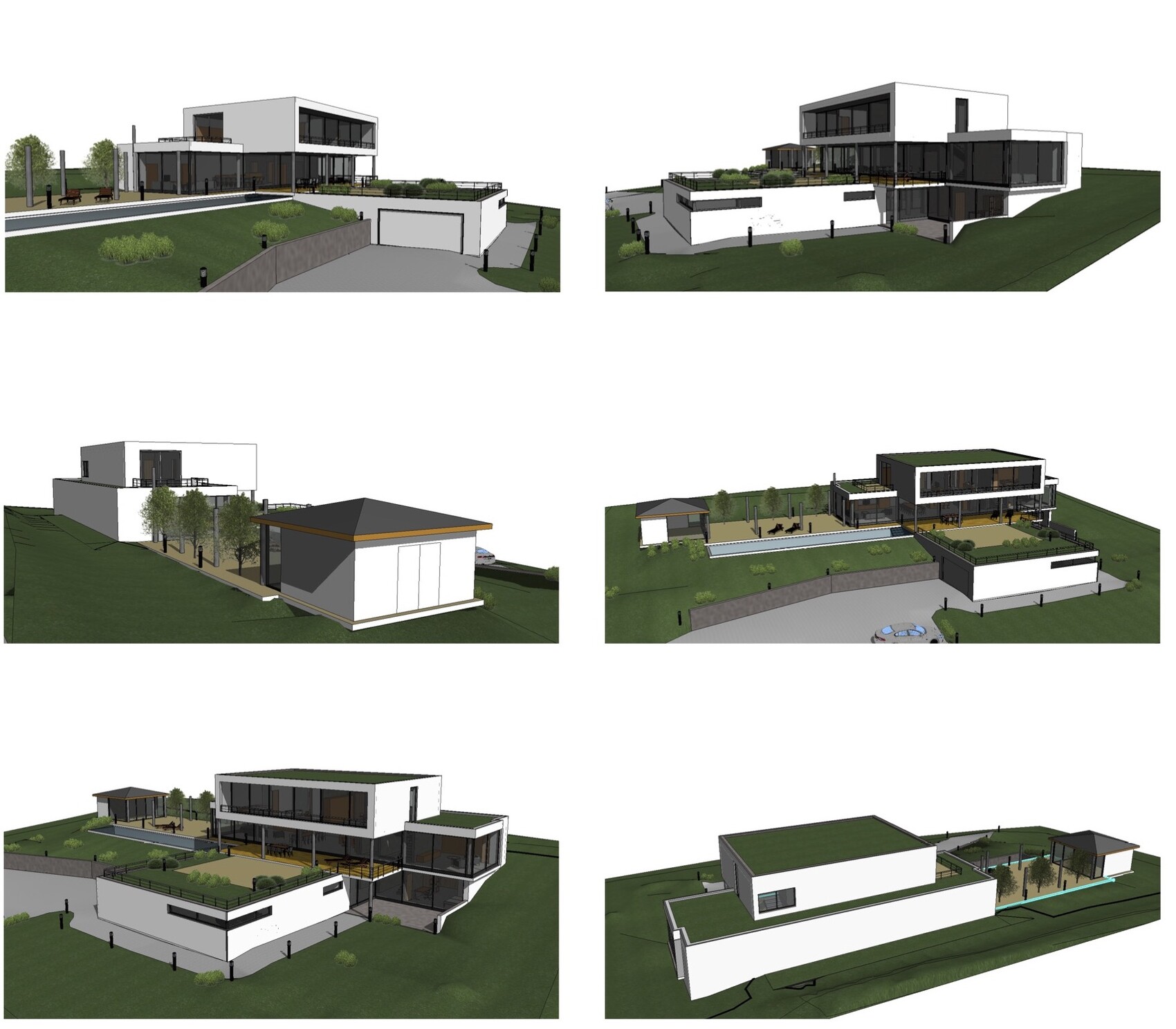
I just wanted to briefly introduce myself and say thank you.
For about a year and a half, I have been a silent reader here to gather inspiration and especially to gain more knowledge about construction technology.
Now a bit about me:
After more than a year of searching for a plot of land, I was able to purchase one from a developer who couldn’t move forward quickly with his plans.
So we found our dream plot (good location, 2500 m² (0.62 acres), slight slope, underground private spring that we have to preserve and are allowed to use).
There was an old house on the property, which we have since demolished.
There is no zoning plan, so §34 applies. During an initial informal inquiry at the building authority, almost everything we planned was rejected.
So we submitted an official preliminary building inquiry, involved the right people, and had lengthy discussions. In the end, we received a positive decision.
Therefore, there is nothing standing in the way of the building permit. The building permit should be granted within the next few weeks as there are no changes from the preliminary inquiry.
My wife (37) and I (36) want to build a Bauhaus-style villa in southern Baden-Württemberg.
It will be constructed from concrete (with core insulation) or in combination with insulated precast elements.
A lot of glass (full-glass system), textile shading, KNX, fast network both wired and wireless, strong mechanical ventilation with additional cooling coils, stainless steel pool, large cistern, and more.
The electrical planning must be 100% spot on since it’s almost impossible to make changes afterward.
Since I am friends with an architect from a larger firm, it was clear which route we would take. Such a house can basically only be realized with an architect.
I also personally know the electrician and KNX system integrator, as well as the owners and work approach of the heating, plumbing, and ventilation companies involved.
Some trades have already been contracted, and part of the equipment has already been ordered.
I’m really looking forward to getting started and to the final result. The goal is to move in by the end of 2019.
Once again, many thanks for the information I have received from you so far.
If you have any questions, just let me know.
Attached is the design, though not the final version. There have been a few minor changes.
Greetings from Swabia
R
research868 Apr 2020 11:59An east/west system is definitely the right choice if no battery storage is available or planned in the near future. This setup allows you to use self-generated electricity directly from early morning until evening. On the other hand, if you have a (quite large for typical households) battery storage system like @rick2018, it is especially beneficial in the winter months to orient the system toward the south to ideally fully charge the battery by the afternoon. With a ratio of photovoltaic system to storage of 1 to 1, achieving a full charge in November to January is difficult with an east/west system (except perhaps in Freiburg). However, a photovoltaic system is always better than none, and it’s fun too.
M
Matthew038 Apr 2020 13:02rick2018 schrieb:
With higher-performance modules, we could have installed a bit more. We have 310-watt modules. Could you (or another reader) provide some information on this? We are currently planning our system and have been offered 310-watt and 315-watt modules by two different suppliers. However, no one has clearly and understandably explained why choosing 310 or 315 watts would be such a critical mistake. Is it like with Tim Taylor, the home improvement expert, where the idea is simply to get as much power as possible whenever possible?

@11ant
For photovoltaic systems, there is a 70% rule or active power reduction.
This can be implemented in two ways.
Usually, the inverter is already sized smaller than the theoretical power of the modules and the limitation is set in the inverter.
The power reduction of the system relates to the feed-in.
A hard 70% means that this is configured directly in the inverter. Simply put, for example, you have a 10 kWp system. If you do not consume any electricity yourself and the system produces 10 kW (which it never really does), your inverter limits the output to 70%. So only 7 kW is fed into the grid. If you consume 7 kW yourself, no power is fed into the grid. The feed-in is always limited to 70%, regardless of the distribution.
A soft or dynamic 70% means that your self-consumption is taken into account. This is possible with an additional meter and a corresponding inverter.
If you do not consume any electricity yourself and the system produces 10 kW (which it never really does), your inverter limits the output, so only 7 kW is fed into the grid. If you consume 7 kW yourself, there is still 3 kW fed into the grid. In other words, you can use the full system output as soon as your self-consumption is greater than 30% of the total output.
This option is somewhat more complex in terms of investment and installation.
For photovoltaic systems, there is a 70% rule or active power reduction.
This can be implemented in two ways.
Usually, the inverter is already sized smaller than the theoretical power of the modules and the limitation is set in the inverter.
The power reduction of the system relates to the feed-in.
A hard 70% means that this is configured directly in the inverter. Simply put, for example, you have a 10 kWp system. If you do not consume any electricity yourself and the system produces 10 kW (which it never really does), your inverter limits the output to 70%. So only 7 kW is fed into the grid. If you consume 7 kW yourself, no power is fed into the grid. The feed-in is always limited to 70%, regardless of the distribution.
A soft or dynamic 70% means that your self-consumption is taken into account. This is possible with an additional meter and a corresponding inverter.
If you do not consume any electricity yourself and the system produces 10 kW (which it never really does), your inverter limits the output, so only 7 kW is fed into the grid. If you consume 7 kW yourself, there is still 3 kW fed into the grid. In other words, you can use the full system output as soon as your self-consumption is greater than 30% of the total output.
This option is somewhat more complex in terms of investment and installation.
@Matthew03 Even with 310-watt panels, there are naturally differences. So no general statement can be made.
If you have limited space, higher-power modules make sense. For us, it didn’t matter. We still reached just under 10 kWp (10 kW peak capacity).
Higher-power modules usually use newer technology, for example, they deliver more output even under high temperatures (direct summer sun) and don’t drop performance as much. The technology is somewhat different as well.
We have Luxor ECO LINE FULL BLACK LX-310.
Originally, we wanted the AC-310M, but these were not available. Since the COVID situation had already started in Asia, we switched to the modules that were available.
Luxor offers a German warranty because there is a German company behind it.
Of course, you can push the technological limits and use 370-watt panels with the latest technology. This panel costs twice as much as our 310-watt module.
In the end, it depends on your available space, how much you want to invest, whether you want to design the system for maximum return, and so on.
We just wanted a good and sensible system. Economically, we certainly did not get the maximum possible return.
@research86 We are at a similar latitude as Freiburg. It could probably work.
If you have limited space, higher-power modules make sense. For us, it didn’t matter. We still reached just under 10 kWp (10 kW peak capacity).
Higher-power modules usually use newer technology, for example, they deliver more output even under high temperatures (direct summer sun) and don’t drop performance as much. The technology is somewhat different as well.
We have Luxor ECO LINE FULL BLACK LX-310.
Originally, we wanted the AC-310M, but these were not available. Since the COVID situation had already started in Asia, we switched to the modules that were available.
Luxor offers a German warranty because there is a German company behind it.
Of course, you can push the technological limits and use 370-watt panels with the latest technology. This panel costs twice as much as our 310-watt module.
In the end, it depends on your available space, how much you want to invest, whether you want to design the system for maximum return, and so on.
We just wanted a good and sensible system. Economically, we certainly did not get the maximum possible return.
@research86 We are at a similar latitude as Freiburg. It could probably work.
M
Matthew038 Apr 2020 14:04Alright, thanks for the input.
In the east-west direction, we should actually get around 9 kWp, so I didn't quite understand the criticism, especially since it wasn't explained why... and for us, the initial costs definitely play a role, unfortunately.
In the east-west direction, we should actually get around 9 kWp, so I didn't quite understand the criticism, especially since it wasn't explained why... and for us, the initial costs definitely play a role, unfortunately.
Costs are also an important factor for us, even if it might not always seem that way from the outside. Otherwise, I would probably have chosen "better" modules or done some things differently in other areas.
Everyone has to stretch their budget. Ours might be a bit higher, but the price fluctuations for this project are also greater. For example, if the flooring costs €50 more per m² (per 10.8 sq ft), it might add up to around €6,000 (about 6,456 USD) for a "normal" house with 100 m² (1,076 sq ft), but for us, assuming 500 m² (5,380 sq ft), it would be roughly €30,000 (about 32,280 USD)...
Everyone has to stretch their budget. Ours might be a bit higher, but the price fluctuations for this project are also greater. For example, if the flooring costs €50 more per m² (per 10.8 sq ft), it might add up to around €6,000 (about 6,456 USD) for a "normal" house with 100 m² (1,076 sq ft), but for us, assuming 500 m² (5,380 sq ft), it would be roughly €30,000 (about 32,280 USD)...
Similar topics