
ᐅ Modernist Concrete Villa with Cavity Wall Insulation – Experiences
Created on: 11 Sep 2018 07:32
R
rick2018
Hello everyone,
I just wanted to briefly introduce myself and say thank you.
For about a year and a half, I have been a silent reader here to gather inspiration and especially to gain more knowledge about construction technology.
Now a bit about me:
After more than a year of searching for a plot of land, I was able to purchase one from a developer who couldn’t move forward quickly with his plans.
So we found our dream plot (good location, 2500 m² (0.62 acres), slight slope, underground private spring that we have to preserve and are allowed to use).
There was an old house on the property, which we have since demolished.
There is no zoning plan, so §34 applies. During an initial informal inquiry at the building authority, almost everything we planned was rejected.
So we submitted an official preliminary building inquiry, involved the right people, and had lengthy discussions. In the end, we received a positive decision.
Therefore, there is nothing standing in the way of the building permit. The building permit should be granted within the next few weeks as there are no changes from the preliminary inquiry.
My wife (37) and I (36) want to build a Bauhaus-style villa in southern Baden-Württemberg.
It will be constructed from concrete (with core insulation) or in combination with insulated precast elements.
A lot of glass (full-glass system), textile shading, KNX, fast network both wired and wireless, strong mechanical ventilation with additional cooling coils, stainless steel pool, large cistern, and more.
The electrical planning must be 100% spot on since it’s almost impossible to make changes afterward.
Since I am friends with an architect from a larger firm, it was clear which route we would take. Such a house can basically only be realized with an architect.
I also personally know the electrician and KNX system integrator, as well as the owners and work approach of the heating, plumbing, and ventilation companies involved.
Some trades have already been contracted, and part of the equipment has already been ordered.
I’m really looking forward to getting started and to the final result. The goal is to move in by the end of 2019.
Once again, many thanks for the information I have received from you so far.
If you have any questions, just let me know.
Attached is the design, though not the final version. There have been a few minor changes.
Greetings from Swabia
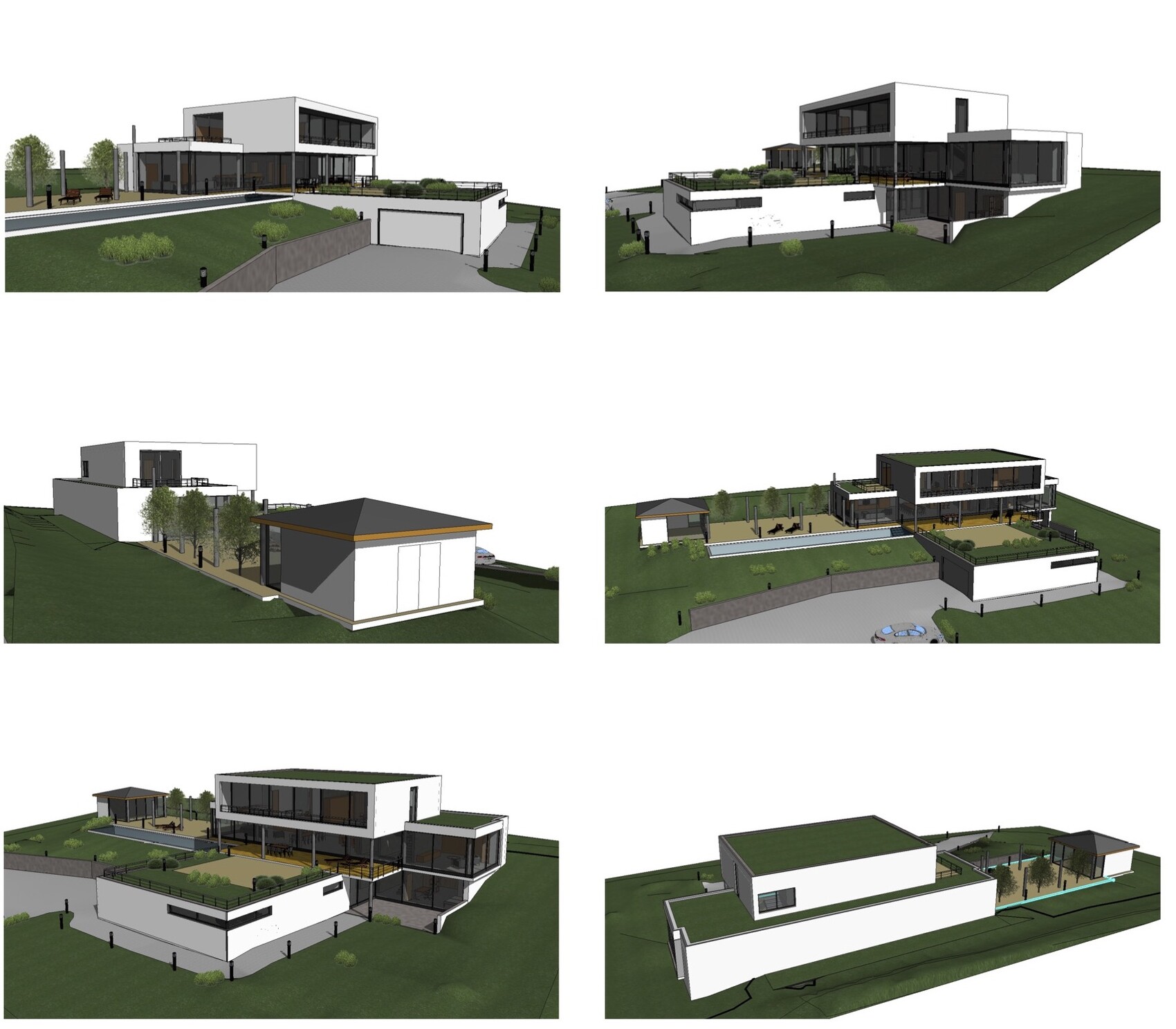
I just wanted to briefly introduce myself and say thank you.
For about a year and a half, I have been a silent reader here to gather inspiration and especially to gain more knowledge about construction technology.
Now a bit about me:
After more than a year of searching for a plot of land, I was able to purchase one from a developer who couldn’t move forward quickly with his plans.
So we found our dream plot (good location, 2500 m² (0.62 acres), slight slope, underground private spring that we have to preserve and are allowed to use).
There was an old house on the property, which we have since demolished.
There is no zoning plan, so §34 applies. During an initial informal inquiry at the building authority, almost everything we planned was rejected.
So we submitted an official preliminary building inquiry, involved the right people, and had lengthy discussions. In the end, we received a positive decision.
Therefore, there is nothing standing in the way of the building permit. The building permit should be granted within the next few weeks as there are no changes from the preliminary inquiry.
My wife (37) and I (36) want to build a Bauhaus-style villa in southern Baden-Württemberg.
It will be constructed from concrete (with core insulation) or in combination with insulated precast elements.
A lot of glass (full-glass system), textile shading, KNX, fast network both wired and wireless, strong mechanical ventilation with additional cooling coils, stainless steel pool, large cistern, and more.
The electrical planning must be 100% spot on since it’s almost impossible to make changes afterward.
Since I am friends with an architect from a larger firm, it was clear which route we would take. Such a house can basically only be realized with an architect.
I also personally know the electrician and KNX system integrator, as well as the owners and work approach of the heating, plumbing, and ventilation companies involved.
Some trades have already been contracted, and part of the equipment has already been ordered.
I’m really looking forward to getting started and to the final result. The goal is to move in by the end of 2019.
Once again, many thanks for the information I have received from you so far.
If you have any questions, just let me know.
Attached is the design, though not the final version. There have been a few minor changes.
Greetings from Swabia
I think I’m repeating myself
even though the house is not really my style, nor does the environmental concept appeal to me (crazy space and resource consumption for 2 people) – I find watching the construction process fascinating, and I really appreciate that we get such detailed insights into a project like this. Thank you
even though the house is not really my style, nor does the environmental concept appeal to me (crazy space and resource consumption for 2 people) – I find watching the construction process fascinating, and I really appreciate that we get such detailed insights into a project like this. Thank you

Looking at the photo, there seems to be space for another row facing south. The parapet is also very low, so maybe another row could fit next to it. Alternatively, the panels could be mounted flat and upright facing south. Depending on the visual preference, the parapet might need to be raised so that the modules are not visible from below (personally, I don’t like it when you can see what’s on the flat roof from underneath).

tumaa schrieb:
Rule 1 = if you want to be a good tradesperson, always leave your workspace clean. Recommendations attract better clients than advertising. Therefore, a tradesperson should use the psychology of subtle language and deliberately link the idea of “clean work” with “clean work”. Someone who shows up in an oil-stained work suit wearing old clothes and drives a van that looks like it’s headed for the scrap yard will mostly get jobs from stingy clients.
research86 schrieb:
70% hard What does that mean? Could you please explain it in very simple terms? I am a technical sales professional with no specific knowledge of the Renewable Energy Act.
https://www.instagram.com/11antgmxde/
https://www.linkedin.com/company/bauen-jetzt/
H
hampshire8 Apr 2020 11:36I also noticed the clean construction site very positively. We observed the same with our tradespeople. After all, it is also a trust-building measure because those who leave a clean site give the impression of working carefully. And what can I say: The "messiest" workers on our site also delivered the poorest quality work.
@research86: Regarding the photovoltaic system – if you consider the photovoltaic system purely as a financial product, you probably could have gotten more out of it. However, with the goal of optimizing self-consumption, the east-west orientation is by no means bad advice but rather a different choice. To me, it looks like it was "done right."
@Müllerin: In everything we do, we can find a downside, and I find the way you address the high resource consumption per person refreshingly sympathetic and unideological. I think it’s great that in these projects, people receive fair pay for good work on a project they can identify with, rather than awarding contracts based on "who does it cheaper." We still need to live from what we earn in our society, and projects and clients like these are urgently needed.
@research86: Regarding the photovoltaic system – if you consider the photovoltaic system purely as a financial product, you probably could have gotten more out of it. However, with the goal of optimizing self-consumption, the east-west orientation is by no means bad advice but rather a different choice. To me, it looks like it was "done right."
@Müllerin: In everything we do, we can find a downside, and I find the way you address the high resource consumption per person refreshingly sympathetic and unideological. I think it’s great that in these projects, people receive fair pay for good work on a project they can identify with, rather than awarding contracts based on "who does it cheaper." We still need to live from what we earn in our society, and projects and clients like these are urgently needed.

Our energy consultant also advised us that an east/west orientation is more optimal for private use (our house faces southeast and northwest due to its location). This makes sense to me: in the morning, a working person mainly needs electricity, so it’s good if the first morning rays already provide some power. In the evening, they’re back and use the late afternoon sun.
As I said, if we don’t use the sauna, it works very well for us. Since one side faces southeast, it gets a lot of sun for a long time, and almost without interruption (yes, the angle of incidence naturally gets worse), it continues on the west side.
We really don’t care much about what we feed back into the grid. We’ll see how it goes—since the compensation isn’t very high anyway, it’s more of a nice bonus for us.
As I said, if we don’t use the sauna, it works very well for us. Since one side faces southeast, it gets a lot of sun for a long time, and almost without interruption (yes, the angle of incidence naturally gets worse), it continues on the west side.
We really don’t care much about what we feed back into the grid. We’ll see how it goes—since the compensation isn’t very high anyway, it’s more of a nice bonus for us.
Similar topics