
Hello everyone!
Who would like to help me with the bathroom design?
Our bathroom measures 3.50 m x 2.86 m (11 ft 6 in x 9 ft 5 in). If you draw it in portrait orientation, the walls are as follows:
- On the left is a 350-cm (11 ft 6 in) wall with a continuous strip window across the entire width of the room (sill height 132 cm (52 inches)).
- On the right is a 350-cm (11 ft 6 in) wall where the door must be placed, though it can still be moved.
- The top and bottom walls each measure 286 cm (9 ft 5 in).
The floor-to-ceiling tiled shower has to be positioned on the upper wall of the room because of the drain location, but naturally not in front of the window.
Otherwise, the following fixtures should be placed:
- Double sink (130 cm x 48 cm) (51 in x 19 in)
- Standard-size bathtub (175 cm x 75 cm) (69 in x 30 in)
- Toilet
At first, we thought of a T-layout:
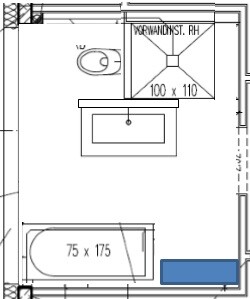
However, 2.86 m (9 ft 5 in) room width seems too narrow for a T-layout. The passage to the shower is too tight, and without a door on the shower, water splashes out—which is usually the advantage of a T-layout, allowing you to avoid having a shower door.
So, we modified the plan to an L-layout:
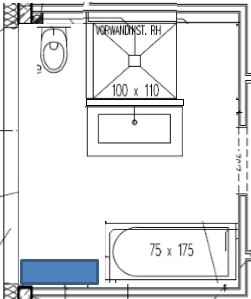
But we didn’t find that very convincing either. Currently, we are considering the following solution:
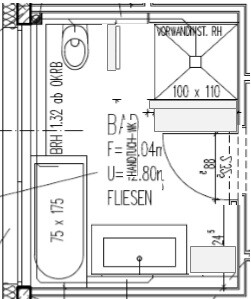
The toilet and bathtub could also be swapped, which would place the shower/bath area in the upper half of the room and the toilet/sink area in the lower half.
Do you have any other ideas or suggestions?
Best regards
jx7
Who would like to help me with the bathroom design?
Our bathroom measures 3.50 m x 2.86 m (11 ft 6 in x 9 ft 5 in). If you draw it in portrait orientation, the walls are as follows:
- On the left is a 350-cm (11 ft 6 in) wall with a continuous strip window across the entire width of the room (sill height 132 cm (52 inches)).
- On the right is a 350-cm (11 ft 6 in) wall where the door must be placed, though it can still be moved.
- The top and bottom walls each measure 286 cm (9 ft 5 in).
The floor-to-ceiling tiled shower has to be positioned on the upper wall of the room because of the drain location, but naturally not in front of the window.
Otherwise, the following fixtures should be placed:
- Double sink (130 cm x 48 cm) (51 in x 19 in)
- Standard-size bathtub (175 cm x 75 cm) (69 in x 30 in)
- Toilet
At first, we thought of a T-layout:
However, 2.86 m (9 ft 5 in) room width seems too narrow for a T-layout. The passage to the shower is too tight, and without a door on the shower, water splashes out—which is usually the advantage of a T-layout, allowing you to avoid having a shower door.
So, we modified the plan to an L-layout:
But we didn’t find that very convincing either. Currently, we are considering the following solution:
The toilet and bathtub could also be swapped, which would place the shower/bath area in the upper half of the room and the toilet/sink area in the lower half.
Do you have any other ideas or suggestions?
Best regards
jx7
I think the last option is quite good, but you will probably need a door in front of the shower for splash protection. My bathroom renovator told me that a walk-in shower without a door is best if it is about 150 cm deep (60 inches). At least, that’s how I planned it for my own bathroom, although I gave up the originally planned bathtub to do so.
Thank you, Frank, for your response. A wall width of 286 cm (113 inches) at the top wall could be divided into 75 cm (30 inches) for the bathtub, 80 cm (31 inches) for the passage, and 131 cm (52 inches) for the shower area, which is slightly less than 150 cm (59 inches). It might be necessary to install a door or a shower curtain.
I’ve also given it some thought: since I have a walk-in shower myself, but 2 meters (6.6 feet) deep, I remember that after about 1.50 meters (5 feet), there are no significant splashes anymore. If the toilet is placed there, it creates more space in between. For bathing, I also find it more pleasant not to look directly at a wall corner.
B
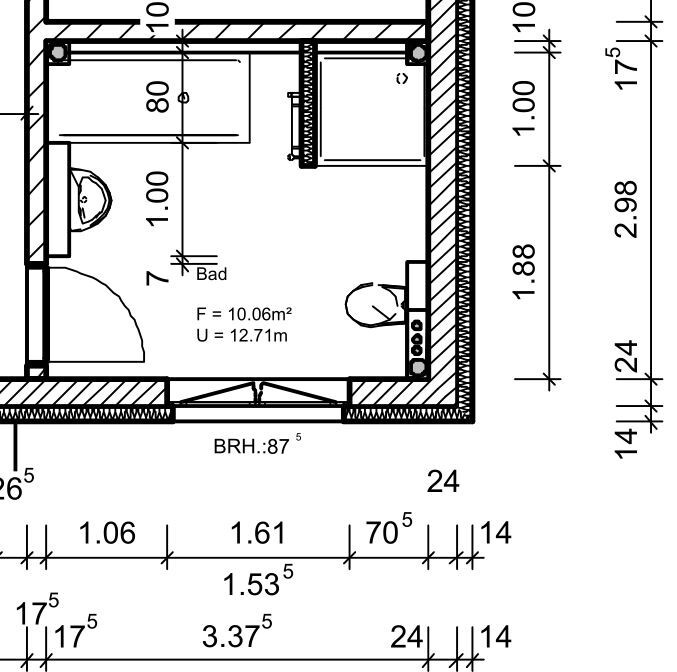
Bieber08158 Oct 2015 21:07The toilet will likely require ventilation through the roof, so I expect a boxed enclosure in that corner. This will reduce the clear passage between the toilet and shower. If the shower controls are to be installed on the short wall, an additional partition wall might be needed.
Pro tip (from personal experience): It’s best to plan with partition walls everywhere. If they’re not needed later, all the better. Otherwise, this helps avoid surprises. How will the bathtub be drained? Can the faucet be installed inside the wall? The same applies to the washbasin...
Pro tip (from personal experience): It’s best to plan with partition walls everywhere. If they’re not needed later, all the better. Otherwise, this helps avoid surprises. How will the bathtub be drained? Can the faucet be installed inside the wall? The same applies to the washbasin...
Similar topics