
ᐅ Bathroom in an older building: Is a second radiator necessary? And if so, should it be electric?
Created on: 2 Sep 2025 08:01
J
jverbeekHello everyone!
After reading this forum for a long time, I finally created an account to ask a question!
We are currently renovating an old building from 1959. We combined the previously separate toilet and bathroom but mostly kept the wall between them, only making an opening between the bathroom and toilet. These rooms are located along an uninsulated 29cm (11.4 inch) exterior wall and have a total area of about 7.5m² (81 square feet). Here is the floor plan:
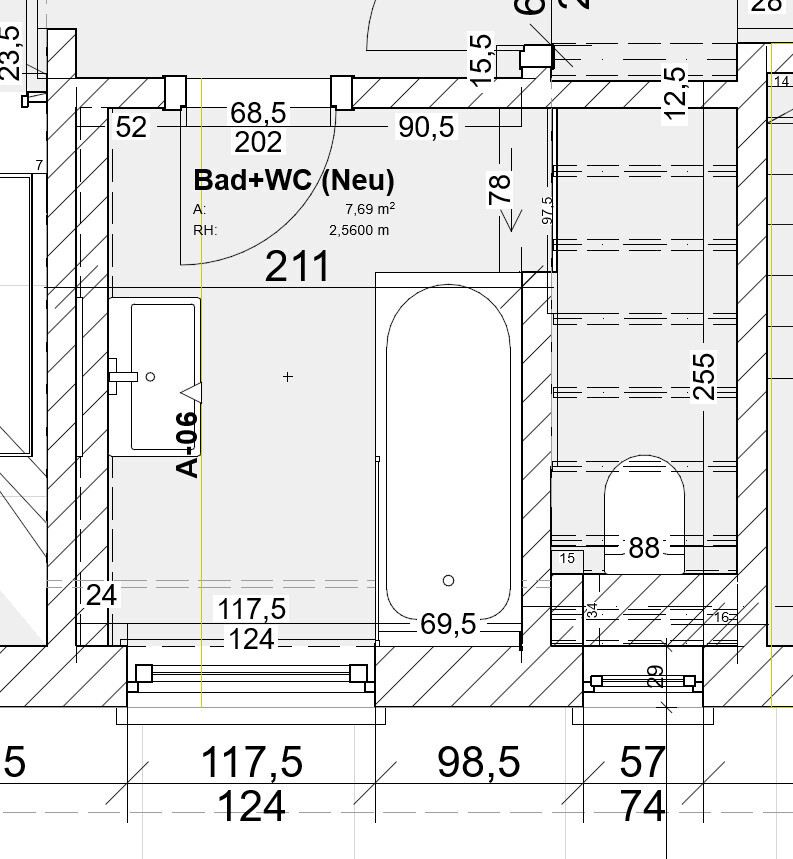
Originally, there was a panel radiator under the window. We plan to install one again—a Type 22 radiator, either 100x60cm (39x24 inches) or possibly 120x60cm (47x24 inches). However, we are unsure if this single radiator will adequately heat the newly connected toilet area. The wall (14cm (5.5 inch) sand-lime brick) between the bathroom and toilet runs up to the ceiling, with only the width of a door opening—but no door installed—allowing passage. The warm air would have to flow “around the corner” to the toilet, which seems unlikely to me. Therefore, we are considering adding a second radiator to ensure that the toilet is always comfortably warm.
I was thinking of a towel radiator on the right side of the door leading into the whole room (opposite the bathtub). Would that be sensible?
Also, would an electric towel radiator be an option? Unfortunately, we slightly overlooked this during planning, and the screed is already finished there—I would rather not break it up again. But if necessary, we will.
I’m looking forward to your opinions!
Best regards,
Johnny
After reading this forum for a long time, I finally created an account to ask a question!
We are currently renovating an old building from 1959. We combined the previously separate toilet and bathroom but mostly kept the wall between them, only making an opening between the bathroom and toilet. These rooms are located along an uninsulated 29cm (11.4 inch) exterior wall and have a total area of about 7.5m² (81 square feet). Here is the floor plan:
Originally, there was a panel radiator under the window. We plan to install one again—a Type 22 radiator, either 100x60cm (39x24 inches) or possibly 120x60cm (47x24 inches). However, we are unsure if this single radiator will adequately heat the newly connected toilet area. The wall (14cm (5.5 inch) sand-lime brick) between the bathroom and toilet runs up to the ceiling, with only the width of a door opening—but no door installed—allowing passage. The warm air would have to flow “around the corner” to the toilet, which seems unlikely to me. Therefore, we are considering adding a second radiator to ensure that the toilet is always comfortably warm.
I was thinking of a towel radiator on the right side of the door leading into the whole room (opposite the bathtub). Would that be sensible?
Also, would an electric towel radiator be an option? Unfortunately, we slightly overlooked this during planning, and the screed is already finished there—I would rather not break it up again. But if necessary, we will.
I’m looking forward to your opinions!
Best regards,
Johnny
N
nordanney2 Sep 2025 08:171. I don’t need 26 degrees Celsius (79°F) in the bathroom.
2. A 33cm (13 inches) radiator as an alternative – it has significantly higher output.
3. An electric auxiliary heater doesn’t solve the "problem" that the air needs to circulate.
4. Do you turn on the auxiliary heater 15 minutes before flushing to hope everything gets warm enough?
5. An electric auxiliary heater could also be an underfloor heating option – large surface area and feasible in the toilet area as well.
2. A 33cm (13 inches) radiator as an alternative – it has significantly higher output.
3. An electric auxiliary heater doesn’t solve the "problem" that the air needs to circulate.
4. Do you turn on the auxiliary heater 15 minutes before flushing to hope everything gets warm enough?
5. An electric auxiliary heater could also be an underfloor heating option – large surface area and feasible in the toilet area as well.
I know people who need at least 24°C (75°F) everywhere or else they get very uncomfortable; we are not among them.
We have installed electric underfloor heating in both bathrooms, which works well.
It might also be worth considering a small glass infrared panel on the ceiling, which can come combined with lighting, although I assume an additional radiator wouldn’t be necessary there.
In our previous house, for example, there was a large radiator in the kitchen. When we renovated and partially opened it up to the dining area, we completely removed that radiator and never noticed its absence.
We have installed electric underfloor heating in both bathrooms, which works well.
It might also be worth considering a small glass infrared panel on the ceiling, which can come combined with lighting, although I assume an additional radiator wouldn’t be necessary there.
In our previous house, for example, there was a large radiator in the kitchen. When we renovated and partially opened it up to the dining area, we completely removed that radiator and never noticed its absence.
W
wiltshire2 Sep 2025 10:13Infrared panels provide quick and comfortable heat. There are decorative options for the ceiling or disguised as mirrors.
M
MachsSelbst2 Sep 2025 11:42If you don't install a radiator, the toilet room will always be noticeably colder than the bathroom and will eventually develop mold.
The exterior wall is not insulated, you take a shower, the moist air spreads into both rooms and condenses on the exterior wall in the toilet because there is no heating there. Or it condenses on the interior walls because the temperature difference between the heated and unheated room is too large.
The exterior wall is not insulated, you take a shower, the moist air spreads into both rooms and condenses on the exterior wall in the toilet because there is no heating there. Or it condenses on the interior walls because the temperature difference between the heated and unheated room is too large.
How do you use the bathroom? It has already been mentioned that many people prefer it cozy and warm, especially children. Others are not as sensitive.
A towel radiator is mainly used as a towel holder and then cannot provide any warmth.
So it’s better to plan for a larger radiator from the start or consider infrared heating, as already mentioned here.
A towel radiator is mainly used as a towel holder and then cannot provide any warmth.
So it’s better to plan for a larger radiator from the start or consider infrared heating, as already mentioned here.
Similar topics