
Since I am planning to build a house, I am naturally also considering smart home solutions. As this topic is completely new to me, I first need to do some research. I would therefore like to clarify some basic questions and facts before proceeding. I will simply write down my thoughts as if they were facts and would ask you to correct me where I am wrong 🙂
I want to leave KNX or BUS systems aside for now and focus only on wireless solutions, so please do not discuss which makes more sense or is "better." One step at a time; this is purely about understanding :p
There are many different wireless protocols. Open ones like Z-Wave, ZigBee; "semi-open" like eNet; and proprietary ones like Somfy io.
Somfy has the advantage that everything comes from one source and it should be plug and play. The ideal solution for beginners—you simply put together what you need, install it, and it works right away. The big disadvantage, of course, is that you can only integrate Somfy or Somfy-approved sensors and actuators and are dependent on Somfy continuing to develop new products and supporting the current protocol.
eNet is a protocol from a few premium manufacturers, and as such, the devices are quite expensive. Although it is an open protocol, it is supported by only a few providers and products. So it has the same disadvantage as Somfy: limited selection and dependency on a small number of providers.
The open protocols, which are basically standards, have the advantage of many providers. However, this is also the biggest disadvantage because it’s easy to lose oversight, you end up assembling the whole system yourself without it all coming from one source, and there are likely to be significant differences in quality.
Is this roughly correct?
I want to leave KNX or BUS systems aside for now and focus only on wireless solutions, so please do not discuss which makes more sense or is "better." One step at a time; this is purely about understanding :p
There are many different wireless protocols. Open ones like Z-Wave, ZigBee; "semi-open" like eNet; and proprietary ones like Somfy io.
Somfy has the advantage that everything comes from one source and it should be plug and play. The ideal solution for beginners—you simply put together what you need, install it, and it works right away. The big disadvantage, of course, is that you can only integrate Somfy or Somfy-approved sensors and actuators and are dependent on Somfy continuing to develop new products and supporting the current protocol.
eNet is a protocol from a few premium manufacturers, and as such, the devices are quite expensive. Although it is an open protocol, it is supported by only a few providers and products. So it has the same disadvantage as Somfy: limited selection and dependency on a small number of providers.
The open protocols, which are basically standards, have the advantage of many providers. However, this is also the biggest disadvantage because it’s easy to lose oversight, you end up assembling the whole system yourself without it all coming from one source, and there are likely to be significant differences in quality.
Is this roughly correct?
H
hampshire10 Mar 2021 09:15From my experience with parents and parents-in-law, I have concluded that there is a certain likelihood that I myself will become a basic user (often called a DAU – “Dumbest Assumed User”) over the years. Additionally, I want the house to have the infrastructure option to grow old in it – the house is designed accordingly. Therefore, I considered two alternatives: either an extremely high-end automation system that eliminates the need for human intervention in daily life, or a very simple implementation of the basic functions—lighting, heating, and access. I chose the simple solution.
K
knalltüte10 Mar 2021 09:3311ant schrieb:
Is it even possible to downgrade the roller shutters to crank-operated windows?
I think this is an important aspect to consider during planning: not just the Wife-Acceptance Factor, but also how user-friendly it is for the least experienced users. Next to a bunch of confusing, Rubik's Cube-like switches, there should also be one that works in a simple analog input/output way. So guests don’t have to wear a visitor badge with a transponder just to turn on the light in the bathroom 🙂The WAF (Woman Acceptance Factor) is usually considered in connection with integrating technical gadgets into the living room, mainly regarding their appearance. Less often is it associated with the comfort that comes with them. For example: Is the soundbar also available in "taupe" instead of black?
But yes, I also believe the switch should simply turn the light on or off. What technology is behind it to make it work is usually irrelevant to the user. Additional comfort features don’t need to be visible. They can remain hidden behind smart apps, key combinations, or similar methods.
By the way, DAU stands for "Dümmster anzunehmender User," which means "Dumbest Assumed User" for those unfamiliar. I once felt like that when I couldn’t get any water out of the "designer" faucet in a client’s ultra-modern bathroom (cabinetmaking shop) for a long time. So much for "form follows function" 😡
H
HansDampf131111 Mar 2021 08:10Thank you very much for the many responses. The thread was not intended to be a "Wireless vs KNX" debate, but that was hardly avoidable, lol. I have looked further into the subject and have concluded that I will consider KNX and use wireless possibly as an extension or if KNX turns out to be way too expensive for what I want to do.
What I would also like to mention: during my research, I noticed that the "KNX vs wireless" discussion is often very ideological, especially among KNX users. I now believe that both systems are justified and each has its advantages depending on the wishes and plans.
What I would also like to mention: during my research, I noticed that the "KNX vs wireless" discussion is often very ideological, especially among KNX users. I now believe that both systems are justified and each has its advantages depending on the wishes and plans.
A
Alessandro11 Mar 2021 08:49As an expert in wireless technology for single-family homes, I would strongly advise against it! Zigbee, Z-Wave, EnOcean, and similar systems were all developed for buildings where a lot of glass or drywall partitions are used nowadays, and where room layouts are frequently changed.
If you still want to go for it, as I mentioned before, I would recommend installing deep recessed wall boxes.
The only combination that makes sense for a single-family home is EnOcean window contacts or window handles that then communicate with a KNX gateway. This way, you can avoid wiring altogether.
If you still want to go for it, as I mentioned before, I would recommend installing deep recessed wall boxes.
The only combination that makes sense for a single-family home is EnOcean window contacts or window handles that then communicate with a KNX gateway. This way, you can avoid wiring altogether.
H
HansDampf131111 Mar 2021 08:52Alessandro schrieb:
As an expert in wireless technology for single-family homes, I would strongly advise against it! Zigbee, Z-Wave, EnOcean, etc., were all developed for buildings where a lot of glass or drywall partition walls are used nowadays and where room layouts frequently change.
If you still want to go ahead, as I mentioned before, I would recommend installing deep recessed mounting boxes. The house will be a timber frame bungalow, so the issues often caused by reinforced concrete walls or ceilings should not be a problem. As I said, the system would only be used in emergencies. KNX RF is also an option. I have already considered the deep recessed mounting boxes, thanks 🙂
A
Alessandro11 Mar 2021 09:00As you wish.
Just for your information:
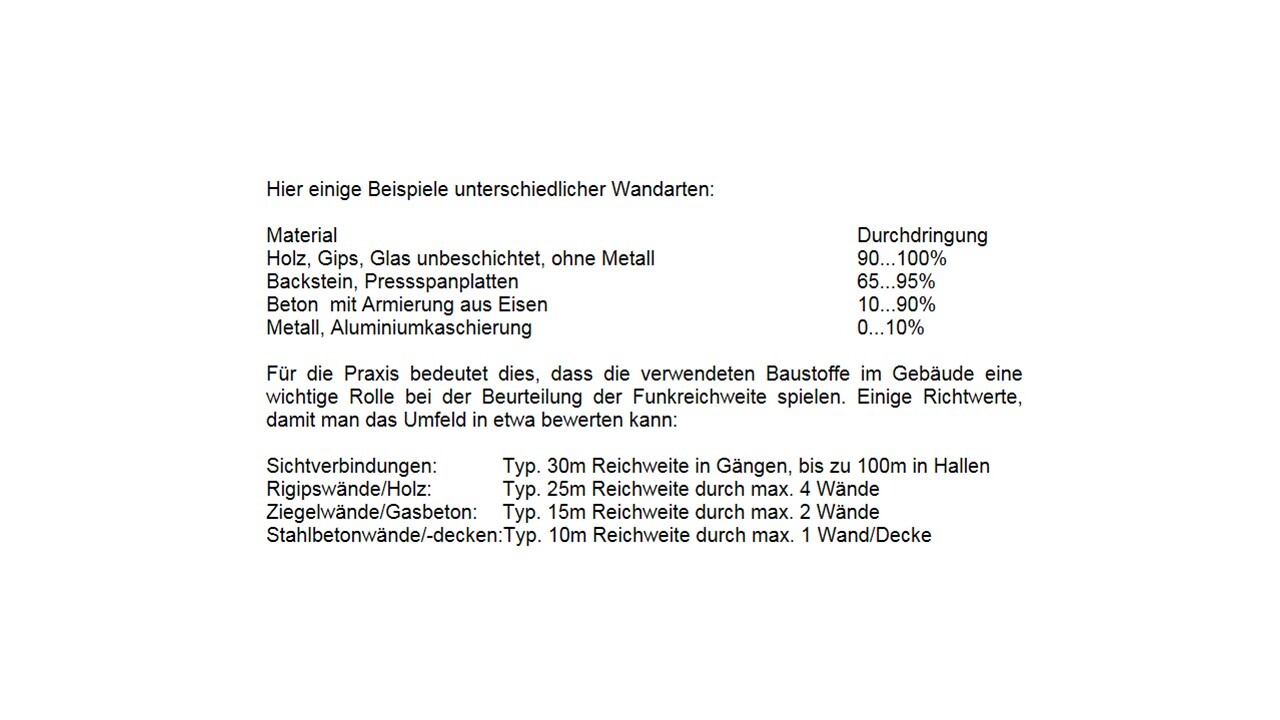
This applies 90% to EnOcean.
Just for your information:
This applies 90% to EnOcean.