
ᐅ Basic Information on Radiator Replacement in Older Buildings
Created on: 12 Jul 2023 13:57
A
Alibert87
Hello everyone,
We want to replace the radiators in the children’s rooms or rather install new ones. What exactly do I need for that?
I need some basic information.
The house was built in 1981, gas heating (condensing boiler), underfloor heating on the ground floor, radiators upstairs.
Niches were bricked up and the heating pipes were left about 50cm (20 inches) apart.
Should I buy radiators that are suitable for low-temperature heating systems?
Are DIY store radiators much worse than, for example, a Kermi x2 (is the higher price worth it)?
Thanks a lot!!
We want to replace the radiators in the children’s rooms or rather install new ones. What exactly do I need for that?
I need some basic information.
The house was built in 1981, gas heating (condensing boiler), underfloor heating on the ground floor, radiators upstairs.
Niches were bricked up and the heating pipes were left about 50cm (20 inches) apart.
Should I buy radiators that are suitable for low-temperature heating systems?
Are DIY store radiators much worse than, for example, a Kermi x2 (is the higher price worth it)?
Thanks a lot!!
Buchsbaum schrieb:
It's hard to argue against physics.Exactly. So please spare us your nonsense that has nothing to do with physics. Type 33 radiators are practical and future-proof.Is it possible to identify the type of radiator from any markings on existing units? We plan to switch to a heat pump in the coming years, and some of the radiators in the house are significantly newer than others, but we have no idea if they are already suitable for a heat pump.
K
KarstenausNRW14 Jul 2023 13:04An image like this is much easier than writing a long text ;-)
KarstenausNRW schrieb:
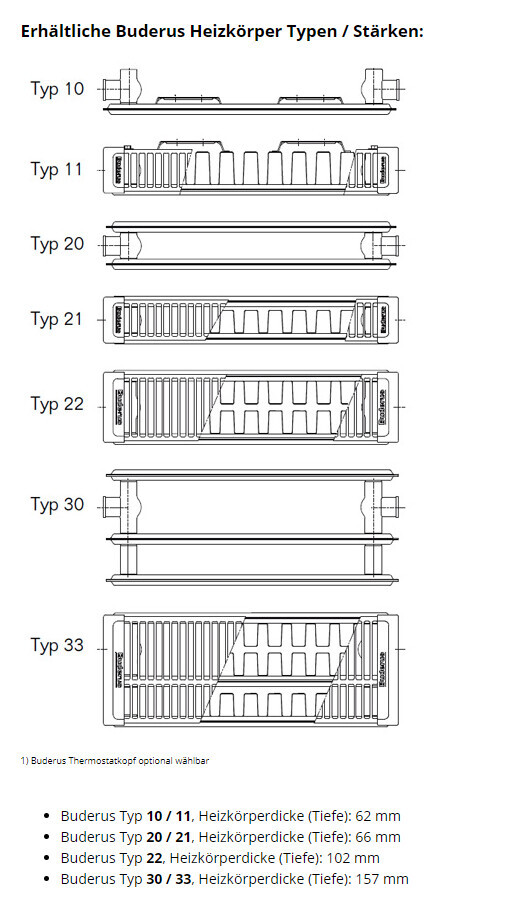
A picture like this is just as good as writing a long text ;-)Thanks! So it seems ours are probably Type 22, too badB
Buchsbaum14 Jul 2023 16:48Type 33 radiators, the thickest available on the market, have always existed and are not specifically related to heat pumps. They were already installed 40 years ago.
Alternatively, if space allows, you can install two Type 22 radiators instead of one Type 33.
It will not get warm. I wonder why, over all these years, owners of gas or oil heating systems have not lowered their supply temperature to 30°C (86°F), thereby significantly reducing their energy consumption—if that were effective.
If I have a Type 22 radiator with two heating panels measuring, for example, 1.40 x 0.60 m (4.6 x 2 feet) in a room and a supply temperature of 60°C (140°F), it is pointless to install a Type 33 radiator and reduce the supply temperature to 35°C (95°F). The room will remain cold. It’s that simple. There is no need for a heat loss calculation or anything else. Common sense is enough.
Alternatively, if space allows, you can install two Type 22 radiators instead of one Type 33.
It will not get warm. I wonder why, over all these years, owners of gas or oil heating systems have not lowered their supply temperature to 30°C (86°F), thereby significantly reducing their energy consumption—if that were effective.
If I have a Type 22 radiator with two heating panels measuring, for example, 1.40 x 0.60 m (4.6 x 2 feet) in a room and a supply temperature of 60°C (140°F), it is pointless to install a Type 33 radiator and reduce the supply temperature to 35°C (95°F). The room will remain cold. It’s that simple. There is no need for a heat loss calculation or anything else. Common sense is enough.
K
KarstenausNRW14 Jul 2023 18:06Buchsbaum schrieb:
Type 33 radiators, the thickest on the market, have always existed and have nothing to do with heat pumps. They have been installed for over 40 years.
Instead of one 33-type radiator, you can also install two 22-type radiators if there is enough space.
It won’t get warm. I wonder why, over the years, owners of gas or oil heating systems have never lowered their supply temperature to 30 degrees Celsius (86°F) and thus significantly reduced their consumption — if that actually worked.
If I have a 22-type radiator with two heating panels, for example 1.40 x 0.60 m (4.6 x 2.0 ft) in the room and a 60°C (140°F) supply temperature, it doesn’t help to replace it with a 33-type radiator and lower the supply temperature to 35°C (95°F). The place will stay cold. It’s that simple. I don’t need to calculate heat load or anything else. My common sense is enough. I’m honestly sorry for your common sense if you dismiss factual calculations by saying “my common sense knows better.” Sorry. Then my tenant’s 23°C (73°F) isn’t real either, and the electricity bill is just a figment of the imagination.
Do you also believe that people cannot survive on trains traveling over 30 km/h (18 mph) and that the Earth is flat because your “common sense” says so? Or do you believe in facts? No wonder Germany is going downhill when it has residents like this...
Oh, and switching from two 140 x 60 cm (55 x 24 inches) 22-type radiators with a 60°C (140°F) supply to two 140 x 60 cm (55 x 24 inches) 33-type radiators reduces the supply temperature by about 15 degrees Celsius (27°F) while maintaining the same heating output. THAT is science, not gut feeling. And if I can go up to 160 x 60 cm (63 x 24 inches), I reduce the supply temperature by 20 degrees Celsius (36°F) (assuming a supply-return difference of 5 degrees Celsius (9°F)). This will heat the room just as well. Two small pieces of wood produce the same heat as one large piece. Maybe you just need some understandable comparisons for it to sink in ;-)
Similar topics