
M
Marcel_MT875 Jan 2026 15:36Hello everyone,
I need some advice regarding waterproofing my basement and hope someone can help.
The current situation is as follows.
House built in 1965
Basement height is 2 meters (6.6 feet) – about 1.80 meters (5.9 feet) of which is underground.
The basement walls consist of 50-60 cm (20-24 inches) of rubble stone masonry. The previous owner (a master mason) partially plastered the interior completely with renovation plaster / lime-cement plaster (with mesh).
The basement was carved out of rock. Strip foundations were poured, and the wall was built on top. The interior floor was installed later. The base there was also rock. I am currently not sure if any waterproofing was applied at that point.
(see sketch) I am looking for a way to waterproof the lower side, the left side, and the upper side of the house from the outside since rubble stone masonry seems to be a special case when it comes to waterproofing.
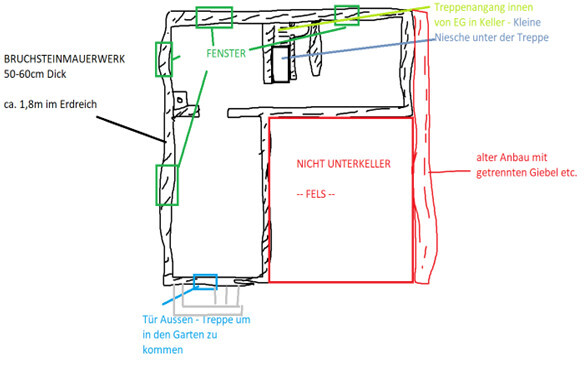
My idea is as follows:
This is what I recently heard regarding rubble stone masonry from a professional company.
They said that for these types of walls, you shouldn’t smooth the exterior and then apply the “standard” waterproofing method (roughcast to create a smooth surface, two-component thick coating, XPS insulation, and dimpled membrane). This would actually be counterproductive because rubble stone causes too much movement and the plaster would crack.
Their advice was: The motto is “do not smooth the wall, only stabilize it – the waterproofing follows the shape of the wall.” Also, the XPS is more for protection than for insulation.
(see sketch) The next challenge will surely be interesting as well. How do I keep the walls dry between the non-basement rock and the basement? When it rains for a long time outside, quite a bit of water seems to penetrate the rock (this happened only once so far – the weather was extreme those days). Back then, the previous owner foresaw this and installed floor drains so that water escaping from the rock can flow directly into the drainage. His comment was that physically he was no longer able to excavate the last part (he did all the digging and chiseling by hand).
What other alternatives do I have? Has anyone gained experience with rubble stone masonry?
Best regards,
Marcel_MT87
I need some advice regarding waterproofing my basement and hope someone can help.
The current situation is as follows.
House built in 1965
Basement height is 2 meters (6.6 feet) – about 1.80 meters (5.9 feet) of which is underground.
The basement walls consist of 50-60 cm (20-24 inches) of rubble stone masonry. The previous owner (a master mason) partially plastered the interior completely with renovation plaster / lime-cement plaster (with mesh).
The basement was carved out of rock. Strip foundations were poured, and the wall was built on top. The interior floor was installed later. The base there was also rock. I am currently not sure if any waterproofing was applied at that point.
(see sketch) I am looking for a way to waterproof the lower side, the left side, and the upper side of the house from the outside since rubble stone masonry seems to be a special case when it comes to waterproofing.
My idea is as follows:
- Expose the walls section by section, 2.5-3 meters (8.2-9.8 feet) down to the underside of the foundation.
- Clean the wall
- Chisel out the joints 2-3 cm (0.8-1.2 inches)
- Repoint with lime-cement mortar and fill all deep holes
- Local patching / thin leveling plaster
- Apply two layers of mineral waterproofing slurry
- Apply flexible bitumen coating (PMBC)
- Install protection/drainage membrane with fleece
- Place XPS insulation boards (loose) – only for protecting steps 6 and 7 + dimpled membrane
- Backfill and compact every 30 cm (12 inches)
This is what I recently heard regarding rubble stone masonry from a professional company.
They said that for these types of walls, you shouldn’t smooth the exterior and then apply the “standard” waterproofing method (roughcast to create a smooth surface, two-component thick coating, XPS insulation, and dimpled membrane). This would actually be counterproductive because rubble stone causes too much movement and the plaster would crack.
Their advice was: The motto is “do not smooth the wall, only stabilize it – the waterproofing follows the shape of the wall.” Also, the XPS is more for protection than for insulation.
(see sketch) The next challenge will surely be interesting as well. How do I keep the walls dry between the non-basement rock and the basement? When it rains for a long time outside, quite a bit of water seems to penetrate the rock (this happened only once so far – the weather was extreme those days). Back then, the previous owner foresaw this and installed floor drains so that water escaping from the rock can flow directly into the drainage. His comment was that physically he was no longer able to excavate the last part (he did all the digging and chiseling by hand).
What other alternatives do I have? Has anyone gained experience with rubble stone masonry?
Best regards,
Marcel_MT87
Hi Marcel,
The general approach is sound. Natural stone doesn’t tolerate constraint well, so allowing the wall to follow the surface is sensible. Rigid waterproof renders tend to cause problems later on with 50–60cm (20–24 inches) thickness and rock contact. Polymeric modified bituminous coatings (PMBC) on a mineral waterproofing layer can work, but only if completely free of voids; otherwise, you risk trapping moisture inside. I see extruded polystyrene (XPS) more as protection—it offers little insulation benefit with this build-up. Compacting every 30cm (12 inches) is ambitious and carries the risk of damaging the waterproofing again. For me, the critical issue remains the rock: you can hardly remove water from behind externally without extensive exposure. The floor drains serve more as damage control than a proper solution.
The general approach is sound. Natural stone doesn’t tolerate constraint well, so allowing the wall to follow the surface is sensible. Rigid waterproof renders tend to cause problems later on with 50–60cm (20–24 inches) thickness and rock contact. Polymeric modified bituminous coatings (PMBC) on a mineral waterproofing layer can work, but only if completely free of voids; otherwise, you risk trapping moisture inside. I see extruded polystyrene (XPS) more as protection—it offers little insulation benefit with this build-up. Compacting every 30cm (12 inches) is ambitious and carries the risk of damaging the waterproofing again. For me, the critical issue remains the rock: you can hardly remove water from behind externally without extensive exposure. The floor drains serve more as damage control than a proper solution.
Similar topics