ᐅ Basement Renovation in an Older Home: Do It Yourself or Hire a Professional?
Created on: 6 Oct 2021 15:02
P
piepen55
Hello everyone,
I just registered to gather some experiences and opinions regarding the following situation. Briefly about the conditions: We are renovating an old building (built around 1930), which is being converted from a two-family house into a single-family house and upgraded to an energy-efficient house standard 70 or 55. Currently, we are working with architects and an energy consultant to finalize the scope of the construction measures. This means that until we obtain the building permit (also called planning permission), we want to focus on the basement. Based on any feedback we receive here, we hope to better assess whether this is a good idea.
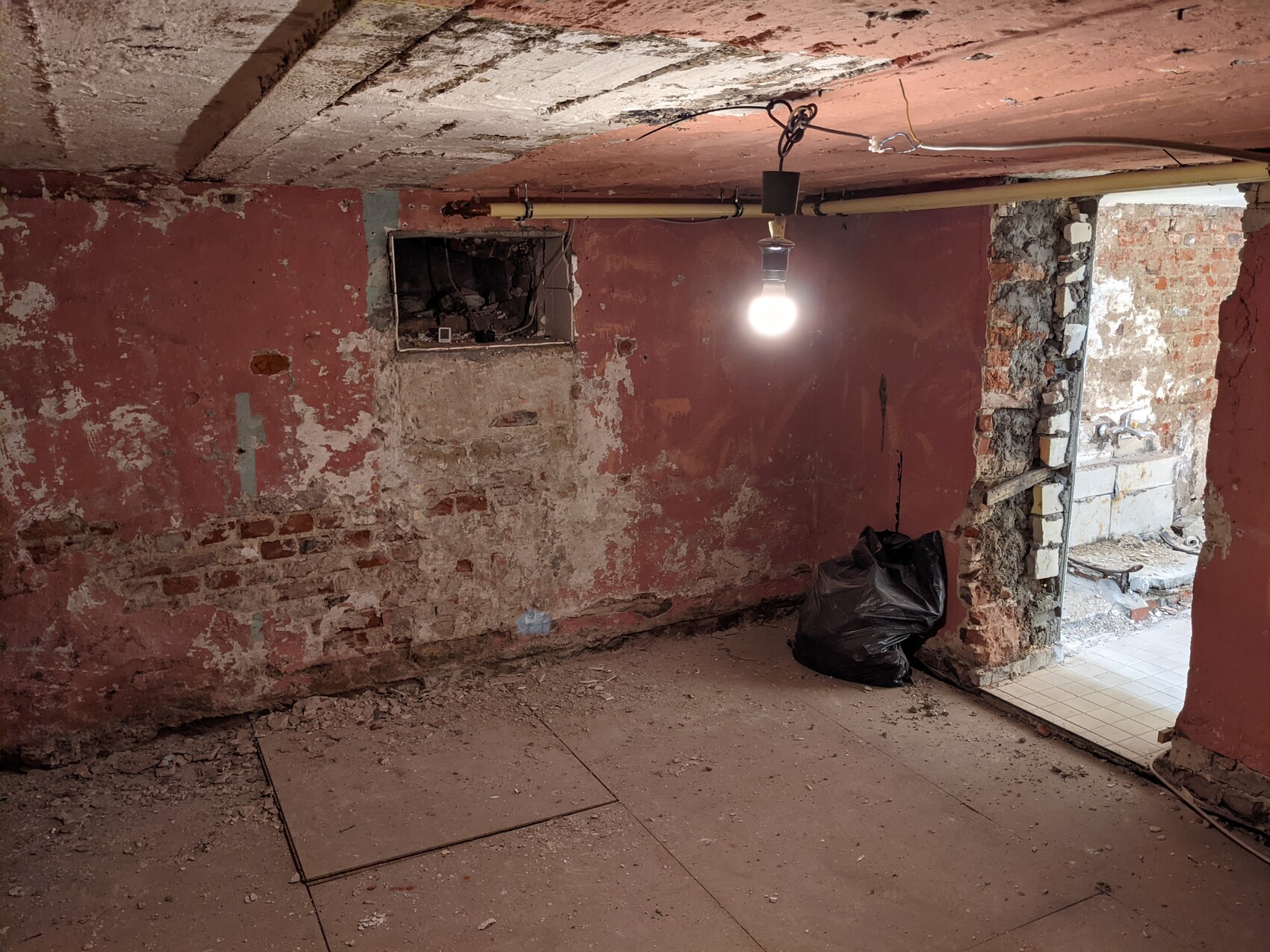
About the basement: It consists of three rooms with a total area of about 56 m² (600 sq ft), which previously housed a workshop (with heating system), a storage room, and a "sanitary area" (bathtub, shower, toilet). Two rooms have window wells, while the third room’s window well was bricked up because a conservatory was built above it. The last-mentioned room (which I call the wine cellar, as we had to dispose of a lot of wine there) was the storage room. This room’s walls were constructed as follows: brick wall → plaster → polystyrene insulation → wood paneling (tongue and groove boards). So far, we have removed everything except the plaster, as the boards were extensively moldy. Since the plaster also shows efflorescence, it will be removed soon. The wine cellar floor currently has particle boards screwed down (previously covered with PVC flooring), and there is a vapor barrier visible underneath the particle boards. The particle boards are also damp. What is beneath the vapor barrier, I don’t yet know.
The other two rooms have tiled walls. Here, the grout, especially along the exterior walls, is at least partially blackened (the closer to the floor, the darker it gets). We will also remove everything down to the foundation walls in the coming weeks. Once we have completely gutted the basement, the question is how to proceed. The planned future uses for the basement are:
The expert advised installing a horizontal damp-proof course just above the basement floor and another barrier near ground level, as water rises through capillary action. With some handyman skills and good tools (both of which we have), it could be done ourselves. The costs would be manageable in this case, whereas hiring a specialized company would likely run into the mid five-figure range. However, his conclusion was that despite all efforts, the rooms could never be made completely dry.
The specialist from the renovation company, on the other hand (understandably from his perspective), recommended against attempting this ourselves, stating that the market solutions for installing a horizontal barrier typically last only 5 to 10 years. He also advised injecting and sealing a similar "barrier material" vertically into the entire affected walls. Furthermore, he said moisture had almost reached the ground floor, the mold was highly dangerous, and cracks could also develop. Whether this was partly alarmist, I cannot judge. We are currently awaiting the company’s offer for the recommended measures. Both the independent expert and the specialist agreed that the rooms are more "wet" than just "damp." The specialist’s conclusion was that the rooms can be dried enough to allow for building a “children’s room” inside.
A third option suggested by our architect is to proceed with the gutting to the foundation walls as planned, make the window wells more air-permeable, and then observe how the moisture conditions develop.
Given the intended use, we certainly do not require completely dry rooms. However, we are naturally concerned about moisture spreading to the upper floors. Installing a horizontal damp-proof course sounds plausible to me, especially since we cannot access the walls from the outside anyway.
My questions to those who have read this far (thanks for that!) are:
Best regards!
I just registered to gather some experiences and opinions regarding the following situation. Briefly about the conditions: We are renovating an old building (built around 1930), which is being converted from a two-family house into a single-family house and upgraded to an energy-efficient house standard 70 or 55. Currently, we are working with architects and an energy consultant to finalize the scope of the construction measures. This means that until we obtain the building permit (also called planning permission), we want to focus on the basement. Based on any feedback we receive here, we hope to better assess whether this is a good idea.
About the basement: It consists of three rooms with a total area of about 56 m² (600 sq ft), which previously housed a workshop (with heating system), a storage room, and a "sanitary area" (bathtub, shower, toilet). Two rooms have window wells, while the third room’s window well was bricked up because a conservatory was built above it. The last-mentioned room (which I call the wine cellar, as we had to dispose of a lot of wine there) was the storage room. This room’s walls were constructed as follows: brick wall → plaster → polystyrene insulation → wood paneling (tongue and groove boards). So far, we have removed everything except the plaster, as the boards were extensively moldy. Since the plaster also shows efflorescence, it will be removed soon. The wine cellar floor currently has particle boards screwed down (previously covered with PVC flooring), and there is a vapor barrier visible underneath the particle boards. The particle boards are also damp. What is beneath the vapor barrier, I don’t yet know.
The other two rooms have tiled walls. Here, the grout, especially along the exterior walls, is at least partially blackened (the closer to the floor, the darker it gets). We will also remove everything down to the foundation walls in the coming weeks. Once we have completely gutted the basement, the question is how to proceed. The planned future uses for the basement are:
- Housing the heating system
- Laundry
- Tool storage/workshop
- Storing food and beverages, including space for a freezer
The expert advised installing a horizontal damp-proof course just above the basement floor and another barrier near ground level, as water rises through capillary action. With some handyman skills and good tools (both of which we have), it could be done ourselves. The costs would be manageable in this case, whereas hiring a specialized company would likely run into the mid five-figure range. However, his conclusion was that despite all efforts, the rooms could never be made completely dry.
The specialist from the renovation company, on the other hand (understandably from his perspective), recommended against attempting this ourselves, stating that the market solutions for installing a horizontal barrier typically last only 5 to 10 years. He also advised injecting and sealing a similar "barrier material" vertically into the entire affected walls. Furthermore, he said moisture had almost reached the ground floor, the mold was highly dangerous, and cracks could also develop. Whether this was partly alarmist, I cannot judge. We are currently awaiting the company’s offer for the recommended measures. Both the independent expert and the specialist agreed that the rooms are more "wet" than just "damp." The specialist’s conclusion was that the rooms can be dried enough to allow for building a “children’s room” inside.
A third option suggested by our architect is to proceed with the gutting to the foundation walls as planned, make the window wells more air-permeable, and then observe how the moisture conditions develop.
Given the intended use, we certainly do not require completely dry rooms. However, we are naturally concerned about moisture spreading to the upper floors. Installing a horizontal damp-proof course sounds plausible to me, especially since we cannot access the walls from the outside anyway.
My questions to those who have read this far (thanks for that!) are:
- Should we install the horizontal barrier ourselves, or
- hire a company to do it as they propose, or
- gut the basement first and wait to see, or
- are there other ideas?
Best regards!
The boards definitely need to be removed; they have become stained and cannot be left unsupported. The sand/clay is not particularly compacted, it’s like walking on a beach... I need to dig a bit deeper there today.
Would gravel and something like paving slabs maybe be an alternative? I can’t place anything directly on the sand. However, I’m also concerned about causing moisture buildup if I use a screed there again...
Would gravel and something like paving slabs maybe be an alternative? I can’t place anything directly on the sand. However, I’m also concerned about causing moisture buildup if I use a screed there again...
 Winniefred12 Oct 2021 11:26
I think something like paving would be a good idea. It would need to be considered further. Many old floors look like that—they were often paved with bricks back then. These allow the surface to "breathe." If it’s not solid but more like sand, I wouldn’t want that either. You want to be able to place things on it.
Here is an example photo of a wall in the "wine cellar." It appears that there was once a damp-proof course. The material is, of course, very crumbly and is falling apart immediately. However, unlike the adjacent room, the plaster there is still quite solid, even though the moisture levels in the wall are actually high.