
ᐅ Which is more suitable for the site conditions: a basement or a slab foundation?
Created on: 28 Jan 2024 19:38
T
TobsBAU
Hello everyone,
I am new to the forum and have purchased a plot of land from the municipality in a new development area, where a single-family house is planned to be built within the next 1.5 years (1 or 2 stories).
For some time now, I have been struggling with the site conditions (slight slope and below street level) and the associated question of whether a basement might actually be the smarter/more cost-effective (or at least cost-neutral) solution in this situation. To answer this question properly, I will probably need quotes from civil contractors and, above all, a geotechnical soil report. Regarding the soil report, I seem to be going in circles because all geotechnical engineers want very precise information about the planned construction, which in turn depends on the decision between a basement or slab-on-grade foundation.
I am hoping to get advice on the following questions:
All prefab house suppliers, etc., I have contacted so far have really not addressed these conditions. They just ask for a budget range and then assume a flat fee of €25,000 for earthworks, etc. I suspect this will not be enough, and I want to make these costs tangible for my financial planning! When the basement topic comes up, even architects generally say a basement is always expensive. If the budget is tight, better to do without a basement...
Here are some details and premises I want to share with you:
Thank you very much, and I look forward to your suggestions and advice!
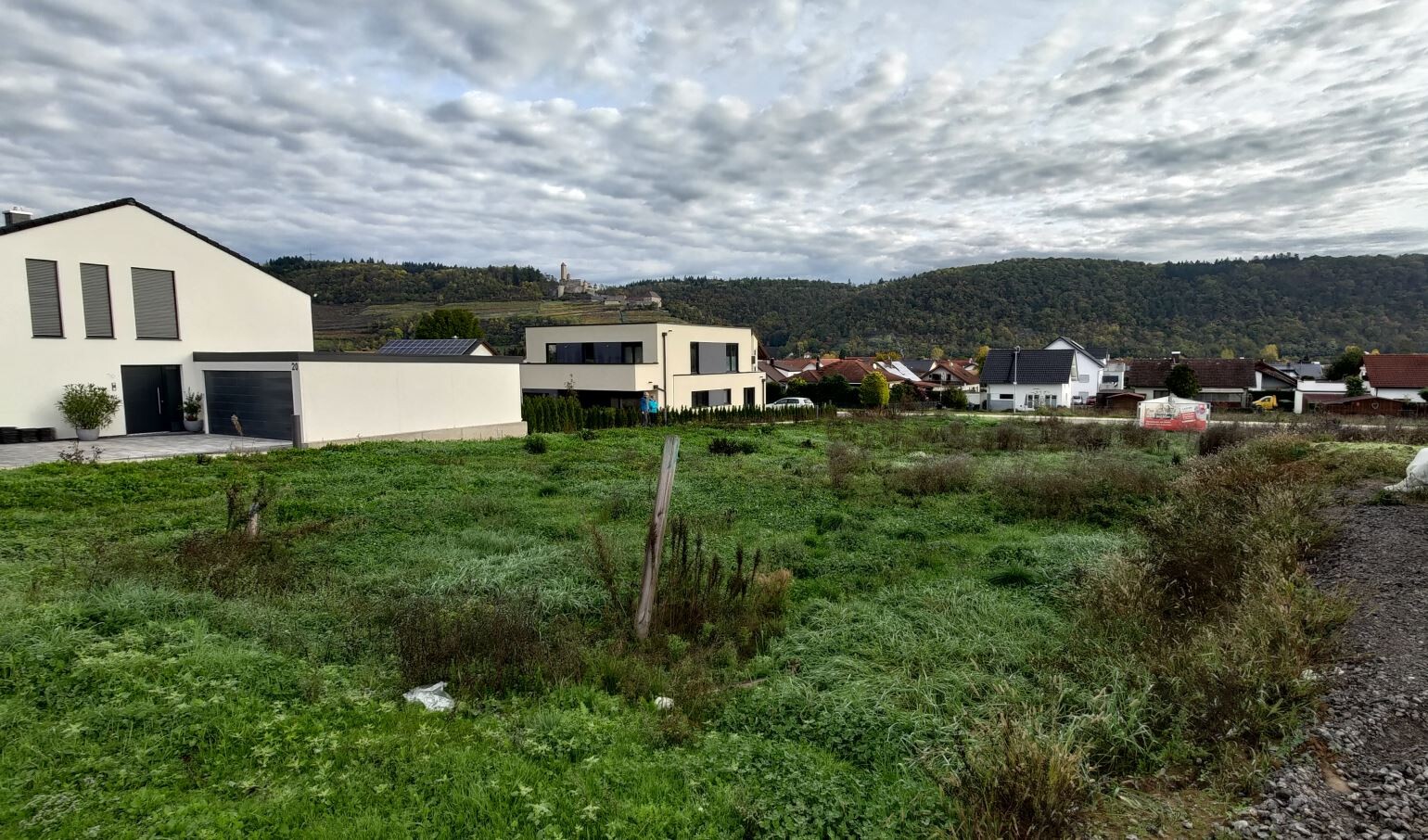

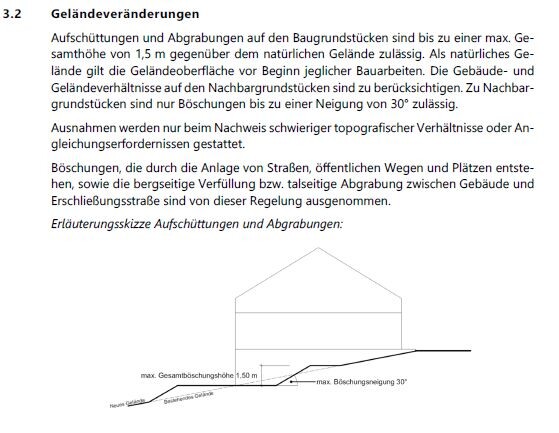
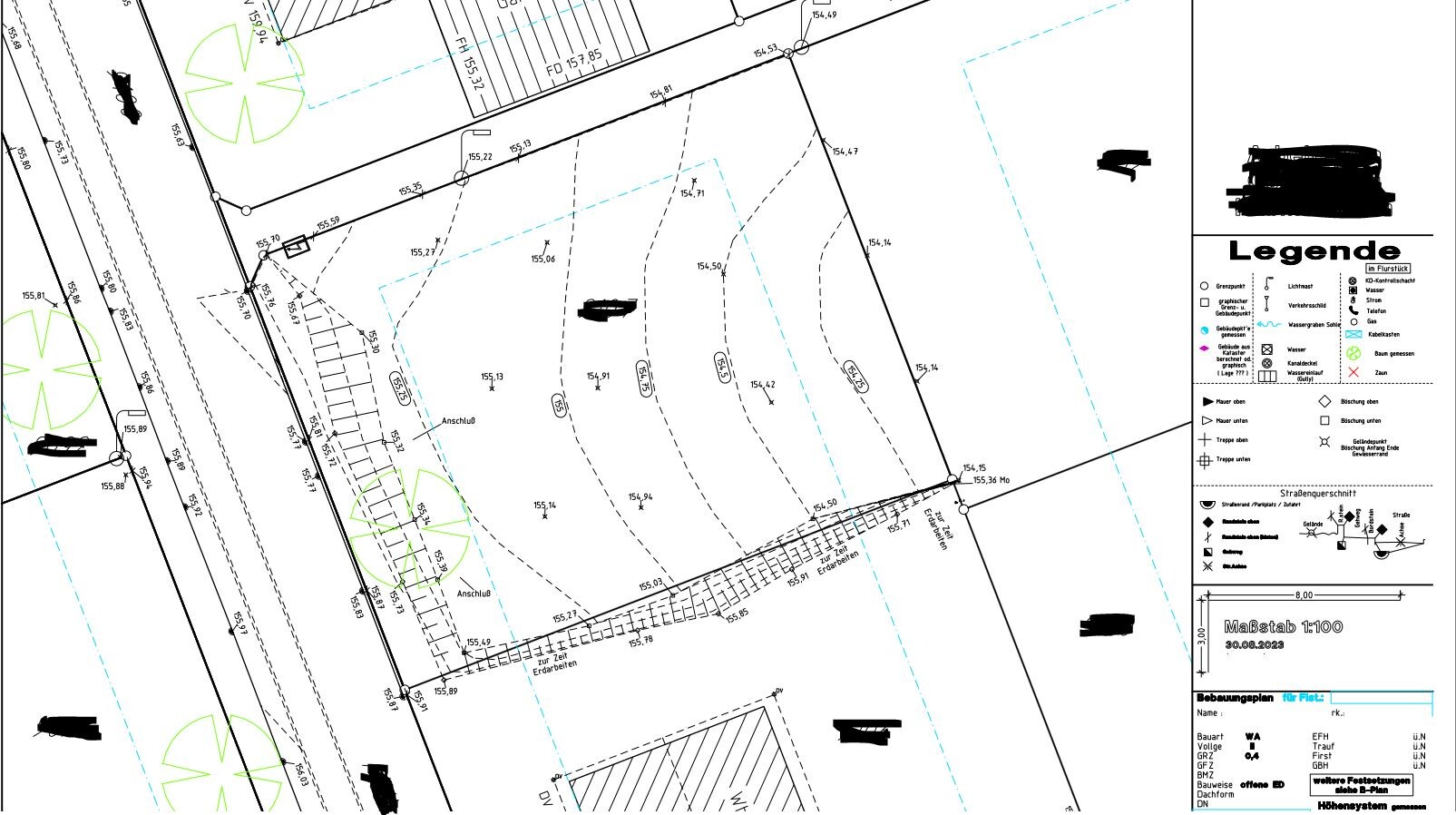
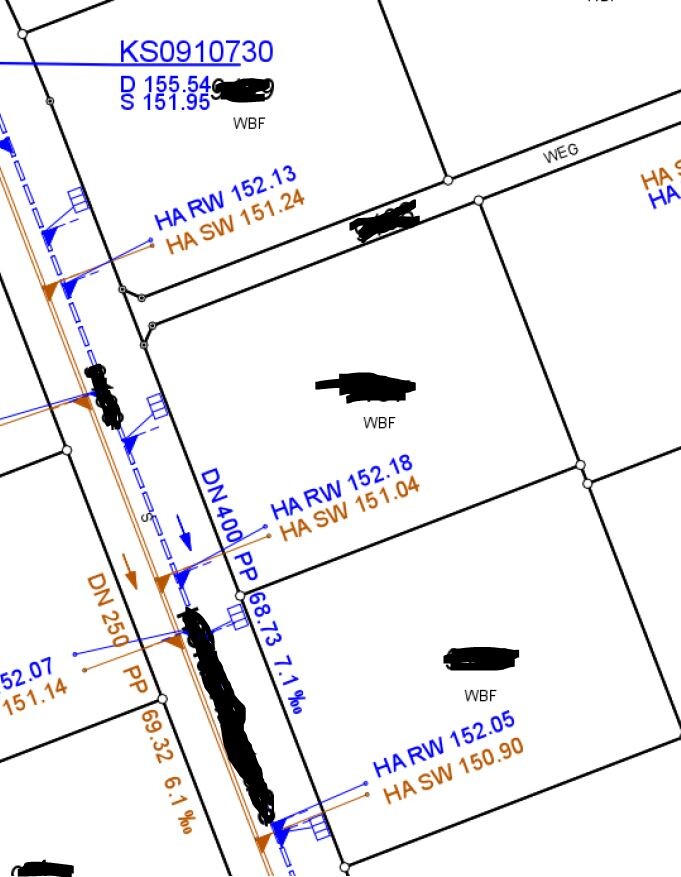
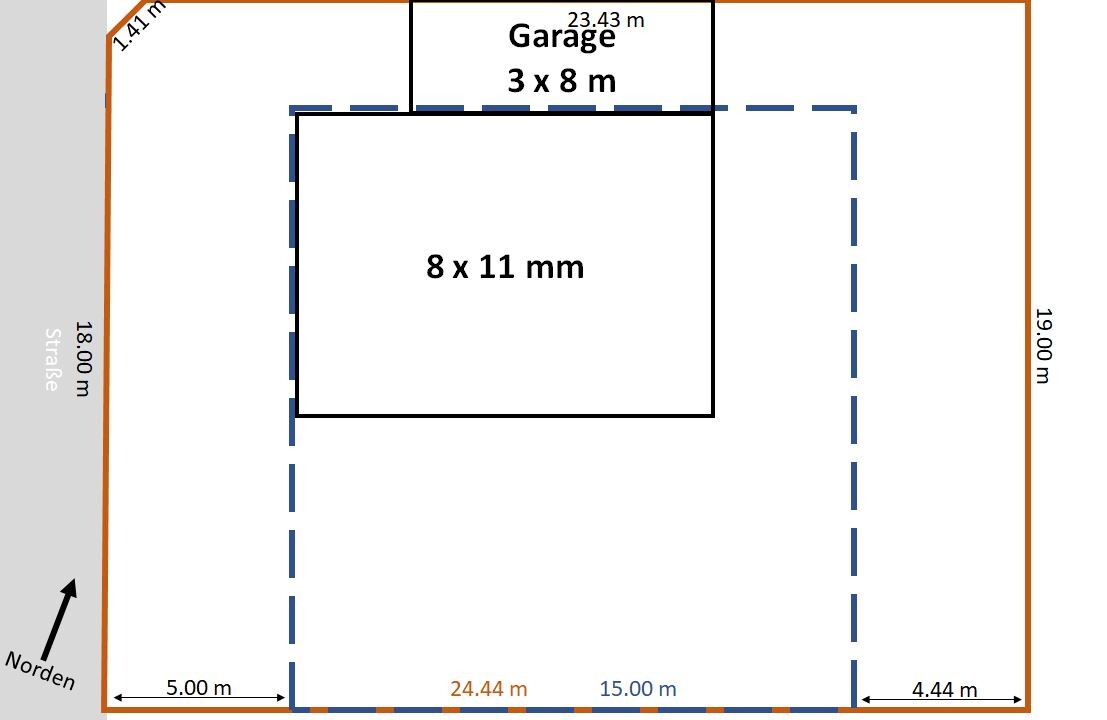

I am new to the forum and have purchased a plot of land from the municipality in a new development area, where a single-family house is planned to be built within the next 1.5 years (1 or 2 stories).
For some time now, I have been struggling with the site conditions (slight slope and below street level) and the associated question of whether a basement might actually be the smarter/more cost-effective (or at least cost-neutral) solution in this situation. To answer this question properly, I will probably need quotes from civil contractors and, above all, a geotechnical soil report. Regarding the soil report, I seem to be going in circles because all geotechnical engineers want very precise information about the planned construction, which in turn depends on the decision between a basement or slab-on-grade foundation.
I am hoping to get advice on the following questions:
- Is it possible, when building with a basement, to use the excavated soil to fill the plot up to street level (no costly disposal required)?
- What advice can you give me about the soil report (the exact future construction is not yet fixed)?
- I am torn between the following options (which do you think is more sensible?):
- Build with a basement and fill the plot to street level using the excavated soil (hold back the northeast property boundary with a 1 m high retaining wall). Allow a partial slope to create a daylight basement room facing northeast, which could possibly be used as an office. The utility room would naturally also be in the basement, but I would prefer to avoid a sump pump system if possible.
- Fill the plot (up to street level or slightly below) and build with a slab-on-grade foundation (hold back the northeast property boundary with a 1 m high retaining wall). However, I am concerned about the costs for fill material and necessary compaction. The utility room would be on the ground floor or upper floor, no sump pump system, but probably with a backwater valve.
All prefab house suppliers, etc., I have contacted so far have really not addressed these conditions. They just ask for a budget range and then assume a flat fee of €25,000 for earthworks, etc. I suspect this will not be enough, and I want to make these costs tangible for my financial planning! When the basement topic comes up, even architects generally say a basement is always expensive. If the budget is tight, better to do without a basement...
Here are some details and premises I want to share with you:
- The plot is below street level. The adjacent neighboring plot (southeast) has been raised up to street level (top of finished floor level +156.14 m).
- Because of the filling up to street level, no backwater valve was needed there. On the opposite plot (northwest, behind the sidewalk), the fill was not raised as high, so a backwater valve was required. If I build with a basement, I would probably have to plan for a sump pump system even if I fill up to street level.
- According to the development plan, a retaining wall up to one meter high may be built to compensate for the slope; beyond that, slopes with an angle of 30° must be used (see attachment). Of course, both neighboring properties have taken advantage of this and installed suitable L-shaped retaining walls on the northeast side.
- Basically, I would not have necessarily filled the plot, but since the southeast side was raised and that is where most of the natural light comes from, I feel almost compelled to at least partially fill.
- Unlike the neighboring development, I am considering positioning the house (gable roof) with the gable perpendicular to the street (see sketch). This would improve lighting and usability of the plot.
- There is a castle to the northeast at some distance, which should also be taken into account when planning the house (view connection).
- The plot is 464 m² (about 5,000 sq ft) and located 800 m (0.5 miles) from a river (about 15 m (50 feet) above the water surface, no flood risk). Additional waterproofing measures for a basement are to be expected (most likely a waterproof concrete shell). A neighbor who built with a basement had to seal it from the outside (apparently afterwards).
- The development plan is generally quite generous: 2 full floors allowed, max ridge height = 6.5 m (21 ft 4 in), max eaves height = 10.5 m (34 ft 5 in), floor area ratio: 0.4
- Surveying has been done (see attachment)
Thank you very much, and I look forward to your suggestions and advice!
H
hanghaus202329 Jan 2024 11:15A 6% slope over the area of the house is only about 75cm (30 inches), which is easy to manage without a basement. If you rotate the house, it’s just 0.5m (20 inches).
I always like to see how the neighbors have solved it and ask them how the building ground is behaving.
I always like to see how the neighbors have solved it and ask them how the building ground is behaving.
H
hanghaus202329 Jan 2024 11:16K a t j a schrieb:
Which brings us to Split as another option. This brings me to the question of the budget.
H
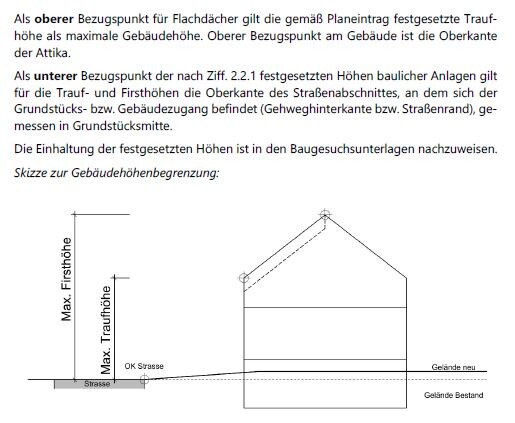
hanghaus202329 Jan 2024 11:33What is the reference height for THmax = 6.5 m (21.3 ft), FHmax = 10.5 m (34.4 ft)? An incomplete development plan is unusable. What is being planned? A gable roof?
Hi everyone, thanks for the many contributions. I would like to address the questions:
In my opinion, the following points are relevant for the house orientation:
I agree with you that a square floor plan would likely work well independently and offer slight advantages regarding the terrain grading effort. As I mentioned before, I think a 1 m (3 ft) retaining wall on the northeast side is unavoidable (both neighboring properties have already built one).
Thanks for the assessment. Could you mark points in the concept draft where you think soil sampling locations would be necessary (including garage/carport on the northeast), and also indicate how many?
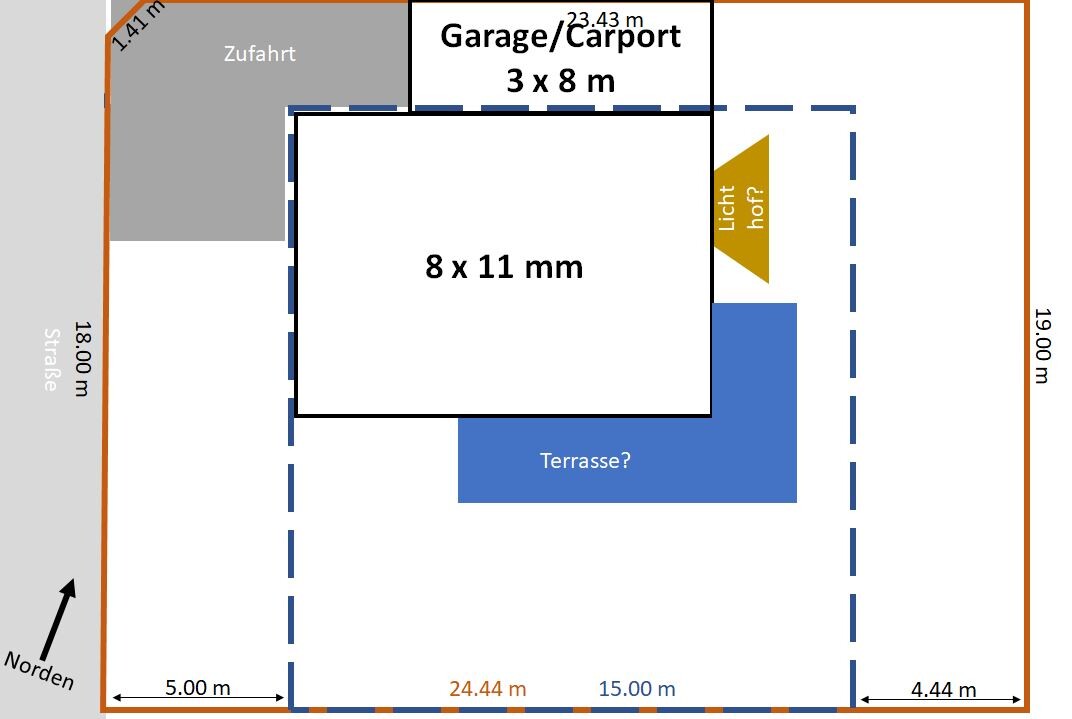
I have added a possible terrace, light well, and driveway to the concept draft. Steps down to the garden may still be acceptable, but the terrace of course should be level with the house. An older architect once told me: "Anyone sitting lower always loses out; you don’t want to be lower than your neighbors." Use of the office is certain (2-3 days per week).
Interestingly, I had already considered split levels as an option at the start of the project. However, none of the architects or others have really addressed this topic, despite my suggestions. Besides the advantage of better using the terrain, I also see the benefit of creating a more spacious feeling locally in the living/dining/kitchen area, etc.
As mentioned, the neighbors simply filled up to street level or almost up to street level and built retaining walls, etc. From a cost perspective, I find that solution questionable, and I think a property with a slight slope is much more appealing than just a flat filled surface.
The budget is not yet 100% fixed (it mainly depends on interest rate developments). I currently assume that about €550,000 (approx. $600,000) is feasible and consider this sum appropriate (€600,000 [$650,000] might still be possible). The property has already been purchased and is fully paid for, so the mentioned amount is available for:
As already mentioned, a gable roof is planned, but practically everything is allowed. I have attached the information from the development plan. Two full stories are also permitted.
Finally, I want to note that the neighbor to the southwest planned a garage on the property boundary, which currently cannot be built because the filled ground makes it too high and it is not permitted. If I were to fill in, would this then be possible? There is also a desire that I take over a building encumbrance (Baulast), which would no longer be necessary after filling.

K a t j a schrieb:
At first glance, I would estimate that you can still build well without a basement. Terrain grading will be unavoidable either way. But a basement adds quite a bit more on top of that.
The first question you should really ask yourself is: What do you need and what is your budget?
Apart from that, a lift station is not a disaster. If you’re still wary of it, no one is forcing you to build one even with a basement.
If I interpret your sketch correctly, you are placing your house mostly along the slope. Perhaps a more square shape would be a bit more cost-effective.
In my opinion, the following points are relevant for the house orientation:
- Usability of the garden with reasonable lighting
- View towards the castle (or the northeast side, which would also work with a different orientation)
- Garage/Carport on the northwest side (by the sidewalk)
- Usability/orientation of the roof for photovoltaic panels (the property is in Baden-Württemberg, so this is mandatory and desired)
- For this reason, and also to avoid extra costs and create storage space, I am planning a gable roof
I agree with you that a square floor plan would likely work well independently and offer slight advantages regarding the terrain grading effort. As I mentioned before, I think a 1 m (3 ft) retaining wall on the northeast side is unavoidable (both neighboring properties have already built one).
11ant schrieb:
More details tomorrow. Briefly for now: with "(11ant) Kellerregel" / "Keller-Frage" you will find my posts on the topic concerning your opinion about basement or partial basement. Whether the excavated soil is suitable for recompaction depends on its quality. Either way, it will be looser after excavation than before and will require compaction. Refilled soil therefore does not occupy the same volume as what was removed.
That’s nonsense. The property and especially the building envelope are not so large that there would be an excessive number of sample points. I would simply select the interior area of the building envelope here.
Thanks for the assessment. Could you mark points in the concept draft where you think soil sampling locations would be necessary (including garage/carport on the northeast), and also indicate how many?
WilderSueden schrieb:
Basically, with the slope you have the problem that you’re caught in between. For a flatland plan, the slope is too steep; for a hillside house, it’s too shallow. When planning, you should also consider the entire outdoor area. Where will the terrace go? How do you want to get from the house to the garden (stairs?) Where would the light well for the basement office be? What makes more sense depends somewhat on your requirements (for example, how often do you use the office?). Ultimately, two very different floor plans result from these two variants. So I only want to address one detail question here.
Excavated material can of course be used for backfilling, but most soils cannot be compacted in a controlled way and you have to expect settling. You can do lawn areas and flower beds on it, but a driveway needs to be built on gravel.
I have added a possible terrace, light well, and driveway to the concept draft. Steps down to the garden may still be acceptable, but the terrace of course should be level with the house. An older architect once told me: "Anyone sitting lower always loses out; you don’t want to be lower than your neighbors." Use of the office is certain (2-3 days per week).
K a t j a schrieb:
That brings us to split levels as another option. It doesn’t have to be a half-story. Sometimes only 2 or 3 steps on the ground floor are enough to create a noticeable effect. This often allows very nice zoning as well.
Interestingly, I had already considered split levels as an option at the start of the project. However, none of the architects or others have really addressed this topic, despite my suggestions. Besides the advantage of better using the terrain, I also see the benefit of creating a more spacious feeling locally in the living/dining/kitchen area, etc.
hanghaus2023 schrieb:
A 6% slope is just 75 cm (2.5 ft) in the area of the house, which can easily be managed without a basement. If you rotate the house, it’s only 0.5 m (1.6 ft).
I always like to see how the neighbors solved it and ask them how the building ground behaves.
As mentioned, the neighbors simply filled up to street level or almost up to street level and built retaining walls, etc. From a cost perspective, I find that solution questionable, and I think a property with a slight slope is much more appealing than just a flat filled surface.
hanghaus2023 schrieb:
Regarding the budget question.
The budget is not yet 100% fixed (it mainly depends on interest rate developments). I currently assume that about €550,000 (approx. $600,000) is feasible and consider this sum appropriate (€600,000 [$650,000] might still be possible). The property has already been purchased and is fully paid for, so the mentioned amount is available for:
- House construction including incidental costs and fittings
- Driveway
- Garage/Carport including storage space for bicycles (possible item to cut)
- Cistern (possible item to cut)
- Photovoltaic system
- Garden (especially terrace)
hanghaus2023 schrieb:
What is the reference height for max building height THmax = 6.5 m (21 ft), FHmax = 10.5 m (34 ft)? An incomplete development plan is useless. What is planned? Gable roof?
As already mentioned, a gable roof is planned, but practically everything is allowed. I have attached the information from the development plan. Two full stories are also permitted.
Finally, I want to note that the neighbor to the southwest planned a garage on the property boundary, which currently cannot be built because the filled ground makes it too high and it is not permitted. If I were to fill in, would this then be possible? There is also a desire that I take over a building encumbrance (Baulast), which would no longer be necessary after filling.

TobsBAU schrieb:
Finally, I would like to mention that the neighbor to the southwest planned to build a garage on the property line, but currently cannot proceed because the raised ground makes it too high and therefore not approvable. If I were to raise the ground level, would that then be possible? There is also the desire for me to assume a building encumbrance (which would become unnecessary again after the ground is raised)...Had a good laugh again. Thanks for that! Personally, I’m not a fan of unnecessary landfilling. In this case, your neighbor has created a problem for themselves, and you’ve already found someone who will effectively pay for your site grading on that side.TobsBAU schrieb:
All prefab house suppliers etc. that I’ve been in contact with so far have really addressed these conditions, This can be explained quickly and simply: Prefab house suppliers usually do not offer basements and have to refer you to partners (same with slab foundation, but that is straightforward and unproblematic). Also, basements often, very often, cause problems, especially in combination with prefab construction. People are reluctant to talk about that because problems don’t attract customers.
TobsBAU schrieb:
What advice can you give me regarding soil surveys (exact future construction not finalized yet)? Since the lot is not very large, it should be sufficient to roughly know where the house will be placed.
You’ve already started with that. So you should have a rough idea of what is where.
Residential rooms and terrace to the southeast, utility rooms to the northwest. I would move the house further northeast and have the terrace in the southeast, and maybe also a southwest garden. This gives you two positions for the boreholes needed for the soil report.
TobsBAU schrieb:
to create a basement room with natural light facing northeast, which could potentially be used as an office. This means, besides the higher basement costs, also including the basement inside the building’s thermal envelope and finishing it as living space—just for one room…
I see no reason to consider a basement with a height difference of about 70cm (approximately 2ft 4in). Nor do I see a reason to consider extensive backfilling or similar. The 10cm (4 inches) at the front can be compensated with gravel or driveway surfacing.
The front door should be at the next height level, with the rest of the garden to the northeast accessed via wide steps in the lawn across the entire property. The foundation can be blended with planting or raised beds since this only concerns the back area. The rest will work itself out. If needed, you could still add the expensive
TobsBAU schrieb:
retaining wall at the back later. But with the current information and status, I don’t see any necessity.
The best thing is to sketch out your options. Use paper, colored pencils, many templates, and then take photos with your phone for comparison.
TobsBAU schrieb:
backflow valve I don’t even know what that is.
TobsBAU schrieb:
Basically, I wouldn’t necessarily have done any backfilling, but since the plot was raised on the southeast side and the main light naturally comes from there, I almost feel forced to do backfilling at least in parts. ??? Your main light comes from above, and the hill is negligible.
TobsBAU schrieb:
Northeast, there is a castle some distance away, which should also be taken into account when planning the house (line of sight). Nice!! A bedroom would be suitable there, wouldn’t it?
We have a cathedral that was never really a cathedral… from the church tower we look out from the toilet. We have more than one strained window in the living room because of that. Maybe this will come up again for you.
Similar topics